The short-term rental (STR) market has shifted from a "side hustle" industry into a high-stakes hospitality arms race. As an Airbnb management firm, you are no longer just competing against the house next door; you are competing against boutique hotels and institutional-grade operators who have perfected the art of the "instant" response.
If your team takes twenty or thirty minutes to respond to a booking inquiry, you have already lost. In the world of Airbnb, silence isn't golden, it's expensive. This is the "Turnover Trap." It is a cycle of administrative friction, missed messages, and turnover chaos that slowly drains your profit margins and pushes your listings down the search results.
When communication gaps occur, they don't just result in a missed booking for tonight. They trigger a domino effect that impacts your search visibility, your guest reviews, and ultimately, your contract retention with property owners. To survive in 2026, your management firm must move away from reactive "firefighting" and toward a standardized, 24/7 communication engine.
The 20-Minute Death Sentence: Why Speed is the Only Metric That Matters
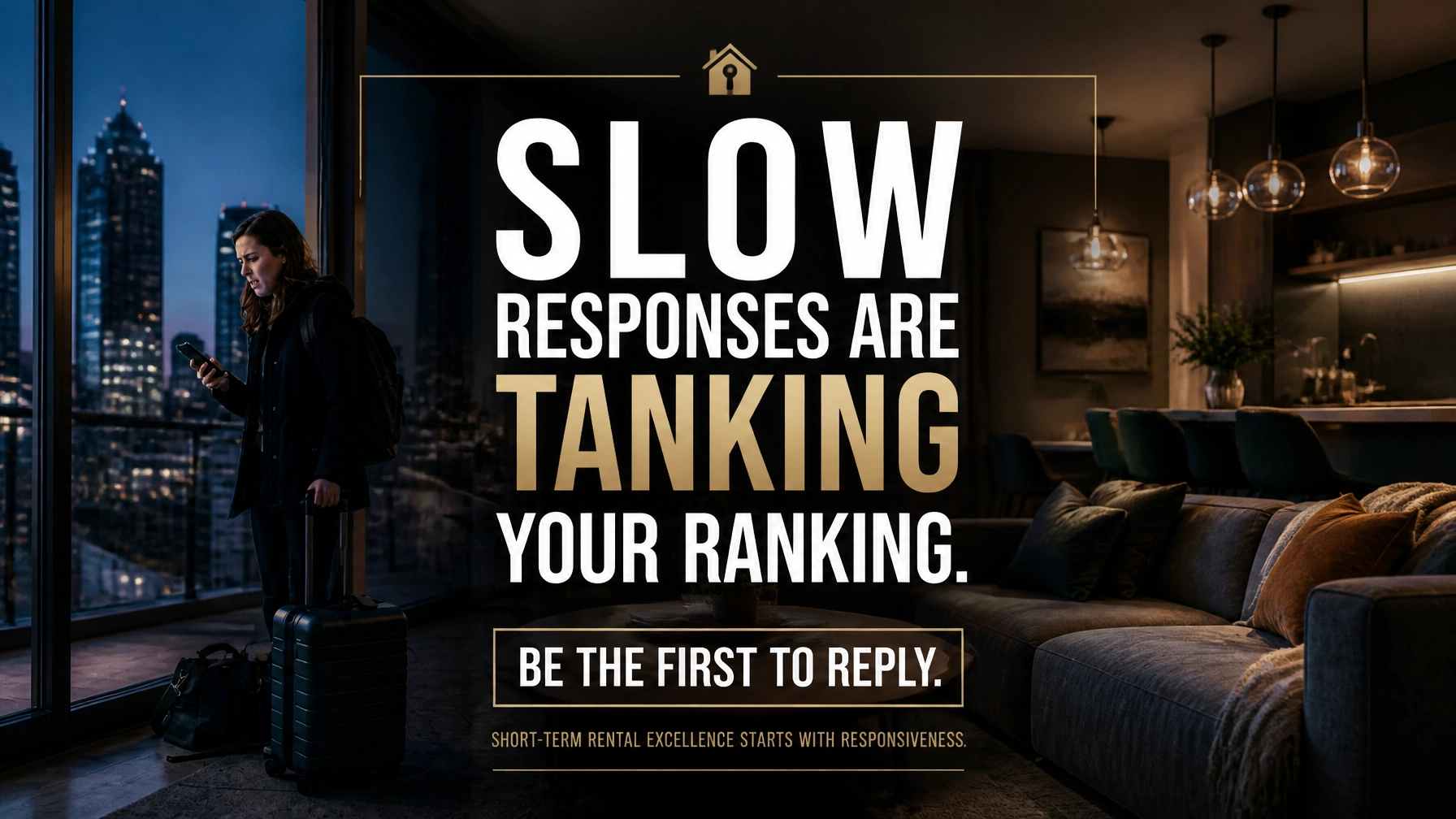
Airbnb’s search algorithm is a black box, but one variable is crystal clear: Response Rate. The platform rewards hosts who respond within minutes and penalizes those who let inquiries linger.
In a competitive market, a guest rarely messages just one host. They are likely "shopping" three or four properties simultaneously. The manager who replies first with a clear, professional, and welcoming tone almost always secures the booking. If your internal team is juggling property inspections, owner reports, and maintenance calls, that "quick" message from a prospective guest often sits in a notification tray for thirty minutes. By the time you hit "send," the guest has already confirmed a stay elsewhere.
This isn't just about losing one night’s revenue. Consistent delays in communication signal to the platform that your listing is less reliable. Over time, your "Response Time" metric degrades, causing your properties to slide from page one to page three. At that point, you aren't just losing guests; you are becoming invisible.
The Review Death Spiral: How One Missed Message Tanks Your Ranking
The most dangerous part of the Turnover Trap is the "Review Death Spiral." It starts innocently enough: one late reply, one missed update, one guest left staring at a locked door while your team is tied up elsewhere. Then the whole thing snowballs with the grace of a falling refrigerator.
Consider the typical turnover window: 11:00 AM to 3:00 PM. This four-hour block is the heartbeat of your business. If the guest in Unit 402 checks out thirty minutes late, and that information isn't relayed to the cleaning crew right away, the schedule wobbles. The cleaners arrive, find the unit occupied, move to another property, and by the time Unit 402 is finally vacant, your next guest is already circling the block with luggage and opinions.
When that incoming guest finds a dirty bathroom or unmade beds, their first move is to message you. If that message sits unanswered for even fifteen minutes because your office is swamped, frustration turns into distrust. Distrust turns into a bad review. A bad review turns into fewer clicks, lower conversion, and a listing that starts sliding down the rankings like it forgot its shoes.
This is why VA-led communication matters so much. A trained VA keeps the guest informed before the guest has to ask. They send proactive arrival updates, flag turnover delays, coordinate with cleaners, and follow up after check-in to catch small issues before they become public complaints. That steady communication interrupts the spiral before it gathers speed. Instead of silence, your guest gets clarity. Instead of a 1-star rant, you have a real shot at preserving the stay and protecting the review.
A single 1-star review for "cleanliness" or "communication" can take months to overcome. It scares away high-value guests and forces you to lower your nightly rates to maintain occupancy. This is how profit leakage happens, not in one giant burst, but in a slow, steady drip of missed opportunities and damaged reputations.
The True Cost of In-House Scaling
Many property managers try to solve this by hiring a local Guest Coordinator, and on paper it sounds perfectly sensible. You get someone in your time zone, someone who knows the area, someone who can keep the guest experience from turning into a soap opera. But once you run the numbers, the charm fades fast. In most US markets, a capable in-house Guest Coordinator will cost you $45,000 or more per year before you even factor in payroll taxes, benefits, equipment, and the everyday cost of keeping another full-time seat filled. And for all that money, you still have coverage for roughly 40 hours a week, which is adorable if guests only had questions between 9 and 5. A specialized Property Management VA, on the other hand, typically costs $8 to $10 per hour and can cover guest messaging, cleaner coordination, check-in support, and issue follow-up at a far leaner operating cost. Instead of piling fixed overhead onto your business, you keep support flexible, protect margins, and avoid paying full-time salary weight for part-time responsiveness. That gap is where admin debt turns into profit leakage, and it is also where smart operators clean it up.
Systematizing the Guest Experience
To escape the Turnover Trap, you must move beyond the "hustle" and start building systems. Every recurring problem in your business, from late checkouts to "how do I use the remote" questions, is an opportunity to create a Standard Operating Procedure (SOP).
When you delegate these tasks to a VA, you aren't just offloading work; you are ensuring that your properties are managed with a level of consistency that a tired, overworked office manager simply cannot provide. A VA follows the script, hits the response time targets, and ensures that every single guest receives the same high-touch experience.
This level of systematization is what allows you to scale from 10 properties to 100 properties without your life becoming a 24-hour nightmare of phone notifications. More importantly, it keeps your communication fast enough to protect your ranking, your reviews, and your sanity.
Tactical SOP: The Mid-Turnover Crisis Protocol
When a turnover goes wrong, the difference between a 5-star and a 1-star review is the speed of the resolution. Here is the protocol your Virtual Assistant should follow when a cleaning crew reports a delay or an issue during the turnover window:
- Immediate Status Update: The moment a cleaner reports a delay (e.g., guest checked out late or maintenance issue found), the VA flags the incoming guest's profile.
- Proactive Guest Outreach: The VA sends a standardized, empathetic message to the incoming guest before they arrive. Example: "Hi [Guest Name], we are putting some extra finishing touches on the unit to ensure it's perfect for your arrival. We expect to be ready by [Time + 30 mins]. We’ll text you the moment the door code is active!"
- The "Value Add" Offer: If the delay is longer than 30 minutes, the VA provides a pre-approved digital gift card for a local coffee shop or suggests a nearby park/attraction.
- Maintenance Sync: If the issue is a broken appliance, the VA immediately contacts the local handyman from your pre-approved list and stays on the line until a repair time is confirmed.
- Documentation: The VA logs the delay in your property management system and notifies the owner if the issue requires a capital expense.
- Follow-up: One hour after the guest checks in, the VA sends a "Checking in" message to ensure everything is up to their standards, effectively neutralizing any lingering frustration from the delay.
Bridging the Gap with Virtual Nexgen Solutions
At Virtual Nexgen Solutions, we specialize in providing the administrative engine for high-growth industries. We understand that in property management, "admin" isn't just filing papers, it's active revenue protection.
Our VAs are trained to handle the specific pressures of the STR market. They don't just "answer messages"; they manage your reputation. By handling the heavy lifting of guest coordination, turnover scheduling, and review management, we free you up to do what actually grows your business: acquiring new property owners and expanding your portfolio.
If you are still the one waking up at 3:00 AM to tell a guest how to find the extra blankets, you aren't a business owner, you're an employee of your own properties. It's time to plug the profit leak and build a business that runs without you.
Stop letting administrative friction tank your rankings. Schedule a consultation with Virtual Nexgen Solutions today and see how our $8/hour specialized support can transform your operations.
Frequently Asked Questions (FAQs)
1. How can a Virtual Assistant handle physical emergencies like a plumbing leak?
While a VA cannot physically turn a wrench, they act as the "air traffic controller." They receive the guest's report, verify the urgency via photos/videos, and immediately dispatch your local, pre-approved maintenance team. This ensures the guest feels heard instantly and the problem is addressed while you are busy with other tasks.
2. Is it safe to give a VA access to my Airbnb or VRBO account?
Yes. We recommend using property management software (PMS) that allows for "team member" permissions. This way, the VA has access to the messaging and calendar functions they need without having access to your banking information or account ownership settings.
3. How do you ensure the VA sounds like "me" when talking to guests?
We work with you to develop a "Brand Voice Guide." This document outlines your preferred greetings, your stance on early check-ins, and how you handle complaints. The VA follows this guide strictly to ensure a consistent guest experience that matches your company's identity.
4. Can a VA help with property owner reporting?
Absolutely. Many of our clients have their VAs pull monthly occupancy and revenue data from their PMS to create professional owner reports. This keeps your clients happy and proves the value of your management services without taking up your weekend.
5. What happens if a guest speaks a language I don't know?
One of the major benefits of a global VA team is linguistic diversity. Many of our VAs are multilingual, allowing your firm to cater to international travelers and expand your market reach without any added effort on your part.
6. Will hiring a VA affect my status as a "Local" host?
Not at all. You are still the local expert. The VA simply ensures that your "local expertise" is delivered to guests 24/7. Most guests actually prefer the rapid response of a managed team over a solo host who is occasionally unavailable.
7. How quickly can a Virtual Assistant be onboarded into my workflow?
Because we focus on standardized SOPs, we can typically have a VA integrated into your messaging and scheduling systems within a few days. We start with the highest-impact tasks: guest communication: and expand their responsibilities as they become familiar with your specific portfolio.
8. Why is $8/hour the rate for Virtual Nexgen Solutions?
We believe in a model that balances high-quality talent with extreme cost-efficiency. By leveraging global talent markets, we provide specialized administrative support at a rate that allows small to mid-sized firms to compete with industry giants while maintaining healthy profit margins.