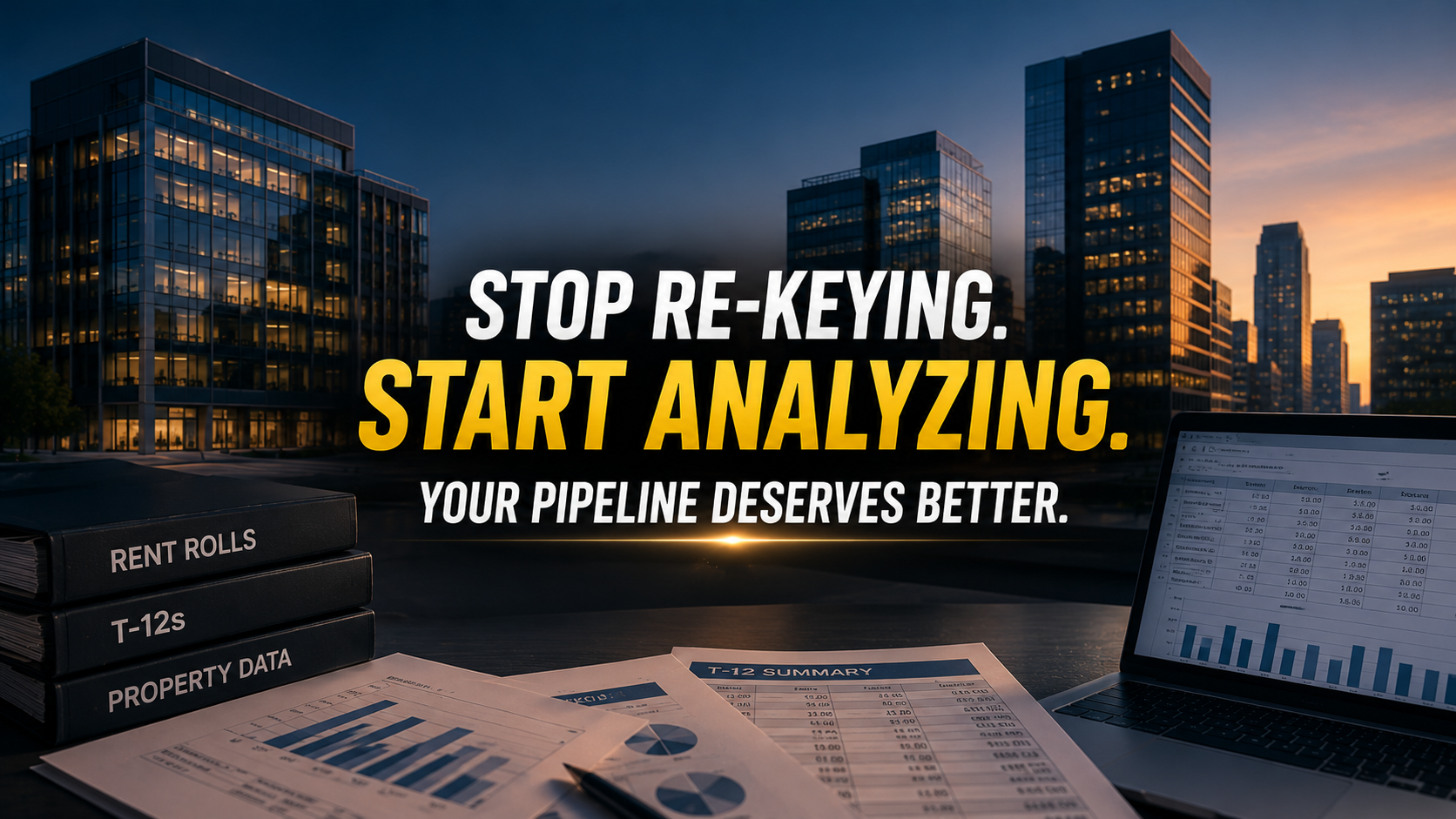
Every Monday morning, acquisition analysts across top commercial real estate brokerages, private equity funds, and development firms stare down the barrel of an impossible mountain. Fresh offering memorandums (OMs), scanned PDF rent rolls, and historical T-12 operating statements sit waiting in their inboxes. Before a single discounted cash flow (DCF) model can be built, before a cap rate can be stress-tested, and before investment committees can review the merits of a new acquisition, an excruciating ritual must take place: manual transcription.
Your high-priced, highly analytical acquisition associates are spending 60% to 70% of their working hours acting as human photocopiers and data-entry clerks. They manually re-key tenant names, square footages, lease start dates, expiration schedules, rent bumps, and line-item operating expenses from messy broker PDFs into rigid Excel underwriting models. This is the Underwriting Intake Black Hole. It drains morale, introduces transposition errors that distort net operating income (NOI), and strangles deal flow. When your analysts are chained to keyboard entry, your firm misses out on time-sensitive bidding windows and leaves millions in uncaptured property acquisitions on the table.
Virtual Nexgen Solutions solves this structural inefficiency. By deploying a specialized commercial real estate virtual assistant, your firm can completely systematize the intake pipeline. You remove the administrative burden from your senior analysts, slash review preparation time from 15 hours down to 15 minutes, and instantly scale your underwriting capacity by 3x.
Understanding Admin Debt in Commercial Real Estate
Admin debt accumulates silently in commercial real estate firms. Unlike financial debt, which appears clearly on a balance sheet, admin debt manifests as wasted hours, delayed LOIs, missed acquisition opportunities, and burnout among core talent.
In a typical CRE firm, admin debt originates from unstructured data intake. When a broker sends a 150-unit multifamily rent roll as a non-searchable image-based PDF, or a messy Excel export with inconsistent date formats and hidden rows, your in-house team is forced to spend days cleaning the raw data. They wrestle with inconsistent headers: where "Base Rent," "Scheduled Rent," and "Gross Rent" are used interchangeably across properties. They manually reconcile trailing-12 financial statements against different charts of accounts.
This friction creates a severe operational bottleneck. Instead of evaluating market dynamics, touring assets, building broker relationships, and running sophisticated sensitivity analyses, your most expensive talent is stuck fixing broken spreadsheet formulas and chasing down missing lease amendment dates. Admin debt is the silent killer of profitability in modern real estate investment and brokerage operations. Eliminating it requires separating low-value data cleansing from high-value investment strategy.
The Half-Day Problem: Where Deal Velocity Dies
Consider the math of a standard commercial real estate deal pipeline. To successfully acquire or broker a property, an analyst must evaluate roughly 10 to 15 deals for every single one that proceeds to a formal Letter of Intent (LOI). If your firm evaluates 30 deals a month, and each deal requires 15 hours of initial data extraction, formatting, and lease abstraction before underwriting can even begin, your team burns 450 hours every month purely on clerical transcription.
That equals nearly three full-time equivalents (FTEs) doing nothing more than copying numbers from PDFs into spreadsheets.
This is the Half-Day Problem. When an analyst spends half their day re-keying rent rolls and T-12 operating statements, they experience severe cognitive fatigue. By the time they actually sit down to model terminal cap rates, debt service coverage ratios (DSCR), and internal rates of return (IRR), their mental energy is depleted. Mistakes slip through. A transposed decimal in a rent step-up schedule or an overlooked tenant termination option can corrupt the entire valuation model, leading to overbidding during auction cycles or painful miscalculations during due diligence.
Speed is the ultimate competitive advantage in commercial real estate. Deals move fast. Sellers and brokers award exclusivity to the fund or brokerage that can review the book, verify the underlying economics, and return a clean, defensible underwriting model within 48 hours. If your intake pipeline is bogged down by manual data entry, you are simply too slow to win competitive processes.
The $8/hr Virtual Assistant vs. The $60K Salary Trap
The traditional response to analytical bandwidth constraints has been to post job listings for junior analysts or operations coordinators. Bringing on an entry-level real estate analyst in major US markets requires a base salary of $60,000 to $80,000 annually, plus recruitment fees, onboarding time, health insurance, payroll taxes, and software seat licenses. Furthermore, when you hire a local junior employee for a $70k salary, you expect them to perform high-level analysis. Yet, in reality, 70% of their day still devolves into rent roll entry, filing, and basic document formatting.
This is the $60K Salary Trap: paying analyst-level compensation for data-entry-level work.
Virtual Nexgen Solutions offers a superior financial and operational model. Through our specialized commercial real estate virtual assistant services, you secure dedicated, trained remote talent starting at just $8 per hour.
Let's examine the financial contrast:
- In-House Junior Analyst: $60,000/year (~$30/hour) burdened with administrative distractions, turnover risks, and overhead.
- Virtual Nexgen Solutions CRE Virtual Assistant: $8/hour (~$16,640/year for full-time support) laser-focused exclusively on administrative intake, lease abstraction, and data structuring without fringe overhead.
By shifting the intake pipeline to a specialized Virtual Nexgen Solutions assistant at $8/hour, you free your $75k analysts to focus 100% of their time on underwriting, market research, and deal structuring. You slash your operational cost per deal while simultaneously tripling your team's throughput.
Technical Mastery: ARGUS, Excel, CoStar, and VTS
A commercial real estate virtual assistant from Virtual Nexgen Solutions is not a generalist who simply answers phones. Our VAs are rigorously trained in the core software stack that powers modern commercial real estate brokerages, development firms, and investment funds across the United States.
Core Platform Fluency
Our specialists work inside your existing technology ecosystem with zero friction:
- Excel & Financial Modeling: Advanced manipulation of underwriting templates, dynamic formula building, pivot tables, macro execution, and error-checking for complex DCF models.
- ARGUS Enterprise: Assisting with property asset data entry, lease structuring, tenant recovery profiles, and baseline rent roll inputs for commercial office and retail properties.
- CoStar & Reonomy: Extracting comparable sales data, lease comps, tenant footprints, and market intelligence to populate valuation memos.
- VTS & Dealpath: Managing pipeline stages, tracking incoming OMs, logging tenant inquiries, and updating real-time leasing statuses.
- Yardi & RealPage: Pulling historical property management reports, cross-referencing tenant ledgers, and organizing multifamily rent roll exports.
Data Extraction and Lease Abstraction
When an offering memorandum arrives, our VAs execute a systematic extraction protocol. They ingest the raw PDF rent roll and convert it into a standardized, model-ready spreadsheet format. Every lease term is meticulously reviewed: base rent schedules, expense recoveries (NNN, CAM, tax, insurance), renewal options, security deposits, parking fees, and percentage rent clauses.
By standardizing this intake process, Virtual Nexgen Solutions ensures that your internal analysts receive clean, audited, and perfectly formatted data within hours of a deal landing in your inbox: eliminating the margin of error inherent in manual transcription.
Licensed vs. Unlicensed CRE Virtual Assistants
When outsourcing administrative and operational support in commercial real estate, regulatory compliance is paramount. State real estate commission laws strictly regulate what remote or third-party personnel can and cannot do regarding licensed brokerage activities.
Virtual Nexgen Solutions maintains absolute clarity on this distinction. Our commercial real estate virtual assistant solutions are designed around non-licensed operational support. Our VAs do not negotiate lease terms on behalf of clients, solicit new listing clients, host open houses, or provide professional investment advice to the general public.
Instead, our VAs operate strictly as back-office powerhouses. They handle:
- Offering memorandum review and initial data extraction.
- Rent roll and T-12 transcription, normalization, and auditing.
- CRM hygiene and pipeline tracking in Salesforce, Hubspot, or Redtail.
- Marketing collateral coordination, flyer generation, and listing syndication preparation.
- Due diligence document collection, digital data room organization, and vendor coordination.
This clean separation ensures your firm remains fully compliant with state licensing requirements while unleashing unprecedented operational leverage behind the scenes.
Proven Case Studies: Unlocking 3x Deal Flow
Case Study 1: Multifamily Private Equity Fund in Dallas, Texas
A mid-sized multifamily investment firm based in Dallas was evaluating 25 to 30 apartment acquisitions monthly across the Sunbelt region. Their team of three analysts spent an average of 12 hours per deal manually re-keying rent rolls and historical operating statements into proprietary underwriting models. This bottleneck restricted their acquisition team to submitting offers on only 4 properties per month.
By partnering with Virtual Nexgen Solutions, the firm integrated two dedicated CRE virtual assistants at $8/hour to run the initial intake and rent roll transcription pipeline. Raw OMs received by the firm were immediately routed to the VAs, who delivered audited, standardized Excel intake sheets within 4 hours.
The Result: Initial data prep time dropped from 12 hours to 15 minutes per deal. The firm scaled its monthly deal underwriting capacity from 4 properties to 14 properties, successfully closing two additional acquisitions within six months without adding a single expensive in-house analyst.
Case Study 2: Industrial Brokerage Team in Atlanta, Georgia
An industrial leasing and investment sales brokerage team managing major logistics hubs across the Southeast was drowning in lease renewals, property inquiries, and broker opinion of value (BOV) preparation. Their senior brokers spent entire weekends pulling comparables from CoStar and manually formatting lease abstracts.
The team onboarded a specialized Virtual Nexgen Solutions assistant to manage CoStar data pulls, populate BOV templates, maintain CRM pipeline hygiene, and organize due diligence folders.
The Result: Administrative hours dropped by 35 hours per week per broker. The team reclaimed their weekends, accelerated BOV delivery to prospective landlords from 5 days to 24 hours, and secured three exclusive representation agreements within the first 90 days of deployment.
Tactical Standard Operating Procedure (SOP): The 15-Minute Intake Pipeline
To capture the full economic benefit of outsourcing, your firm must establish a repeatable, frictionless workflow. Below is the exact tactical Standard Operating Procedure used by high-performing CRE firms partnering with Virtual Nexgen Solutions.
- OM Intake & Logging (T+0 Hours): When a new Offering Memorandum or deal teaser arrives via email or broker platform, your acquisition manager forwards the asset package to your dedicated Virtual Nexgen Solutions vault or shared folder.
- Document Triage & Classification (T+30 Minutes): Your virtual assistant logs the property details into your CRM (e.g., Salesforce or VTS), classifies the asset type, and segregates the documents into distinct folders: Rent Roll, T-12 Operating Statement, Lease Abstracts, and Offering Memorandum.
- Rent Roll Extraction & Normalization (T+2 Hours): The VA extracts tenant rosters from PDF or image scans, standardizes column headers (Tenant Name, Suite, Unit Size, Start Date, Expiration Date, Current Rent, Escalation Terms, Security Deposit), and runs automated formula checks for unit count reconciliation and square footage totals.
- T-12 Line-Item Mapping (T+3 Hours): The VA maps historical operating income and expense line items from the T-12 statement against your firm’s standardized chart of accounts, flagging anomalies such as uncollected receivables, non-recurring capital expenditures, or sudden expense spikes.
- Model Population & Audit (T+4 Hours): The VA populates the standardized underwriting template with the cleaned rent roll and financial data. A second-pass audit is performed to verify transposition accuracy against source documents.
- Analyst Hand-Off & Review (T+4.5 Hours): Your senior analyst receives a fully prepped, audit-ready underwriting model and normalized rent roll, allowing them to instantly begin DCF modeling, scenario analysis, and investment committee memo drafting.
Frequently Asked Questions
1. What exactly does a commercial real estate virtual assistant do?
A commercial real estate virtual assistant handles non-licensed administrative and analytical support tasks, including rent roll transcription, T-12 financial statement normalization, lease abstraction, CRM pipeline management, CoStar data extraction, and due diligence document organization.
2. How much does a commercial real estate virtual assistant cost?
Virtual Nexgen Solutions provides specialized commercial real estate virtual assistants starting at just $8 per hour, offering a massive cost advantage compared to hiring in-house administrative or junior analyst staff.
3. How do VAs handle messy, scanned PDF rent rolls?
Our VAs are trained in meticulous data extraction techniques. They manually review and transcribe image-based or unstructured PDFs into standardized Excel models while verifying mathematical totals and tenant rosters against source documents.
4. Are Virtual Nexgen Solutions VAs licensed brokers?
No. Our virtual assistants operate strictly in a back-office and analytical support capacity. They do not engage in licensed brokerage activities such as negotiating lease terms or soliciting listing clients on your behalf.
5. Can our VA work inside our proprietary underwriting models?
Yes. Our VAs are proficient in Excel, Google Sheets, ARGUS, Yardi, and customized proprietary DCF underwriting models utilized by private equity funds and brokerages.
6. How does outsourcing intake speed up deal flow?
By removing the 10-to-15 hours of manual data entry required per deal, your acquisition analysts receive clean models within hours instead of days, allowing your firm to evaluate 3x more deals and submit bids faster.
7. What software do your CRE virtual assistants use?
Our VAs are experienced across major industry platforms including Excel, ARGUS Enterprise, CoStar, Reonomy, VTS, Dealpath, Yardi, Salesforce, and HubSpot.
8. How long does onboarding and training take?
Onboarding is rapid. Once we analyze your specific underwriting templates and intake preferences, your dedicated VA is fully integrated into your workflow within 48 to 72 hours.
9. How do you ensure data security and confidentiality?
Virtual Nexgen Solutions maintains strict enterprise security protocols, secure cloud access controls, and strict confidentiality agreements to protect sensitive deal terms and proprietary financial data.
10. Can a VA help with preparing Broker Opinions of Value (BOVs)?
Yes. Our VAs pull comparable sales and lease data from CoStar, format property photos, and organize market metrics to streamline the assembly of BOV presentation decks.
11. Do VAs manage tenant communications?
Our VAs can manage internal administrative communications, vendor coordination, and broker follow-ups, but they do not act as tenant-facing property managers for leasing inquiries unless specifically configured for administrative support.
12. How does the pricing compare to hiring an in-house junior analyst?
An in-house junior analyst typically costs $60,000 to $80,000 annually plus overhead, whereas a full-time Virtual Nexgen Solutions assistant at $8/hour delivers equivalent administrative output at a fraction of the cost.
13. What happens if our deal volume fluctuates seasonally?
Our flexible staffing model allows you to scale your virtual support up or down dynamically based on market cycles and acquisition pipelines without employment liabilities.
14. How are tasks assigned and tracked?
Tasks are managed through your existing project management tools (Asana, Trello, ClickUp) or via direct email and shared task lists established during onboarding.
15. Do your VAs understand commercial lease structures (NNN, Gross, Modified Gross)?
Yes. Our VAs are trained to identify and abstract key lease structures, including Triple Net (NNN), Full Service Gross, and Base Year stop clauses.
16. Can a VA assist with closing and due diligence checklists?
Absolutely. VAs manage digital data rooms, track missing tenant estoppel certificates, organize title documents, and ensure closing checklists are meticulously updated.
17. What industries within commercial real estate do you serve?
We serve multifamily, industrial, retail, office, and mixed-use investment funds, developers, and commercial brokerage brokerages across the United States.
18. How do I communicate with a VA working in a different time zone?
Our virtual assistants operate on schedules aligned with your business hours to ensure seamless, real-time collaboration and daily communication.
19. What is the minimum commitment to hire a CRE VA?
We offer flexible engagement models tailored to the operational cadence of growing investment firms and brokerages. Contact our team to discuss your exact volume requirements.
20. How do I get started with Virtual Nexgen Solutions?
Simply schedule a free consultation with our team. We analyze your firm's specific underwriting bottleneck, match you with a trained CRE specialist, and launch your streamlined intake pipeline within days.
Conclusion
Commercial real estate is a game of speed, precision, and operational leverage. Letting your expensive acquisition analysts spend their days as data-entry clerks is a hidden tax on your firm's growth. By eliminating Admin Debt, standardizing your intake pipeline, and partnering with Virtual Nexgen Solutions, you reclaim hundreds of hours of high-value advisory time every month.
Ready to scale your deal flow without adding bloated in-house overhead? Put our specialized professionals to work and transform your underwriting intake today.