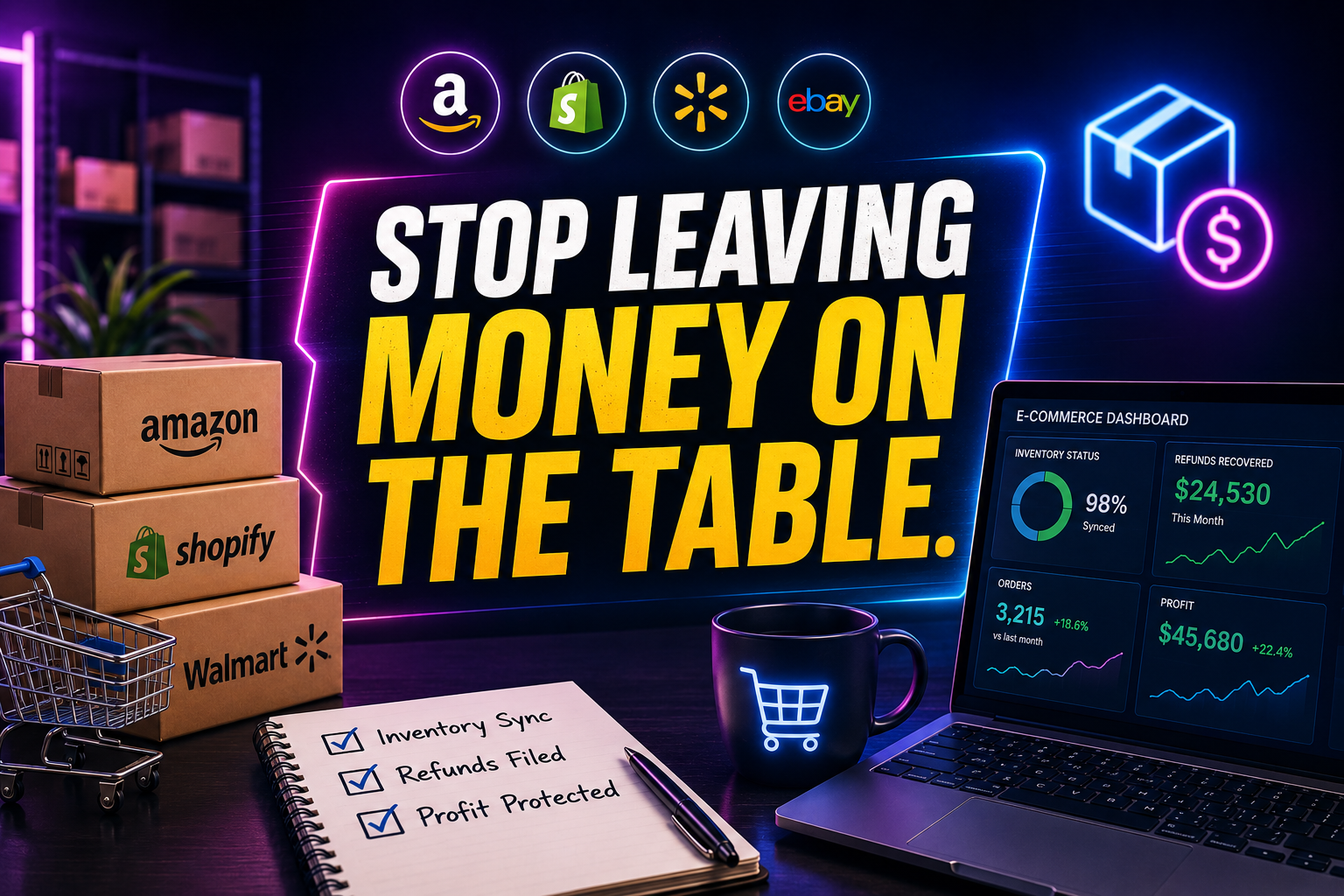
Running a direct-to-consumer brand in today's multi-channel retail environment is an exercise in high-stakes juggling. You launched on Shopify to capture direct brand equity, expanded to Amazon Seller Central to tap into high-intent buyer traffic, and perhaps layered in Walmart Marketplace or TikTok Shop to capture emerging search demand. But as your sales velocity accelerates, a silent operational killer creeps into your business: Admin Debt.
Admin debt is the accumulation of unmanaged operational friction: stale inventory counts, unfulfilled customer tickets, unverified 3PL invoices, and unclaimed Amazon FBA discrepancies: that drains your working capital and paralyzes your growth. For most growing e-commerce founders and brand managers, 40 percent of the workweek is consumed by reactive firefighting rather than strategic product expansion and top-of-funnel marketing. You find yourself manually updating stock levels between channels, wrestling with CSV files, and watching hard-earned gross margins evaporate into unoptimized overhead and marketplace penalties.
When inventory sync fails between your Shopify store and your Amazon fulfillment nodes, overselling becomes an inevitable catastrophe. Customers buy out-of-stock items, your fulfillment rate drops, marketplace algorithms penalize your store visibility, and customer support queues swell with angry inquiries. Meanwhile, Amazon owes you thousands of dollars in lost, damaged, or misplaced inventory reimbursements that sit uncollected because your internal team lacks the bandwidth to audit monthly ledger reports.
You cannot out-hire this problem with traditional local staffing. Hiring a full-time, in-house e-commerce operations manager in the United States now commands upwards of $65,000 to $75,000 per year plus benefits: an impossible burden for a growing brand trying to preserve cash flow. The modern solution is partnering with a specialized e-commerce virtual assistant through Virtual Nexgen Solutions. At a predictable rate of $8 per hour, you deploy trained operational talent who live inside your tech stack, eradicate inventory discrepancies, recover lost revenue, and allow your core team to focus on scaling the brand.
The Mechanics of Inventory Mismatches and Fulfillment Drag
To understand why traditional e-commerce operations break down, examine the anatomy of a typical multi-channel supply chain. Modern shoppers expect instant gratification: two-day shipping, real-time tracking updates, and flawless stock availability. Behind the scenes, however, your inventory is fragmented across multiple warehouses, third-party logistics providers (3PLs), and digital storefronts.
When a flash sale hits on Shopify or your TikTok video goes viral, stock counts deplete rapidly. If your inventory management system (IMS) or marketplace connectors fail to sync in real-time, Amazon or Walmart continues displaying available units that no longer exist in your physical warehouse. The result is an oversell event. Fulfilling that order requires scrambling to source emergency inventory at retail prices, shipping via expedited carrier at a loss, or canceling the order entirely: triggering severe marketplace health metric penalties that can suppress your product listings for weeks.
Beyond inventory mismatches, fulfillment drag bleeds cash through unmonitored shipping discrepancies, dimensional weight overcharges by carriers, and frequent inbound receiving errors at Amazon FBA fulfillment centers. Every month, Amazon loses or damages a small percentage of your inbound shipments. Without rigorous monthly reconciliation of your inventory ledger against reimbursement reports, these losses become permanent write-offs. Independent e-commerce brands routinely leave $10,000 to $30,000 unclaimed every single year simply because their internal teams are too overwhelmed with daily firefighting to audit the data.
This operational friction creates a ceiling on your revenue. You cannot scale ad spend or launch new product lines when your foundation is leaking capital through administrative neglect. You need dedicated execution power that operates with precision, consistency, and deep familiarity with e-commerce protocols.
What an E-Commerce Virtual Assistant Actually Does
Many founders misunderstand the scope of remote support, assuming virtual assistants only handle basic customer service replies. In a modern e-commerce enterprise, a specialized e-commerce virtual assistant functions as the operational engine supporting your entire supply chain, marketplace compliance, and customer experience desk.
When you onboard a trained professional through Virtual Nexgen Solutions, their daily workflows span several critical domains:
Shopify and Amazon Seller Central Management
Your virtual assistant monitors dashboard alerts, manages product listing updates, optimizes backend search terms, tracks buy box suppression warnings, and ensures that pricing and inventory levels remain perfectly synchronized across Shopify, Amazon, Walmart, and eBay. They handle daily catalog maintenance so your listings remain compliant and visible to shoppers.
Inventory Sync and 3PL Reconciliation
Your VA performs daily audits of stock levels between your Shopify store, Amazon FBA, and third-party logistics portals (such as ShipBob, RedStag, or Deliverr). They flag low-stock thresholds before stockouts occur, coordinate inbound purchase orders with manufacturers, and track freight shipments to ensure timely warehouse check-in.
Order Fulfillment Tracking and Exception Management
When carrier delays, address errors, or carrier exceptions occur, your virtual assistant steps in immediately. They monitor tracking dashboards, communicate with carrier support desks, update customers proactively before complaints arise, and re-route shipments to prevent delivery failures.
Customer Support Ticketing and Dispute Resolution
Customer satisfaction directly dictates your store ratings and repeat purchase rate. Your VA manages your helpdesk software (such as Gorgias, Zendesk, or Freshdesk), resolving shipping inquiries, processing standard returns and exchanges, issuing replacement orders, and managing customer feedback to protect your seller ratings.
FBA Lost Inventory and Reimbursement Claims
Amazon frequently loses inventory during inbound receiving or mismanages customer returns in fulfillment centers. Your virtual assistant meticulously audits your inventory ledger, reconciles shipment discrepancies, gathers proof of delivery and supplier invoices, and files systematic reimbursement claims to recover missing funds.
The True Cost of Growth: $8/Hour Virtual Assistant vs. $65K/Year In-House Manager
When evaluating how to scale your operational capacity, the financial math dictates your strategy. Traditional hiring in major US metropolitan markets requires hiring a full-time e-commerce operations manager. That hiring decision carries substantial fixed costs that impact your cash flow regardless of seasonal revenue fluctuations.
Consider the true annual cost of an in-house e-commerce manager:
- Base Salary: $65,000
- Payroll Taxes and Workers Compensation: $6,500
- Health Insurance and Benefits: $8,000
- Software Licenses, Hardware, and Office Overhead: $4,000
- Total Annual Investment: ~$83,500
Now examine the alternative. By partnering with Virtual Nexgen Solutions, you secure dedicated, vetted operational talent at $8 per hour. Operating a full-time equivalent schedule of 160 hours per month results in an annual investment of approximately $15,360. That represents an annual cash savings of over $68,000 while eliminating long-term employment liabilities, severance risks, and recruitment overhead.
More importantly, your virtual assistant is backed by standardized workflows and continuous supervision from Virtual Nexgen Solutions. You gain flexible scalability: you can ramp hours up during peak fourth-quarter holiday surges and adjust seamlessly without the painful overhead of layoffs or termination proceedings.
Five Essential Tasks to Delegate Immediately to Protect Gross Margins
To immediately recapture your time and protect your bottom line, offload these five foundational workflows to your e-commerce virtual assistant:
1. Daily Inventory Reconciliation Audits
Stop relying on passive software integrations that occasionally fail. Have your virtual assistant perform a morning cross-check between your physical 3PL stock reports, Shopify backend, and Amazon FBA inventory views to catch discrepancies before they trigger oversell events.
2. Amazon FBA Reimbursement Tracking
Set up a recurring weekly audit where your VA reviews Amazon settlement reports, identifies shipments with missing units or unreimbursed customer returns, compiles supplier invoices, and submits formal claim tickets to recover cash owed to your business.
3. Customer Inquiry and Return Triage
Delegate your tier-one support desk. Your virtual assistant can resolve 85 percent of routine WISMO ("Where Is My Order?") inquiries, process return merchandise authorizations (RMAs), and issue store credits within minutes of customer contact, drastically improving your CSAT scores.
4. Marketplace Listing Optimization and Health Monitoring
Your VA monitors Account Health Rating dashboards in Amazon Seller Central and Shopify, ensuring zero policy violations, monitoring intellectual property complaints, updating bullet points, and refreshing keyword tags based on recent search trends.
5. Supplier and 3PL Purchase Order Tracking
Keep your supply chain moving smoothly. Your virtual assistant communicates with overseas or domestic manufacturers, tracks production milestones, updates bill of lading documents, and schedules freight pickups with your freight forwarder.
Case Study 1: How a Shopify Brand Eliminated Inventory Oversells
A fast-growing DTC home goods brand based in Austin, Texas, was experiencing rapid top-line growth on Shopify while simultaneously expanding onto Amazon and Walmart. However, their internal team of two founders and one customer support rep could not keep pace with inventory updates across channels. During a major promotional campaign, a synchronization lag caused their store to oversell 320 units of a flagship ceramic cookware set that was completely out of stock in their primary warehouse.
The resulting fallout was severe: forced order cancellations, angry customer emails, negative store reviews, and a temporary suppression of their Shopify store ranking. The founders were spending 15 hours every week manually reconciling inventory spreadsheets and fighting customer complaints.
They partnered with Virtual Nexgen Solutions to onboard a dedicated e-commerce virtual assistant at $8 per hour. The virtual assistant instituted a rigorous twice-daily inventory audit protocol across Shopify, Amazon, and their 3PL partner (ShipBob), established low-stock alert thresholds, and took over tier-one support ticketing.
Within 30 days, inventory oversells dropped to absolute zero. Customer support response times decreased from 12 hours to under 45 minutes, and the founders reclaimed 15 hours per week to focus on influencer partnerships and product development. The brand increased its monthly revenue by 34 percent over the next quarter without adding any additional local headcount.
Case Study 2: Recovering $15,000 in Lost Amazon FBA Reconciliations
An established Amazon FBA seller of pet supplies in Chicago, Illinois, generated over $2.5 million in annual gross revenue. Because their catalog included thousands of SKUs shipped in bulk pallets to multiple Amazon fulfillment centers across the Midwest, inbound receiving discrepancies and lost inventory items were a regular occurrence.
Their internal team focused entirely on advertising optimization and inventory purchasing, leaving Amazon shipment reports largely unaudited. Over eighteen months, uncollected reimbursement claims for lost and damaged warehouse inventory accumulated to an estimated $18,000 in unrecovered capital.
The seller engaged Virtual Nexgen Solutions to deploy an e-commerce virtual assistant specializing in Amazon Seller Central accounting and FBA reconciliation workflows. Operating at $8 per hour, the virtual assistant conducted a historical audit spanning the previous 18 months, pulling inbound shipment logs, carrier bills of lading, supplier commercial invoices, and customer return ledgers.
The virtual assistant filed 142 structured reimbursement claims through Seller Central support, providing precise documentation for every discrepancy. Over a 60-day period, Amazon approved and credited $15,240 back into the seller’s account balance. Furthermore, the virtual assistant established a weekly ongoing audit SOP that permanently closed the leak, ensuring future inventory discrepancies were claimed within Amazon's strict 90-day window.
Step-by-Step Operating Procedures for Daily Store Hygiene
To ensure seamless collaboration with your virtual assistant, implement this standardized operating procedure (SOP) for daily e-commerce hygiene:
Step 1: Morning Channel Health Check (08:00 AM)
Your virtual assistant logs into Shopify, Amazon Seller Central, and Walmart Seller Center to check Account Health Ratings, review order error logs, verify that API inventory sync connections are active, and flag any sudden traffic or conversion anomalies.
Step 2: 3PL and Warehouse Discrepancy Review (09:30 AM)
The virtual assistant reviews pending outbound shipments from the previous 24 hours, identifies any carrier pickup delays or address exceptions, and communicates directly with your 3PL account manager to resolve staging blocks.
Step 3: Customer Support Ticket Triage (11:00 AM)
Your VA opens your helpdesk dashboard (Gorgias or Zendesk), sorts tickets by priority, processes standard tracking requests, issues return shipping labels, and escalates complex product defect claims to your internal product quality team.
Step 4: Marketplace Claim and Ledger Audit (02:00 PM)
The virtual assistant reviews weekly Amazon FBA shipment settlement reports, cross-references received quantities against manifest documents, and prepares reimbursement claim files for any missing or damaged units.
Step 5: End-of-Day Inventory Buffer Check (04:30 PM)
Before signing off, your VA reviews safety stock thresholds across your top 20 revenue-generating SKUs, confirms upcoming purchase order delivery dates with suppliers, and delivers a concise daily operational briefing to your Slack or email inbox.
Frequently Asked Questions
1. What is an e-commerce virtual assistant?
An e-commerce virtual assistant is a trained remote professional who manages daily operational tasks for online brands, including inventory sync, marketplace management, order tracking, customer support, and FBA reimbursement audits.
2. How much does an e-commerce virtual assistant cost?
At Virtual Nexgen Solutions, specialized e-commerce virtual assistants are available at a predictable, transparent rate of $8 per hour with no long-term contracts or hidden overhead costs.
3. Which e-commerce platforms can your virtual assistants manage?
Our virtual assistants are trained across major platforms and tools, including Shopify, Amazon Seller Central, Walmart Marketplace, WooCommerce, ShipBob, Gorgias, Zendesk, and leading inventory management systems.
4. How do virtual assistants prevent inventory oversells?
They perform rigorous daily cross-checks between physical 3PL warehouse data, marketplace channels, and your central inventory management system to catch sync errors before stockouts occur.
5. Can an e-commerce virtual assistant help recover lost Amazon FBA money?
Yes. Your virtual assistant audits historical inventory ledgers, inbound shipment discrepancies, and customer return records to file systematic reimbursement claims with Amazon.
6. How long does onboarding an e-commerce virtual assistant take?
Onboarding typically takes between 48 to 72 hours. We match you with pre-vetted talent familiar with e-commerce operations and guide them through your brand's specific standard operating procedures.
7. Do I need to provide software licenses for the virtual assistant?
You grant role-based access permissions to your existing platforms (Shopify, Seller Central, helpdesk software) using secure login credentials, exactly as you would for an in-house hire.
8. How do I communicate with my virtual assistant daily?
You communicate via Slack, WhatsApp, Microsoft Teams, or email, supplemented by daily operational briefings and weekly sync meetings to review performance metrics.
9. What is the advantage of hiring through Virtual Nexgen Solutions?
We provide rigorously vetted, US-oriented operational professionals at $8 per hour, backed by proven industry workflows, robust quality assurance, and seamless scalability without local hiring overhead.
Conclusion
Admin debt and operational friction are silent profit killers that prevent your e-commerce brand from reaching its true valuation. When your team spends valuable hours manually fighting inventory mismatches, untangling shipping delays, and leaving thousands of dollars in unfiled Amazon reimbursements on the table, growth stalls. You cannot outwork systemic operational bottlenecks without dedicated execution power.
Partnering with Virtual Nexgen Solutions transforms your operational overhead into a lean, scalable growth engine. At just $8 per hour, you deploy elite remote talent equipped to master your tech stack, protect your gross margins, and secure your brand's market position. Reclaim your time, protect your inventory, and scale your brand with confidence.