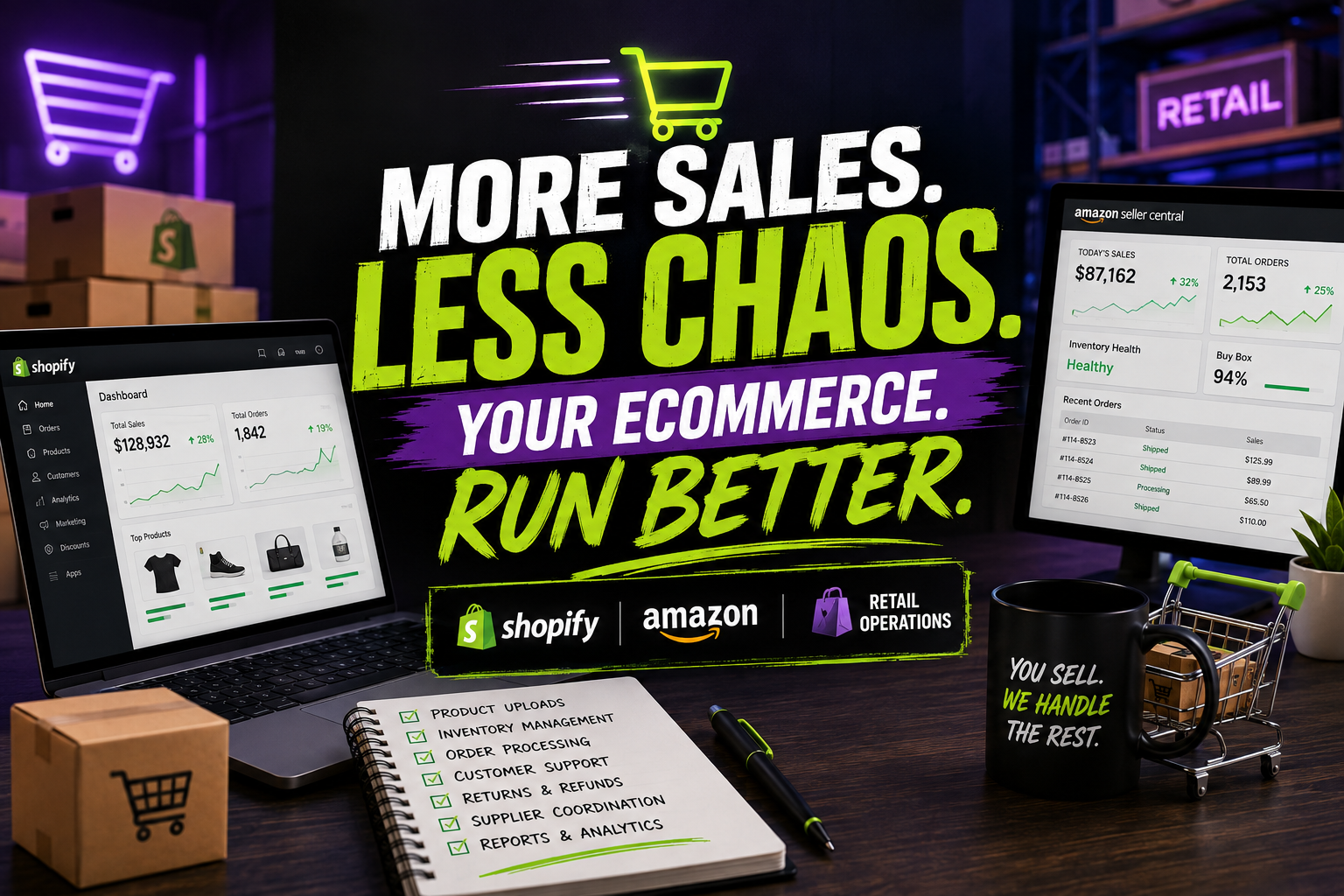
Your store may have strong demand but weak follow-through. You may have excellent products but inconsistent customer communication. A human ecommerce virtual assistant can take ownership of approved operational tasks while you retain control of pricing, merchandising, brand voice, and strategy.
The Retail & Commerce Owner's Daily Fire Drill
An illustrative scenario: You start the morning checking Shopify orders, answering an Amazon customer message, investigating an inventory question, correcting a product listing, and responding to a return request. Before breakfast, your attention has already moved across five systems.
Then the review notifications begin. A shipment is delayed. A product description needs updating. A customer wants an exchange outside your normal policy. Meanwhile, you still need to review advertising, source inventory, and plan your next product launch.
That operational backlog creates real pressure. The solution is not another app. It is a trained human who can own the repeatable work with judgment.
What a Virtual Assistant for Retail & Commerce Actually Does
A retail VA supports the complete store-to-customer lifecycle.
During order management, your VA reviews new orders, checks fulfillment details, updates tracking information, flags exceptions, and coordinates with suppliers or third-party logistics providers.
During customer service, your VA handles approved email, chat, and helpdesk responses. They answer order-status questions, explain published policies, document complaints, and escalate sensitive issues.
During catalog maintenance, your VA updates product titles, descriptions, images, tags, collections, variations, and SKU information. They can prepare changes for your approval before publishing.
During inventory coordination, your VA reviews stock levels, compares marketplace quantities, records discrepancies, and prepares low-stock reports. Keep purchasing decisions with you or your operations manager.
Your VA can also support returns and refunds, review management, marketplace messages on Amazon, Etsy, and Walmart, spreadsheet updates, vendor follow-up, inbox management, and basic reporting.
Use the VA as an operational extension, not as the person making brand or financial decisions.
What a Retail & Commerce VA Should NOT Do
Set boundaries before granting access. A VA should not:
- Approve final pricing, discounts, or promotions.
- Make brand voice or merchandising decisions.
- Approve advertising budgets or ad-spend changes.
- Make financial, legal, tax, or compliance decisions.
- Commit to inventory purchases or supplier contracts.
- Resolve complex marketplace disputes without approval.
- Promise refunds or exceptions outside your written policy.
Give your VA clear escalation rules and individual user accounts.
Shopify Store Owners vs. Amazon Sellers vs. Multi-Channel Retailers
A Shopify store owner usually needs help with order processing, product pages, customer emails, discount-code updates, returns, and Klaviyo campaign preparation.
An Amazon seller needs tighter marketplace support. The VA may monitor Seller Central notifications, maintain listings, respond to buyer messages, track returns, review account-health alerts, and prepare information for cases.
A multi-channel retailer needs consistency. Your VA can compare Shopify, Amazon, Etsy, and Walmart listings, check SKU alignment, track inventory differences, and maintain a shared exception log.
Human VA vs. AI Chatbots and Support Tools: An Honest Comparison
Chatbots and support tools can help with instant FAQ answers, simple order-status questions, product searches, and after-hours coverage. They work well when the customer request is predictable and your policies are clear.
Human judgment matters when a customer is upset, a return falls outside policy, a shipment is damaged, a marketplace dispute requires context, or a review needs a thoughtful response. A human VA also handles back-office work that a chatbot cannot manage, such as catalog cleanup, inventory reconciliation, vendor follow-up, and reporting.
At $8/hour, a human ecommerce VA offers a balanced middle option: broader support than a chatbot and more flexibility than a managed monthly staffing plan.
Software a Retail & Commerce VA Can Support
A trained VA can work inside:
- Shopify Admin and Shopify Help Center workflows
- Amazon Seller Central
- WooCommerce, Etsy, and Walmart Marketplace
- Gorgias and Zendesk
- Klaviyo
- Helium 10
- Inventory Planner
- QuickBooks
- Google Workspace
- Canva
Use least-privilege access. Review permissions monthly.
How Much a Retail & Commerce VA Costs
Virtual Nexgen Solutions provides retail and ecommerce VA support at $8 per hour.
At 10 hours per week, the estimated monthly cost is $346.40. At 20 hours per week, it is $692.80. At 40 hours per week, it is $1,385.60, using 4.33 weeks per month.
Managed services commonly range from approximately $899 to $2,200 per month, depending on supervision, coverage, and service scope. Lower-cost offshore support may appear at $6 to $7 per hour, but compare experience, software familiarity, quality checks, communication, and security, not price alone.
The True Cost of an In-House Retail or Customer Service Hire
A $60,000 annual salary does not represent the full cost of an in-house hire. Add payroll taxes, benefits, recruiting, onboarding, equipment, paid time off, management time, and workspace expenses.
Review the Bureau of Labor Statistics customer service data for occupation details and wage information. Compare the total employment cost with the exact VA hours your store needs.
How to Hire and Onboard a Retail VA
Use this seven-point checklist:
- Require Shopify, Amazon, or marketplace experience.
- Test written customer-service quality with sample replies.
- Evaluate whether the VA can follow your brand voice.
- Confirm experience with Gorgias, Zendesk, Klaviyo, or similar tools.
- Sign an NDA and use individual logins.
- Start with a focused 30-day pilot.
- Require weekly reporting on completed work, exceptions, and open questions.
Give your VA policies, escalation examples, product information, and a clear task queue.
Red Flags to Avoid
Avoid providers that guarantee sales, revenue, rankings, or marketplace results. Reject any service that will not sign an NDA, relies on shared passwords, skips brand-voice training, or vaguely claims to "handle everything."
Good support has defined ownership, documented procedures, permission controls, and measurable work.
How to Measure Success
Track response time, order accuracy, listing accuracy, return-processing time, review response volume, ticket resolution, inventory discrepancies, and hours reclaimed. Review results after 30, 60, and 90 days.
Illustrative scenario one: A Shopify apparel store could compare its order-error rate and customer-response backlog before and after assigning a VA to daily support and order review.
Illustrative scenario two: An Amazon home-goods seller could measure listing corrections, unresolved buyer messages, return status, and account-health follow-up during a defined pilot.
Use your own baseline. Do not rely on unverified claims.
A 30-Day Pilot Plan
Days 1–5: Select one queue, such as customer support or order review. Define access, policies, escalation rules, and success measures.
Days 6–12: Train with closed orders, approved replies, product information, and return examples.
Days 13–20: Process live work with daily quality checks. Keep pricing, refunds outside policy, and marketplace disputes under owner review.
Days 21–30: Compare baseline metrics, identify rework, and decide whether to maintain, adjust, or expand the VA's hours.
Frequently Asked Questions
What does an ecommerce virtual assistant do?
An ecommerce virtual assistant handles approved store tasks such as order processing, customer support, product listings, inventory coordination, returns, reviews, and reporting.
Can an ecommerce VA manage a Shopify store?
Yes. A trained VA can update listings, review orders, manage customer messages, coordinate returns, maintain collections, and prepare reports in Shopify.
Can an ecommerce VA handle Amazon Seller Central?
Yes. A VA can support listings, buyer messages, return tracking, account-health monitoring, and case preparation inside Amazon Seller Central.
How much does an ecommerce virtual assistant cost?
Virtual Nexgen Solutions charges $8 per hour. Ten hours weekly costs about $346.40 monthly, while 20 hours weekly costs about $692.80.
Can an ecommerce VA respond to customers?
Yes. A VA can respond to approved customer questions through email, chat, Gorgias, Zendesk, Shopify, or marketplace messaging systems.
Can an ecommerce VA process returns?
Yes. A VA can review return requests, follow your written policy, update records, coordinate labels, and escalate unusual cases for approval.
Does an ecommerce VA need brand voice training?
Yes. Provide brand guidelines, approved phrases, prohibited language, product details, and examples of excellent customer responses.
What should an ecommerce virtual assistant not do?
A VA should not make final pricing, financial, purchasing, legal, compliance, ad-spend, or brand-strategy decisions without your approval.
Why Choose Virtual Nexgen Solutions
Virtual Nexgen Solutions has provided tailored virtual assistant support since 2016. We assess your store model, platforms, customer-service standards, product catalog, and operational backlog before defining the role.
You receive flexible human support at $8 per hour for the work you actually need.
Ready to reduce the operational backlog without committing to a full-time retail hire? Book a 30-minute consultation with Virtual Nexgen Solutions to review your Shopify, Amazon, marketplace, customer-service, and store-support workflows.