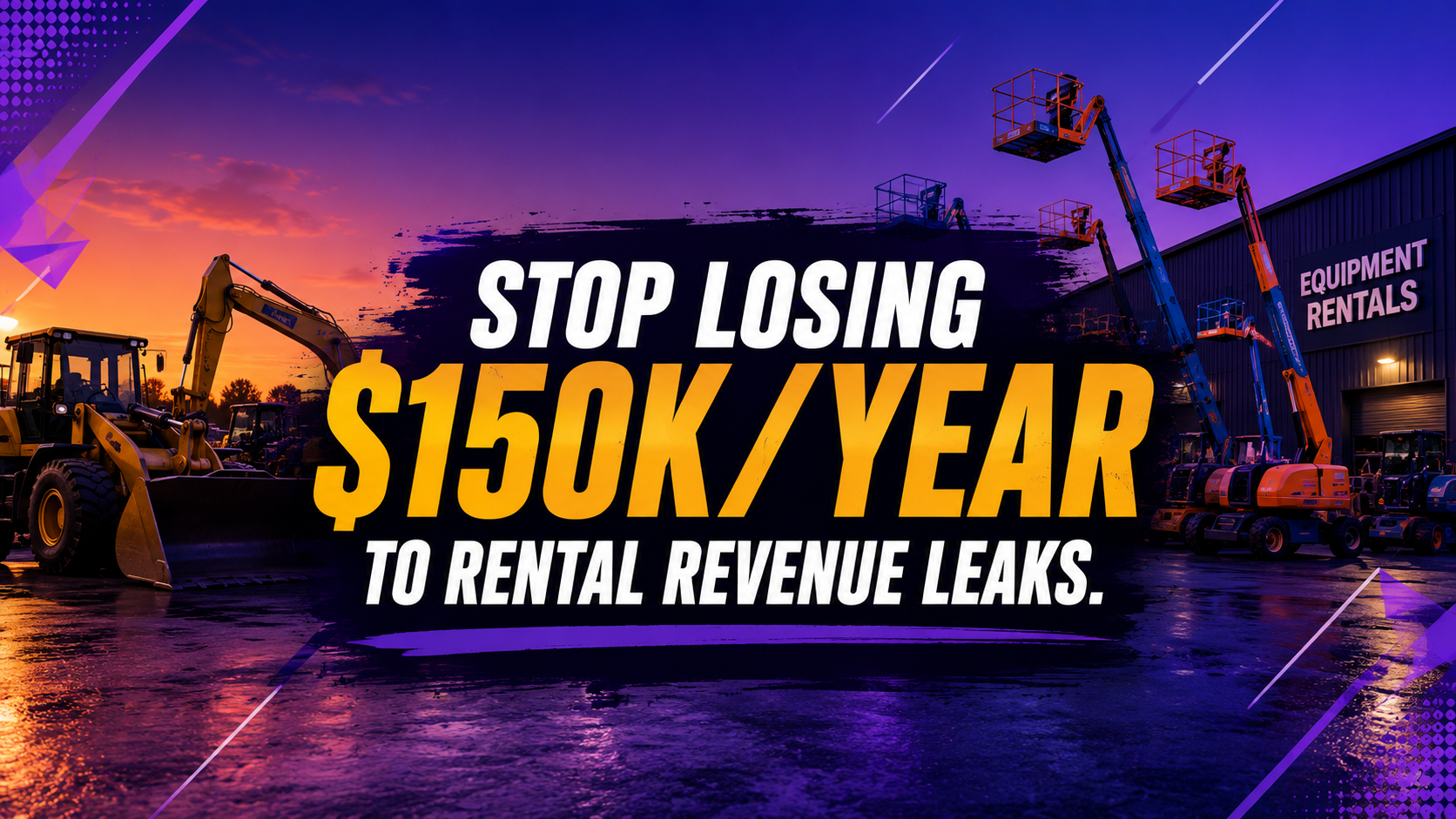
You look out at your yard and see $2 million in iron. To most, it’s a fleet of excavators, generators, and scissor lifts. To you, it’s a ticking clock. Every hour a machine sits idle, it’s not just "not making money", it’s costing you. It’s the "Idle Asset Tax." It’s the depreciation, the insurance, the storage, and the opportunity cost of a lost rental.
But the most dangerous revenue loss isn't just the machine that didn't go out. It's the machine that did go out and came back with a bent hydraulic ram, a cracked windshield, or an empty fuel tank, and you never billed for it.
This is the reality of "Admin Debt." In the equipment rental industry, where margins are squeezed by rising equipment costs and labor shortages, operational friction is the silent killer of profitability. Most owners are so busy putting out fires, handling walk-ins, managing angry mechanics, and chasing down trailers, that they ignore the profit leakage happening in their software.
Revenue leakage in the rental world is typically 2% to 7% of gross revenue. For a mid-sized yard doing $3M a year, that’s up to $210,000 vanishing into thin air. Why? Because your team is too small to handle the "Contract-to-Return" lifecycle with precision.
At Virtual Nexgen Solutions, we see this cycle daily. Owners are drowning in admin tasks while their most expensive assets sit unrented due to "scheduling ghosts." It is time to systematize your yard and recover that $150K+ in lost revenue.
The 5 Rental Operational Crises No One Talks About
Crisis 1: The Double-Booking Disaster
Nothing kills a customer relationship faster than a contractor showing up with a trailer to pick up a skid steer that was already promised to another crew. This usually happens because of "laggy" inventory updates. If your inventory software isn't updated the second a contract is signed, you are operating on a hope and a prayer.
Crisis 2: The Idle Asset Tax
Utilization is the only metric that matters. If your scissor lifts are at 40% utilization while your competitors are at 65%, you are losing. Often, assets sit idle because they are "stuck" in the system as "Needs Service" or "Pending Return" even when they are ready to go. Without a dedicated eye on the dashboard, these assets remain invisible to your sales team.
Crisis 3: The Unbilled Damage & Late Return Leak
A machine returns. It’s dirty. The yard guy is rushed. He checks it in but misses the new dent in the ROPS or the fact that it’s 4 hours late. By the time the invoice is sent, the customer disputes the damage, and because you don't have time-stamped photo evidence ready to go, you eat the $800 repair cost.
Crisis 4: The Contract Generation Bottleneck
If it takes 20 minutes to get a customer through the paperwork, you are losing money on labor and customer experience. Manual data entry into systems like Point of Rental or Booqable leads to errors in tax rates, insurance waivers, and delivery fees.
Crisis 5: The Maintenance Scheduling Gap
Preventive maintenance (PM) is often treated as a "when we have time" task. But missed PMs lead to unplanned downtime. When a machine breaks down on a job site, you don't just lose the rental; you pay for the haul-back, the repair, and the reputation damage.
What Is an Equipment Rental Virtual Assistant?
An Equipment Rental Virtual Assistant (ERVA) is not a general secretary. They are specialized operations coordinators who live inside your rental management software (RMS).
Unlike a standard VA who might just answer emails, an ERVA from Virtual Nexgen Solutions understands the nuances of:
- Serialized vs. Bulk Inventory: They know how to track specific VINs and meter hours.
- Cycle Billing: They manage the complex billing cycles for long-term rentals (4-week cycles).
- Damage Waivers: They ensure every contract has the proper insurance and liability protections.
- Logistics Coordination: They act as the bridge between the customer, the yard, and the delivery driver.
For just $8 per hour, an ERVA provides the administrative engine that allows you to stop playing "catch up" and start focusing on fleet expansion. An in-house operations manager will cost you $60,000+ per year plus benefits. An ERVA provides the same precision for a fraction of the cost.
The $150K Math: Quantifying the Admin Friction
Let’s look at how the numbers actually break down for a typical yard with a $2.5M annual turnover.
- Unbilled Damage & Fuel: If you miss just two $500 damage claims and four $50 fuel surcharges per month, that’s $14,400 a year.
- Idle Asset Recovery: Increasing utilization by just 5% on a $2M fleet (assuming a 15% average rental rate) yields an additional $15,000 per month or $180,000 per year.
- Late Return Fees: Most yards "forgive" late fees because they don't have the documentation to back them up. Capturing just $1,000 a month in valid late fees adds $12,000 to the bottom line.
- Admin Labor Savings: Replacing 40 hours of "owner time" or "manager time" spent on data entry with an $8/hr VA saves roughly $45,000 in high-value labor costs.
Total Potential Recovery: $251,400.
Even if you only recover 60% of that through better systematization, you have found $150,840 in "found money" that was previously leaking out of your yard.
25 Tasks an Equipment Rental VA Can Handle
Contract & Order Management
- Quote Generation: Promptly turning phone inquiries into digital quotes in Point of Rental or Quipli.
- Contract Execution: Sending e-sign documents and ensuring insurance certificates (COIs) are uploaded.
- Order Modifications: Handling "I need it for two more days" calls and updating the RMS instantly.
- Reservation Audits: Clearing out "zombie" reservations that are blocking inventory.
- Deposit Management: Verifying credit card authorizations are active before equipment leaves the yard.
Inventory & Availability
- Real-Time Tracking: Moving equipment status from "In Yard" to "On Rent" as drivers confirm delivery.
- Sub-Rental Coordination: If you are short an item, the VA coordinates the sub-rental from a partner yard.
- Asset Lifecycle Entry: Adding new equipment to the system with serial numbers, photos, and PM schedules.
- Tiered Pricing Management: Adjusting rates for weekend, weekly, and monthly intervals.
Billing & Revenue Recovery
- Damage Claim Processing: Comparing "Before" and "After" photos and generating damage invoices.
- Fuel & Consumable Billing: Ensuring propane, fuel, and sandpaper are added to final invoices.
- Cycle Billing for Long-Term: Automatically generating invoices every 28 days for long-term jobs.
- Collections: Following up on 30/60/90-day overdue invoices.
- Credit Memo Audits: Reviewing why discounts were given to ensure policy compliance.
Maintenance & Dispatch
- PM Scheduling: Alerting mechanics when a machine is within 10 hours of its service interval.
- Breakdown Coordination: Taking the call from the field and dispatching a service tech or swap-out.
- Route Optimization: Using software like FieldEquip to group deliveries and save fuel.
- Telematics Monitoring: Tracking GPS locations to ensure equipment hasn't left the agreed-upon job site.
Customer Service & Marketing
- Lead Follow-Up: Calling back people who abandoned their online rental cart.
- Google Review Management: Sending a "How was your rental?" text with a review link after every return.
- Social Media Updates: Posting "Now Available" photos of new fleet arrivals.
- Client Portal Support: Helping contractors navigate their online billing portal.
- Satisfaction Surveys: Identifying "at-risk" clients before they switch to a competitor.
- Competitor Rate Shopping: Monthly audits of what local yards are charging for similar assets.
- Email Newsletters: Informing clients about seasonal equipment (e.g., heaters in winter, fans in summer)
Before vs. After: The Operational Transformation
The "Manual Yard" (Before)
- The Problem: The owner, John, spends 4 hours every Monday morning manually checking in equipment and trying to remember which machine had the cracked bucket. He misses three damage claims because the photos were lost in a text thread.
- Inventory: The system shows two trenchers available, but one is actually broken and the other was "promised" to a buddy over a beer. A customer shows up and leaves angry.
- Billing: Invoices are sent 7 days after the rental ends. Cash flow is tight.
The "Systematized Yard" (After)
- The Solution: A Virtual Nexgen Solutions VA manages the Point of Rental dashboard.
- The Result: Every return triggers an "SOP: Return Audit." The VA compares the driver’s photos to the original contract. Damage is billed within 2 hours of return.
- Inventory: Inventory is 100% accurate. John hasn't had a double-booking in six months.
- Billing: Invoices are generated automatically. John spends his Mondays visiting job sites and closing $50k/month contracts instead of doing data entry.
5 Actionable SOPs for Equipment Rental Operations
If you want to scale, you need Standard Operating Procedures (SOPs). Here are the five most critical workflows your VA will execute.
SOP 1: Daily Inventory Availability Audit (8:00 AM Standard)
- Goal: Ensure the RMS matches the physical yard.
- Step 1: VA runs the "Daily Availability Report."
- Step 2: VA cross-references with the "Due In" list from the previous day.
- Step 3: If a machine is marked "In" but not "Available," the VA messages the Yard Lead to check if it's ready for rent.
- Step 4: Update statuses in Booqable/Texada to reflect live availability.
SOP 2: The 15-Minute Contract Generation Standard
- Goal: Reduce customer wait time.
- Step 1: Upon receiving a quote acceptance, the VA verifies the customer's COI and credit card.
- Step 2: Generate the Rental Agreement with all "Hard Costs" (Delivery, Pick-up, Damage Waiver).
- Step 3: Send via DocuSign/HelloSign.
- Step 4: Once signed, move the asset to "Reserved" status to prevent double-booking.
SOP 3: Damage & Late Return Recovery Flow
- Goal: Zero unbilled revenue leakage.
- Step 1: Within 1 hour of equipment check-in, the VA reviews the "Return Photos" uploaded by the driver/yard.
- Step 2: Compare to "Outbound Photos."
- Step 3: If damage is found, the VA creates a "Damage Work Order" and emails the customer a "Notice of Damage" with evidence.
- Step 4: Calculate late fees based on the time-stamp and apply to the final invoice.
SOP 4: Preventive Maintenance (PM) Trigger System
- Goal: Reduce unplanned downtime.
- Step 1: VA monitors telematics (e.g., Trackunit) for hour meter readings.
- Step 2: When a machine is 20 hours away from a 250/500/1000-hour service, the VA creates a "Service Hold" in the system for a future date.
- Step 3: Coordinate with the shop manager to ensure parts are in stock.
SOP 5: Monthly Revenue Reconciliation
- Goal: Ensure every rental was billed and collected.
- Step 1: VA runs a report of all "Closed Contracts" for the month.
- Step 2: Cross-reference with "Invoiced Totals" in QuickBooks.
- Step 3: Identify any "Open" contracts that should have been closed and investigate why.
- Step 4: Send "Statement of Account" to all clients with balances over 30 days.
Case Study 1: Texas Construction Equipment Yard
The Scenario: A mid-sized general equipment rental yard in Texas was struggling with "Inventory Ghosts." Their software (Texada) showed machines available that were actually in the shop for repairs. This led to an average of three double-bookings per week, resulting in lost revenue and a tarnished reputation.
The Intervention: Virtual Nexgen Solutions placed a specialized VA to handle all status updates. The VA implemented a "Return-to-Ready" workflow, ensuring that no machine was marked "Available" until the mechanic signed off digitally.
The Results (90 Days):
- Double-Bookings: Reduced from 12 per month to 0.
- Utilization: Increased by 12% across the fleet.
- Found Revenue: The VA recovered $3,100 in unbilled detention and damage charges in the first month alone.
- Owner Time: The owner reclaimed 15 hours per week previously spent on "crisis management."
Case Study 2: Florida Party Rental Operation
The Scenario: A high-volume party and event rental company in Florida was losing thousands of dollars to unbilled damage on tents, chairs, and linens. Their yard staff was overwhelmed during weekend returns and failed to document tears or stains.
The Intervention: A Virtual Assistant was brought in at $8/hr to act as a "Virtual Inspector." As yard staff took photos of returns, they uploaded them to a shared drive. The VA reviewed every photo against the outbound inventory list.
The Results (6 Months):
- Damage Recovery: Billed and collected $18,400 in damage and cleaning fees that would have otherwise been missed.
- Contract Accuracy: Implemented a digital signature process that reduced "missing item" disputes by 85%.
- ROI: The cost of the VA was $1,280/month, while the recovered revenue and labor savings exceeded $6,000/month, a 4.6x ROI.
Cost & ROI Comparison
When you look at the numbers, the choice between in-house and a specialized VA becomes a matter of basic math.
In-House Operations Assistant:
- Salary: $45,000 - $60,000/year
- Taxes & Benefits: $12,000 - $18,000/year
- Overhead (Desk, Computer, Software): $5,000/year
- Total: ~$72,000/year
- Risk: High turnover, training costs, management burden.
Virtual Nexgen Solutions VA:
- Rate: $8/hr
- Annual Cost (Full-Time): ~$16,640/year
- Benefits: $0 (Managed by us)
- Overhead: $0
- Total: ~$16,640/year
- Risk: Zero. We handle training and replacements.
The ROI Advantage:
By choosing a VA, you save $55,000+ in annual overhead while recovering potentially $150,000 in revenue leaks. That is a net positive swing of over $200,000 for your business.
Software Recommendations for 2026
Your VA is only as good as the tools they use. For 2026, we recommend the following "Gold Standard" platforms that integrate seamlessly with a remote team:
- Booqable: Best for small to mid-sized yards or tool rental shops. Its website integration is the best in the industry for online bookings.
- Point of Rental (Elite/Expert): The powerhouse for heavy equipment and multi-location yards. Excellent for complex serialized tracking.
- Texada: Best for heavy equipment fleets that require deep telematics integration and AI-assisted damage detection.
- Quipli: A rising star for construction equipment rental with a focus on a "one-click" customer experience.
- Trackunit: The essential telematics layer. Your VA can monitor this to prevent equipment theft and track billable hours.
Expert Opinions & Industry Insights
Operational experts in the American Rental Association (ARA) have long stated that "the equipment rental business is actually a logistics and data business disguised as an iron business."
The companies winning in 2026 are those that have eliminated "Admin Debt." They don't have paper files. They don't have "verbal agreements." They have a digital twin of their yard that is updated in real-time by a specialized administrative team. By offloading the $15/hr tasks to a specialized VA, the owner can focus on $500/hr tasks like fleet procurement and strategic partnerships.
Common Mistakes When Hiring
- Hiring for "General Admin": Equipment rental is too technical for a generalist. You need someone who knows what a "ROPS" is and understands the difference between a daily and a 28-day billing cycle.
- Lack of SOPs: Even the best VA will fail without a roadmap. You must document your "Way of Doing Things."
- Treating them as "Support" instead of "Operations": Your VA should be empowered to update inventory and chase damage claims, not just "answer phones."
- Ignoring Data Quality: Garbage in, garbage out. If your VA isn't trained on your specific software (e.g., InTempo), your reports will be useless.
Future Trends: The Rental Yard of 2027
As we look toward 2027, the trend is clear: Remote Operations.
Physical yards will become leaner, focusing on maintenance and logistics, while the "Control Tower" (billing, customer service, inventory) will be entirely remote. We are seeing a move toward "Dynamic Pricing," where your VA adjusts rental rates based on local demand and competitor availability, much like the airline industry. Those who don't systematize now will be left with high overhead and low margins.
Frequently Asked Questions (20 Q&A)
- Can a virtual assistant really understand heavy equipment?
Yes. Our specialized VAs are trained on industry terminology and the specific workflows of equipment rental software. - How do they handle the "Return Inspection" if they aren't in the yard?
Your yard staff takes photos/videos via a mobile app. The VA reviews these against the outbound condition report to identify damages. - What software do they work in?
We work in all major systems including Booqable, Point of Rental, Texada, Quipli, InTempo, and more. - How much does an equipment rental virtual assistant cost?
Our specialized rental VAs start at just $8 per hour. - Do I have to train them from scratch?
No. We provide VAs who already understand the rental industry. You only need to show them your specific yard’s nuances. - Can they help with my Google Business Profile?
Yes. They can manage reviews, post photos of new equipment, and respond to customer inquiries. - How do they communicate with my yard team?
Typically via Slack, WhatsApp, or the internal messaging systems within your rental software. - Can they handle collections for overdue invoices?
Absolutely. They can follow up on aging reports and ensure you get paid on time. - Will they help with my IFTA or DOT compliance?
Yes, they can track mileage and maintenance logs to ensure your hauling trucks remain compliant. - How fast can they generate a contract?
With a systematized workflow, our VAs can turn a quote into a contract in under 15 minutes. - Can they help with SEO for my rental website?
Yes, they can update product descriptions with keywords to help you rank higher on Google. - What happens if the VA is in a different time zone?
We provide VAs who work your yard’s business hours to ensure real-time support. - Do I need to provide them with equipment?
No. Our VAs come fully equipped with high-speed internet and the necessary hardware. - Can they handle dispatching my drivers?
Yes. They can group deliveries and optimize routes to save on fuel and labor. - How do they handle security deposits?
They manage the "Authorization" and "Capture" process within your merchant gateway to ensure funds are secured. - Can they help me transition from spreadsheets to software?
Yes. We specialize in data migration and getting your inventory live in an RMS. - What is the minimum commitment?
We offer flexible plans to suit your yard's size and needs. Contact us for details. - Can they call my customers to confirm deliveries?
Yes. They act as your front-office team, providing professional customer service. - How do they track equipment that is stolen?
They monitor telematics alerts and can coordinate with local law enforcement if an asset leaves a geofenced area. - Why should I choose Virtual Nexgen Solutions?
Because we are industry specialists. We don't just provide "help"; we provide an operational engine for the rental industry.
Conclusion: Reclaim Your Yard, Reclaim Your Profit
Your equipment rental yard is a high-stakes environment. Every minute spent on data entry is a minute lost on growth. The $150K in revenue leakage isn't just a number: it’s the new excavator you didn't buy or the second location you didn't open.
By integrating a specialized Equipment Rental Virtual Assistant from Virtual Nexgen Solutions, you are not just "outsourcing." You are systematizing your success. For $8/hr, you can stop the profit leaks, eliminate the "Idle Asset Tax," and finally scale your operation to its true potential.
Stop drowning in admin debt. Start leading your industry.