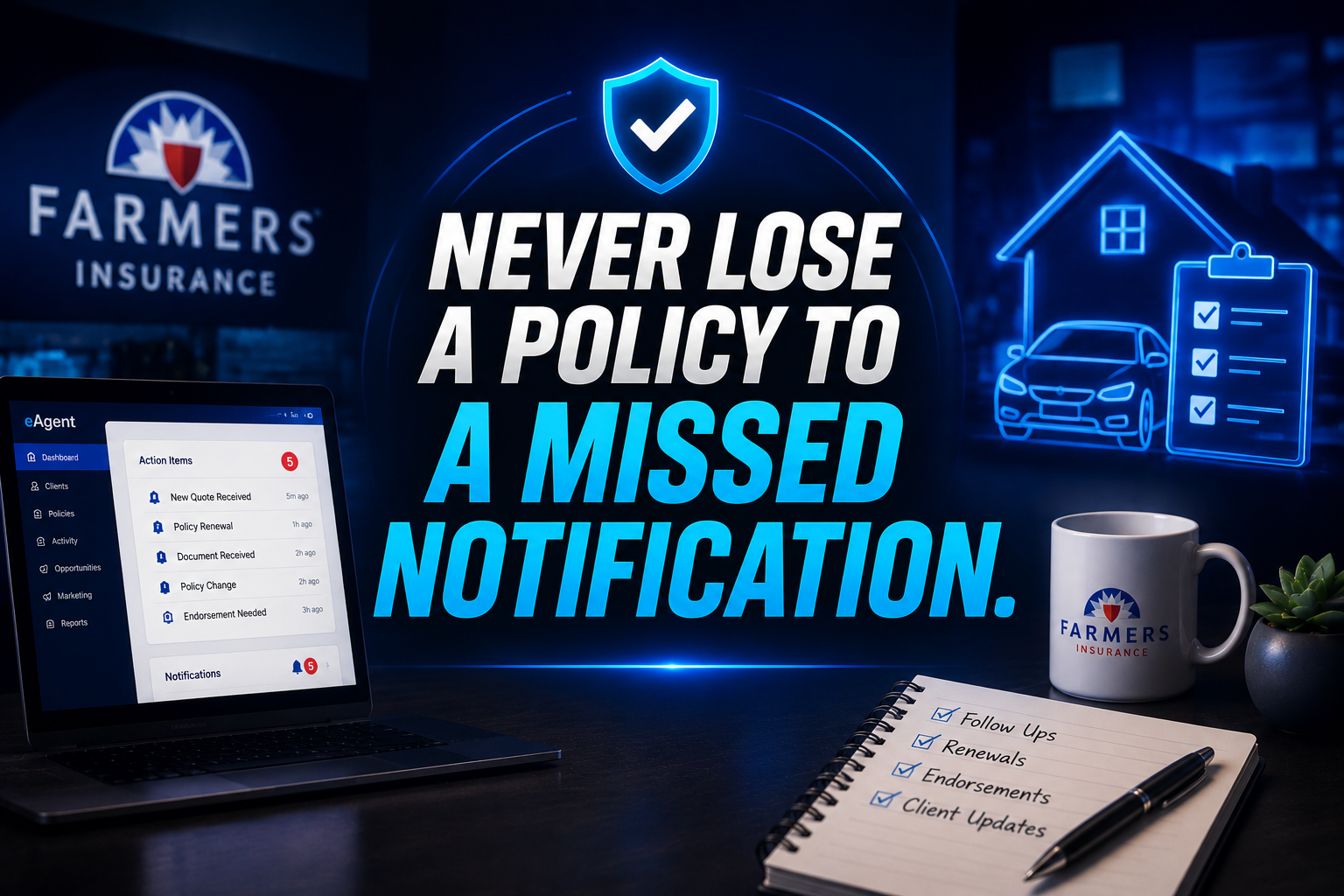
Every single morning, thousands of Farmers Insurance agents across the United States open their laptops, pour their first cup of coffee, and log into eAgent. What greets them is rarely a clean slate or an inspiring summary of yesterday's sales victories. Instead, it is a sprawling, chaotic list of red flags, pending cancel notices, billing exceptions, and underwriting requirements.
You have 200, 300, or sometimes over 400 action items sitting in your eAgent dashboard right now. Some of those items are urgent billing flags that will cancel policies tomorrow. Some are underwriting requirements you forgot about amid a flurry of afternoon quote requests. And others are document requests from long-standing clients who are waiting on your response while wondering if they should shop their auto and home insurance elsewhere.
When you spend your first two hours of every morning fighting fires inside eAgent, you are not acting as an agency owner, risk advisor, or producer. You are acting as a glorified administrative clerk. That is the definition of admin debt. It suffocates your growth, drains your energy, and puts your Elite status at risk.
At Virtual Nexgen Solutions, we understand that running a profitable Farmers agency requires relentless focus on revenue-generating activities like cross-selling, networking, and risk reviews. That is why we provide specialized Farmers Insurance Virtual Assistants at just $8/hr who take over your daily eAgent operations, clear your dashboard before you wake up, and protect your hard-earned book of business.
The Anatomy of Admin Debt in Modern Farmers Agencies
Admin debt is the silent killer of agency profitability. Unlike financial debt, which appears clearly on a balance sheet with an interest rate attached, admin debt accumulates invisibly in the form of delayed callbacks, uncleared notifications, unreturned endorsements, and neglected billing flags.
In the fast-paced environment of a Farmers agency, new business takes precedence. You spend your day quoting new auto, home, umbrella, and commercial policies. You chase leads, conduct property walkthroughs, and handle incoming phone calls. Meanwhile, the administrative machinery hums in the background: until it breaks down.
When your eAgent dashboard overflows, operational friction multiplies. Every minute spent searching for an upload confirmation or tracking down a mortgagee clause is a minute stolen from revenue production. Furthermore, administrative backlogs lead to compliance errors, missed renewal windows, and preventable cancellations.
If you want to scale your agency past the million-dollar premium mark, you cannot afford to manage administrative tasks yourself, nor can you afford to let them pile up. You need a systematized operational engine powered by a dedicated virtual assistant who treats your eAgent dashboard with clinical precision.
What is the eAgent Morning Sweep Protocol?
The eAgent Morning Sweep Protocol is a structured, 15-minute daily operational routine designed to neutralize agency chaos before business hours begin. Developed through years of working with top-tier insurance agencies across the United States, this protocol transforms the overwhelming eAgent notification screen into a streamlined, categorized action list.
Instead of waking up with anxiety over what might have slipped through the cracks over the weekend, you log in to find every single item triaged, categorized, and either resolved or escalated.
Here is how the protocol operates in practice:
- Pre-Market Ingestion (6:00 AM EST): Your dedicated virtual assistant logs into eAgent before local business hours begin, pulling fresh reports and filtering notifications by urgency.
- Automated Triage and Sorting: Items are immediately sorted into four distinct operational tiers: billing flags, underwriting requirements, pending cancellation notices, and client document requests.
- Immediate Remediation: Routine processing tasks: such as updating mortgagee clauses, attaching renewal declarations, and processing minor endorsement requests: are executed immediately.
- Executive Escalation Briefing: Any complex underwriting disputes or high-value client retention risks are flagged and placed neatly into a morning summary email waiting in your inbox.
By the time you sit down at your desk, your dashboard is clear, your clients' needs have been addressed, and your agency is positioned for clean, uninterrupted selling.
The Four Critical Categories of eAgent Notifications
To truly master your eAgent dashboard, you must understand the exact nature of the notifications it generates. Ignoring these alerts is not an option; each category carries a specific financial and operational penalty when mishandled.
1. Billing Flags and Payment Exceptions
Billing flags represent immediate cash flow threats. When an Electronic Funds Transfer (EFT) bounces or a credit card expires, eAgent triggers a billing exception notice. If left unaddressed, these policies enter grace periods and ultimately cancel for non-payment. Every non-pay cancellation represents lost retention bonus potential, broken multi-line discounts, and wasted acquisition marketing dollars.
2. Underwriting Requirements and Compliance Stints
Underwriting requirements are non-negotiable conditions set by regional underwriters. Whether it is a roof certification photo, a signed wood-destroying insect report, or proof of prior coverage, missing these deadlines results in binding cancellations or restrictive endorsements. A Farmers Insurance virtual assistant tracks these requirements meticulously, ensuring all requested documents are uploaded directly into eAgent well before the carrier's drop-dead deadline.
3. Pending Cancellation Notices
When a policy approaches cancellation status, the pressure mounts. Pending cancellation notices require immediate outreach: both digital and telephonic: to secure payment or resolve outstanding policy discrepancies. A trained virtual assistant reviews these lists daily, contacting insureds to update payment details and saving policies before they hit the cancellation register.
4. Client Document and Service Requests
Clients frequently submit inquiries or document requests through customer portals, emails, or direct calls. When these requests linger in eAgent without acknowledgment, client satisfaction plummets. Prompt handling of ID card requests, binder generation, and certificate issuances builds immense goodwill and drives long-term policyholder retention.
The True Cost of Ignoring Dashboard Alerts
Many agency owners adopt a reactive approach to agency management, tackling administrative items only when a client complains or a carrier sends a final notice. This reactive stance carries staggering hidden costs.
Consider the economics of a single non-pay cancellation. If an auto and home bundle with a combined annual premium of $3,200 cancels due to an ignored billing flag, you lose the immediate commission income, the future renewal revenue stream, and your hard-earned bonus eligibility tiers. Multiply that by twenty policies a year, and administrative neglect is quietly draining tens of thousands of dollars from your bottom line.
Beyond direct financial losses, there is the devastating cost of cognitive fatigue. When your mind is cluttered with unfinished administrative tasks, your capacity for high-stakes advisory conversations diminishes. You cannot close a complex commercial insurance prospect when you are mentally calculating how many emails and eAgent alerts are waiting for you back at the office.
What a Dedicated Farmers Insurance Virtual Assistant Does Daily
When you partner with Virtual Nexgen Solutions, your virtual assistant becomes the linchpin of your daily operations. Operating seamlessly within your agency's tech stack, your VA executes a rigorous daily checklist designed to keep your systems pristine.
Here is a breakdown of the core tasks your virtual assistant performs every single day:
- Dashboard Clearing: Logging into eAgent every morning to execute the Morning Sweep Protocol, categorizing and resolving pending notifications.
- Billing Management: Monitoring payment accounts, updating expired payment methods, and processing reinstatement requests within carrier guidelines.
- Underwriting Support: Reviewing underwriting requirements, communicating with insureds for required documentation, and uploading photos and inspection reports directly into eAgent.
- Endorsement Processing: Handling routine policy changes such as vehicle additions, address updates, and lienholder modifications with speed and accuracy.
- Policy Renewal Tracking: Reviewing upcoming renewals for potential rate increases, flagging accounts that require proactive retention reviews by the agent.
- Client Communication: Managing routine email correspondence, issuing temporary insurance ID cards, and fulfilling certificate of insurance requests.
The Economics of Agency Support: $8/hr Virtual Assistant vs. $35/hr Local CSR
When agency owners consider expanding their support staff, the conversation usually revolves around hiring a local Customer Service Representative (CSR) or licensed producer. Let us examine the harsh mathematical reality of local hiring versus specialized remote staffing in 2026.
Hiring a full-time, in-house CSR in the United States typically involves an annual salary ranging from $50,000 to $65,000, plus payroll taxes, workers' compensation insurance, health benefits, paid time off, and office space overhead. When you factor in all associated costs, your local employee costs roughly $30 to $35 per productive hour. Furthermore, local employees often get bogged down by office distractions, personal interruptions, and local turnover.
In stark contrast, partnering with Virtual Nexgen Solutions gives you access to elite, dedicated virtual assistants for just $8/hr.
Let us look at the monthly financial impact:
- In-House Local CSR: ~160 hours/month at $35/hr = $5,600+ per month (plus benefits and overhead).
- Virtual Nexgen Solutions VA: ~160 hours/month at $8/hr = $1,280 per month (zero overhead, zero benefits administration, zero turnover headaches).
That is an annual savings of over $50,000 while gaining a specialized operator trained specifically in insurance agency workflows and eAgent management.
Case Study One: Eradicating a 400-Item eAgent Backlog in Five Days
The Challenge
An established Farmers agency owner in Texas was drowning in administrative debt. Following a busy property and casualty renewal season and the loss of a part-time local admin, their eAgent dashboard ballooned to over 400 unresolved action items. Billing flags were stacking up, underwriting requirements were past due, and client service requests were taking up to seven business days to resolve. The agent was working 70-hour weeks and facing severe pressure from district management over declining policy retention metrics.
The Solution
The agency owner partnered with Virtual Nexgen Solutions and onboarded a dedicated Farmers Insurance Virtual Assistant at $8/hr. On day one, the virtual assistant implemented the eAgent Morning Sweep Protocol. Working systematically through the backlog, the VA categorized every single item, contacted insureds for missing documents, updated mortgagee listings, and resolved billing holds.
The Results
Within five business days, the 400-item backlog was completely eradicated. The eAgent dashboard was brought down to zero pending alerts for the first time in three years. Non-pay cancellations dropped by 85% within the first month, and the agent reclaimed 18 hours of weekly advisory time, allowing them to focus entirely on closing new commercial accounts and hitting Elite status benchmarks.
Case Study Two: Halting Non-Pay Cancellations and Saving Lapsed Commissions
The Challenge
A multi-location Farmers agency principal in Ohio was experiencing persistent friction with client retention. Despite writing strong new business numbers every month, their net growth remained stagnant. An internal audit revealed the culprit: unmonitored billing flags in eAgent were resulting in dozens of accidental policy cancellations every month. Clients who wanted to keep their coverage were slipping through the cracks simply because nobody was calling them when their credit cards expired or EFT payments failed.
The Solution
The agency integrated a Virtual Nexgen Solutions virtual assistant dedicated entirely to daily billing management and customer retention outreach inside eAgent. The VA established a proactive outbound calling and email protocol for all accounts flagged with billing exceptions five days prior to cancellation.
The Results
Over the course of 90 days, the agency saved over 140 policies from non-pay cancellation, protecting approximately $12,500 in recurring commission revenue that would have otherwise vanished. The agency's retention ratio climbed into the top tier of their zone, and the principal gained complete peace of mind knowing their financial baseline was fully protected.
Step-by-Step SOP: Implementing the eAgent Triage System
To ensure absolute operational clarity, here is the exact Standard Operating Procedure (SOP) that your virtual assistant will execute every day inside your agency.
Standard Operating Procedure: eAgent Daily Triage & Clearance
- Objective: Maintain a zero-backlog eAgent dashboard, eliminate billing cancellations, and resolve all carrier underwriting requirements within 24 hours of notification.
- Frequency: Daily, Monday through Friday, beginning at 6:00 AM local agency time.
Step 1: Initial Dashboard Audit
- Log into the eAgent platform using secure credentials.
- Navigate to the Action Items and Notifications dashboard.
- Export the daily exception report to identify total volume by category.
Step 2: Categorization and Priority Sorting
- Priority 1 (Critical): Pending cancellation notices and imminent billing drops. Process immediately.
- Priority 2 (High): Underwriting requirements with deadlines expiring within 48 hours. Gather necessary documentation or contact clients.
- Priority 3 (Medium): Endorsement requests and mortgagee clause updates. Process within the daily workflow window.
- Priority 4 (Low): Informational notices and general correspondence. Review and archive or file accordingly.
Step 3: Execution and Resolution
- For billing flags: Reach out to the policyholder via phone and email to update payment methods. Process payments securely through authorized carrier portals.
- For underwriting requirements: Upload verified photos, inspection reports, and signed forms directly into eAgent and confirm carrier receipt.
- For client requests: Generate ID cards, binders, or declarations pages and email them securely to policyholders.
Step 4: Executive Briefing Submission
- Compile a concise daily summary email for the agency principal detailing all resolved items, saved policies, and any high-level escalations requiring the agent's personal attention.
Overcoming Operational Resistance and Transitioning to Remote Support
Many agency owners hesitate to delegate core operational software access to remote team members out of security and control concerns. This hesitation is entirely understandable given the sensitive nature of P&C insurance data.
However, modern agency operations require modern security protocols. When you partner with Virtual Nexgen Solutions, your virtual assistant operates under strict enterprise-grade security standards, including encrypted virtual desktop infrastructure (VDI), multi-factor authentication, role-based permission scoping, and comprehensive activity logging. Your VA only has access to the specific modules required to perform their daily administrative duties.
Furthermore, delegation is a skill. The transition from doing everything yourself to overseeing a trained virtual assistant requires a shift in mindset. By relying on established Standard Operating Procedures (SOPs) and structured daily briefings, you maintain absolute oversight of your agency without getting bogged down in the manual execution of daily tasks.
Frequently Asked Questions
1. What exactly is a Farmers insurance virtual assistant?
A Farmers insurance virtual assistant is a dedicated, remote administrative professional trained specifically in agency workflows, carrier portals, and eAgent management. They handle tasks such as dashboard clearing, billing follow-ups, underwriting requirements, and client document requests at an economical rate of $8/hr.
2. How does a virtual assistant access our eAgent dashboard securely?
Your virtual assistant accesses eAgent using role-based user permissions set up within your agency's administrative controls. They utilize secure, encrypted connection protocols and multi-factor authentication to ensure full data compliance and security.
3. Can a virtual assistant help reduce non-pay cancellations?
Yes. Your virtual assistant monitors daily billing exception reports, proactively contacts policyholders with expired payment methods, and processes reinstatements before policies reach the cancellation register.
4. How long does it take to onboard a Virtual Nexgen Solutions VA?
Onboarding typically takes between 3 to 5 business days. During this period, we match you with a pre-trained insurance virtual assistant, review your agency's specific workflows, and establish secure access protocols.
5. Why is a virtual assistant priced at $8/hr while local CSRs cost $35/hr?
Our pricing reflects global operational efficiencies and specialized talent sourcing. By providing top-tier remote professionals without local overhead, payroll taxes, or benefit administration costs, we pass substantial savings directly to agency owners.
6. Will my clients know they are speaking with a remote virtual assistant?
Your virtual assistant operates as an integrated member of your agency team. They use your agency's email domains, professional phone protocols, and branding, ensuring a seamless, unified experience for your policyholders.
7. What happens if our underwriting requirements are ignored?
Ignored underwriting requirements lead directly to policy cancellations, binding restrictions, and carrier audits. Your virtual assistant ensures every document requested by underwriters is submitted on time, protecting your agency's binding authority.
8. How do we communicate daily tasks to our virtual assistant?
Communication is managed through daily morning briefing emails, shared task management boards, and structured morning sweep protocols where your VA reviews your eAgent dashboard and reports back with a completed action summary.
9. How do I get started with Virtual Nexgen Solutions?
Getting started is simple. Visit www.virtualnexgen.com, book your free consultation call at https://calendly.com/virtualnexgen-info/30min, or call us directly at +1 (341) 888-6504 to discuss your agency's specific staffing needs.
Conclusion and Action Plan
Your eAgent dashboard should be a command center for growth, not a graveyard of administrative debt. When you allow unmanaged action items, billing flags, and underwriting requirements to accumulate, you sacrifice your profitability, your client retention, and your personal well-being.
By implementing the eAgent Morning Sweep Protocol and partnering with a dedicated Farmers Insurance Virtual Assistant from Virtual Nexgen Solutions at just $8/hr, you can permanently eliminate admin debt, protect your commission revenue, and reclaim the freedom to focus on what you do best: advising clients and growing your agency.
Take control of your operations today. Stop fighting dashboard fires and start scaling your agency with absolute confidence.