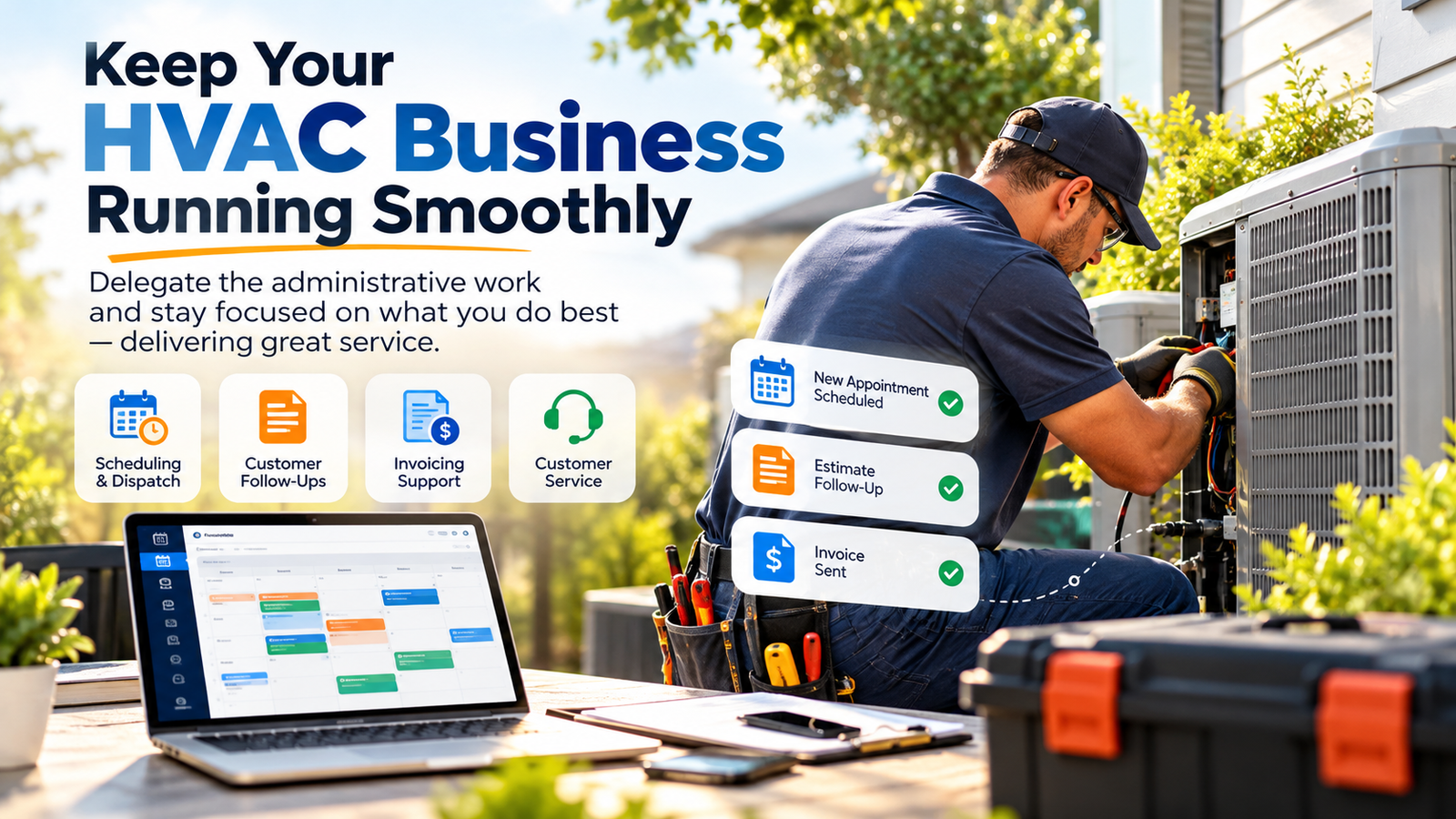
HVAC market is projected to reach unprecedented heights by the end of 2026, driven by extreme weather patterns and a massive shift toward high-efficiency climate control systems. However, while demand is soaring, the skilled labor shortage and rising operational costs are squeezing margins. HVAC business owners frequently find themselves trapped in a cycle of "Admin Debt", a backlog of unfiled warranties, uncalled leads, and messy dispatch boards, that prevents them from scaling. When your technicians are sitting idle because a dispatcher missed a call, or your maintenance agreements are expiring without a renewal attempt, you aren't just losing a job; you are experiencing "Profit Leakage" that can sink a company.
The solution isn't necessarily hiring more local staff at $60,000 per year plus benefits. In 2026, high-growth contractors are turning to specialized support. An HVAC Virtual Assistant from Virtual Nexgen Solutions provides the administrative engine you need for just $8 per hour, allowing you to reclaim your time and focus on high-level strategy.
The Heavy Burden of Peak Season Call Volume
Imagine it is mid-July in Phoenix or late January in Chicago. Your phones are ringing off the hook. Every minute a CSR spends on the phone with a difficult customer is a minute they aren't dispatching a technician to a high-value emergency repair. This is where most HVAC companies falter. You lose thousands of dollars in potential revenue because your "Speed to Lead" is nonexistent.
You need a system that ensures no call goes unanswered and no technician spends twenty minutes looking for their next job. A Construction Virtual Assistant can sit inside your ServiceTitan or FieldEdge account and manage the board in real-time, ensuring that your most profitable technicians are always on the move.
SOP 1: The Urgent Call Triage Protocol
- Answer every inbound service call within three rings using a professional, scripted greeting.
- Identify the nature of the issue immediately: No Heat/No Cool (Priority 1), Leak/Water Damage (Priority 1), Maintenance/Tune-up (Priority 3).
- Verify the customer’s existing maintenance agreement status in the FSM software.
- Input all mandatory data fields: equipment age, system location (attic/closet), and symptoms.
- Offer the next available slot based on the technician's geographic zone and skill set.
- Send an immediate SMS confirmation with the technician's bio and tracking link.
Eliminate Technician Idle Time with Geographic Dispatching
Profit Leakage often happens in the "dead zones" between jobs. If your technician finishes a repair in the north end of the city but their next scheduled call is forty miles south, you are paying for windshield time, not wrench time. This is a dispatching failure.
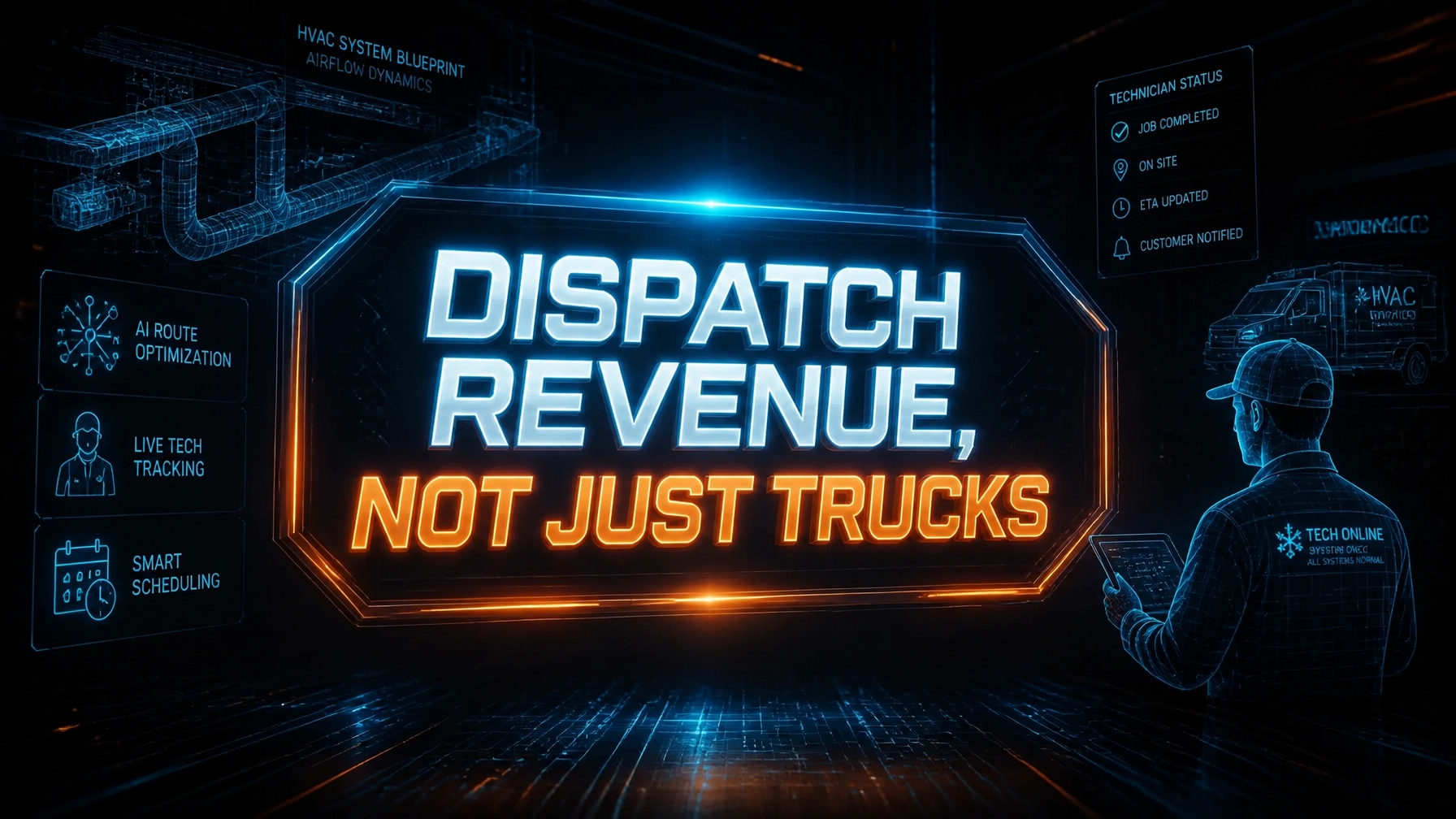
A specialized HVAC Virtual Assistant monitors your dispatch board with a hawk-eye. They don't just look at who is next; they look at who is closest. By systematizing your routing, you can often fit one extra call per technician, per day. At an average ticket of $450, that is $2,250 in additional daily revenue for a five-truck fleet.
SOP 2: Real-Time Dispatch Board Optimization
- Log into the dispatch board (e.g., Housecall Pro) at 7:00 AM daily.
- Review the day's route for all technicians to identify overlapping geographic clusters.
- Drag and drop jobs to minimize drive time between stops, ensuring no tech crosses more than two zones per day.
- Contact customers at least 60 minutes before their window to confirm arrival.
- Move "floating" maintenance calls to fill gaps created by early job completions.
- Update the technician's status to "En Route" as soon as they clear their previous job.
Stop the Bleeding: Recovering Your Maintenance Agreement Revenue
Maintenance agreements are the lifeblood of a sustainable HVAC business. They provide predictable recurring revenue and keep your technicians busy during the slow "shoulder seasons." Yet, many contractors treat them as an afterthought. You sell the agreement during the install, and then it sits in your database until it expires.
This is "Admin Debt" at its worst. If you have 500 customers on maintenance plans and a 40% renewal rate, you are leaving six figures on the table every single year. A Virtual Assistant focuses on proactive renewals, calling your customers before the agreement expires to secure their next year of service.
SOP 3: Proactive Maintenance Agreement Renewal
- Generate a "Expiring Agreements" report in your FSM software on the first of every month.
- Sort the list by expiration date and geographic zone.
- Call every customer whose agreement expires within the next 45 days.
- Pitch the "Preferred Customer" benefits: 15% discount on repairs and priority emergency service.
- Secure the renewal payment via the integrated merchant processor.
- Pre-schedule the customer’s next 21-point inspection immediately during the call.
Case Study: HVAC Excellence in Florida
A mid-sized HVAC company in Florida struggled with the summer surge. Their in-house dispatcher was overwhelmed, leading to a 35% missed call rate and frequent technician complaints about "zigzagging" across the county. Virtual Nexgen Solutions implemented two HVAC Virtual Assistants to handle dispatch and intake.
- Results: Missed calls dropped to near zero. Route density improved by 22%, allowing the team to handle 14 additional calls per week without hiring new technicians. The owner saved $52,000 in annual labor costs by utilizing VAs at $8/hour compared to local hires.
Hack 1: Use a Virtual Assistant to Manage the Warranty Black Hole
Filing warranty claims is a tedious, detail-oriented task that technicians hate and office managers avoid. This leads to thousands of dollars in unclaimed credits from manufacturers. A Construction Virtual Assistant can take this off your plate entirely.
SOP 4: The 24-Hour Warranty Claim Submission
- Review every completed job record for part replacements that fall under manufacturer warranty.
- Cross-reference the model and serial number with the manufacturer’s portal (Carrier, Trane, Lennox, etc.).
- Upload the required diagnostic photos and technician notes.
- Submit the claim within 24 hours of job completion.
- Track the claim status until the credit is issued to the company account.
- Reconcile the credit with the original work order in the accounting software.
Hack 2: Systematize Your Shoulder Season Success
When the weather is mild, the phone stops ringing. Most HVAC companies lay off staff or cut hours, losing good people in the process. Instead, use your Virtual Assistant to run outbound "Tune-up" campaigns. They can fill your schedule with profitable maintenance work that uncovers the need for system replacements.
SOP 5: Shoulder Season Outbound Campaigning
- Identify all customers who have not had a tune-up in the last 12 months.
- Create a "Shoulder Season Special" offer (e.g., $79 precision tune-up).
- Contact these customers via phone and personalized SMS.
- Emphasize the risk of a breakdown during the upcoming peak season.
- Schedule the visits in geographic clusters to maximize technician efficiency.
- Update the FSM board to ensure these jobs are used as fillers between emergency repairs.
Hack 3: The 5-Star Review Engine
Online reputation is everything in the trades. If your competitors have 500 reviews and you have 50, you are losing the search game. A Virtual Assistant ensures that every happy customer is prompted to leave a review while the air is still blowing cold.
SOP 6: Post-Service Review Harvesting
- Monitor the dispatch board for jobs marked as "Complete" and "Paid."
- Call the customer within 4 hours of completion to perform a "Happy Call" quality check.
- Ask: "On a scale of 1 to 10, how likely are you to recommend us?"
- For scores of 9 or 10, send a direct link to the Google Business Profile via SMS.
- Offer a small incentive (like a $5 coffee card) for a photo-based review.
- Log all feedback and alert the owner immediately to any score below a 7.
Software Stack for the Modern HVAC Powerhouse
To truly streamline your operations, your Virtual Assistant needs the right tools. Virtual Nexgen Solutions specializes in the following software environments:
- ServiceTitan: The gold standard for enterprise-level HVAC and plumbing operations.
- FieldEdge: Excellent for QuickBooks integration and real-time dispatch mapping.
- Housecall Pro: A robust, user-friendly platform for growing residential service companies.
- Jobber: Ideal for smaller teams focusing on fast quoting and easy scheduling.
- RingCentral: A cloud-based phone system that allows your VA to answer calls from anywhere as if they were in your office.
- Slack: For real-time communication between your remote dispatch team and your field technicians.
Hack 4: Managing Inventory and Parts Without Lifting a Finger
Technicians often forget to log parts used on a job, leading to inventory discrepancies and missed billing. Your HVAC Virtual Assistant can bridge the gap between the field and the warehouse.
SOP 7: Inventory & Parts Reconciliation
- Compare the technician’s "Parts Used" log with the truck’s starting inventory daily.
- Flag any missing high-value items (motors, compressors, boards) that weren't billed.
- Update the digital inventory count in the FSM software.
- Generate a "Replenishment List" for the warehouse manager based on weekly usage.
- Link specific part serial numbers to the customer’s equipment history for future service.
- Verify that all truck stock levels are within the 10% tolerance threshold.
Hack 5: Speeding Up the "Cash-to-Cash" Cycle
If it takes you two weeks to send an invoice for a commercial job, you are strangling your cash flow. A Virtual Assistant ensures that invoices are generated and sent before the technician even leaves the driveway.
SOP 8: Instant Field Invoicing Oversight
- Audit all "Completed" jobs at the end of every shift.
- Ensure the technician has uploaded photos of the finished work and the signed work order.
- Verify that all labor hours match the GPS "On-Job" and "Off-Job" timestamps.
- Finalize the invoice and send it to the customer via email and SMS.
- Follow up on any unpaid "Due on Receipt" invoices within 24 hours.
- Process credit card payments through the integrated portal to ensure immediate funding.
SOP 9: Fleet Maintenance & GPS Tracking
- Monitor the GPS telematics for all service vehicles (e.g., Samsara, Verizon Connect).
- Log daily mileage and fuel consumption for every truck.
- Schedule oil changes, tire rotations, and inspections based on manufacturer guidelines.
- Alert technicians to upcoming maintenance 48 hours in advance.
- Record all vehicle repair costs in the company expense tracker.
- Report any unauthorized vehicle usage or excessive idling to management.
Hack 6: Eliminating the "Technician Performance" Mystery
Do you know which of your technicians has the highest average ticket? Do you know who has the highest callback rate? If you don't track these metrics, you can't manage your team effectively. Your VA can provide these insights weekly.
SOP 10: Weekly Technician KPI Reporting
- Extract performance data for each technician from the FSM software every Friday afternoon.
- Calculate the "Revenue per Lead" and "Average Ticket" for the week.
- Track the "Member Conversion Rate" (how many maintenance plans they sold).
- Identify any "Callbacks" or "Warranty Returns" linked to specific technicians.
- Compile the data into a clean, easy-to-read dashboard for the owner.
- Highlight the top performer for the week for internal recognition.
Case Study: Construction and HVAC Growth in Texas
A large residential contractor in Texas was suffering from severe Profit Leakage. Their maintenance agreement renewal rate had plummeted to 18% because no one had time to make the calls. They hired three Virtual Assistants from Virtual Nexgen Solutions to handle outbound renewals and dispatching for their construction and HVAC divisions.
- Results: Within six months, the maintenance renewal rate jumped to 52%. The company added $112,000 in recurring revenue. By systematizing their dispatching, they reduced technician overtime by 15 hours per week, saving an additional $4,500 monthly in payroll costs.
Hack 7: The "No Lead Left Behind" Policy
Most contractors lose leads because they don't follow up on quotes. If a technician quotes a $15,000 system replacement and the customer says "let me think about it," that lead often disappears into the abyss. A Virtual Assistant ensures that every quote is chased until it is closed.
SOP 11: High-Ticket Proposal Follow-up
- Identify all open quotes for system replacements or major repairs daily.
- Call the customer 24 hours after the quote to answer any technical questions.
- Offer financing options (e.g., GoodLeap, GreenSky) and explain the application process.
- Perform a second follow-up 72 hours later if the quote remains unsigned.
- For quotes over $10,000, schedule a brief "Expert Consultation" call with the owner or lead estimator.
- Update the lead status to "Lost" only after five failed contact attempts over 14 days.
SOP 12: Administrative Debt Cleanup
- Audit the customer database for duplicate entries or missing contact information.
- Link PDF equipment manuals and spec sheets to the corresponding customer assets.
- Organize the digital filing system for permits and inspection reports by project.
- Reconcile monthly credit card statements with receipts uploaded by the field team.
- Verify that all technician certifications (EPA, NATE) are current and on file.
- Clean up the "Unbooked Leads" queue to ensure the data remains accurate for marketing.
The True Cost of Inaction
Maintaining the status quo is expensive. When you pay a local admin $30 per hour (after taxes and benefits) to do tasks that a specialized HVAC Virtual Assistant can do for $8 per hour, you are voluntarily lighting money on fire. More importantly, you are sacrificing your own growth. You cannot build a multi-million dollar HVAC empire if you are spent eight hours a day dragging boxes around a dispatch board.
Virtual Nexgen Solutions provides the human intelligence and the technical workflows to help you exit the day-to-day grind. We provide industry-trained VAs who understand the difference between a capacitor and a compressor, and who know exactly how to navigate the complexities of ServiceTitan or FieldEdge.
Don't let your business stay small because your operations are messy. Systematize your dispatching, secure your recurring revenue, and start scaling today.
FAQs About HVAC Virtual Assistants
Can an HVAC Virtual Assistant really handle my dispatch board?
Yes. Our VAs are trained in major platforms like ServiceTitan and FieldEdge. They manage the board in real-time, matching jobs to the right technicians and optimizing routes to reduce drive time. For $8/hour, you get a dedicated professional who lives and breathes your schedule.
How do they answer my phones?
We use cloud-based phone systems like RingCentral or Dialpad. Your VA answers the phone with your company's greeting, and the customer has no idea they are speaking with someone remote. They handle intake, triage, and booking directly into your software.
Is there a long-term contract?
At Virtual Nexgen Solutions, we believe in proving our value every day. We offer flexible terms designed to grow with your business, whether you need one VA for 20 hours a week or a full team of ten working 24/7.
Do I need to train them on HVAC terminology?
While every business has its own unique way of doing things, our VAs come with a foundational understanding of the HVAC and construction industries. They know the importance of "No Heat" calls and understand the value of maintenance agreements.
Can they help with my construction projects too?
Absolutely. As a Construction Virtual Assistant, they can handle permit filing, subcontractor scheduling, and project documentation, ensuring your jobs stay on track and under budget.
What happens if I already have an office manager?
A VA is the perfect partner for an office manager. Your office manager can focus on high-level issues like hiring and local vendor relations, while the VA handles the repetitive, time-consuming tasks like data entry, warranty filing, and renewal calls.
How do I know they are actually working?
We provide full transparency through time-tracking software and daily activity reports. You will see exactly which calls were made, which jobs were booked, and which invoices were sent.
How fast can we start?
We can typically have a specialized HVAC Virtual Assistant integrated into your workflow within 7 to 10 days, following our proven onboarding and SOP implementation process.
Ready to Eliminate Your Admin Debt?
Stop letting "Profit Leakage" ruin your margins. Reclaim your time and scale your HVAC business with a specialized Virtual Assistant who understands your industry.