

Every spring and autumn, residential and commercial HVAC contractors execute a familiar ritual. You ramp up marketing spend, dispatch service technicians across your service radius for tune-ups, and convert one-time repair calls into recurring maintenance agreements. On paper, your customer base looks robust. Your dispatch board is packed, your technicians are logging billable hours, and your monthly recurring revenue (MRR) statement shows thousands of dollars hitting your bank account like clockwork.
Yet, when you review your profit and loss statements at the end of the quarter, the numbers do not match your operational busyness. Cash flow feels tight, technician utilization fluctuates wildly between peak weather extremes, and customer churn eats away at your recurring revenue base faster than your sales team can replace it.
The culprit is not your technical craftsmanship, your pricing structure, or even local market competition. The silent killer of HVAC profitability is Admin Debt compounded by severe Profit Leakage in your membership lifecycle.
When your dispatchers, service managers, and customer service representatives are buried under inbound emergency calls, parts ordering, warranty paperwork, and dispatch routing, proactive membership retention falls by the wayside. Renewal notices go out late, expired credit cards fail silently in your merchant gateway, seasonal maintenance reminders are forgotten during peak heatwaves or freezing snaps, and dissatisfied customers slip away to competitors simply because nobody called to check on their system performance.
You did not build your HVAC business to spend your evenings chasing expired credit cards or manually reconciling maintenance schedules in ServiceTitan. You built it to provide reliable climate comfort, lead a skilled team of technicians, and build generational wealth. Reclaiming your operational freedom requires a systematic, dedicated engine designed specifically to protect your recurring revenue stream.
This comprehensive guide explores the mechanics of the 90-Day Membership Retention Engine, a proven operational framework powered by specialized Virtual Nexgen Solutions Virtual Assistants at just $8 per hour. By deploying dedicated remote professionals who master your industry software and execute rigorous standard operating procedures, you can eliminate admin debt, plug profit leaks, and transform erratic service calls into a predictable, multi-million-dollar recurring revenue machine.
The True Cost of Admin Debt and Profit Leakage in Heating and Cooling
Admin debt is the accumulated burden of manual, repetitive operational tasks that drain your team's energy without generating direct revenue. In an HVAC business, admin debt manifests in missed customer follow-ups, incomplete data entry after a service call, uncollected invoices, and ignored membership renewal alerts.
When your team operates in a constant state of reactive firefighting, handling no-heat calls in January and no-cool calls in July, proactive administrative duties are immediately deprioritized. Dispatchers skip follow-up calls after maintenance visits. Customer service representatives fail to log equipment serial numbers or filter sizes into Housecall Pro. Office managers spend hours trying to match credit card processing batch reports with bank deposits.
This operational friction creates massive profit leakage. Consider the financial impact of a neglected membership base:
- Uncollected Renewal Invoices: When a customer's credit card expires or fails on billing day, many HVAC software platforms send an automated email that goes straight to the client's spam folder. Without a personal phone call or secure text message follow-up from a dedicated administrative professional, the subscription lapses permanently.
- Ignored Pre-Season Tune-Up Slots: Maintenance agreements promise two seasonal visits per year, spring cooling checks and autumn heating checks. If your office fails to book these visits proactively during shoulder seasons, customers perceive that they are paying for a service they never received. This perceived lack of value leads directly to cancellation at the annual renewal date.
- Lost Cross-Sell and Upsell Opportunities: Every preventative maintenance visit is an opportunity for a trained technician to identify aging equipment, indoor air quality improvements, or plumbing add-ons. If your office staff does not review technician notes and follow up with estimates within 48 hours, conversion rates plummet by over 60%.
In an industry operating on razor-thin net margins, typically between 8% and 12%, losing even 20% of your recurring membership base can wipe out your net profit for the entire year. To survive and scale in today's competitive home services market, you must separate field execution from administrative overhead.
The Membership Revenue Math: How 1,500 Members Equal $1.35M in Annual Stability
To understand the transformative power of a membership retention engine, you must examine the underlying math of recurring revenue in the HVAC industry.
Let us analyze a typical mid-sized residential HVAC contracting company with 1,500 active maintenance agreement members. Assuming an average membership pricing tier of $75 per month (or $900 annually per household), the gross revenue generated by your membership base alone equals:
$$\text{1,500 Members} \times $75\text{/month} = $112,500\text{ in Monthly Recurring Revenue (MRR)}$$
$$$112,500\text{ MRR} \times 12\text{ months} = $1,350,000\text{ in Annual Recurring Revenue (ARR)}$$
This $1.35 million forms the bedrock of your business stability. It covers your baseline overhead, payroll, vehicle leases, insurance, and warehouse rent, long before your first emergency repair call of the season comes in. Furthermore, data from home services industry benchmarks indicates that HVAC membership customers spend an average of 2.4 times more on equipment replacements, major repairs, and indoor air quality add-ons than non-membership customers.
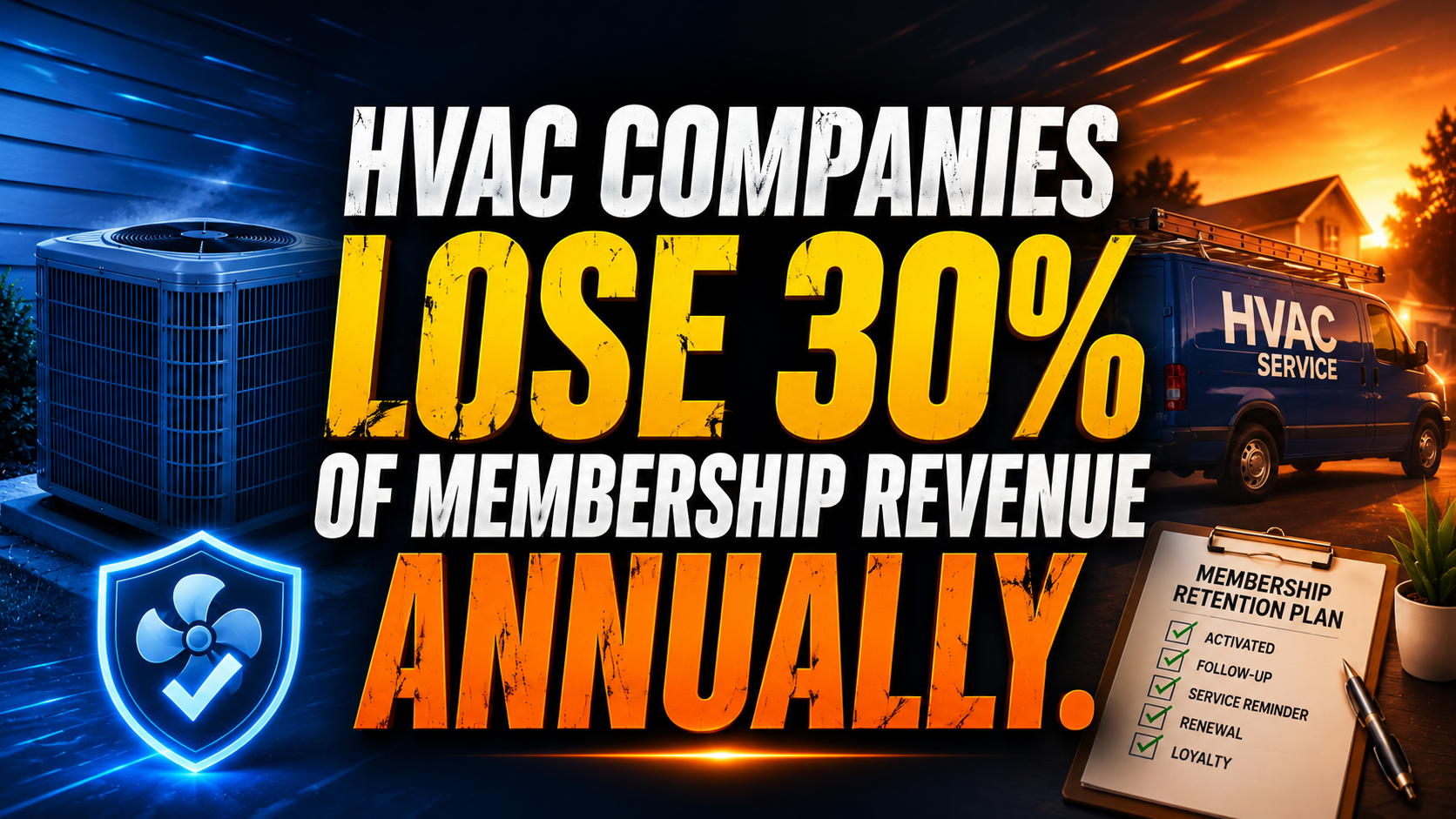
However, industry averages also reveal a sobering statistic: the average HVAC company without a dedicated retention coordinator suffers an annual membership churn rate of 30%.
Applying a 30% churn rate to 1,500 members means you lose 450 members every single year. At $900 per member, that represents an annual revenue loss of $405,000. To stand still and maintain your 1,500-member base, your sales and marketing teams must constantly acquire 450 new members just to replace the ones leaking out the back door.
If you reduce that churn rate from 30% down to 10% through a disciplined 90-day retention engine managed by a Virtual Nexgen Solutions assistant, your annual lost members drop from 450 to 150. You retain 300 additional households. At $900 per year, that is $270,000 in saved revenue retained directly on your bottom line with zero additional marketing spend.
Why HVAC Companies Lose 30% of Memberships Annually
Understanding why members leave is the first step toward building an effective retention engine. Customer churn in the HVAC sector is rarely caused by poor technical service in the field; rather, it is almost always the result of an operational breakdown in communication and administrative follow-through.
1. The Silent Billing Failure
The most common and preventable cause of membership cancellation is payment failure. Credit cards expire, bank accounts close, and security codes change. When an automatic monthly or annual charge fails, many software platforms make three automated attempts and then cancel the subscription. If your internal staff is too busy answering inbound emergency calls to monitor daily billing failure reports, these accounts lapse without anyone noticing until the customer calls six months later for a no-heat emergency and realizes they are no longer active members.
2. The Absence of Onboarding and Value Reinforcement
When a homeowner signs up for an HVAC maintenance plan, they experience immediate buyer's remorse if they do not hear from your company again until six months later. Without a structured welcome sequence, including a welcome packet, an explanation of their portal login, a breakdown of their priority dispatch benefits, and a scheduled tune-up date, the customer forgets why they are paying $75 a month.
3. Reactive-Only Communication
If the only time a customer hears from your HVAC company is when their system breaks down or when their annual bill arrives, the relationship feels transactional and cold. Customers begin to view the membership as an unwanted utility bill rather than a valuable partnership protecting their home's climate system.
4. Delayed Service Scheduling
When shoulder season arrives and you launch your pre-season tune-up campaign via a mass email blast, your phones ring off the hook. Customers who try to call in and book their tune-up encounter busy signals, long hold times, or voicemails that are never returned. Frustrated by the lack of responsiveness, they cancel their membership and call a local competitor.
The 60-Day Renewal Trigger: The Core Mechanism of the Retention Engine
To stop membership leakage, you must shift from a reactive renewal process to a proactive 60-day retention trigger. Waiting until a membership expiration date or billing failure occurs is already too late.
The 90-Day Membership Retention Engine operates on a precise timeline managed daily by your Virtual Nexgen Solutions Virtual Assistant. Here is how the timeline unfolds:
Days 60 to 45 Prior to Renewal
Your Virtual Assistant runs a daily report in ServiceTitan or Housecall Pro identifying all customer memberships expiring in the next 60 days. The VA initiates the retention sequence by sending a personalized email and text message thanking the customer for their loyalty over the past year, summarizing the number of tune-ups performed and filter changes completed, and highlighting the priority emergency service hours they utilized.
Days 45 to 30 Prior to Renewal
The VA reviews the customer's payment method on file. If the credit card is expiring within the next 60 days, the VA reaches out via secure communication channels to update the payment token, ensuring zero billing interruption. For annual renewal accounts, the VA sends a renewal invoice outlining the upcoming year's benefits and inviting them to schedule their upcoming seasonal maintenance visit.
Days 30 to 15 Prior to Renewal
If the customer has not yet renewed or confirmed their upcoming maintenance slot, the VA places a direct phone call. This is not a high-pressure sales pitch; it is a customer success check-in. The VA asks about their current system performance, verifies their satisfaction with past technician visits, and books their spring or autumn tune-up on the spot.
Day 0 (Renewal Date)
Because the groundwork was laid 60 days in advance, the renewal processes seamlessly. The credit card charges successfully, the annual agreement rolls over, and the customer receives an automated receipt thanking them for another year of partnership.
By outsourcing this rigorous operational cadence to a Virtual Nexgen Solutions virtual assistant at $8/hour, your internal team is entirely freed from administrative micromanagement while your retention rate climbs toward 90% and beyond.
Seasonal Maintenance Outreach and Pre-Season Scheduling Protocols
In the HVAC industry, capacity planning is everything. If all 1,500 of your members try to book their spring air conditioning tune-up during the first 90-degree week in May, your dispatchers will drown in scheduling chaos, your technicians will be overwhelmed, and your customer satisfaction scores will plummet.
The solution is proactive pre-season scheduling executed weeks ahead of peak weather transitions.
The Shoulder Season Outreach Protocol
Shoulder seasons, March through April for cooling, and September through October for heating, represent the golden window for revenue stabilization. During these months, your Virtual Assistant executes a systematic outbound scheduling campaign:
- Geographic Batching: The VA organizes customer accounts by postal code and assigns them to specific technician service zones. This ensures that when a technician is dispatched to a neighborhood, they have three or four preventative maintenance visits lined up back-to-back, minimizing wind-shield time and maximizing billable technician hours.
- VIP Priority Booking: Members are contacted first, before non-members, reinforcing the tangible value of their membership agreement. Your VA communicates this exclusivity: "As one of our preferred VIP members, we are reaching out to secure your pre-season AC tune-up before our schedule fills up for the summer heatwave."
- Automated Multi-Channel Follow-Up: If an initial email reminder is unopened after 48 hours, the VA follows up with an SMS text message containing a direct booking link to your scheduling software, allowing the homeowner to select their preferred morning or afternoon window with a single tap.
ServiceTitan and Housecall Pro Integration: Tying Software to VA Workflows
A virtual assistant is only as effective as the systems they operate within. Virtual Nexgen Solutions virtual assistants are thoroughly vetted and trained in the leading HVAC field service management platforms, including ServiceTitan, Housecall Pro, FieldEdge, Service Fusion, and Successware.
When you integrate a Virtual Nexgen Solutions VA into your daily operations, they do not require months of technical hand-holding. They understand industry-specific terminology, such as SEER ratings, IAQ accessories, refrigerant recovery, line sets, dual capacitors, and dispatch priority codes.
Here is how your VA leverages your software stack to protect your revenue:
- Dispatch Board Monitoring: While your service manager focuses on complex diagnostic escalations, your VA monitors unassigned maintenance agreements, flags un-dispatched tune-up windows, and fills empty technician time slots resulting from last-minute customer cancellations.
- Customer Database Hygiene: Clean data drives marketing and retention. Your VA regularly audits customer profiles in ServiceTitan, updating phone numbers, email addresses, equipment age, and warranty expiration dates so your marketing campaigns never hit dead ends.
- Membership Tagging and Segmentation: The VA creates custom tags in your CRM for membership tiers (e.g., Bronze, Silver, Gold, Commercial VIP), enabling you to target specific segments with tailored renewal offers or equipment replacement promotions.
Actionable Industry SOP: The 5-Step Membership Renewal Protocol
To ensure flawless execution, implement this Standard Operating Procedure (SOP) for your Virtual Nexgen Solutions assistant.
Step 1: Daily Expiration Audit
Every morning at 8:00 AM local time, the VA logs into ServiceTitan or Housecall Pro and generates the "Memberships Expiring in 60 Days" report. The VA exports this data into a secure tracking sheet and verifies that all contact details are up to date.
Step 2: Multi-Touch Personalized Outreach
At Day 60, Day 45, and Day 30 prior to expiration, the VA executes the communication sequence:
- Email 1 (Day 60): Membership value summary and renewal reminder with direct link to update payment info.
- SMS 1 (Day 45): Quick check-in text asking if the customer would like to lock in their current membership rate for another year.
- Phone Call (Day 30): Direct telephone conversation to verify satisfaction, address any system concerns, and schedule the upcoming maintenance tune-up.
Step 3: Billing Failure Intervention
When a credit card fails on the automated billing cycle, the merchant gateway flags the account. Within 2 hours of the notification, the VA pulls the failed payment report, contacts the customer via phone and secure SMS, and assists them in updating their payment token before service is suspended.
Step 4: Maintenance Scheduling & Technician Routing
Once the renewal is secured, the VA coordinates with the customer to book their seasonal tune-up. The VA matches the appointment geographic location with existing technician routes in the dispatch board to minimize transit time.
Step 5: Testimonial and Review Collection
Immediately following the completed maintenance visit, the VA sends an automated review request via SMS and email, asking the satisfied member to leave a 5-star Google review praising the technician's professionalism.
Case Study 1: A Residential HVAC Contractor in Dallas Reclaims $185,000 in Lost Renewals
A well-established residential HVAC contractor in Dallas, Texas, managing approximately 1,200 maintenance agreement members, was facing severe administrative burnout. Their two front-desk coordinators were overwhelmed answering emergency repair calls during scorching Texas summers, leaving membership renewals unmonitored. Their annual churn rate had climbed to 32%, resulting in over 380 lost members every year and nearly $200,000 in leaked recurring revenue.
The owner partnered with Virtual Nexgen Solutions and onboarded a dedicated Virtual Assistant trained in ServiceTitan at $8/hour (totaling roughly $1,400 per month for a 40-hour workweek).
The VA implemented the 60-day renewal trigger protocol, established daily billing failure audits, and took over pre-season scheduling for spring cooling tune-ups.
Within 90 days, the results were transformative:
- Membership Churn Reduction: Churn dropped from 32% down to 11%.
- Retained Members: The company retained an additional 252 households that would have otherwise lapsed.
- Financial Impact: At an average annual membership value of $730, this retention recovery saved $183,960 in recurring revenue.
- Admin Hours Saved: Front desk staff reclaimed over 25 hours per week of administrative focus, allowing them to answer inbound emergency calls on the first ring and increase repair-to-replacement conversion rates.
Case Study 2: A Commercial Mechanical Service Provider in Chicago Scales to 2,000 Active Members
A commercial and light-industrial mechanical service provider in Chicago, Illinois, specializing in rooftop HVAC units and chillers, wanted to scale their maintenance contract portfolio from 1,200 to 2,000 active members. However, their internal service managers were bogged down manually tracking preventative maintenance compliance, equipment warranty logs, and filter replacement schedules across dozens of commercial properties.
They deployed two specialized Virtual Nexgen Solutions administrative assistants to manage their Housecall Pro CRM, customer communications, and commercial maintenance scheduling workflows.
By streamlining contract renewals, automating pre-season maintenance outreach, and ensuring rigorous equipment data tracking, the company achieved remarkable growth:
- Portfolio Growth: Scaled active commercial maintenance agreements from 1,200 to 2,000 within 10 months.
- Administrative Cost Efficiency: Achieved this massive scale without adding expensive full-time in-house administrative headcount, keeping overhead lean while recurring revenue grew by over $600,000 annually.
- Customer Retention: Maintained a 94% retention rate across commercial accounts due to proactive communication and flawless scheduling consistency.
Cost Comparison: In-House Administrative Staff vs. Virtual Nexgen Solutions at $8/Hour
When evaluating administrative support, HVAC business owners often debate whether to hire a local, full-time administrative assistant or partner with a specialized remote provider. The financial and operational reality heavily favors specialized virtual assistance.
Hiring a full-time in-house administrative assistant in the United States typically involves an annual salary ranging from $45,000 to $60,000, plus payroll taxes, workers' compensation insurance, health benefits, paid time off, paid sick leave, office space, computer hardware, and software license seats. Furthermore, local hires often lack specialized familiarity with HVAC field service management software like ServiceTitan or Housecall Pro, requiring weeks of costly training.
In contrast, Virtual Nexgen Solutions provides elite, pre-trained virtual assistants for $8 per hour.
Let us examine the annual cost comparison:
- In-House Full-Time Admin: Approximately $55,000 to $65,000 per year (inclusive of salary, taxes, benefits, and overhead).
- Virtual Nexgen Solutions VA (40 hours/week at $8/hr): Approximately $16,640 per year (zero benefits overhead, zero hardware costs, zero downtime).
By choosing Virtual Nexgen Solutions, an HVAC contractor saves over $40,000 annually while gaining access to professionals who specialize in home services operations, billing management, and customer retention.
ROI Breakdown: Measuring the Financial Impact of Dedicated Support
Evaluating the return on investment (ROI) of a Virtual Nexgen Solutions assistant requires looking at both cost savings and revenue generation.
Assume you invest in a full-time Virtual Nexgen Solutions VA at $8/hour for 40 hours per week:
- Monthly Investment: ~$1,386/month.
- Annual Investment: ~$16,640/year.
Now, consider the financial returns delivered by the 90-Day Membership Retention Engine:
- Saved Lapsed Members: Retaining just 20 additional members at $900/year generates $18,000 in protected recurring revenue, covering the entire annual cost of the VA within the first few months.
- Additional Maintenance Bookings: Proactive shoulder-season outreach books an extra 100 tune-ups that would have otherwise been missed. At an average diagnostic and minor repair ticket of $250 per visit, that generates $25,000 in incremental service revenue.
- Admin Time Reclaimed: Freeing up 30 hours of admin time per week allows your internal team to close more high-ticket equipment replacement estimates, resulting in an estimated $50,000 in new equipment sales.
Total annual financial impact: $93,000+ in ROI against a $16,640 investment, a greater than 5x return on investment.
Expert Insights on Operational Efficiency and Customer Lifetime Value
Industry veterans and business consultants agree that customer lifetime value (LTV) is the ultimate metric determining the long-term valuation of an HVAC contracting business. An HVAC company with a loyal, recurring membership base commands a significantly higher valuation multiple when seeking private equity acquisition or internal succession than a company reliant entirely on transactional, one-off emergency repairs.
When you protect your membership base through proactive retention systems, you accomplish three critical business objectives:
- Predictable Cash Flow: Monthly recurring revenue smooths out seasonal revenue dips between winter heating and summer cooling peaks.
- Maximized Technician Utilization: Pre-scheduled maintenance visits fill technician calendars during slow shoulder weeks, ensuring your skilled labor force remains profitable year-round.
- Maximized LTV: Customers enrolled in maintenance plans stay with your company for an average of 7.5 years compared to 1.8 years for non-membership customers, multiplying their lifetime value exponentially.
Common Mistakes HVAC Owners Make When Managing Membership Programs
Even well-intentioned HVAC business owners often stumble when trying to scale their membership programs without dedicated operational support. Here are the most common pitfalls to avoid:
- Treating Membership Renewal as an Automated-Only Process: Relying solely on automated software emails for credit card updates and renewals fails because modern consumers receive dozens of automated billing alerts daily. Personal human follow-up via phone and secure SMS is essential.
- Ignoring Shoulder Season Capacity Planning: Waiting until the first extreme weather week to schedule tune-ups guarantees customer frustration and membership cancellations. Proactive outreach must happen weeks in advance.
- Failing to Track Churn Analytics: If you do not track your monthly and annual membership churn rate, you cannot diagnose profit leaks. Your administrative team must review cancellation reasons weekly.
- Overburdening Inhouse Staff: Expecting dispatchers who are handling emergency no-heat calls to simultaneously manage proactive retention outbound calling leads to burnout, missed calls, and disgruntled staff.
Future Trends in HVAC Service Operations and Customer Retention
The HVAC contracting landscape is evolving rapidly. Successful contractors are adopting forward-looking operational strategies to maintain a competitive advantage:
- Predictive Maintenance Scheduling: Integrating IoT smart thermostat data (such as Ecobee or Nest diagnostics) to notify your office when a homeowner's system efficiency drops, allowing your VA to proactively book a service call before the system fails entirely.
- Omnichannel Client Success: Moving beyond phone calls to integrate secure two-way texting portals where homeowners can chat instantly with your Virtual Nexgen Solutions assistant about billing, scheduling, or filter replacements.
- Specialized Remote Teams: Transitioning away from generalist local hires toward specialized remote professionals who have undergone rigorous vetting and training in HVAC dispatching and CRM management.
Tips and Tricks for Maximizing Field Service Efficiency
Implement these proven tips to immediately boost your HVAC operational efficiency:
- Establish Clear Dispatch Zones: Group your maintenance routes by zip code to cut technician wind-shield time by 20%.
- Implement a 48-Hour Follow-Up Rule: Ensure your VA follows up on every equipment replacement estimate within 48 hours of a service call.
- Leverage Text-to-Pay: Use secure SMS payment links for membership renewals to eliminate friction and reduce billing failure rates by 70%.
- Audit CRM Data Monthly: Keep equipment serial numbers and filter sizes updated in ServiceTitan so technicians arrive at job sites fully prepared.
Frequently Asked Questions
1. What is an HVAC virtual assistant, and how do they help my business?
An HVAC virtual assistant is a specialized remote professional trained in home services operations, customer support, dispatching, and field service management software like ServiceTitan and Housecall Pro. They handle administrative tasks, membership renewals, and customer follow-ups so your team can focus on growth.
2. How much does a Virtual Nexgen Solutions HVAC virtual assistant cost?
Virtual Nexgen Solutions provides dedicated, specialized virtual assistants at a flat rate of $8 per hour, offering massive cost savings compared to full-time in-house administrative staff.
3. What software do Virtual Nexgen Solutions VAs use?
Our virtual assistants are thoroughly trained in leading HVAC platforms including ServiceTitan, Housecall Pro, FieldEdge, Service Fusion, Successware, and major CRM and merchant gateway systems.
4. How does the 90-Day Membership Retention Engine work?
It is a proactive operational protocol where your VA tracks customer memberships expiring in 60 days, manages credit card updates, handles multi-channel outreach, and books seasonal maintenance tune-ups before customers lapse.
5. How do VAs handle failed credit card payments for memberships?
When an automated payment fails, your VA immediately pulls daily gateway reports, contacts the customer via phone and secure SMS, and assists them in updating their payment token before service is interrupted.
6. Can a virtual assistant handle emergency dispatching?
Yes. Virtual Nexgen Solutions VAs are trained to triage inbound emergency calls, assess urgency, and dispatch technicians according to your company's priority routing rules.
7. How do VAs assist with shoulder-season tune-up campaigns?
During spring and autumn shoulder seasons, your VA executes outbound scheduling campaigns, batching customer accounts geographically to maximize technician route efficiency and fill calendar slots.
8. What is the typical ROI of hiring an HVAC virtual assistant?
Clients typically see a 5x or greater return on investment through recovered membership revenue, booked pre-season tune-ups, and increased high-ticket equipment replacement conversions.
9. Do I need to provide computer hardware or software licenses for the VA?
No. Virtual Nexgen Solutions VAs operate from secure professional remote workstations equipped with high-speed internet and necessary security protocols, logging directly into your existing software accounts.
10. How quickly can a virtual assistant be onboarded?
Onboarding is rapid and streamlined. Once we analyze your specific workflow needs, your dedicated VA can be fully integrated into your daily operations within a few business days.
11. How does outsourcing administration reduce profit leakage?
By eliminating missed renewals, uncollected invoices, and neglected follow-up calls, your VA ensures that every dollar of recurring revenue and service opportunity is captured.
12. Can a VA help with collecting customer reviews and testimonials?
Yes. Immediately following a completed maintenance or repair visit, your VA automatically sends review request links to customers, boosting your Google rating and online reputation.
13. Are Virtual Nexgen Solutions VAs available outside normal business hours?
We offer flexible coverage options, including 24/7 availability, ensuring your business never misses an after-hours emergency repair call.
14. What separates Virtual Nexgen Solutions from other VA providers?
We provide tailored industry-specific solutions, rigorous pre-training in home services software, continuous performance optimization, and proven reliability since 2016.
15. How do we communicate with our remote virtual assistant?
Communication is seamless through your preferred channels, including Slack, Microsoft Teams, WhatsApp, email, and direct phone integration.
16. How does a membership program increase customer lifetime value?
Maintenance agreement customers stay with your company an average of 7.5 years and spend 2.4 times more on major repairs and system replacements than non-members.
17. What industries beyond HVAC does Virtual Nexgen Solutions serve?
We serve businesses across real estate, healthcare, law, insurance, home improvement, HVAC, construction, plumbing, e-commerce, and accounting.
18. How do we get started with Virtual Nexgen Solutions?
Simply visit our website at www.virtualnexgen.com or book a free consultation call directly to discuss your specific operational bottlenecks.
19. What training do Virtual Nexgen Solutions VAs undergo?
Our VAs undergo comprehensive training in professional communication, data security, industry software navigation, and specific workflow execution before joining client teams.
20. Can a VA help with equipment replacement estimates?
Yes. Your VA can track warranty expiration dates and technician recommendations, following up with homeowners to schedule sales consultations for aging systems.
Conclusion and Next Steps
Your HVAC business deserves to operate with maximum efficiency, predictable recurring revenue, and zero administrative gridlock. Letting admin debt and membership churn drain $400,000+ annually from your bottom line is no longer a viable option when specialized support is available at just $8 per hour.
Take control of your operational engine today. Partner with Virtual Nexgen Solutions to deploy dedicated professionals who master your software, protect your membership base, and scale your profitability.
Ready to Scale Without Hiring In-House? Virtual Nexgen Solutions provides Specialized Virtual Assistants for businesses across the United States. Whether you need help with: Scheduling, Dispatching, Operations, Customer Support, Industry Specific Software, Administrative Tasks, Revenue Generating Activities. We've got you covered.


