

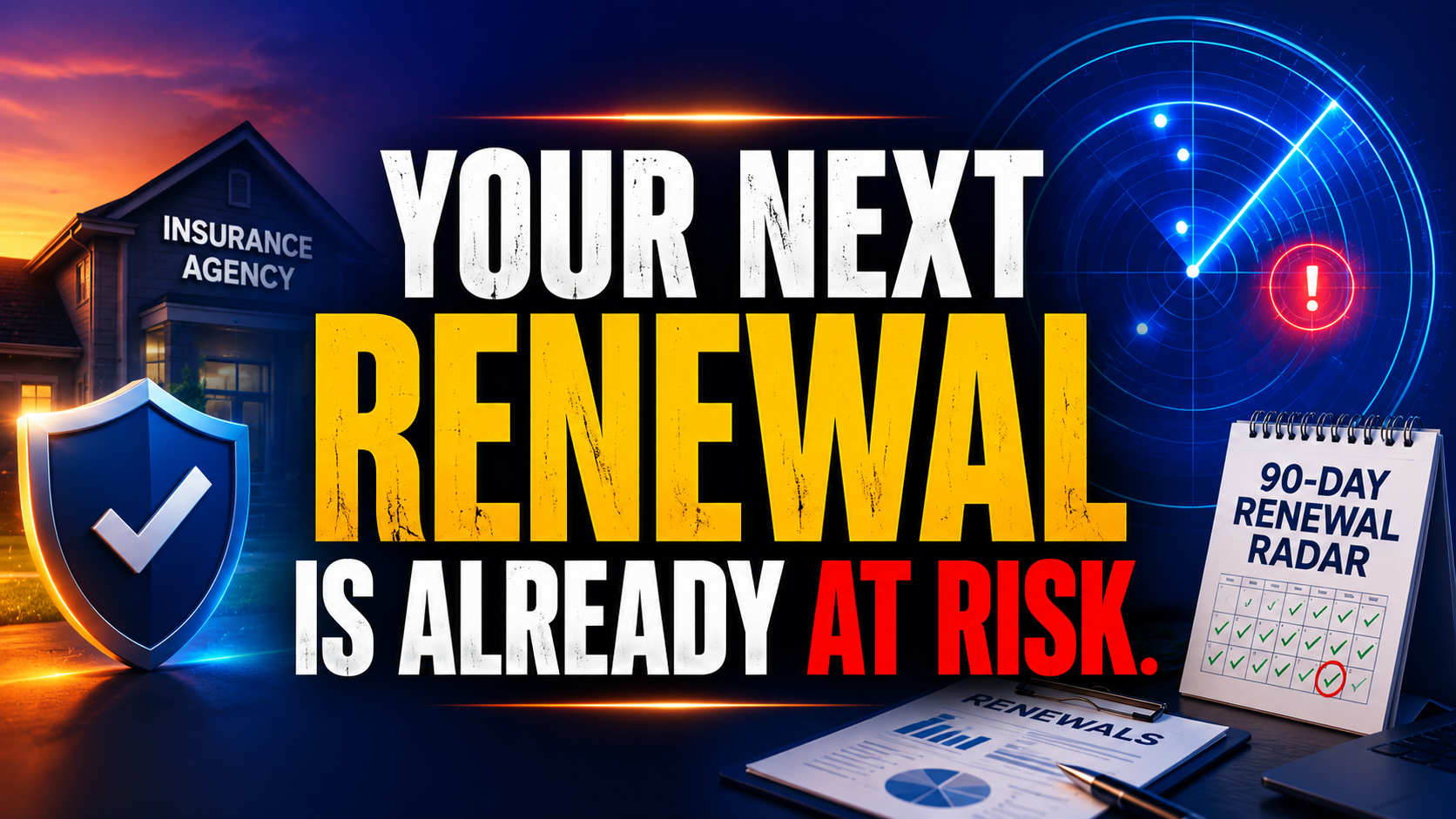
The commercial and personal lines insurance landscape in 2026 is unforgiving. If you manage an independent insurance agency, a brokerage, or a Managing General Agency (MGA), you already feel the pressure of the ongoing hard market. Carriers are trimming capacity, tightening underwriting guidelines, and pushing through rate increases averaging 20% to 30%. Your policyholders are feeling the squeeze on their personal and corporate balance sheets, and every single renewal notice that lands in their inbox acts as an invitation for them to shop your book of business with direct writers and online aggregators.
In this environment, client retention is not merely an operational metric; it is the ultimate measure of agency survival. Yet, most independent agencies are fighting this battle with one hand tied behind their back. Your licensed producers and account managers are drowning in administrative debt, manually chasing loss runs, updating certificate holders, data entry in AMS360 or Applied Epic, fielding billing inquiries, and processing endorsements. By the time your team finally looks at an expiring policy, it is 14 days before renewal. The client has already received a rate spike notification, panicked, and called a competitor. That is profit leakage at its absolute worst.
You cannot out-hustle a hard market with manual workflows and overburdened local staff. Hiring experienced, licensed customer service representatives locally costs upwards of $60,000 per year plus benefits, training overhead, and payroll taxes, an expense that compresses your operating margins when growth is already hard-won.
The solution is not working your local staff harder; it is fundamentally transforming your operational engine by deploying a dedicated insurance agency virtual assistant. At Virtual Nexgen Solutions, we deploy specialized virtual assistants starting at just $8 per hour who execute a proven, multi-touch retention protocol known as the 90-Day Renewal Radar. This comprehensive guide explores how independent agencies across the United States are utilizing this framework to protect their renewals, eliminate admin debt, and maintain a 96% client retention rate without inflating their fixed overhead.
The True Cost of Reactive Renewals in Property & Casualty
To understand why proactive retention frameworks are vital, you must first calculate the true financial damage of reactive renewals. In a soft market, agencies could afford a certain amount of operational laziness. If a client left because their renewal notice arrived late or unannounced, acquiring a replacement policy was relatively straightforward.
In today's hard market, acquisition costs have skyrocketed. Every client you lose represents thousands of dollars in lost commission revenue, plus the hundreds of dollars spent on marketing or producer prospecting to replace them. Worse yet, reactive renewals trigger a domino effect of operational inefficiencies:
- The Scramble Effect: When renewals are addressed two weeks before expiration, your producers are forced into emergency firefighting mode. They abandon prospecting, cross-selling, and high-value advisory work to answer panicked phone calls about rate increases.
- The Information Gap: Rushed renewals mean missing updated risk profiles. You cannot properly advise a commercial client or homeowners policyholder about deductible adjustments or coverage gaps when you are simply rushing to push a renewal through before expiration.
- The Trust Erosion: When a policyholder opens their mailbox and sees a 25% rate increase with zero prior explanation from their agent, trust evaporates. Silence from the agency is interpreted as indifference.
When you operate reactively, your agency becomes a revolving door. You work twice as hard every single month just to stand still, watching your net growth stagnate while your overhead climbs. Reversing this dynamic requires shifting from a reactive posture to a structured, predictive radar system that engages policyholders long before the renewal notice ever reaches them.
Understanding the 90-Day Renewal Radar Framework
The 90-Day Renewal Radar is a systematic, multi-touch operational framework designed to transform renewal management from a chaotic administrative chore into a predictable, relationship-building advisory engine. Developed through years of operational consulting with independent agencies and MGAs, this framework rests on a simple premise: Policyholders do not leave because rates go up; they leave because they feel abandoned when rates go up.
By deploying a trained insurance agency virtual assistant from Virtual Nexgen Solutions to manage the repetitive execution of this framework, your agency can systematically touch every single account at precise intervals: 120 days, 90 days, 60 days, 30 days, and 7 days before expiration.
Your virtual assistant handles the heavy lifting, pulling data from your Agency Management System (AMS), drafting custom renewal review summaries, tracking carrier appetite changes, coordinating schedule calendars, and executing pre-renewal outreach templates. Your producers step in only at the strategic moments to deliver expert counsel and close the renewal. This division of labor eliminates admin debt, protects your commission revenue, and positions your agency as an indispensable risk management partner.
Phase 1: The 120-Day Horizon and Predictive Segmentation
Proactive retention does not start at 90 days; it begins four months before policy expiration. In Phase 1, your Virtual Nexgen Solutions virtual assistant runs a monthly automated report in your agency management system, whether you use Applied Epic, AMS360, HawkSoft, or EZLynx, to identify every policy expiring in 120 days.
Once the expiring policies are isolated, your virtual assistant executes predictive segmentation. Not all clients carry the same renewal risk or commission value. Your virtual assistant categorizes the expiring book into three distinct tiers:
- Tier 1 (High-Value / High-Risk Accounts): Commercial accounts with recent loss history, accounts facing carrier non-renewals, or personal lines clients with high total insured value (TIV) and premium spikes exceeding 20%. These accounts require immediate, high-touch strategy sessions.
- Tier 2 (Stable / Standard Accounts): Accounts with moderate rate adjustments and clean loss histories. These require structured digital touchpoints and optional review offers.
- Tier 3 (Automated / Low-Touch Accounts): Small, standard personal lines policies with nominal adjustments. These receive automated, highly personalized value-reinforcement messaging.
By establishing this clarity 120 days out, your leadership team and producers can spot carrier capacity issues early. If an incumbent carrier is signaling a broad withdrawal or a massive rate revision in a specific zip code or industry vertical, your virtual assistant can immediately begin exploring alternate markets and MGAs before the crunch hits.
Phase 2: The 90-Day Risk Audit and Appetite Matching
At the 90-day mark, the operational engine shifts into high gear. This is the critical window for risk auditing and appetite matching. In a hard market, carrier underwriting guidelines shift constantly. A carrier that loved light-industrial risks last year may be non-renewing them today.
Your virtual assistant takes ownership of the following 90-day workflows:
- Loss Run Retrieval: Automatically requests and downloads current loss runs from carrier portals, flagging any emerging frequency or severity issues.
- Coverage Gap & Limit Audit: Cross-references the expiring policy against current property values, construction costs, inflation factors, and liability limits. Because replacement costs have surged across the United States, under-insurance is a massive E&O (Errors and Omissions) liability. Your virtual assistant flags accounts where limits need adjustment.
- Life & Business Event Verification: Sends a structured, friendly inquiry to the client asking about any operational changes, fleet additions, home renovations, new drivers, or corporate expansions that occurred over the past year.
- Pre-Renewal Letter Generation: Prepares and populates a personalized pre-renewal advisory letter or email confirming that the agency is actively reviewing their portfolio against current market conditions.
This proactive outreach reassures the policyholder that their account is receiving dedicated attention well in advance of their expiration date.
Phase 3: The 60-Day Multi-Option Presentation Protocol
Sixty days out is where the hard market battle is won or lost. When a rate increase of 20% or 30% is inevitable, presenting a single, take-it-or-leave-it renewal invoice is a recipe for cancellation. Clients demand choices, and successful agencies provide structured options.
Your Virtual Nexgen Solutions assistant prepares a comprehensive multi-option renewal proposal for every Tier 1 and Tier 2 account. Working within your AMS, the assistant models three distinct scenarios for the producer to review:
- Option A (Current Coverage Restructured): The policy renewed with the incumbent carrier at the new hard-market rate, accompanied by a clear, human explanation of why the market shifted.
- Option B (Deductible & Limit Optimization): A modified proposal where deductibles are adjusted (e.g., moving from a $1,000 property deductible to $2,500) to offset the rate increase while maintaining core protection.
- Option C (Alternate Market Proposal): If alternate quotes were secured during the 90-day phase, this option introduces a competitive proposal from an alternative carrier or MGA.
Once these options are modeled, your virtual assistant schedules a dedicated, 15-minute producer-led consultation call on your team's calendar. The assistant populates the calendar invite with the complete renewal comparison package, ensuring your producer walks into the conversation fully prepared to act as an expert advisor rather than a billing clerk.
Phase 4: The 30-Day Binding Confirmation and Friction Removal
As the expiration date draws within 30 days, administrative efficiency dictates whether the policy binds smoothly or falls into last-minute chaos. The 30-day window is managed through disciplined follow-up protocols executed seamlessly by your virtual assistant:
- Confirmation Tracking: If the renewal proposal was sent at 60 days and the client has not yet signed or confirmed intent to renew, the virtual assistant triggers a polite, targeted follow-up communication via phone, email, or SMS.
- Billing & Payment Setup: Confirms electronic funds transfer (EFT) details, mortgagee clauses, and premium financing arrangements to prevent cancellation notices triggered by billing misunderstandings.
- Endorsement Processing: Collects final signatures on disclosure forms, exclusions, and vehicle schedules, clearing all underwriting subjectivities before the effective date.
By removing operational friction during this final month, your agency eliminates the eleventh-hour scramble that stresses your staff and frustrates your policyholders.
Phase 5: The Post-Renewal Appreciation and Retention Lock
Most agencies commit their final retention mistake right after the policy binds: they vanish until the next renewal cycle. True client retention is a year-round discipline.
Within 7 days of the renewal date, your virtual assistant executes the final phase of the radar protocol:
- Welcome Package & Policy Delivery: Delivers the finalized policy documents, digital ID cards, and certificate schedules with a clean, branded cover note.
- Appreciation Touchpoint: Sends a personalized thank-you message acknowledging their continued partnership, reinforcing the agency's commitment to ongoing advocacy.
- Milestone Tracking: Logs next year's review triggers and schedules mid-term check-in reminders in your CRM or agency management system.
This final touchpoint cements the relationship, neutralizing competitor poaching attempts that often occur weeks after a policy renews.
Integrating Your Agency Management System: AMS360, Applied Epic, HawkSoft, and EZLynx
A retention framework is only as effective as the technology stack supporting it. Too many agencies store client data in fragmented spreadsheets, sticky notes, and disconnected email folders. To execute the 90-Day Renewal Radar at scale, your Virtual Nexgen Solutions virtual assistant becomes an expert operator inside your specific Agency Management System (AMS) and comparative rater.
Whether your brokerage relies on Vertafore AMS360, Applied Systems Epic, HawkSoft, or EZLynx, our virtual assistants are trained to navigate these platforms with precision. They do not require weeks of basic software training; they understand workflows, acord forms, policy tabs, activity logging, and reporting dashboards from day one.
Applied Epic Integration
Our assistants utilize Applied Epic to set up automated workflow templates, track policy expiration pipelines, attach loss runs, and generate renewal reminders. They ensure every client interaction is meticulously logged, maintaining airtight E&O compliance across your entire book of business.
AMS360 & EZLynx Integration
For agencies utilizing AMS360 combined with EZLynx for personal and commercial rating, our assistants seamlessly pull expiring data, run comparative quotes across multiple carrier portals, and prepare side-by-side proposal summaries without your local producers ever touching manual data entry.
Case Study One: P&C Agency in Dallas, Texas Reclaims $180,000 in Retained Premium
To see the 90-Day Renewal Radar in action, consider the operational transformation of a mid-sized Property & Casualty agency located in Dallas, Texas. Managing over 3,200 commercial and personal lines policies, the agency was hit hard by the 2025/2026 hard market. Average rate increases of 24% caused their client churn rate to spike to 11.8%. Their three licensed producers were spending 65% of their working hours chasing missing renewal documents, updating certificate holders, and handling billing complaints.
The agency principal partnered with Virtual Nexgen Solutions to onboard two specialized insurance virtual assistants at $8 per hour. Within 30 days, the virtual assistants deployed the 90-Day Renewal Radar framework across the entire book of business.
The Results After 12 Months:
- Client Retention Rate: Increased from 88.2% to 95.7%.
- Retained Premium: Reclaimed over $180,000 in annual premium that otherwise would have churned to competitors.
- Producer Capacity: Local producers reclaimed 28 hours per week each, redirecting that time toward high-margin commercial prospecting and closing new accounts.
- Operational Cost Savings: Achieved a net savings of over $88,000 compared to hiring local customer service staff.
Case Study Two: Independent Brokerage in Chicago Cuts Churn from 14% to 3.8%
An independent commercial lines brokerage in Chicago, Illinois faced severe operational bottlenecks. Specializing in contractors and small business owner policies, their renewal pipeline was entirely reactive. Because policies were reviewed only two weeks prior to expiration, clients experiencing steep rate adjustments felt blindsided and immediately sought quotes elsewhere, resulting in an alarming 14% annual customer churn rate.
The brokerage onboarded a dedicated Virtual Nexgen Solutions virtual assistant to implement the 120-90-60-30-7 renewal cadence inside their HawkSoft AMS.
The Results After 9 Months:
- Churn Reduction: Churn plummeted from 14.0% to 3.8%.
- Pre-Renewal Contact Rate: Reached 100% of all accounts at least 60 days prior to expiration.
- E&O Compliance: Achieved a 100% audit score for completed coverage audits and signed declination forms.
- Agency Profitability: Net commission revenue grew by 22% due to stabilized book growth and eliminated leakage.
The Economics of Delegation: $8/Hour Virtual Assistants vs. $60,000 In-House Staff
When agency owners evaluate scaling their operations, the conversation invariably turns to staffing costs. In the current labor market, hiring an experienced, licensed customer service representative locally requires a substantial financial commitment:
- Base Salary: $50,000 to $65,000 per year.
- Payroll Taxes & Workers' Compensation: Approximately 10% to 15% ($5,000 - $7,500).
- Health Insurance & Benefits: Average $8,000 to $12,000 per year.
- Hardware, Software Licensing, and Office Space: $3,000 to $5,000 per year.
- Total True Cost: $66,000 to $89,500 annually for a single employee working 40 hours a week.
Now examine the economic model offered by Virtual Nexgen Solutions. At our transparent rate of $8 per hour, a full-time virtual assistant working 160 hours per month costs approximately $1,280 per month, or roughly $15,360 per year. There are zero benefits costs, zero payroll tax burdens, zero equipment overhead, and zero recruitment friction.
By redirecting $50,000+ in annual savings back into your agency’s marketing, technology stack, or ownership distributions, you accelerate growth while insulating your balance sheet against hard-market volatility.
Step-by-Step SOP: Delegating the Renewal Radar to Virtual Nexgen Solutions
To ensure immediate operational success from day one, we provide our clients with a standardized, step-by-step Standard Operating Procedure (SOP) that your Virtual Nexgen Solutions virtual assistant executes daily. Here is the exact blueprint for delegating your renewal workflow:
Step 1: Morning AMS Audit
Your virtual assistant logs into your agency management system (Applied Epic, AMS360, HawkSoft, or EZLynx) at 8:30 AM local time. They run the Expiration Report for policies expiring in exactly 120, 90, 60, and 30 days.
Step 2: Data Gathering & Loss Run Request
The assistant reviews each expiring policy, checks for active carrier portals, pulls current-year loss runs, and verifies whether any underwriting changes or mid-term endorsements affect the risk profile.
Step 3: Segmented Communication Execution
- 120 Days: Sends the annual review invitation and risk assessment questionnaire.
- 90 Days: Dispatches the pre-renewal advisory letter and coverage gap audit summary.
- 60 Days: Generates the multi-option proposal package and coordinates scheduling with the producer.
- 30 Days: Conducts binding confirmation outreach and collects missing documentation.
Step 4: Activity Logging & Task Escalation
The assistant logs every call, email, and document upload into the client profile within your AMS. If a policyholder expresses extreme dissatisfaction with a rate increase or requests immediate cancellation, the assistant flags the account as an urgent priority and escalates it directly to the agency principal or senior producer via Slack or Microsoft Teams.
Common Mistakes Independent Agencies Make During Renewal Season
Even well-established agencies frequently stumble during hard markets due to recurring operational errors. Avoiding these pitfalls will immediately safeguard your retention metrics:
- Mistake 1: Hiding Behind the Renewal Notice. Waiting for the carrier's automated renewal bill to arrive in the client's mail without prior contact guarantees panic and shopping.
- Mistake 2: Presenting Single-Option Take-It-or-Leave-It Quotes. Offering only one premium amount with no deductible adjustments or coverage alternatives leaves the client feeling powerless.
- Mistake 3: Letting Producers Perform Data Entry. Forcing a $150,000-producer to manually chase loss runs and update ACORD forms is an expensive misallocation of talent.
- Mistake 4: Failing to Document E&O Defensibility. Neglecting to record coverage discussions and declined optional coverages exposes the agency to catastrophic errors and omissions liabilities.
Future Trends in Independent Insurance Operations
The operational future of independent insurance belongs to hybrid agencies, firms that combine local, high-touch advisory relationships with specialized, remote operational back-offices. As carrier technology APIs mature, virtual assistants will increasingly manage automated rating comparisons, predictive churn scoring, and real-time client portal integrations. Agencies clinging to traditional, all-in-house administrative models will find themselves outpaced by leaner, technologically agile competitors.
Tips and Tricks for Maximizing Policyholder Trust
Implement these actionable tips today to elevate your agency's service standards:
- Never use insurance jargon in renewal emails. Explain rate changes using plain, empathetic language (e.g., "rebuilding costs and severe weather trends across the region").
- Include a personalized video message. Have your virtual assistant embed a 30-second personalized Loom video from the producer in 60-day renewal emails to humanize the relationship.
- Conduct mid-term check-ins. Call commercial clients 6 months into their policy term just to ask how business is going, completely unrelated to billing or renewals.
Frequently Asked Questions
1. What is an insurance agency virtual assistant?
An insurance agency virtual assistant is a trained, remote professional who handles administrative tasks, policy renewals, loss run requests, ACORD form completion, and customer communications for independent agencies.
2. How does the 90-Day Renewal Radar work?
It is a structured multi-touch communication framework starting 120 days before expiration, ensuring clients receive risk audits, rate explanations, and multi-option proposals before renewal notices arrive.
3. What is the hourly cost of a Virtual Nexgen Solutions assistant?
Our specialized virtual assistants start at an industry-leading rate of just $8 per hour for full-time engagements.
4. Can your virtual assistants operate our agency management system?
Yes, our assistants are fully trained in leading AMS platforms including Vertafore Applied Epic, AMS360, HawkSoft, and EZLynx.
5. How do virtual assistants handle sensitive client data securely?
Virtual Nexgen Solutions employs enterprise-grade security protocols, encrypted VPN connections, secure virtual desktops, and strict confidentiality agreements to ensure complete data privacy and compliance.
6. Will the virtual assistant work during our local business hours?
Yes, our assistants operate according to your agency's specific time zone (EST, CST, MST, PST) to ensure seamless real-time collaboration.
7. How long does onboarding and training take?
Because our assistants arrive with deep insurance industry experience, onboarding typically takes less than one week to align with your agency's specific standard operating procedures.
8. Can virtual assistants help with commercial lines as well as personal lines?
Absolutely. Our assistants handle complex commercial lines workflows, certificate of insurance (COI) issuance, driver schedules, and equipment lists.
9. How do virtual assistants help combat the 2026 hard market?
By executing proactive 90-day renewal reviews, explaining market rate adjustments early, and presenting multiple coverage options before clients consider shopping.
10. What is the difference between an in-house CSR and a virtual assistant?
An in-house CSR typically costs over $65,000 annually with benefits and taxes, whereas a virtual assistant from Virtual Nexgen Solutions costs $8/hr ($15,360/year) with zero overhead.
11. Do virtual assistants have insurance licenses?
We offer both licensed and unlicensed virtual assistant tiers depending on your state's regulatory requirements and the specific tasks you need executed.
12. How do virtual assistants assist with E&O risk mitigation?
They meticulously log all client communications, coverage declinations, and policy review activities directly into your agency management system.
13. What happens if our virtual assistant is sick or on vacation?
Virtual Nexgen Solutions provides robust backup coverage protocols and continuous operational support so your agency never experiences workflow interruptions.
14. Can our virtual assistant answer incoming client phone calls?
Yes, our assistants can manage inbound customer service calls, answer billing inquiries, and route urgent risk escalations to your licensed producers.
15. How do we communicate with our virtual assistant daily?
You communicate via Slack, Microsoft Teams, Zoom, email, and direct task assignments inside your project management or agency management system.
16. What is admin debt in an insurance agency?
Admin debt refers to the accumulation of repetitive, manual administrative tasks that drain staff time, delay proactive client outreach, and restrict agency growth.
17. How do virtual assistants handle loss run requests?
They automatically generate loss run request letters, submit them to carrier portals, and track retrieval timelines inside your AMS.
18. Can our virtual assistant help with cross-selling policies?
Yes, assistants review policy portfolios for coverage gaps (e.g., umbrella policies missing on homeowners) and prepare cross-selling lists for producers.
19. Is there a long-term contract required?
We offer flexible engagement models designed to scale seamlessly with your agency's growth and seasonal renewal volume.
20. How do we get started with Virtual Nexgen Solutions?
Simply schedule a free consultation call with our team, and we will analyze your agency's workflow needs and match you with the ideal insurance virtual assistant within days.
Conclusion and Actionable Next Steps
The 2026 hard market rewards operational discipline and penalizes administrative inertia. If your producers are still drowning in reactive renewal firefighting and manual data entry, your agency is leaking profit and inviting churn. By implementing the 90-Day Renewal Radar framework and partnering with Virtual Nexgen Solutions, you can slash operating overhead, eliminate admin debt, protect your commission revenue, and achieve a 96% retention rate.
Ready to Scale Without Hiring In-House? Virtual Nexgen Solutions provides Specialized Virtual Assistants for businesses across the United States. Whether you need help with: Scheduling, Dispatching, Operations, Customer Support, Industry Specific Software, Administrative Tasks, Revenue Generating Activities. We've got you covered. Book Your FREE Consultation


