You’ve spent the last six months perfecting your craft. You’ve invested in the latest Morpheus8 platform, your office looks like a Pinterest board come to life, and your Instagram feed is a masterclass in "Before and After" shots. The leads are coming in. The DMs are pinging. The contact forms are filling up.
But here’s the cold, hard truth: Your bank account doesn’t care about "interest." It cares about bookings.
In the high-stakes world of medical aesthetics, a "lead" is a fragile thing. Someone sees a transformation at 11:00 PM, feels a surge of inspiration, and sends a message. If they don’t hear back until 2:00 PM the next day, that inspiration has curdled into doubt, or worse, they’ve already booked with the clinic down the street that responded in five minutes.
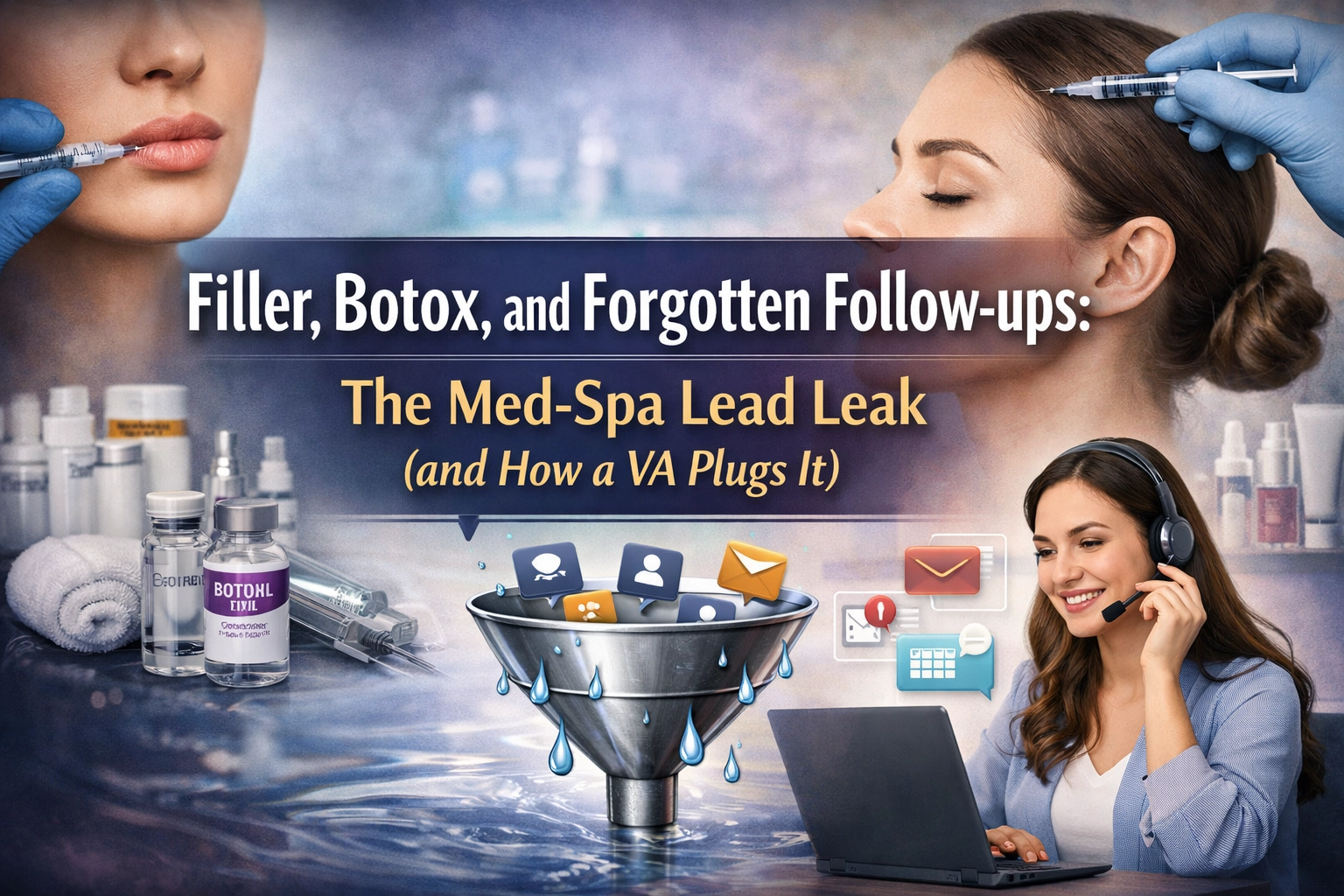
This is the "Med-Spa Lead Leak." It’s the invisible hole in your bucket where thousands of dollars in potential Botox, filler, and laser hair removal revenue disappear every single month. And if you’re the one trying to do the injections and manage the DMs, you aren’t just the CEO; you’re the bottleneck.
This is where a Med Spa Virtual Assistant, specifically one trained as a Patient Success Coordinator, comes in to save your sanity and your margins.
The High Cost of the "Maybe Later"
Most med-spa owners think their biggest problem is "not enough leads." Usually, they’re wrong. The problem is almost always "speed to lead" and "nurture."
Think about the psychology of your patient. Aesthetic procedures are emotional purchases. Whether it’s someone finally deciding to tackle their adult acne or a bride-to-be wanting to look her best, there is a peak "buying window."
When a lead reaches out and gets a "we'll get back to you soon" auto-reply, the connection is lost. A Med Spa Virtual Assistant ensures that the "maybe later" becomes a "see you on Tuesday." By having a dedicated human (not just a bot) monitoring your channels, you ensure that every inquiry is met with a professional, HIPAA-aware response within minutes, not hours.
Why Botox Doesn't Book Itself (The 12-Week Rule)
One of the biggest leaks in a med-spa isn't actually the new leads, it’s the existing ones.
Botox and Dysport have a shelf life. We all know the 12-to-16-week window. Yet, how many of your patients actually have their next appointment on the books before they leave? And of those who don’t, how many do you actually follow up with at the 11-week mark?
If you aren't proactively reaching out to your neurotoxin patients to get them back in the chair, you are essentially giving them permission to go somewhere else. A Med Spa Virtual Assistant manages this "Touch-up Pipeline." They aren't just "booking appointments"; they are managing your recurring revenue.
At Virtual Nexgen Solutions, we see this all the time. An owner is too busy to check the records from three months ago. Our VAs, costing just $8 per hour, can spend their day looking at your CRM, identifying everyone who is "due" for a refresh, and sending a personalized (not automated) text or email to get them back on the schedule.
If a VA books just one $600 Botox appointment in an entire day, they have already paid for their own salary for the week. That’s the kind of Virtual Assistant ROI that actually moves the needle.
The HIPAA Elephant in the Room: Intake and Privacy
You can’t just hire any random freelancer to handle your med-spa operations. Medical aesthetics sit at the intersection of beauty and healthcare, which means HIPAA compliance is non-negotiable.
A common mistake is letting a general VA handle patient names, phone numbers, and treatment interests over unencrypted channels. A specialized Med Spa Virtual Assistant understands the boundaries. They know how to work within your HIPAA-compliant CRM (like Zenoti, Aesthetic Record, or Boulevard) to ensure that patient privacy is protected while still providing a high-touch experience.
They can handle the administrative "heavy lifting" that slows down your in-office staff:
- Sending out digital intake forms before the appointment.
- Verifying that consents are signed.
- Updating patient records after a consultation.
- Ensuring that "before" photos are properly filed in the patient's digital chart.
By moving these tasks to a remote professional, your in-office team can focus on what they do best: making people look and feel amazing.
From "Admin" to Patient Success Coordinator
The reason many med-spas fail with VAs is that they treat them like a "digital filing cabinet." But in 2026, the successful clinics are rebranding this role as a Patient Success Coordinator.
This isn't just about answering phones. It’s about "nurturing" the lead.
- The Consultation Follow-up: Someone came in for a CoolSculpting consult but didn't buy the $3,000 package on the spot. Does anyone call them two days later to ask if they have more questions? Your VA does.
- The "We Miss You" Campaign: If a patient hasn't been in for six months, your VA reaches out with a personalized "anniversary" offer or a "new service" update tailored to their past interests.
- The Review Request: Five-star reviews are the lifeblood of local SEO. Your VA can follow up with happy patients 24 hours after their treatment to encourage a Google review while the "glow" is still fresh.
Plugging the Leak: The Math of a $8/Hour VA
Let's look at the numbers. In the US market, a high-quality in-office front desk coordinator will cost you $20–$30 per hour, plus benefits, taxes, and overhead. And when they are busy checking in a patient or prepping a room, the phone goes to voicemail.
A Virtual Nexgen Solutions VA costs $8 per hour. They don’t take up a desk in your expensive retail space. They don’t need a parking spot. They are there to do one thing: keep your schedule full.
If your VA saves just two high-ticket leads a month from "leaking" to a competitor, say, a laser hair removal package or a full-face rejuvenation, they have more than covered their cost. In reality, a well-integrated Patient Success Coordinator can increase booking rates by 20–30% simply by being faster and more consistent than a distracted in-office team.
How to Get Started Without the Headache
Transitioning to a remote model doesn't have to be a nightmare. It starts with identifying your "Leak Points."
- Where are you losing people? (IG DMs? After-hours calls? No-shows?)
- What tasks are keeping your practitioners from being "hands-on" with patients?
- How much revenue is sitting in your "inactive" patient list?
Once you know the holes, you can bring in a professional to plug them. We’ve seen this work across dozens of high-touch industries, from independent insurance agencies to high-end law firms. The principle is the same: leverage skilled remote talent to handle the "friction" so your experts can focus on the "function."
Stop Letting Your Marketing Dollars Evaporate
You work too hard to get people interested in your med-spa to let them slip away because of a missed DM or a forgotten follow-up. Botox doesn't book itself, and those $3,000 treatment plans won't close themselves while you're in the middle of a procedure.
It’s time to stop being the receptionist and start being the CEO.
If you’re ready to see how a dedicated Patient Success Coordinator can transform your clinic’s bottom line: for less than the cost of a daily latte: let’s talk. At Virtual Nexgen Solutions, we specialize in placing VAs who actually understand the nuances of your business.
Ready to plug the leak?
Book a 30-minute discovery call with our team here and let’s get your schedule filled.
For more insights on how virtual staffing is changing the game in 2026.