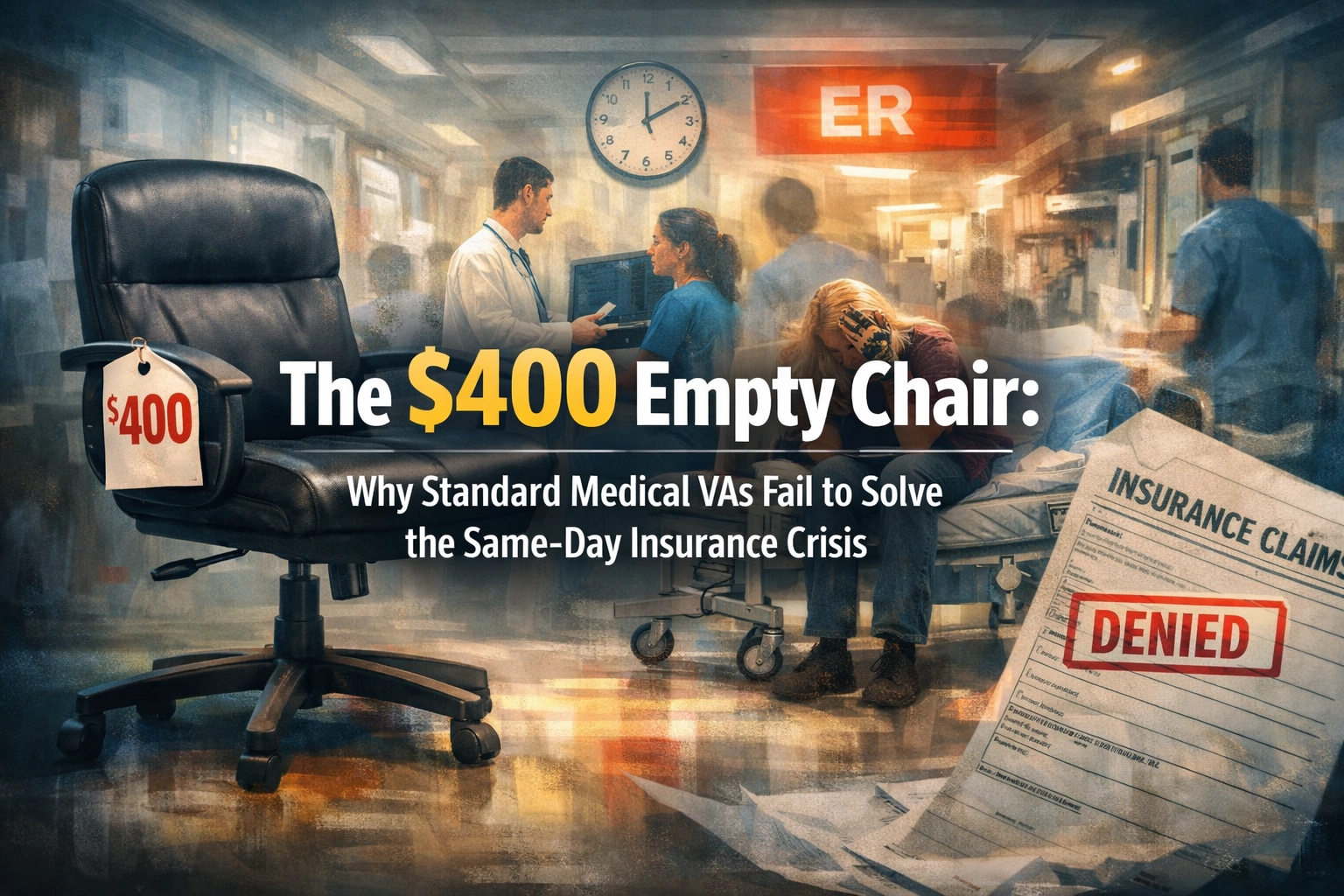
Ask any practice manager or solo practitioner what keeps them up at night, and they won’t tell you it’s the clinical stuff. They’ve got the medicine down. What keeps them awake is the "Empty Chair."
Specifically, it’s the patient who walks in at 10:15 AM, checks in, and then sits there for twenty minutes while your front desk realizes their insurance terminated last month. Or worse, the patient is in the exam room, and you realize the prior-authorization for that specific procedure was never secured.
The result? The patient leaves frustrated, the doctor stands around with nothing to do, and the clinic just ate a $400+ loss in billable time.
If you think a standard Medical Virtual Assistant is the solution to this, you’re only half right. Most VA providers treat insurance verification as a task. At Virtual Nexgen Solutions, we treat it as a timeline. And that distinction is exactly why clinics are bleeding revenue even when they think they’ve outsourced the problem.
The Task vs. Timeline Trap
Most "premium" VA agencies will tell you their assistants are trained in EHRs and HIPAA compliance. That’s great, but it’s the bare minimum. When you hire a generic medical or Dental Virtual Assistant from a big-box provider, they usually follow a reactive workflow. They see a name on the schedule for today, and they check the insurance today.
By then, it’s already too late.
If the verification fails at 9:00 AM for a 10:00 AM appointment, you have zero time to fill that slot. You can't call a waitlist patient and expect them to teleport into the office in sixty minutes. That $400 chair stays empty.
A true Medical Virtual Assistant needs to be a "Revenue Protector." This means working on a 48-to-72-hour rolling window. At Virtual Nexgen Solutions, our VAs don’t just "do" verification; they own the clinical operations of proactive revenue protection. If a patient’s coverage is wonky, it’s flagged two days out. That gives your team time to call the patient, update the info, or: if necessary: flip that slot to someone on the cancellation list.
The Financial Reality of the "Minor" Administrative Friction
Let’s talk numbers. If you’re running a mid-sized clinic or a busy dental practice, losing just three slots a week to insurance snafus or missing authorizations is costing you roughly $1,200 a week. Over a year, that’s $62,400 in "avoidable" losses.
This is what we call a profit leak.
When you hire a Virtual Nexgen assistant at our standard $8 per hour rate, you aren't just paying for data entry. You are paying for a specialist who understands that their job is to keep that $400 chair filled. At $8/hour, the ROI on preventing even one empty chair per week is massive.
Why Standard VAs Can’t Fix "Click Fatigue"
If you’re a doctor or a practice owner, you’re likely suffering from "click fatigue." Modern EHR systems like Athenahealth, eClinicalWorks, or Dentrix are designed for billing and compliance, not for user experience. They require dozens of clicks just to find a single authorization number.
Standard VAs often add to this friction. Because they aren’t specialized in high-level clinical operations, they end up asking the office manager or the doctor questions that they should already know the answer to.
- "Where do I upload the EOB?"
- "Which portal do we use for Blue Cross prior-auths?"
Every time your VA asks a question like this, they are stealing your time. We train our assistants to navigate these "click-heavy" environments independently. The goal is to remove administrative friction, not move it from one person’s desk to another. Whether you need a Medical Virtual Assistant or a Dental Virtual Assistant, the focus is on mastering the specific software ecosystem of your practice.
The Referral Black Hole: Where Revenue Goes to Die
Insurance verification is the front-end problem. The "Referral Black Hole" is the back-end crisis.
In many independent practices, a doctor refers a patient out to a specialist, or receives a referral in. Often, those loops are never closed. The patient forgets to book, the specialist never sends the notes back, and the revenue associated with that follow-up care vanishes.
A standard VA might list "Manage Referrals" on their resume. But what does that actually mean? For most, it means faxing a paper and hoping for the best.
A Virtual Nexgen Revenue Protector tracks every referral like a hawk. They ensure the prior-auth is attached to the outgoing referral so the patient doesn't get hit with a surprise bill (which reflects poorly on you). They follow up with the specialist's office to get the consult notes back so you can bill for the follow-up visit.
Closing the referral loop isn't just "good administration": it's a clinical necessity that directly impacts patient outcomes and your bottom line.
Beyond the Front Desk: Specialized Support
While many people think of VAs as just "remote receptionists," the reality of a modern healthcare practice requires more. For instance, we see a growing need for assistants who can handle the intricacies of medical marketing or even media production for clinics that want to build an online presence.
However, the core of the business remains the clinical operations. If the billing isn't right and the chairs aren't full, no amount of marketing will save the practice.
Why Independent Practices are Targeted by Insurance Companies
Let’s be honest: Insurance companies aren't making it easier for you to get paid. The requirements for prior-authorizations are increasing every year. According to the American Medical Association, the administrative burden of prior authorizations leads to significant delays in care and higher rates of physician burnout.
Independent insurance agencies and medical providers are under fire from "administrative creep." You shouldn't be spending your Sunday nights catching up on charts or checking eligibility.
By integrating an $8/hour specialized assistant into your workflow, you’re effectively hiring a full-time "Authorization Department" for a fraction of the cost of a local hire. More importantly, you're hiring someone who doesn't need to be micromanaged on how to handle a PPO vs. an HMO breakdown.
The Virtual Nexgen Difference: Clinical Operations Excellence
At Virtual Nexgen Solutions, we don’t just provide "staff." We provide a system.
When you look at our different departments, you’ll see that we specialize in niche industries. We don’t try to be everything to everyone. We understand the specific pressures of a busy medical or dental office.
Our VAs are trained to:
- Perform Proactive Eligibility Checks: Verifying coverage 72 hours before the appointment.
- Navigate Authorization Portals: Handling the "click fatigue" so you don’t have to.
- Close Referral Loops: Ensuring patient data flows back into your EHR for follow-up billing.
- Manage Patient Recalls: Keeping the hygiene or follow-up schedule packed.
How to Stop the Bleeding
If you are seeing more than two or three "no-shows" or "insurance denials" at the front desk per week, you don't have a patient problem: you have a process problem.
You can try to fix it by hiring more local staff, but with the current labor market, that's an expensive and risky bet. Between benefits, office space, and turnover, a local administrative assistant can cost you $25–$35 per hour.
Compare that to a specialized Virtual Nexgen assistant at $8 per hour. You can afford to have a dedicated person focusing entirely on revenue protection and insurance verification, ensuring that every single person who walks through your door is ready to be seen and ready to be billed.
Don’t let another $400 chair sit empty today. It’s time to move from "task-based" support to "revenue-based" protection.
Ready to reclaim your time and protect your clinic's revenue?
We’ve helped dozens of solo practitioners and mid-sized clinics eliminate administrative friction and solve the insurance crisis. Let's see how we can do the same for you.
Book a 30-minute strategy call with our team here to discuss your specific EHR and workflow needs.
To learn more about our specialized approach to office administration, visit our About Us page.