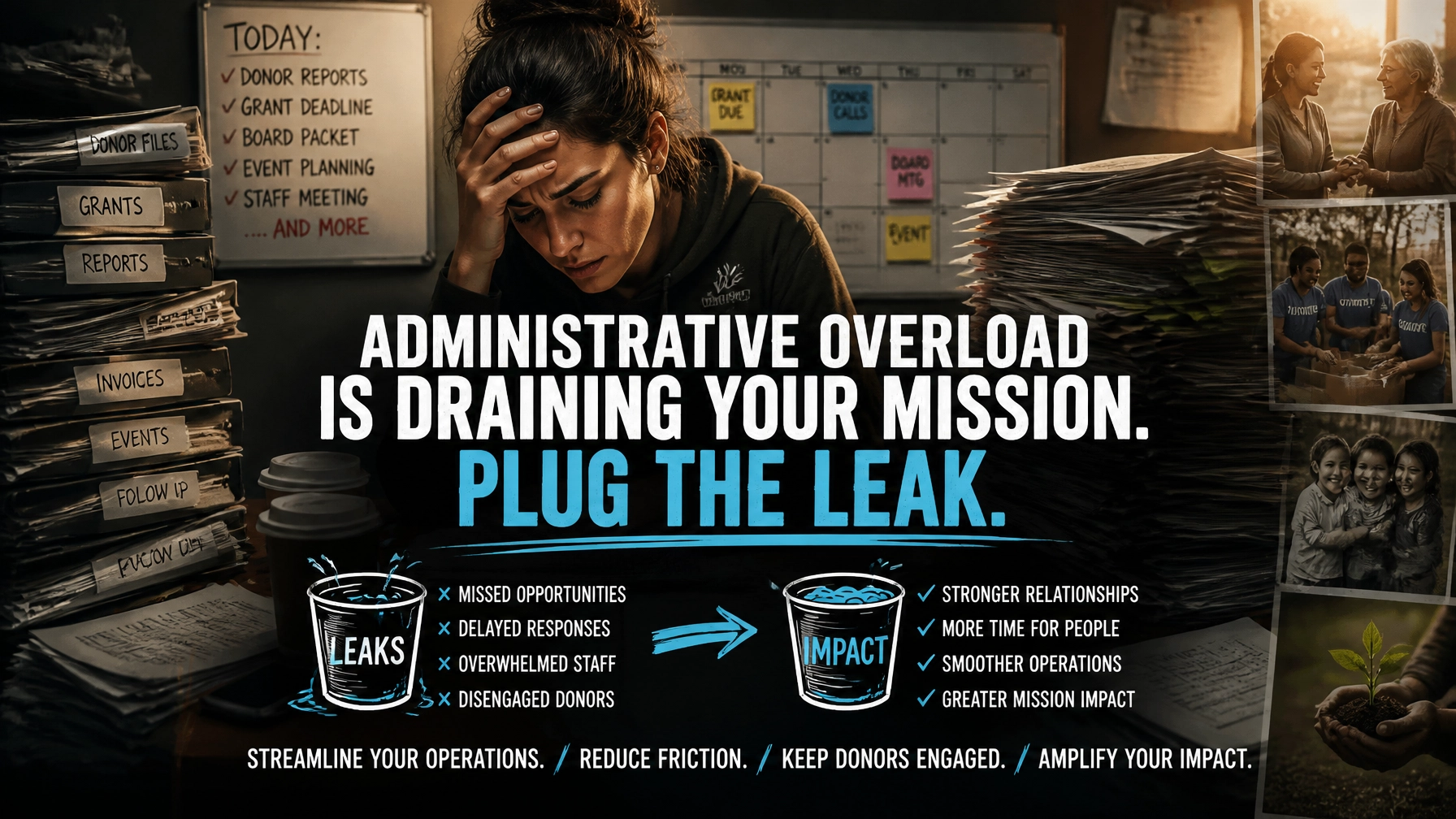
Passion fuels the nonprofit sector, but administrative friction is the silent engine killer. You started your organization to solve a specific problem, feed a community, or protect a resource. However, as the organization grows, the "Impact Leak" begins. This leak occurs when the very people hired to change the world find themselves buried under donor spreadsheets, grant deadlines, and an overflowing inbox of scheduling requests.
Every minute your executive director spends troubleshooting a donation form or manually entering data into a CRM is a minute stolen from the mission. Even worse, this friction bleeds into the donor experience. When a high-capacity donor waits three weeks for a gift acknowledgment or encounters a broken link in a fundraising email, momentum stalls. In the competitive landscape of modern philanthropy, donors do not just give to causes; they give to organizations that respect their time and demonstrate professional stewardship.
To scale impact without drowning in overhead, you must identify where your administrative debt is creating friction and deploy lean, scalable solutions to plug the leak.
The High Cost of Administrative Debt
Administrative debt is the accumulation of manual tasks that have not been systematized or delegated. For nonprofits, this debt is often viewed as a "necessary evil" of being lean. In reality, it is a primary driver of donor attrition. Recent data suggests that for every 100 new donors acquired, nearly 99 are lost through attrition elsewhere in the sector. While some of this is due to shifting donor priorities, a significant portion is attributed to technical and administrative barriers.
Consider the donor journey. If a supporter feels a surge of inspiration and clicks your "Give" button, only to find a cumbersome form that doesn't work on mobile, the momentum is gone. If they reach out with a question about their tax receipt and receive silence for forty-eight hours, the trust begins to erode. These small points of friction create a cumulative "leak" in your impact.
When you operate with a skeleton crew, your team naturally prioritizes "putting out fires" over long-term donor cultivation. This creates a reactive culture. You spend your days managing the noise of administration rather than the signal of your mission. By the time you realize a major donor hasn't been contacted in six months, they have often already moved their support to a more responsive organization.
Shattering the Overhead Myth
For decades, the nonprofit world has been haunted by the "overhead myth", the idea that the lower the administrative costs, the better the charity. This philosophy has forced many organizations into a starvation cycle where they lack the basic infrastructure needed to grow. Donors do want their money to reach the field, but they also want to know that the organization is managed with excellence.
Investing in a back-office engine is not a diversion from the mission; it is the foundation of it. The challenge is finding a way to build this engine without the traditional high costs of domestic hiring. Hiring a full-time Operations Manager in the United States often means signing up for $55,000 or more per year before you even factor in benefits, payroll taxes, software, equipment, and the usual parade of overhead expenses that somehow always show up late and over budget. For many mid-sized nonprofits, that kind of commitment feels less like a smart hire and more like a budget ambush.
Now look at the Virtual Nexgen Solutions model. By bringing in a specialized Virtual Assistant at $8 to $10 per hour, you add reliable administrative support without taking on the full weight of an in-house salary. You still get help with donor data, inbox management, acknowledgments, scheduling, and research, but you keep your cost structure lean and flexible. In plain English, you stop paying operations-manager prices for work that does not need operations-manager pricing. That is not cutting corners. That is protecting the mission while adding real capacity.
Plugging the Leak: Key Areas for Delegation
To reclaim your time and stop the impact leak, you must identify the specific tasks that act as "friction points" in your daily operations. A Virtual Assistant from Virtual Nexgen Solutions can step into these roles immediately, providing a seamless layer of support that keeps the organization running 24/7.
1. Donor Data Management and CRM Hygiene
Your CRM is the lifeblood of your fundraising, but it is only as valuable as the data inside it. Manual data entry is tedious and prone to human error. A Virtual Assistant can standardize your data entry process, ensuring every donation is recorded, every address is updated, and every donor interaction is logged. This allows your fundraising team to pull accurate reports and segment donors for personalized appeals without spending hours cleaning up spreadsheets.
2. Immediate Gift Acknowledgment
The industry standard for gift acknowledgment is 48 hours. If you are taking longer than that, you are losing momentum. A VA can monitor incoming donations across all platforms and ensure that a personalized, accurate acknowledgment is sent out immediately. This fast response reinforces the donor's decision to give and sets the stage for a long-term relationship.
3. Grant Research and Prospecting
Foundations and corporate giving programs are constantly changing their priorities and deadlines. Grant writing is a specialized skill, but grant research is an administrative task that can be delegated. A VA can scan databases, track upcoming deadlines, and compile dossiers on potential funders, ensuring your development team only spends their time writing for the highest-probability opportunities.
4. 24/7 Donor Inquiries
Donors do not always operate on a 9-to-5 schedule. Having a Virtual Assistant available to answer basic inquiries, assist with recurring donation updates, or provide tax documentation at any hour ensures your organization is seen as responsive and professional. This availability removes the friction that often prevents a one-time donor from becoming a monthly partner.
The Economic Reality: VA vs. In-House Operations
The financial impact of shifting to a virtual administrative model is transformative for nonprofit budgets. When you look at the total cost of employment for an in-house Operations Manager or Administrative Assistant, the numbers are often staggering for a mission-driven organization. Between a base salary of roughly $60,000, insurance premiums, retirement contributions, and the physical costs of equipment and space, you are looking at a significant portion of your annual budget dedicated to a single role.
In contrast, a Virtual Assistant through Virtual Nexgen Solutions provides the same, if not higher, level of task-specific productivity for a fraction of the cost. At our standard rate of $8 per hour, a full-time VA costs your organization approximately $16,640 per year. This represents a savings of over $40,000 annually compared to a traditional hire. For a nonprofit, that $40,000 represents a direct injection back into your programs. It could mean more scholarships, more meals served, more acres protected, or more lives changed.
This model allows you to buy back the time of your executive leadership. If your Executive Director earns $100,000 a year, their time is worth roughly $50 per hour. Every hour they spend on $8-per-hour administrative work is a $42 loss for the organization. By delegating those tasks, you empower your highest-level thinkers to focus on vision, major gift solicitation, and strategic growth.
Tactical SOP: Donor Gift Acknowledgment Process
To ensure consistency and speed, you must move away from ad-hoc responses and toward a standardized operating procedure (SOP). Use this workflow to empower your Virtual Assistant to handle gift acknowledgments:
- Monitor Donation Channels: Check the CRM, PayPal, Stripe, and physical mail logs daily at 9:00 AM and 4:00 PM.
- Verify Donor Details: Cross-reference the donor name with the existing CRM profile. If they are a new donor, create a profile using the standardized naming convention.
- Segment the Gift: Identify if the gift is a one-time donation, a recurring monthly gift, or a contribution to a specific capital campaign.
- Select the Template: Choose the pre-approved letter or email template corresponding to the gift type and amount.
- Personalize the Content: Mention the specific campaign or the donor’s history with the organization to show that a human, not just a machine, is paying attention.
- Execute the Send: Send the email acknowledgment immediately. For physical letters, prepare the document for digital signature and printing.
- Log the Interaction: Mark the gift as "Acknowledged" in the CRM with the date and time of the sent communication.
- Escalate Major Gifts: If a gift exceeds a specific threshold (e.g., $1,000), immediately notify the Executive Director via Slack or email for a personal follow-up call.
Tactical SOP: Grant Prospecting and Tracking
Use this procedure to ensure your organization never misses a funding opportunity due to a missed deadline:
- Access Grant Databases: Log into Foundation Directory Online or your preferred grant search tool once per week.
- Apply Search Filters: Use the pre-determined keywords and geographic filters relevant to your current mission.
- Perform Initial Vetting: Review the "Eligibility" and "Areas of Interest" sections. Filter out foundations that do not accept unsolicited proposals or those whose mission does not align.
- Populate the Grant Tracker: Add qualified prospects to the master Google Sheet or Project Management tool. Include the foundation name, average gift size, application deadline, and a link to the guidelines.
- Create Task Reminders: Set a "First Draft" reminder for the Grant Writer 30 days before the deadline and a "Final Submission" reminder 7 days before the deadline.
- Compile Support Documents: Gather the standard 501(c)(3) determination letter, board list, and recent 990 forms into a dedicated folder for each prospect.
Scaling Your Mission with Virtual Nexgen Solutions
The "Impact Leak" isn't a failure of heart; it's a failure of systems. Your nonprofit has a world-changing vision, but it needs an administrative engine to reach its full potential. By removing the friction of day-to-day operations, you allow your team to breathe, create, and lead.
At Virtual Nexgen Solutions, we specialize in providing high-caliber Office Administration support designed for the unique needs of the nonprofit sector. Whether you need help with Customer Support for donor inquiries or Accounting and Bookkeeping to keep your financials audit-ready, our VAs are trained to integrate directly into your workflow.
Stop letting administrative overload drain your mission. Plug the leak by investing in the infrastructure your passion deserves. Our team is ready to help you standardize your back office so you can get back to changing the world.
Ready to see how a Virtual Assistant can reclaim your time? Schedule a consultation with Virtual Nexgen Solutions here and discuss how we can support your mission. For more insights on how we help organizations scale, visit our About Us page to learn more about our commitment to your growth.
Frequently Asked Questions
How does a Virtual Assistant help with donor retention?
By ensuring that every donor receives an immediate, personalized acknowledgment and that their inquiries are answered 24/7, a VA removes the friction that often leads to donor frustration. Consistent communication builds the trust necessary for long-term retention.
Is it safe to give a Virtual Assistant access to our donor CRM?
Yes. Virtual Nexgen Solutions professionals work within your existing security protocols and CRM permissions. We prioritize data privacy and can work within systems like Salesforce, Raiser's Edge, or Kindful while maintaining strict confidentiality.
Can a Virtual Assistant help with our annual gala or fundraising events?
Absolutely. VAs are excellent at managing invite lists, tracking RSVPs, coordinating with vendors, and handling post-event follow-ups. This allows your team to focus on the attendees and the fundraising itself.
How do we handle the "overhead" concern from our board when hiring a VA?
Frame the conversation around "capacity building." Explain that for $8 per hour, you are buying back the time of high-level staff, allowing the organization to raise more money and execute programs more effectively. It is a strategic investment in efficiency, not just a cost.
What software can a Virtual Nexgen VA use?
Our assistants are proficient in a wide range of tools, including Google Workspace, Microsoft 365, Slack, Trello, Asana, and various nonprofit-specific CRMs and grant databases. We adapt to your existing tech stack.
Do I need to spend time training the Virtual Assistant?
While you will need to provide an initial orientation to your specific mission and SOPs, Virtual Nexgen VAs come with a strong foundation in office administration. Our tactical SOPs provided above serve as a great starting point for a seamless integration.
How quickly can a VA start supporting my nonprofit?
We pride ourselves on rapid deployment. Once we understand your needs, we can typically match you with a Virtual Assistant who can begin plugging your "Impact Leak" within a few business days.
Can a VA help with social media and newsletter management?
Yes. Many of our clients use VAs to schedule social media posts, format monthly newsletters, and ensure that the organization's mission is consistently shared across all digital platforms without requiring daily input from the Executive Director.