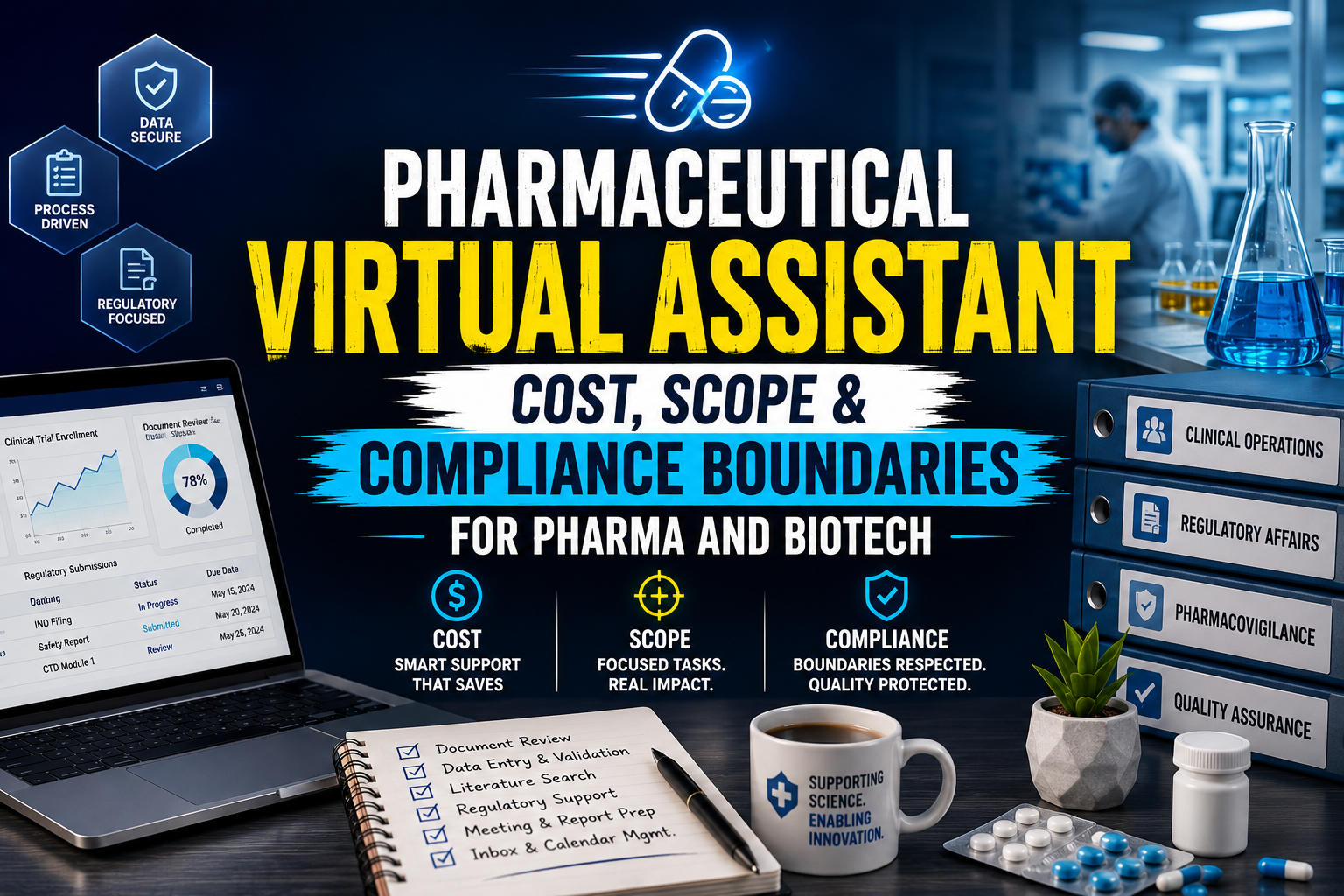
Pharma and biotech teams rarely fail because of a missing idea. They lose momentum through document delays, unclear version histories, missed follow-ups, and calendar friction.
A pharmaceutical virtual assistant can coordinate those administrative workflows while qualified professionals retain all decisions requiring technical judgment.
Why Pharma and Biotech Teams Need Administrative Cover
A small biotech team may start the morning organizing study documents, checking regulatory submission folders, preparing investigator communications, updating compliance paperwork, and managing executive calendars. By lunchtime, important scientific work is still waiting behind routine administration.
That pressure grows as your pipeline expands. Every missing file, unclear version, delayed follow-up, or forgotten meeting creates friction for regulatory, clinical, medical, and operations professionals. The work may look minor, but the delays compound.
An illustrative scenario: a specialty biotech team has a study milestone approaching while its operations lead is also chasing signatures, updating trackers, and preparing meeting minutes. A pharmaceutical virtual assistant can take ownership of those tasks under clear instructions.
What a Pharmaceutical Virtual Assistant Actually Does
A pharmaceutical virtual assistant supports the operational phases surrounding research, development, compliance, and commercial activity.
During research and literature coordination, the VA can collect approved sources, organize PubMed search results, maintain reference folders, prepare citation trackers, and format research materials according to your instructions. A scientist or medical writer must review the content and confirm its interpretation.
During regulatory document coordination, the VA can organize submission folders, maintain document indexes, track review status, record correspondence, monitor deadlines, and prepare checklists for FDA-related work. The VA does not decide whether a submission is compliant or approve the final package.
During clinical trial administration, the VA can prepare site-visit materials, collect documents, schedule investigator meetings, record minutes, update action logs, and follow up on outstanding items. Clinical, statistical, and medical decisions stay with the appropriate study professionals.
For pharmacovigilance documentation support, the VA can organize case folders, track follow-up requests, maintain administrative logs, and route information to the safety team. The VA must never assess causality, seriousness, expectedness, or reportability.
Additional support may include executive scheduling, HCP and partner communication, meeting coordination, MLR document routing, document naming, version-control tracking, and secure archive maintenance.
What a Pharmaceutical VA Should NOT Do
Protect your workflow by defining clear boundaries. A VA should not:
- Make scientific, medical, clinical, or statistical judgments.
- Approve regulatory submissions or determine compliance.
- Perform pharmacovigilance case assessment or safety decisions.
- Sign off on medical writing or promotional claims.
- Analyze clinical data or interpret study outcomes.
- Provide patient-facing medical advice.
- Approve labeling, benefit-risk positions, or investigator qualifications.
- Replace your qualified regulatory, medical, safety, quality, or statistical professionals.
Give the VA written escalation rules. Route uncertain questions to the responsible expert instead of encouraging guesswork.
Where Pharma VAs Fit: Manufacturers, Biotech, CROs, Med Comms Agencies, and Specialty Practices
Pharmaceutical manufacturers may use a VA for quality-document indexing, training-record coordination, vendor files, meeting logistics, and correspondence tracking.
Biotech companies often need flexible help as programs move from research to clinical development. A VA can maintain trackers, organize study materials, and support leadership calendars without requiring a full-time administrative hire.
CROs can delegate meeting coordination, site-document follow-up, investigator communication, and project administration while project managers retain operational control.
Medical communications agencies may use a VA for reference organization, review routing, version tracking, presentation logistics, and HCP meeting coordination.
Specialty practices and research sites may need support with study calendars, document collection, sponsor communication, and administrative follow-up.
Human VA vs. Premium Executive Assistant Services: An Honest Comparison
Market pricing varies widely. Research into pharma and biotech support shows freelance specialists commonly listed around $32 to $72 per hour. Virtual platforms may charge approximately $3,000 to $9,500 per month, while full-service agencies may quote roughly $5,500 to $9,500 per month for senior executive support.
Premium services can make sense when you need a highly experienced assistant for C-suite confidentiality, investor relations, complex travel, board preparation, or sensitive executive work.
A flexible hourly human VA fits a different need. Choose this model for document coordination, routine follow-up, meeting administration, file organization, and study-support tasks with defined instructions. Match the model to the work instead of paying executive-assistant rates for repeatable administration.
Software and Tools a Pharma VA Can Support
Depending on your access policies and training requirements, a pharma VA may support:
- Microsoft 365 and Office 365
- SharePoint document libraries
- Adobe Acrobat and secure PDF workflows
- DocuSign routing and signature tracking
- Veeva Vault document organization under client training
- eTMF coordination and filing trackers
- Salesforce and CRM record updates
- Asana, Monday.com, Smartsheet, or similar project tools
- Microsoft Teams and Zoom
- Google Workspace
- Excel-based milestone, training, and correspondence trackers
Give each user an individual login. Avoid shared credentials and maintain an access review process.
How Much Does a Pharmaceutical Virtual Assistant Cost?
Virtual Nexgen Solutions offers pharmaceutical administrative support at $8 per hour.
At 10 hours per week, the estimated monthly cost is $346.40. At 20 hours per week, it is $692.80. At 40 hours per week, it is $1,385.60, using 4.33 weeks per month.
These figures cover administrative support. They do not represent the cost of a regulatory strategist, medical writer, safety physician, statistician, or qualified person.
For comparison, freelance pharma support at $32 to $72 per hour can cost $1,385.60 to $3,117.12 per month at 10 hours weekly. Platform and agency pricing may be appropriate for broader managed services, but your decision should reflect workload, sensitivity, supervision, and required expertise.
Ask for a written capacity estimate that separates administrative tasks from expert-only responsibilities.
The True Cost of In-House Administrative Staff
The Bureau of Labor Statistics provides occupational and wage context for medical secretaries and administrative assistants. Use its current data as a benchmark, then account for your local labor market and role requirements.
A $60,000 annual in-house employee can cost more after payroll taxes, benefits, recruiting, equipment, paid leave, onboarding, workspace, and management time. A VA does not replace every employee. However, hourly support can give a small pharma or biotech team capacity without committing to a full-time position.
Compliance and Data Security Considerations
Treat access as a controlled business decision. Require confidentiality obligations, an NDA, individual credentials, least-privilege permissions, documented training, and secure communication channels.
If protected health information is involved, review HIPAA requirements with your compliance and legal teams. If Canadian data or partners are involved, consider PHIPA awareness as part of your vendor review. Evaluate data residency, subcontractor access, retention rules, device security, and incident-reporting procedures.
Consult your compliance, legal, and IT teams before granting access to clinical, safety, regulatory, or patient-related information.
How to Hire and Onboard a Pharma VA
Use this seven-point checklist:
- Require document-management or regulated-industry experience.
- Confirm familiarity with pharma, biotech, healthcare, CRO, or medical communications workflows.
- Test proficiency with Microsoft 365, SharePoint, Adobe Acrobat, spreadsheets, and project tools.
- Review the provider's confidentiality and security process.
- Sign an NDA before sharing sensitive operating procedures.
- Start with a limited 30-day pilot and defined permissions.
- Require weekly reporting on completed work, exceptions, risks, and open questions.
Provide SOPs, naming conventions, escalation contacts, approved templates, and examples of acceptable work.
Red Flags to Avoid
Avoid providers that guarantee regulatory outcomes, promise submission approval, or claim to replace medical and scientific professionals.
Reject services that refuse to sign an NDA, rely on shared logins, provide no training records, use vague "handles everything" language, or promise medical expertise without verifiable qualifications.
Ask direct questions about supervision, quality review, access controls, and escalation procedures.
How to Measure Success
Track document turnaround time, folder completeness, meeting-minute quality, scheduling accuracy, follow-up completion, unresolved exceptions, and hours reclaimed.
Review the baseline before the pilot. Compare results after 30, 60, and 90 days. Do not measure success by activity alone. Measure whether your qualified experts spend less time chasing files and more time making high-value decisions.
Illustrative scenario one: A U.S. biotech team assigns a VA to maintain study trackers, meeting minutes, and document indexes. The team evaluates fewer overdue follow-ups and faster retrieval during internal reviews.
Illustrative scenario two: A medical communications agency assigns a VA to route MLR materials, record reviewer comments, and maintain version histories. The agency evaluates rework, routing delays, and time spent by senior staff on document administration.
These examples are planning illustrations, not client results or guarantees.
A 30-Day Pilot Plan
Days 1–5: Select one workflow, define responsibilities, approve access, document escalation rules, and record baseline measurements.
Days 6–12: Train the VA using sample folders, approved templates, naming rules, and closed work items.
Days 13–20: Process live administrative work with daily or scheduled quality checks. Keep all expert decisions with designated professionals.
Days 21–30: Review turnaround, accuracy, exceptions, communication quality, and hours reclaimed. Adjust the scope before expanding hours.
Frequently Asked Questions
What does a pharmaceutical virtual assistant do?
A pharmaceutical virtual assistant handles approved administrative work such as document organization, regulatory tracking, clinical trial coordination, scheduling, correspondence, and version control.
Can a VA support regulatory documentation?
Yes. A VA can organize files, maintain indexes, track deadlines, route documents, and prepare checklists. Qualified regulatory professionals must review, approve, and submit the work.
Can a VA handle clinical trial administration?
Yes. A VA can support meeting preparation, site-document collection, minutes, trackers, and follow-up. Clinical decisions and study oversight remain with qualified professionals.
Can a VA do pharmacovigilance?
A VA can provide pharmacovigilance documentation support, including folder organization and follow-up tracking. The VA must not perform case assessment or make safety decisions.
How much does a pharmaceutical virtual assistant cost?
Virtual Nexgen Solutions charges $8 per hour. Estimated monthly costs are $346.40 for 10 hours weekly, $692.80 for 20 hours, and $1,385.60 for 40 hours.
Does a pharma VA need special compliance training?
Yes. Training should match the information and systems the VA will access. Include confidentiality, security, SOP, escalation, and applicable regulatory-workflow training.
Can a pharmaceutical VA sign or submit documents?
A VA should not sign or submit documents unless your authorized process specifically permits the action and your responsible professionals approve it.
How fast can a pharmaceutical VA start?
A practical start may occur within a week after scope definition, access approval, NDA completion, and onboarding preparation. Timing depends on your security and training requirements.
What should a pharmaceutical virtual assistant not do?
A VA should not make medical, scientific, statistical, regulatory, clinical, or pharmacovigilance decisions. Keep those responsibilities with qualified experts.
Start With the Work That Should Not Be On Your Experts' Desks
If document coordination, scheduling, follow-up, and file maintenance are consuming expert time, define a controlled pilot before the backlog grows.
Book a 30-minute consultation with Virtual Nexgen Solutions to review your pharmaceutical or biotech support needs, identify suitable administrative tasks, and create a practical onboarding path.