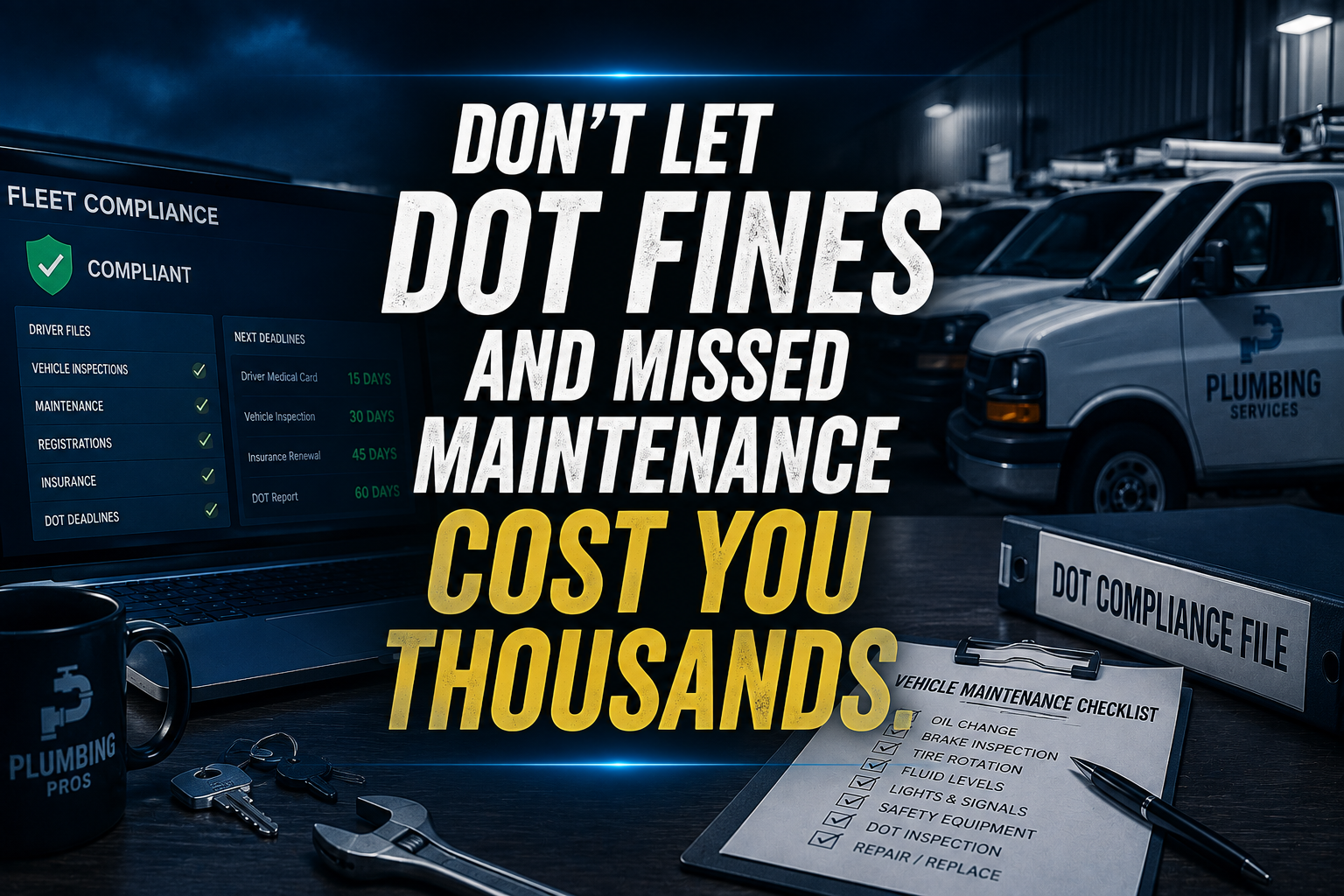
Running a growing plumbing company with five, ten, or twenty service vans on the road is an operational balancing act. While your master plumbers and technicians focus on clearing main lines, repairing water heaters, and handling emergency slab leaks, the administrative reality back at the shop tells a different story. Registration renewals slip through the cracks, Department of Transportation (DOT) compliance records sit scattered across messy spreadsheets, and routine oil changes get postponed until a service van breaks down on the highway during peak morning dispatch.
This administrative blind spot creates severe profit leakage for independent plumbing contractors. When a service vehicle gets pulled over for expired registration or fails a roadside safety inspection, you face steep state fines, towing fees, and lost billable hours while your technician sits stranded. Meanwhile, ignoring scheduled preventive maintenance shortens the lifespan of expensive cargo vans and hydro-jetting equipment, turning minor preventative fixes into costly engine overhauls that drain your monthly cash flow.
Delegating these heavy administrative burdens to a dedicated plumbing virtual assistant at just $8/hr protects your fleet, your budget, and your sanity. Instead of spending your evenings tracking mileage logs, chasing down insurance certificates, and updating maintenance calendars, you can deploy trained remote professionals who live inside your field service management software. By establishing rigorous manual workflows for vehicle compliance and maintenance tracking, your business stays audit-ready, road-ready, and entirely profitable.
10 Core Tasks a Plumbing Virtual Assistant Handles Daily
- Service Vehicle Registration Tracking: Monitoring state-by-state license plate and vehicle registration renewal deadlines to prevent expired tags and roadside ticketing.
- Preventive Maintenance Scheduling: Tracking mileage and engine hours in Fleetio or Verizon Connect to book routine oil changes, tire rotations, and brake inspections before failures occur.
- DOT Compliance Record Management: Organizing driver qualification files, medical examiner certificates, and hours-of-service logs to ensure complete regulatory adherence.
- Tool and Equipment Inventory Auditing: Cross-referencing truck inventory sheets with warehouse stock to ensure every van carries required copper fittings, PVC valves, and safety gear.
- Fuel Card Reconciliation: Matching weekly fuel card receipts against driver mileage reports to flag unauthorized purchases or suspicious fuel consumption patterns.
- Insurance Policy Certificate Tracking: Updating commercial auto insurance binders, adding newly acquired service vans, and removing decommissioned trucks from your policy.
- GPS Telematics Exception Monitoring: Reviewing daily telematics reports for harsh braking, excessive idling, and speeding events to coach drivers and lower liability risks.
- Repair Invoice Auditing: Reviewing mechanic and dealership repair estimates against standard parts pricing before approving maintenance expenditures.
- Permit and License Renewal Coordination: Managing local business licenses, specialized municipal trade permits, and environmental waste disposal certifications for every operating vehicle.
- Fleet Incident and Accident Documentation: Collecting police reports, driver statements, and photo evidence immediately following a roadside incident to streamline insurance claims.
The Technical Fixer: 7 SOPs to Manage Fleet Compliance & Maintenance
-
- Export active vehicle rosters from ServiceTitan or Fleetio on the first business day of each month.
- Cross-reference the roster against state Department of Motor Vehicles (DMV) portals for expiration dates occurring within the next 60 days.
- Compile renewal notices, emissions test certificates, and proof of commercial auto insurance for each upcoming vehicle.
- Submit online renewal applications and payment requests through state DMV portals or local tag agencies.
- Receive updated physical decals and registration cards by mail, then log tracking numbers in the central fleet spreadsheet.
- Dispatch updated registration cards to field technicians and verify physical placement inside each service van's glove compartment.
SOP 2: Preventive Maintenance Milestone Scheduling
-
- Pull weekly odometer readings and engine hour reports from Verizon Connect telematics software every Monday morning.
- Compare current mileage against manufacturer-recommended maintenance intervals for oil changes, transmission servicing, and filter replacements.
- Identify vehicles within 500 miles of their service threshold and contact pre-approved local service centers or dealerships.
- Schedule service appointments during off-peak hours (such as late afternoons or Saturdays) to minimize disruption to dispatch schedules.
- Notify the affected plumbing technician of the appointment time, location, and drop-off protocol 48 hours in advance.
- Update Fleetio with completed service notes, parts replaced, and next-service mileage benchmarks upon job completion.
SOP 3: DOT Compliance and Driver Qualification Audit
-
- Establish digital driver qualification files for all technicians operating heavy utility or box trucks requiring DOT numbers.
- Audit physical medical examiner certificates, commercial driver's licenses (CDLs), and motor vehicle records (MVRs) on a quarterly basis.
- Flag any medical certifications expiring within 90 days and notify both the driver and the operations manager immediately.
- Verify that annual vehicle safety inspection stickers are affixed to windshields and logged in the digital archive.
- Review driver daily vehicle inspection reports (DVIRs) submitted through field apps to ensure defect corrections are signed off by mechanics.
- Archive all compliance logs in secure cloud storage folders organized by driver ID and vehicle VIN number for instant audit retrieval.
SOP 4: Truck Stock and Specialized Tool Inventory Control
-
- Distribute standardized digital inventory checklists to field technicians for weekly completion every Friday afternoon.
- Review submitted checklists against baseline van stock requirements for copper pipes, PEX fittings, wax rings, and torch kits.
- Identify depleted stock items and generate internal warehouse transfer requests or supplier purchase orders.
- Coordinate with warehouse staff to pull requested materials and restock service vans overnight or during morning staging.
- Conduct monthly physical spot-checks of random service vans to verify inventory accuracy and eliminate stock shrinkage.
- Update inventory valuation reports in Jobber or Housecall Pro to maintain accurate accounting of on-board assets.
SOP 5: Fuel Card Expense and Mileage Reconciliation
-
- Export weekly transaction feeds from fleet fuel card providers (such as WEX or Fuelman) every Monday.
- Match each fuel purchase transaction against corresponding GPS telematics location data for that specific vehicle and timestamp.
- Verify that gallons purchased align reasonably with the fuel tank capacity of the assigned service van.
- Flag any anomalies: such as fuel purchases made far outside standard service territories or transactions occurring on weekends without scheduled jobs.
- Request missing paper receipts or written explanations from technicians for any flagged transactions within 24 hours.
- Import reconciled fuel expense data into accounting software and categorize costs by vehicle ID for accurate per-truck ROI tracking.
SOP 6: Commercial Auto Insurance Policy Administration
-
- Maintain a master insurance ledger recording VINs, policy numbers, coverage limits, and premium payment schedules.
- Notify insurance brokers within 24 hours of purchasing a new service van or retiring an older vehicle from the fleet.
- Request updated insurance ID cards and certificates of liability coverage for newly added vehicles.
- Upload digital insurance cards to the glovebox document app on every technician's mobile device.
- Audit monthly insurance premium deductions against carrier statements to ensure correct vehicle rating and premium discounts.
- Coordinate annual policy renewals with insurance agents 45 days prior to expiration to negotiate favorable commercial rates.
SOP 7: Roadside Incident and Repair Damage Documentation
-
- Instruct technicians to immediately notify the virtual assistant via phone and dispatch chat in the event of an accident or breakdown.
- Direct the driver to capture time-stamped photos of vehicle damage, surrounding traffic conditions, and other involved parties' insurance details.
- Dispatch a local towing service or roadside assistance provider using telematics location data if the vehicle is immobilized.
- File initial notice of loss reports with the commercial auto insurance carrier within 4 hours of the incident.
- Coordinate with local collision repair shops to obtain repair estimates and track parts availability daily.
- Update dispatchers on estimated return-to-service dates so customer appointments can be seamlessly reassigned to other technicians.
Industry Software Mastered by Our Virtual Assistants
Our remote professionals arrive equipped with deep operational familiarity across the leading field service and fleet management platforms your plumbing business already relies on:
- ServiceTitan: Managing pricebooks, scheduling, dispatch boards, and fleet asset tracking notes within your primary operating hub.
- Housecall Pro: Handling customer dispatching, job notes, parts tracking, and technician route optimization.
- Jobber: Streamlining client communication, service scheduling, invoice generation, and equipment tracking.
- Fleetio: Tracking preventive maintenance schedules, vehicle inspections, odometer readings, and repair history logs.
- Verizon Connect: Monitoring GPS telematics, driver behavior exceptions, geofencing alerts, and real-time vehicle locations.
Why Plumbing Companies Choose Virtual Nexgen Solutions
Running a profitable plumbing business requires keeping your master plumbers and journeymen focused on high-value installation and repair work rather than wrestling with DMV paperwork and maintenance spreadsheets. When you attempt to manage vehicle compliance, equipment audits, and fuel reconciliation internally, administrative burnout sets in, leading to costly oversights, missed oil changes, and expensive roadside fines that eat straight into your profit margins.
Partnering with Virtual Nexgen Solutions gives you access to rigorously trained virtual assistants who operate as an extension of your back office at just $8/hr. By comparison, hiring a full-time in-house fleet coordinator can easily cost upwards of $60,000 annually in salary, taxes, and benefits. Our remote specialists integrate seamlessly into your existing workflows using ServiceTitan, Fleetio, and Housecall Pro, ensuring your fleet remains compliant, maintained, and profitable around the clock.
Frequently Asked Questions
What does a plumbing virtual assistant actually do?
A plumbing virtual assistant manages essential back-office and operational workflows, including fleet maintenance tracking, registration renewals, parts inventory auditing, dispatch coordination, customer follow-ups, and invoice reconciliation, allowing your team to focus entirely on field work.
How much does a plumbing virtual assistant cost?
With Virtual Nexgen Solutions, specialized plumbing virtual assistants cost just $8 per hour, providing a highly cost-effective alternative to full-time administrative staff while delivering superior operational efficiency.
Can a virtual assistant manage our ServiceTitan or Housecall Pro software?
Yes. Our virtual assistants are thoroughly trained in industry-leading field service platforms including ServiceTitan, Housecall Pro, Jobber, Fleetio, and Verizon Connect, allowing them to jump straight into your existing systems with zero learning curve.
How do virtual assistants handle vehicle compliance and maintenance tracking?
Virtual assistants follow strict, multi-step Standard Operating Procedures (SOPs) to track mileage via telematics, schedule preventive oil changes, monitor state registration deadlines, and manage DOT driver qualification files proactively.
How quickly can a plumbing virtual assistant start working with our company?
Onboarding typically takes between 3 to 5 business days. We analyze your specific operational bottlenecks, match you with a trained specialist familiar with your software stack, and integrate them directly into your daily dispatch and administrative workflows.
Do virtual assistants help with inventory and parts management?
Yes. They audit weekly truck stock checklists, cross-reference inventory levels with warehouse supplies, generate purchase orders for depleted plumbing parts, and maintain accurate parts valuation records.
What is the ROI of hiring a virtual assistant compared to an in-house employee?
While an in-house administrative employee often costs over $60,000 per year, a virtual assistant from Virtual Nexgen Solutions costs only $8 per hour. This dramatically reduces overhead expenses while eliminating costly administrative delays and fleet compliance fines.
How do virtual assistants communicate with our dispatchers and field technicians?
Our virtual assistants integrate directly into your communication channels: including Slack, Microsoft Teams, phone systems, and field service chat tools: ensuring seamless, real-time coordination with your entire team.
Ready to eliminate fleet compliance headaches, prevent expensive roadside breakdowns, and scale your plumbing operations without breaking your budget? Partner with Virtual Nexgen Solutions today to secure expert remote support at just $8/hr. Contact our team now to get started!