Every morning across the United States, master plumbers and shop owners open their dispatch boards with a familiar sense of dread. Your trucks are rolling, your phone is ringing with emergency water heater failures, and your technicians are out in the field turning wrenches. On paper, your revenue looks healthy. But at the end of the month, your net profit margins remain stubbornly flat. Where is the money going?
The culprit is not your parts pricing, nor is it your labor rates. The silent profit killer in modern plumbing operations is the 60/40 utilization crisis.
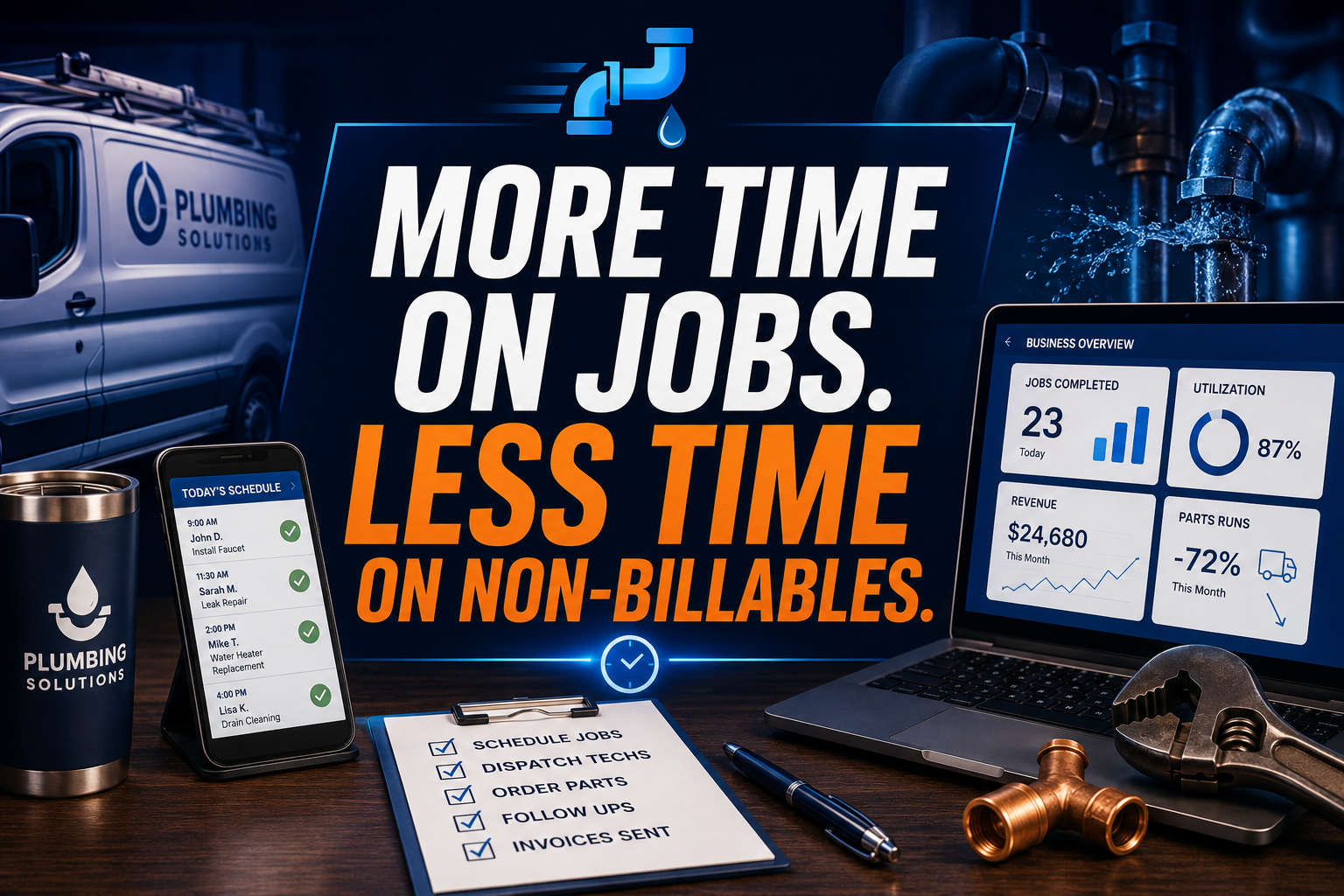
As a plumbing business owner, your most valuable asset is billable technician hours. Yet, across the industry in 2026, field technicians spend only sixty percent of their working day generating revenue. The remaining forty percent evaporates into a black hole of administrative friction, parts runs, unoptimized driving routes, and supplier phone tag. When a $125-per-hour technician drives twenty minutes across town to pick up a missing 3/4-inch brass elbow, you are not just losing time; you are actively bleeding cash.
Traditional thinking suggests hiring another local dispatcher or office admin at sixty-five thousand dollars a year plus benefits to manage the chaos. But in an era marked by severe technician shortages and escalating overhead costs, adding bloated local headcount only compounds your margin pressure.
Virtual Nexgen Solutions provides a smarter operational engine. By deploying specialized plumbing virtual assistants at $8 per hour, growing plumbing contractors across the country are eliminating admin debt, protecting billable hours, and scaling their door counts without expanding their local payroll footprint. In this comprehensive guide, you will discover the exact mechanics of the 60/40 crisis, master the workflows required to fix it, and learn how to leverage remote administrative infrastructure for maximum profitability.
The 2026 Plumbing 60/40 Crisis Explained
To understand why your plumbing business may be struggling despite strong call volume, you must examine how an eight-hour shift is actually utilized in the field.
In a perfectly optimized operation, a service technician arrives at a job site, diagnoses the issue, presents tiered repair options using ServiceTitan or Housecall Pro, executes the work, collects payment, and transitions immediately to the next call. Unfortunately, the reality of modern field service looks vastly different.
Out of a standard 480-minute workday, industry data reveals that technicians routinely lose:
- Ninety minutes to unoptimized drive time and traffic bottlenecks between scattered service calls.
- Sixty minutes to mid-job parts runs because the truck stock was never properly audited or pre-staged.
- Forty-five minutes to administrative interruptions, such as calling the office for customer history, waiting for warranty approvals, or manually filling out paper invoices.
- Thirty minutes to waiting on supply house counters or navigating supplier phone lines for item availability.
When you add these non-billable blocks together, your high-value technician is spending nearly three and a half hours every single day doing non-revenue-generating tasks. That is the 60/40 crisis.
When your net billable utilization sits at sixty percent, your business is operating at a severe structural disadvantage. In an environment where skilled labor is scarce and wage expectations are rising, you cannot afford to have your top technicians acting as high-priced couriers and administrative clerks. You need a dedicated operational layer behind the scenes to absorb every non-field duty before it ever touches your technicians.
Anatomy of Admin Debt and Revenue Leaks in Field Service
Admin debt accumulates silently in a plumbing business. It starts small: a missed customer callback here, an unfiled warranty claim there, an open estimate left sitting in your pipeline for three weeks without follow-up. Over time, these small oversights compound into massive revenue leaks that slowly strangle your bottom line.
Consider your open estimate pipeline. When a technician presents a four-thousand-dollar repipe quote or a water filtration system upgrade, the homeowner often says, "Let me think about it." Without a rigorous, automated, and human-driven follow-up cadence within forty-eight hours, that estimate decays. By day seven, the customer has forgotten the urgency of the problem or called a competitor.
Another major leak occurs at the supply house counter. Technicians walking into a distributor counter often get bogged down in casual conversations, waiting for counter staff to pull inventory, or sorting out purchase order mismatches. Multiply that delay across four or five techs a day, and your weekly labor loss reaches staggering proportions.
Furthermore, emergency dispatching requires lightning-fast response times. When a main sewer line backs up on a Saturday afternoon, homeowners will call the first three companies on Google Local Services. If your phone rings unanswered because your sole in-house dispatcher is busy processing an invoice, you have just handed a high-ticket emergency job directly to your local competitor.
Closing these operational gaps requires dedicated remote administrative infrastructure. You need professionals whose sole focus is keeping your schedule tightly packed, your parts pre-staged, and your customer communication flawless.
What a Specialized Plumbing Virtual Assistant Actually Does
Many plumbing contractors misunderstand what a remote professional can accomplish. They picture a generic receptionist answering basic phone calls and taking messages. A specialized plumbing virtual assistant from Virtual Nexgen Solutions functions as an integral, high-level operational dispatcher embedded directly into your daily software stack.
Here is a breakdown of the core workflows our specialized VAs execute daily to protect your margins:
Emergency Dispatch and Schedule Optimization
Your virtual assistant monitors your dispatch board in real time. When a new service request comes in via web form, emergency hotline, or missed call, your VA instantly checks technician skill sets, geographic locations, and truck inventory. By grouping calls by zip code and matching job types to the right technician, your VA slashes daily drive time and maximizes route density.
Parts Pre-Staging Coordination
Never let a technician run to the supply house mid-job again. Before any major installation or repair is dispatched, your VA cross-references the job requirements against your local supplier catalog (such as Ferguson, WinSupply, or Standard Plumbing Supply), coordinates will-call orders over the phone or online, and ensures all necessary specialty parts are pulled and ready before the truck ever leaves your yard.
Supplier Reordering and Truck Stock Replenishment
Truck stock is your mobile warehouse. When inventory dwindles, your technicians often fail to log used materials. Your virtual assistant reviews weekly truck stock logs, compares them against your minimum-maximum inventory thresholds, and places bulk reorders with your preferred vendors, ensuring your vans are fully stocked every Monday morning without burdening your field staff.
Customer Follow-Up on Open Quotes
Estimates are where plumbing fortunes are made or lost. Your VA executes a rigorous, multi-touch follow-up sequence for every open proposal in your CRM. By combining polite SMS check-ins, phone calls, and financing option reminders, your VA recovers dormant quotes and converts pending proposals into booked jobs.
Review Generation and Reputation Management
Online reputation dictates your inbound lead volume. The exact moment a plumbing job is marked complete in your CRM, your VA automatically triggers a personalized SMS and email review request. If a customer leaves a four-star or five-star review, your VA responds professionally. If a negative rating appears, your VA flags it immediately for management intervention, protecting your local search rankings.
Deep Dive into ServiceTitan and Housecall Pro Optimization
Platform mastery is what separates an ordinary virtual assistant from a true plumbing operations specialist. At Virtual Nexgen Solutions, our VAs undergo rigorous training on the industry's leading field service management platforms.
ServiceTitan Mastery
ServiceTitan is the powerhouse software for scaling residential and commercial plumbing contractors. Navigating its advanced dispatch boards, pricebook item setups, marketing scorecards, and payroll integrations requires specialized knowledge.
Our VAs utilize ServiceTitan to:
- Build and maintain accurate pricebook categories and flat-rate pricing matrices.
- Monitor dispatch board efficiency ratings and identify technician bottleneck periods.
- Handle customer membership agreements, recurring maintenance renewals, and automatic billing runs.
- Audit job costing reports to ensure gross margin targets are met on every completed project.
Housecall Pro Mastery
For growing independent plumbing shops, Housecall Pro offers nimble, powerful scheduling and invoicing tools.
Our VAs leverage Housecall Pro to:
- Instantly dispatch jobs to technicians via the mobile app with complete customer notes and equipment history.
- Set up automated customer text notifications for technician arrival windows ("On My Way" alerts).
- Manage online booking widgets embedded on your website, converting night and weekend traffic into confirmed appointments.
- Track invoice aging reports and send automated payment reminder links for outstanding balances.
By embedding a virtual assistant who already knows the ins and outs of these platforms, you eliminate onboarding friction and gain an operational expert from day one.
The Financial Breakdown: $8/hr Remote Experts vs. $65K/yr In-House Staff
When evaluating administrative support, business owners must look beyond base salary and calculate the total cost of employment (TCE).
Hiring a full-time, in-house dispatcher or office manager in today's labor market involves a heavy financial commitment:
- Base salary ranging from $50,000 to $65,000 annually.
- Payroll taxes (FICA, FUTA, SUTA) adding roughly 8% to 10%.
- Health insurance, workers' compensation, and retirement matching benefits.
- Paid time off, sick leave, and holiday pay.
- Overhead costs for physical desk space, computers, dual monitors, software seat licenses, and office supplies.
When you total these expenses, a single in-house administrative employee easily costs your business between $70,000 and $85,000 per year, all while occupying a physical chair during standard 9-to-5 hours. What happens when your emergency calls come in at 7:00 PM or on a Saturday morning? Your local office is closed.
Compare that traditional model with Virtual Nexgen Solutions.
At our flat rate of $8 per hour, a dedicated full-time virtual assistant (working 40 hours per week for 50 weeks) costs approximately $16,000 annually.
- Zero payroll tax burdens.
- Zero health insurance or benefits administration.
- Zero hardware overhead.
- Flexible scheduling availability to match your peak operating hours and emergency dispatch needs.
By choosing an $8/hr plumbing virtual assistant, you save over $50,000 annually in direct overhead while simultaneously upgrading your operational responsiveness. That capital can be reinvested directly into local marketing, truck fleet expansion, or technician bonuses.
Five Critical Tasks to Delegate Immediately
If you want to experience an immediate lift in technician efficiency and cash flow, stop performing low-leverage administrative tasks yourself and delegate these five core functions to your new virtual assistant today:
1. Inbound Lead Intake and Instant Booking
Never let the phone ring to voicemail. Instruct your VA to answer every inbound call or web lead within sixty seconds. By capturing emergency plumbing requests while competitors are still listening to voicemail greetings, you capture the highest-margin jobs in your market.
2. Proactive Parts Pre-Staging
Review tomorrow's scheduled installations today. Have your VA cross-reference every job against your parts inventory and coordinate with local supply houses so that every morning dispatch is one hundred percent prepared before the first wrench turns.
3. Open Estimate Follow-Up Campaigns
Pull a report of every estimate older than forty-eight hours that has not been converted. Have your VA initiate a structured outreach campaign via phone and text to answer customer questions, offer flexible financing options, and close the sale.
4. Review and Reputation Generation
Automate your post-job feedback loop. Task your VA with sending review requests immediately upon invoice closure, tracking incoming reviews across Google and Yelp, and maintaining your local online authority.
5. Membership and Maintenance Agreement Renewals
Recurring revenue is the lifeblood of a stable plumbing business. Have your VA track annual plumbing maintenance agreements, reach out to homeowners thirty days before expiration, and secure renewals over the phone.
Real-World Transformation: Two Anonymized Case Studies
To understand the tangible ROI delivered by specialized plumbing virtual assistants, consider these two anonymized case studies from our client portfolio at Virtual Nexgen Solutions.
Case Study One: Eliminating Mid-Job Parts Runs for a Residential Shop in Ohio
The Scenario: A mid-sized residential plumbing company in Columbus operating six service trucks was suffering from chronic productivity losses. Technicians were averaging 1.4 mid-job parts runs per day per truck. Because local supply house counters were scattered across the city, each run cost an average of 45 minutes in drive and counter time, plus lost billable hours.
The Intervention: The owner partnered with Virtual Nexgen Solutions to hire a full-time plumbing virtual assistant trained in ServiceTitan. The VA instituted a mandatory next-day job audit protocol every afternoon, verifying that all specialty valves, fixtures, and connectors were pre-ordered and staged in bins for each technician's morning dispatch. Furthermore, the VA established direct phone relationships with local supplier delivery drivers for hot-shot parts drops when unexpected complications arose on site.
The Result: Within 45 days, mid-job parts runs dropped by 92%. Technicians reclaimed over six hours of billable time per truck per week. Across six vans, this operational shift generated an additional $29,000 in monthly billable revenue with zero increase in labor costs.
Case Study Two: Scaling Tech Utilization from 60% to 82% for a Commercial Plumbing Contractor in Texas
The Scenario: A commercial and multi-family plumbing contractor in Dallas with twelve field techs was struggling with administrative bottlenecking. Technicians were spending nearly two hours every evening filling out manual paper work orders, calling in material usage, and trying to schedule their own follow-up inspections with local city code enforcement. Tech utilization hovered stubbornly at 60%.
The Intervention: The company integrated two specialized VAs from Virtual Nexgen Solutions operating in shifts to cover extended hours. The VAs took over all municipal permit applications, coordination with city inspectors, digital work order entry in Housecall Pro, and real-time route optimization. They also instituted a daily follow-up protocol on commercial client accounts for past-due invoice collection.
The Result: Technician billable utilization surged from 60% to 82% within 90 days. Accounts receivable aging dropped from an average of 51 days down to 18 days, injecting immediate cash flow into the business. The owner successfully scaled the company from 12 to 17 trucks without hiring a single additional local office staff member.
Actionable Standard Operating Procedures for Delegation
Successful outsourcing relies on clear, repeatable Standard Operating Procedures (SOPs). Here is how you can document and hand off your first workflow to your Virtual Nexgen Solutions plumbing VA:
Daily Emergency Call Intake and Dispatch Protocol
- Monitor Inbound Channels: Keep ServiceTitan/Housecall Pro dispatch board and phone queue active on your primary monitor at all times.
- Answer Speed: Answer all inbound phone calls within three rings using the approved greeting: "Thank you for calling [Company Name], this is [Name], how can we dispatch an emergency plumber to assist you today?"
- Data Collection: Gather complete customer details: Full Name, Service Address, Phone Number, Email, and exact nature of the plumbing emergency (e.g., active water leak, sewage backup, water heater failure).
- Triage and Assign: Check the geographic dispatch map. Assign the nearest available technician based on skill level and truck inventory.
- Customer Confirmation: Send an automated or manual text confirmation to the homeowner with the technician's name, photo, and estimated arrival window.
Morning Parts Pre-Staging Protocol
- Review Next-Day Schedule: Every afternoon at 3:00 PM, open the upcoming day's dispatch schedule in your CRM.
- Analyze Job Requirements: Read technician job notes to identify specialty parts required for water heater replacements, repipes, or complex fixture installs.
- Inventory Check: Cross-reference requirements against warehouse stock.
- Supplier Coordination: If items are missing, place a will-call order with local supply distributors (Ferguson, WinSupply, etc.) for morning pickup or delivery.
- Bin Staging: Ensure parts are labeled and placed in the designated technician staging bins before 7:30 AM the following morning.
Common Operational Pitfalls and How to Avoid Them
When plumbing business owners first embrace remote administrative support, they occasionally stumble into avoidable traps. Keep these guardrails in mind:
- Pitfall 1: Vague Instructions. Do not tell your VA to "handle the office stuff." Give precise, step-by-step instructions tied to specific software actions within ServiceTitan or Housecall Pro.
- Pitfall 2: Failing to Integrate Communication. Ensure your VA has a dedicated Slack channel or WhatsApp group for instant communication with field technicians.
- Pitfall 3: Not Reviewing Metrics Weekly. Track key performance indicators such as estimate conversion rate, average time to answer, and technician billable utilization weekly to measure your VA's impact.
- Pitfall 4: Treating the VA as an Outsider. Fully onboard your VA into your company culture, mission, and customer service standards from day one. At Virtual Nexgen Solutions, our VAs are trained to act as true extensions of your local team.
Frequently Asked Questions
1. What exactly is a plumbing virtual assistant?
A plumbing virtual assistant is a remote administrative and operational professional trained specifically in field service workflows, customer support, and software management to help plumbing companies eliminate admin debt and boost profitability.
2. How much does a plumbing virtual assistant cost?
With Virtual Nexgen Solutions, specialized plumbing virtual assistants are available at a flat rate of $8 per hour with no long-term employment contracts or hidden overhead costs.
3. Do plumbing virtual assistants know how to use ServiceTitan?
Yes. Our specialized VAs undergo rigorous training on ServiceTitan, Housecall Pro, Jobber, and other leading plumbing management platforms.
4. Can a virtual assistant handle emergency dispatching?
Absolutely. Your VA can monitor inbound emergency calls, manage your dispatch boards in real time, and route technicians based on location and skill set.
5. How do I communicate with my virtual assistant during the workday?
You can communicate seamlessly through Slack, Microsoft Teams, WhatsApp, email, or direct phone calls, ensuring real-time coordination with your field operations.
6. Will my customers know the assistant is remote?
Your VA represents your brand professionally using your company phone numbers, email domains, and greeting protocols, ensuring a seamless experience for your customers.
7. Can a plumbing virtual assistant handle supply house ordering?
Yes. Your VA can review upcoming job requirements, coordinate will-call orders with local suppliers like Ferguson or WinSupply, and manage truck stock replenishment.
8. How does hiring an $8/hr VA compare to an in-house dispatcher?
An in-house dispatcher typically costs $65,000+ per year plus taxes, benefits, and office overhead. An $8/hr remote VA provides the same or superior output at a fraction of the cost, saving over $50,000 annually.
9. What happens if my VA is sick or takes time off?
Virtual Nexgen Solutions provides robust operational continuity and backup coverage options so your phones and dispatch boards are never left unattended.
10. How long does it take to onboard a plumbing virtual assistant?
Onboarding typically takes between 3 to 5 business days, including platform access setup, workflow familiarization, and custom SOP integration.
11. Can a virtual assistant follow up on open plumbing estimates?
Yes. Proactive estimate follow-up is one of the highest-ROI tasks our VAs perform, turning dormant quotes into booked revenue through systematic phone and text outreach.
12. Are virtual assistants available on weekends and evenings?
We offer flexible scheduling options to align with your business hours, including evening and weekend emergency dispatch coverage.
13. What kind of internet and computer setup do your VAs have?
All Virtual Nexgen Solutions professionals work from secure, high-speed corporate facilities equipped with enterprise-grade redundant power, high-speed fiber internet, and secure hardware.
14. Can my VA manage my online reviews and reputation?
Yes. Your VA can automatically trigger review requests upon job completion, monitor feedback on Google and Yelp, and help build your local search authority.
15. How do you ensure data security and client confidentiality?
All VAs sign strict non-disclosure agreements, operate within secure virtual environments, and use role-based permissions in your CRM software.
16. Can a virtual assistant help with accounts receivable and collections?
Yes. Your VA can track invoice aging reports, send automated payment reminder links, and place friendly collection calls to past-due commercial and residential accounts.
17. What industries do you serve besides plumbing?
While we specialize in plumbing, HVAC, electrical, and home services, Virtual Nexgen Solutions also serves legal, medical, real estate, insurance, and e-commerce industries across the United States.
18. Do I need to provide software licenses for my VA?
You will provide standard user access seats within your existing CRM (such as ServiceTitan or Housecall Pro), just as you would for an in-house employee.
19. How do I track my VA's daily productivity?
You can monitor completed tasks, dispatch board accuracy, and customer communication directly within your CRM and communication channels.
20. How do I get started with Virtual Nexgen Solutions?
Simply book a free discovery consultation on our website at www.virtualnexgen.com or call us directly at +1 (341) 888-6504 to discuss your specific operational needs.
Conclusion
The plumbing industry in 2026 rewards efficiency, speed, and precision. If you continue to let your high-value technicians burn forty percent of their working day on parts runs, unoptimized driving, and administrative friction, your profit margins will remain trapped. You do not need to absorb the crushing overhead of a sixty-five-thousand-dollar in-house employee to solve this crisis.
By partnering with Virtual Nexgen Solutions, you gain access to expert, platform-trained plumbing virtual assistants for just $8 per hour. From emergency dispatching in ServiceTitan to parts pre-staging and quote follow-ups, our remote professionals act as the administrative engine that protects your billable hours and scales your business.
Stop the profit leak. Reclaim your time. Elevate your operations today.