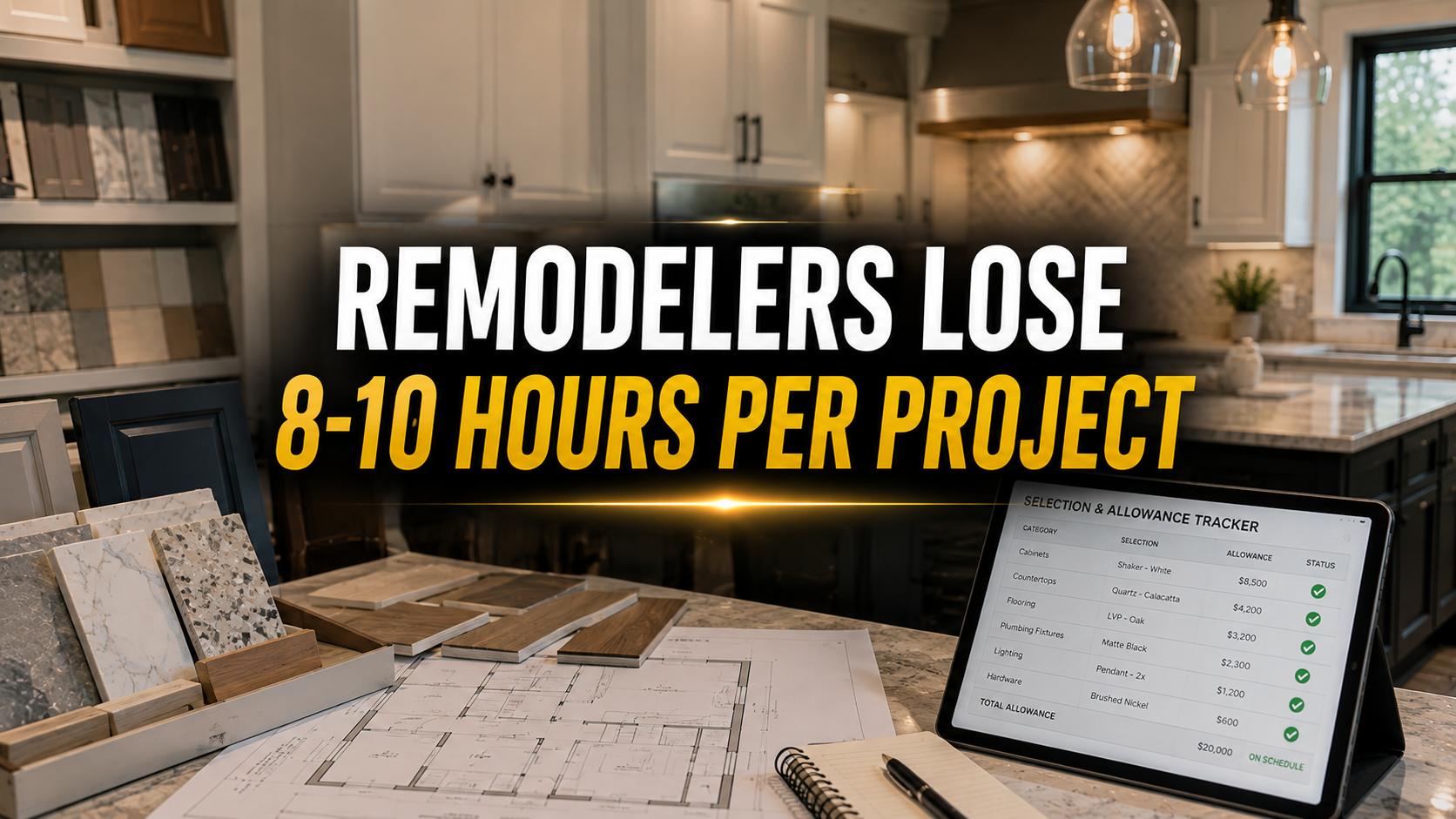
Picture this scenario: You signed a high-end kitchen and primary bath remodeling contract three weeks ago. The deposit cleared, your lead carpenter is ready to mobilize, and your subcontractors are lined up on the calendar. But there is one massive, invisible bottleneck holding the entire operation hostage: the homeowner still hasn’t chosen their tile, plumbing fixtures, or cabinet hardware. Your project manager spends three hours every Tuesday chasing down fabric swatch approvals, forwarding supplier links, and recalculating allowance variances because the client fell in love with marble slabs that cost triple the budget placeholder. Meanwhile, your job schedule slips by four weeks, cash flow stalls, and your field crew sits idle waiting for material specs.
For growing home improvement and remodeling contractors across the United States, client material selections represent the single largest operational black hole in project management. While you pride yourself on exceptional craftsmanship, structural integrity, and clean job sites, your business is hemorrhaging billable hours in the showroom showroom. Between coordinating with local tile distributors, chasing down discontinued SKU numbers, reconciling allowance overruns, and fielding frantic evening text messages about backsplash grout colors, your high-value production time is being consumed by administrative friction. This is the hidden crisis plaguing residential remodeling companies today, and it requires a structured, scalable operational fix that doesn't break the bank.
The Weight of Admin Debt in Residential Remodeling
Admin debt is the silent killer of remodeling profit margins. Unlike material costs or direct labor, which show up neatly on your profit and loss statements, admin debt accumulates in the shadows. It is built from every unreturned supplier phone call, every manually updated spreadsheet tracking tile allowances, every lost change order request, and every delayed client sign-off. When your project managers and lead designers spend 40 percent of their working week wrestling with paperwork instead of overseeing job site quality, your gross margins erode rapidly.
In the remodeling industry, admin debt manifests most violently during the pre-construction and selection phases. When a client signs a contract with a $5,000 plumbing allowance, that number is merely a placeholder. Navigating the journey from placeholder to ordered product requires dozens of micro-decisions: verifying stock availability, checking lead times against the master schedule, coordinating pick-ups with local supply houses, and issuing formal change orders when selections exceed the allowance. When your internal team handles these manual touchpoints ad-hoc, balls get dropped, deadlines are missed, and projects hemorrhage profit before the first demolition hammer even swings.
The Half-Day Problem: Why Showroom Coordination Paralyses Your Business
Ask any residential general contractor or design-build firm owner what their most frustrating weekly task is, and they rarely point to framing or drywall installation. Instead, they talk about the "Half-Day Problem", the cumulative 15 to 20 hours per week spent managing client showroom visits, cataloging selections, and mediating indecision. Homeowners embarking on a major kitchen or bath overhaul face choice overload. Faced with seventy different shades of white quartz and forty variations of matte black shower valves, clients freeze. They take two weeks to decide on cabinet pulls, putting your ordering timeline in complete jeopardy.
When your lead project manager or company owner acts as an unpaid personal shopper and administrative intermediary, your business suffers a severe opportunity cost. Every hour spent emailing tile samples to an indecisive client is an hour not spent bidding new profitable contracts, inspecting field quality, or recruiting skilled trade partners. Furthermore, when selections are delayed, material lead times stretch past your project milestones. A single backordered custom sink can stall a $150,000 kitchen remodel for three weeks, locking up your retention payments and infuriating clients who expected rapid execution.
The $8/hr vs. $60K Salary Trap
Many growing remodeling companies recognize their administrative bottleneck and immediately default to a flawed hiring model: posting an ad for a full-time, in-house administrative assistant or junior project coordinator. In today’s labor market, bringing on a full-time local admin staffer means paying $55,000 to $65,000 per year, plus payroll taxes, workers' compensation, health insurance benefits, desk space, and hardware overhead. For a small or mid-sized remodeling firm completing 12 to 20 projects a year, carrying a $60,000 fixed overhead burden for basic data entry, selection tracking, and supplier follow-up is financially punishing.
Worse yet, traditional in-house hires often lack specialized familiarity with construction management platforms like Buildertrend or Houzz Pro, requiring months of costly onboarding and training. The smarter, highly scalable alternative is partnering with Virtual Nexgen Solutions. By deploying specialized virtual assistants starting at just $8 per hour, you eliminate the rigid $60,000 salary trap entirely. You gain dedicated, highly trained remote professionals who plug directly into your existing software stack, manage your client selection pipelines, track every allowance variance in real time, and keep your projects moving forward on schedule, all at a fraction of the cost of traditional staffing.
Technical Expertise: Mastering Buildertrend, Houzz Pro, and Supplier Portals
To successfully run a modern remodeling operation, your administrative engine must be deeply integrated with industry-standard software. Virtual Nexgen Solutions virtual assistants are rigorously trained in the exact platforms residential contractors rely on every day. Whether your business operates on Buildertrend, Houzz Pro, CoConstruct, or Builderall, our remote specialists hit the ground running without requiring basic software tutorials.
Our virtual assistants take absolute ownership of your technical workflows, including:
- Buildertrend Selections Module: Setting up detailed categories (cabinets, flooring, plumbing, lighting), inputting allowance placeholders, attaching multiple good/better/best choices, and publishing organized selection packages directly to the client portal.
- Houzz Pro Budget & Allowance Tracking: Linking client product selections to line-item budgets, automatically flagging over-allowance choices, and generating instant change orders for client approval before ordering.
- Supplier Portal Management: Logging into local distributor accounts, tracking material lead times, confirming shipping statuses, and coordinating freight deliveries with your field superintendents.
- Change Order Documentation: Drafting formal change orders whenever selections exceed allowances, securing digital client sign-offs, and updating master project schedules immediately.
Licensed vs. Unlicensed: Why Specialized Support Protects Your Business
In the home improvement sector, compliance and accuracy are non-negotiable. Whether you specialize in kitchen remodeling, bathroom overhauls, whole-house renovations, or custom additions, every document, allowance calculation, and supplier communication must be handled with absolute precision. Unstructured delegation or hiring untrained, generic virtual assistants who do not understand construction terminology often creates more administrative chaos than it solves.
Virtual Nexgen Solutions provides thoroughly vetted, specialized virtual assistants who understand the nuances of residential construction. They know the difference between a rough-in valve and a trim kit, they understand why tile lot numbers matter, and they know how to read architectural specifications. By combining strict operational protocols with deep industry familiarity, our virtual assistants protect your professional reputation, ensure your clients feel supported throughout their design journey, and safeguard your profit margins against costly ordering errors.
Proven ROI: Three Remodeling Success Stories
Case Study 1: Design-Build Firm in Atlanta, Georgia
A premier residential design-build firm in Atlanta was struggling with chronic project delays caused by client indecision during the material selection phase. With 14 active whole-home remodels running simultaneously, their lead designer was spending 25 hours a week managing showroom appointments and updating allowance spreadsheets. After partnering with Virtual Nexgen Solutions to deploy a dedicated remodeling virtual assistant at $8/hour, all client selection packages were centralized inside Buildertrend. The virtual assistant established strict decision deadlines, managed supplier communications, and tracked every allowance variance automatically. Project schedule slippage dropped by 78 percent within 90 days, saving the firm an estimated $42,000 in overhead and indirect labor costs annually while eliminating client friction.
Case Study 2: Kitchen & Bath Specialist in Denver, Colorado
A high-volume kitchen and bath remodeling contractor in Denver faced severe profit leakage due to unbilled allowance overages and missed change order documentation. Clients frequently upgraded tile and plumbing selections without formal approvals, leaving the company absorbing thousands of dollars in material cost overruns at project closeout. Virtual Nexgen Solutions implemented a rigorous selection-to-approval workflow managed entirely by a remote specialist. Every material choice made by homeowners was instantly cross-referenced against contract allowances, and automated change orders were issued before any purchase order was placed. The company recovered over $65,000 in previously lost selection overages within the first six months, transforming low-margin jobs into highly profitable projects.
Case Study 3: General Remodeling Contractor in Dallas, Texas
A busy general remodeling contractor in Dallas was on the brink of burnout. Handling sales, project supervision, subcontractor coordination, and client selection emails left the owner working 70 hours a week with zero personal downtime. By integrating two specialized Virtual Nexgen Solutions virtual assistants, one focused on client communication and selection tracking, the other on scheduling and supplier follow-ups, the owner reclaimed 30 hours of personal time every week. Project turnaround times accelerated by two weeks per job, customer satisfaction scores surged to near-perfect levels, and the company successfully scaled its annual completed project volume by 45 percent without adding a single expensive local employee.
Tactical SOP: The 6-Step Showroom Selection & Allowance Management Workflow
Implement this standardized operating procedure across your remodeling business immediately to take control of project selections and protect your profit margins:
- Audit and Establish Baseline Allowances: During contract signing, ensure every product category (cabinetry, tile, flooring, plumbing, lighting, appliances) has a clearly defined allowance placeholder and a hard decision deadline date entered into your project management software (Buildertrend or Houzz Pro).
- Publish the Client Selection Portal: Build structured selection packages with 3 pre-approved product options per category. Grant your client secure portal access where they can view specs, pricing, and allowance impacts in real time.
- Automate Decision Deadline Reminders: Have your Virtual Nexgen Solutions virtual assistant send automated weekly reminder notifications to clients 14 days, 7 days, and 48 hours prior to each material selection deadline to prevent project delays.
- Reconcile Allowance Variances Instantly: When a client selects a premium material exceeding the allowance placeholder, require the virtual assistant to generate an instant budget impact report showing the exact dollar difference.
- Issue Formal Change Orders Before Ordering: Never purchase out-of-allowance materials without a signed digital change order. Route the change order through the client portal for instant approval and payment authorization.
- Track Supplier Lead Times and Delivery Schedules: Once approved, instruct your virtual assistant to place orders with local distributors, verify stock availability, and coordinate exact delivery dates with your field crew to ensure zero job site downtime.
Frequently Asked Questions
1. What exactly does a remodeling virtual assistant do?
A remodeling virtual assistant handles back-office administrative tasks including client selection management, allowance tracking, Buildertrend or Houzz Pro updates, supplier follow-ups, change order documentation, and scheduling coordination.
2. How much does a remodeling virtual assistant cost?
Virtual Nexgen Solutions provides specialized virtual assistants starting at $8 per hour, allowing you to scale your administrative support without the overhead of a full-time local employee.
3. Will the virtual assistant know how to use Buildertrend and Houzz Pro?
Yes. Our virtual assistants are fully trained in major construction and remodeling management software platforms, ensuring seamless integration into your existing workflows.
4. How do virtual assistants help manage client tile and finish selections?
They organize selection categories, publish options in your client portal, track decision deadlines, monitor allowances, and ensure choices are finalized before project start dates.
5. How does this prevent project delays?
By actively tracking selection deadlines and communicating with clients and suppliers proactively, virtual assistants eliminate the bottlenecks that cause projects to stall for weeks.
6. What is the difference between an allowance and a selection?
An allowance is a budget placeholder in the contract for unselected items, while a selection is the final product chosen by the homeowner that determines the actual project cost.
7. How are allowance overages handled?
Virtual assistants track actual costs against allowances in real time and automatically generate formal change orders for client approval whenever selections exceed the budget placeholder.
8. Can a virtual assistant order materials directly from suppliers?
They manage supplier communications, verify stock and lead times, request quotes, and coordinate purchase orders and delivery schedules with your approval.
9. How do we communicate with our virtual assistant during the workday?
You communicate seamlessly via Slack, Microsoft Teams, email, phone, and project management software platforms, operating just like an in-house team member.
10. How quickly can a virtual assistant start working with our remodeling business?
Onboarding is fast and streamlined. Virtual Nexgen Solutions matches you with a pre-vetted specialist tailored to your specific software and workflow needs within days.
Conclusion
Administrative debt, runaway allowance overages, and endless client selection delays do not have to be an accepted cost of doing business in residential remodeling. When you stop acting as an unpaid personal shopper for indecisive homeowners and delegate your pre-construction workflows to trained professionals, your entire business transforms. By partnering with Virtual Nexgen Solutions, you gain a dedicated operational engine that keeps your projects on schedule, protects your profit margins, and frees you up to focus on high-value craftsmanship and business growth: all starting at just $8 per hour.