If you run a water damage mitigation or property restoration company, you already know the sinking feeling of opening your accounts receivable aging report. The job was completed weeks ago. The homeowner is thrilled that their flooded kitchen is dry. Your technicians have already moved on to the next emergency loss. But your payment from the insurance carrier is stuck in limbo, sitting on a desk or caught in an endless loop of desk reviews, carrier audits, and missing information requests.
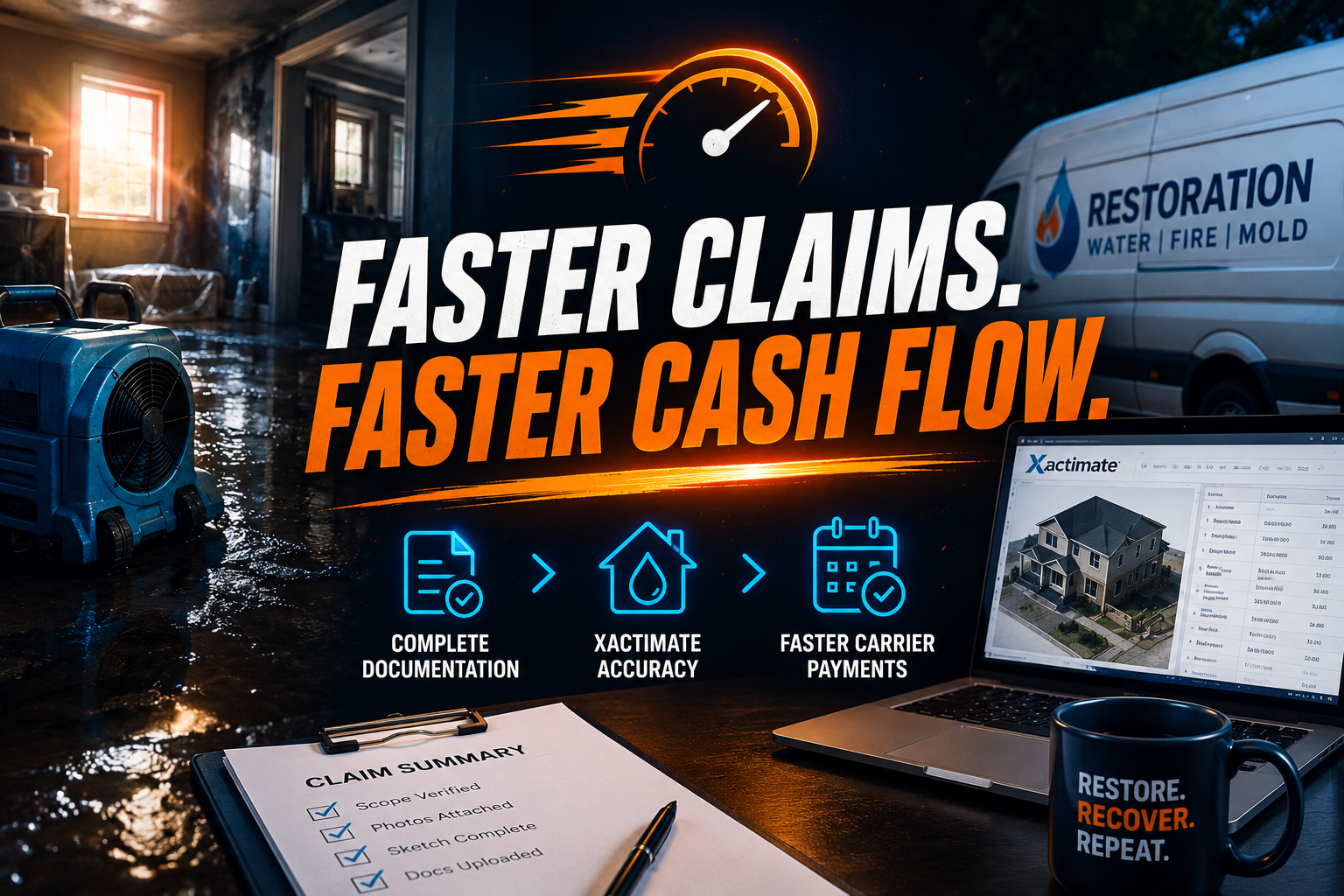
According to the 2026 Restoration Benchmarking Survey, restoration firms are currently waiting anywhere from 3 to 8 weeks longer than necessary for final claim payouts. The primary culprit isn't malicious carrier delay: though adjusters certainly use every tool at their disposal to protect their loss ratios. The root cause is upstream documentation gaps. When your field crews fail to capture defensible moisture logs, miss critical pre-mitigation photos, or leave out strict IICRC S500 standard references, you hand the insurance desk adjuster an excuse to cut your Xactimate line items, deny your equipment days, and freeze your cash flow.
Fixing this bottleneck does not require spending $65,000 a year plus benefits on an in-house administrative coordinator or burning out your field project managers with endless paperwork. By deploying a specialized restoration virtual assistant through Virtual Nexgen Solutions at just $8 per hour, you can bridge the gap between field software like DASH or Encircle and carrier estimating platforms like Xactimate. In this guide, we will break down the exact operational mechanics of administrative debt in property restoration, explore the high-impact tasks you can delegate today, review two real-world case studies of accelerated cash flow, and answer the top questions restoration contractors ask about outsourcing.
The 2026 Restoration Cash Flow Crunch: Why Your Initial Claims Are Failing Desk Review
Operating a restoration business is fundamentally an exercise in logistics and evidence management. When a category 3 water loss or a severe mold remediation project kicks off at 2:00 AM, your technicians focus on what matters most on-site: extracting standing water, setting structural drying equipment, establishing containment barriers, and comforting the property owner. Paperwork is naturally the last thing on their minds.
Unfortunately, insurance carriers do not pay for good intentions. They pay for auditable, bulletproof evidence.
When your team uploads raw notes and unorganized photos into DASH or Encircle, a dangerous disconnect happens. Field technicians document in one ecosystem, while insurance desk adjusters review in another. If photos are unlabeled, if moisture maps lack consistent point IDs, or if daily psychrometric readings fail to track temperature, relative humidity, and GPP across consecutive days, your file is flagged.
This creates what industry veterans call admin debt. Every missing photo, unreferenced line item, and incomplete equipment log turns into a revenue leak. Adjusters use these gaps to question whether containment was necessary, whether equipment was pulled too late, or whether technician labor hours exceed industry standards. The result is a sluggish 60-to-90-day payment cycle that starves your business of working capital, making it difficult to payroll your crews, buy replacement drying equipment, or invest in marketing for new emergency calls.
What a Restoration Virtual Assistant Actually Does
Many contractors misunderstand what a remote professional can accomplish in a technically demanding field like property restoration. You might wonder how someone sitting miles away can assist with water damage claims, Xactimate estimates, and mitigation documentation.
The reality is that a trained restoration virtual assistant acts as the central administrative engine of your operation, handling the high-volume data coordination that bogs down your project managers and estimators. They do not go on-site to place air movers, but they ensure that every piece of data captured in the field is formatted, organized, and defended according to carrier expectations before the claim is ever submitted.
Here are the core operational functions a restoration virtual assistant executes daily:
- Xactimate Supplement Preparation & Defense: Cross-referencing field notes, photos, and municipal code requirements to build comprehensive supplement packages that prevent carrier pushback.
- Photo Labeling & Organization: Sorting hundreds of raw site photos into structured folders by room and phase (pre-mitigation, demolition, drying, post-remediation verification), embedding timestamps and descriptions directly into the file.
- Moisture Log Assembly & Psychrometric Tracking: Auditing daily drying logs for missing readings, calculating GPP trends, and aligning moisture maps with Xactimate sketch room names so adjusters can trace every drying day to verifiable data.
- DASH and Encircle Synchronization: Managing your job management software to ensure every form, sketch, and equipment log flows seamlessly into your billing workflow without manual entry errors.
- Carrier Desk Review Tracking & Follow-Up: Maintaining a relentless follow-up cadence with carrier desk adjusters, third-party administrators (TPAs) like Alacrity or Contractor Connection, and independent adjusters to push pending claims across the finish line.
The Economics: $8/hr Virtual Assistant vs. $65K/Yr In-House Admin
When evaluating how to scale administrative operations, restoration owners often default to hiring locally. They post a job ad for an office administrator, interview candidates, and commit to a full-time salary ranging from $50,000 to $65,000 per year, plus payroll taxes, workers' compensation insurance, health benefits, PTO, and the overhead cost of desk space, computer hardware, and software licenses.
Worse yet, when that local hire gets overwhelmed by peak storm season volume or quits unexpectedly, the entire back-office operation grinds to a halt.
Compare that traditional model to partnering with Virtual Nexgen Solutions. At our transparent rate of $8 per hour, a dedicated full-time remote professional working 160 hours a month costs approximately $1,280 monthly: translating to roughly $15,360 annually. You eliminate fixed overhead, bypass recruitment headaches, and gain instant access to professionals trained specifically in restoration workflows, Xactimate principles, and industry-standard CRM platforms.
More importantly, freeing your high-ticket project managers and estimators from administrative data entry allows them to focus on what actually drives revenue: inspecting new losses, scoping complex commercial jobs, building relationships with plumbers and insurance agents, and closing new mitigation contracts.
5 High-Impact Tasks to Delegate to Your Restoration Virtual Assistant Immediately
To unlock immediate operational velocity, you must stop letting your most expensive employees handle tasks that require zero physical presence. Hand over these five critical workflows to your virtual assistant on day one:
1. Pre-Submission File Audits
Before any mitigation invoice or Xactimate estimate leaves your office, your virtual assistant runs it through a rigorous quality assurance checklist. They verify that every line item (such as containment, HEPA air scrubbing, or specialty cleaning) has corresponding photo evidence and job-condition notes attached. If a component is missing, they flag it for the project manager before the carrier gets a chance to issue a denial.
2. Daily Drying Log Reconciliation
Moisture logs are the ultimate battleground between restoration contractors and insurance carriers. Your virtual assistant reviews incoming daily logs from DASH or Encircle every morning, ensuring that psychrometric readings are complete, material moisture percentages are accurately recorded, and equipment placement counts match what is billed in the estimate.
3. TPA and Carrier Status Tracking
Third-party administrator portals and carrier claim systems require constant monitoring. Your virtual assistant logs into DASH, XactAnalysis, and TPA dashboards daily, updating claim statuses, uploading requested documents within carrier SLAs, and logging notes on every pending file so nothing falls through the cracks.
4. Vendor and Material Invoice Processing
Matching supplier receipts from Ferguson, Jon-Don, or local supply houses to specific job numbers is tedious work. Your virtual assistant reconciles material purchases, tracks equipment maintenance records, and ensures that direct job expenses are accurately assigned in your accounting software.
5. Customer Communication & Review Generation
While your mitigation crews are busy drying structures, customer satisfaction can dip simply due to lack of communication. Your virtual assistant manages automated check-in SMS sequences, sends pre-mitigation educational guides to homeowners, and follows up post-job to secure five-star Google reviews and completed customer satisfaction surveys.
Real-World ROI: Two Case Studies in Restoration Excellence
Numbers on a page only tell part of the story. To understand the true impact of integrating a restoration virtual assistant into your business, let us examine two anonymized case studies from our client portfolio at Virtual Nexgen Solutions.
Case Study 1: Accelerating Cash Flow by 45 Days in Florida
The Scenario: A mid-sized water damage restoration firm operating in South Florida was experiencing severe cash flow strangulation. Despite completing over 30 mitigation jobs a month, their average days sales outstanding (DSO) hovered at 75 days. Desk adjusters consistently cut equipment days and challenged containment line items because field technicians uploaded unorganized photos and submitted inconsistent moisture logs through Encircle.
The Solution: The owner partnered with Virtual Nexgen Solutions to onboard two full-time restoration virtual assistants trained in Xactimate and Encircle. The VAs instituted a mandatory pre-submission audit protocol. Every photo was instantly sorted, labeled, and timestamped by room. Moisture logs were cross-referenced against psychrometric charts, and custom cover letters citing IICRC S500 standards were attached to every initial claim package.
The Impact: Within 90 days, the firm's average payment cycle plummeted from 75 days down to 30 days: an acceleration of 45 days. Carrier desk review cuts dropped by 84%, and the company unlocked over $180,000 in previously trapped working capital without adding a single local employee to their payroll.
Case Study 2: Eliminating Supplement Denials for a Mid-Atlantic Mitigation Company
The Scenario: A growing property mitigation company in Maryland was struggling with supplement fatigue. Their lead estimator spent 20 hours every week manually compiling documentation, chasing down field notes, and arguing with insurance desk reviewers over overlooked scope items like specialty PPE, heavy-duty extraction labor, and complex drying chambers.
The Solution: The company delegated all initial photo organization, psychrometric chart verification, and supplement draft assembly to a dedicated Virtual Nexgen Solutions assistant working at $8/hr. The assistant prepared fully defended supplement packages complete with manufacturer specifications, code references, and clean before-and-after photo collages.
The Impact: The lead estimator reclaimed 20 hours weekly, redirecting that time toward commercial property networking and closing direct-to-consumer bids. Supplement denial rates dropped from 38% to under 4%, increasing monthly gross billing by $42,000 while reducing administrative overhead costs by over 70%.
Frequently Asked Questions About Restoration Virtual Assistants
To help you make an informed decision about outsourcing your back-office operations, here are answers to nine of the most common questions restoration business owners ask.
1. What is a restoration virtual assistant?
A restoration virtual assistant is a remote professional specifically trained in property restoration workflows, industry software like DASH, Encircle, and Xactimate, and insurance documentation standards who manages your back-office administrative tasks.
2. How much does a restoration virtual assistant cost?
With Virtual Nexgen Solutions, a dedicated professional costs transparently at $8 per hour, allowing you to scale administrative support flexibly without the heavy burden of local salaries and employee benefits.
3. Can a virtual assistant write Xactimate estimates?
Yes. While complex scoping decisions are made by your field project managers, virtual assistants assemble estimate line items, organize room sketches, and prepare fully justified supplement packages based on your field data.
4. Are virtual assistants familiar with industry software like DASH and Encircle?
Absolutely. Our virtual assistants undergo rigorous training in major restoration software ecosystems, ensuring they can navigate your existing tools without a steep learning curve.
5. How do virtual assistants handle confidential customer and insurance data?
Virtual Nexgen Solutions enforces strict data security protocols, secure cloud access controls, and non-disclosure agreements to protect all homeowner and carrier information.
6. Will my field technicians need to change how they collect data?
Field technicians simply continue logging photos and moisture readings in mobile apps like Encircle or DASH. Your virtual assistant bridges the gap by auditing, organizing, and formatting that data for carrier review.
7. How long does it take to onboard a restoration virtual assistant?
Onboarding typically takes between 3 to 5 business days, including initial system access setup, workflow alignment, and pairing your team with a vetted professional matched to your specific needs.
8. Can a virtual assistant help with TPA compliance and portal updates?
Yes. Managing third-party administrator (TPA) portals, uploading required compliance documents, and maintaining strict SLA timelines are core tasks handled seamlessly by our virtual assistants.
9. How does outsourcing administrative tasks improve my cash flow?
By ensuring every claim package is submitted with bulletproof photo documentation, complete moisture logs, and IICRC S500 compliance right from the start, you eliminate desk review delays and get paid weeks faster.
Conclusion: Stop Funding Insurance Companies and Reclaim Your Margins
The restoration industry is unforgiving. Between unpredictable emergency call volumes, rising equipment costs, and relentless carrier pushback on insurance claims, profit margins can evaporate quickly if your back office is lagging behind. Continuing to accept 60-to-90-day payment cycles caused by upstream documentation gaps is no longer a viable business strategy in 2026.
You do not need to burn out your project managers with paperwork, nor do you need to take on the crushing overhead of expensive local administrative hires. The most successful restoration contractors are leveraging remote operational leverage to turn their paperwork into a profit center.
By partnering with Virtual Nexgen Solutions at $8 per hour, you gain a dedicated administrative engine that eliminates admin debt, organizes your moisture logs, defends your Xactimate supplements, and accelerates your cash payment cycles by weeks. Take control of your operations today, protect your hard-earned revenue, and position your restoration business for aggressive, sustainable growth.