Walk into almost any successful water, fire, or mold mitigation business generating $2 million to $5 million in annual revenue, and you will find a quiet panic buried underneath the shiny wrapped box trucks and gleaming extraction gear. On paper, the business is thriving. The dispatch board is full. Technicians are running emergency mitigation calls at midnight. The phone is ringing off the hook with new property loss claims from residential homeowners and commercial property managers.
Yet, when Friday payroll arrives or equipment financing notes come due, the owner logs into QuickBooks and feels a knot in their stomach. The bank balance is hovering near zero. Line of credit draws are becoming a monthly necessity.
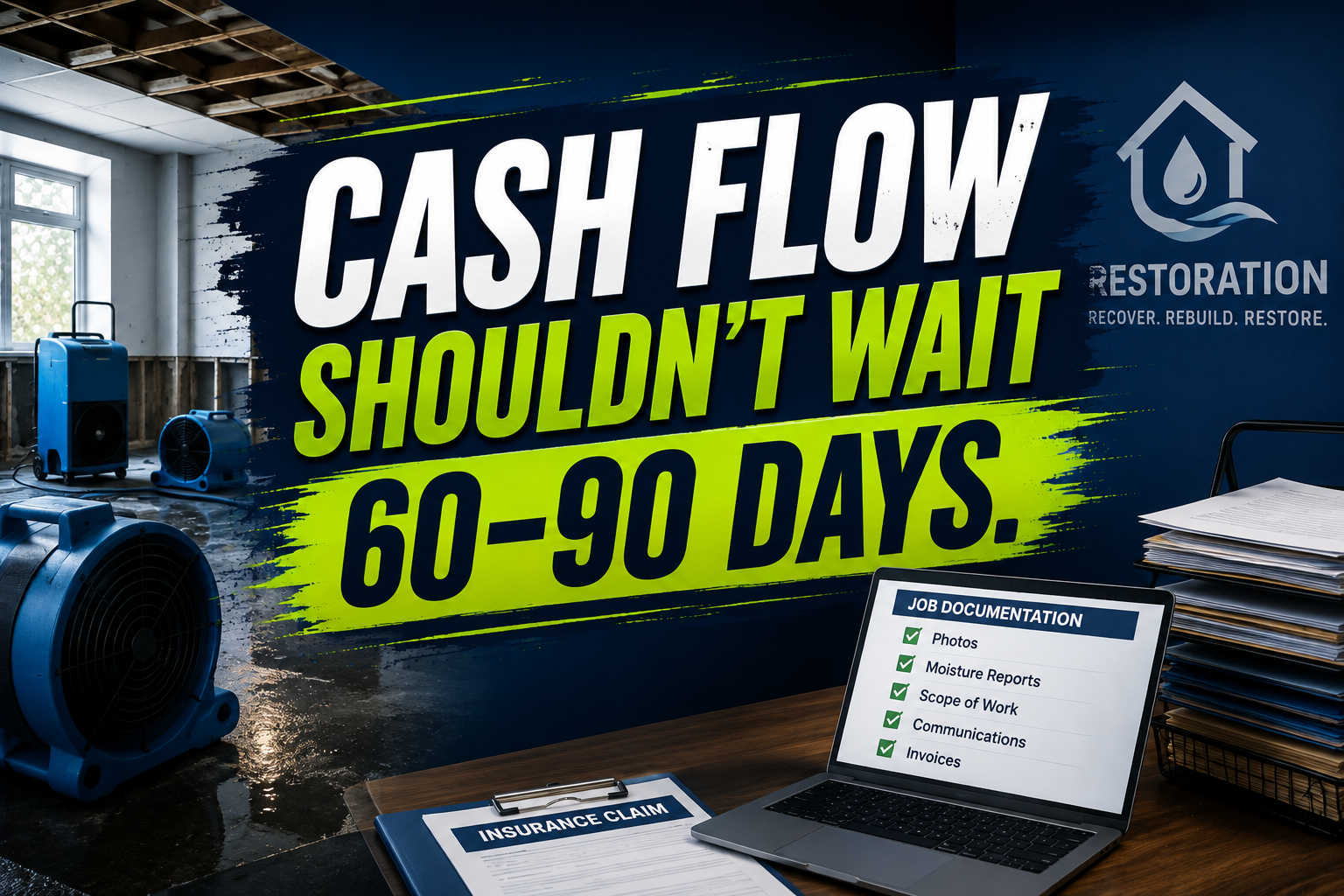
This is the 2026 Restoration Cash Flow Paradox: you are working harder than ever, closing more jobs than last quarter, and watching your top-line revenue climb, but your cash is trapped in purgatory. Insurance carriers, third-party administrators (TPAs), and mortgage companies are taking 60, 75, or even 90 days to settle claims. Meanwhile, your fuel bills, chemical restocking, disposal fees, and technician wages must be paid every single week.
In the restoration industry, profit on a spreadsheet is an illusion until the funds actually clear your bank account. When your Days Sales Outstanding (DSO) stretches past 60 days, your business stops operating as an emergency service provider and inadvertently becomes an interest-free bank for insurance carriers. Solving this crisis does not require working more hours on site; it requires plugging the administrative leaks in your back office. By deploying a specialized restoration virtual assistant at $8/hr, growing mitigation and reconstruction firms are reclaiming control of their billing cycles, eliminating administrative bottlenecks, and accelerating cash flow from 72 days down to 28 days.
What "Documentation Leak" Actually Means
Most restoration business owners believe their cash flow problems start with stingy insurance adjusters or slow-paying carriers. While carrier friction is real, the root cause of 80% of delayed payments and denied supplements is an invisible profit killer known as the "Documentation Leak."
In restoration, your invoice is only as strong as the electronic paper trail backing it up. If your field technicians rush through an emergency extraction, leave moisture logs half-filled, upload blurry photos without room tags, or fail to cite specific IICRC S500 and S520 standards, you have created a documentation leak. When that file lands on an adjuster’s desk, it triggers an automatic review delay, a request for information (RFI), or a brutal line-item reduction in Xactimate.
Insurance carriers do not reject claims out of pure malice; they reject claims because their automated auditing software and desk adjusters require undeniable proof of necessity. If you billed for 15 axial air movers and 4 dehumidifiers over four days, but your daily psychrometric logs do not clearly demonstrate drying goals, psychrometric calculations, and daily atmospheric readings, the carrier will slash your equipment days. If your structural framing demolition photos do not show charred studs or rot with a measuring tape reference, your reconstruction supplement gets thrown out.
Every missing moisture reading, every unlabeled photo, and every delayed submission of your estimate package adds weeks to your collection cycle. Your technicians are masters of demolition, drying, and microbial remediation, but asking high-priced field operatives to sit in a truck at 7:00 PM typing comprehensive narrative reports and formatting photo logs is a recipe for burnout and human error. Closing the documentation leak requires dedicated administrative horsepower that operates systematically behind the scenes, ensuring every claim file is airtight before it ever touches a carrier portal.
Progress Billing as the Operational Solution
If your business model relies on completing an entire multi-phase mitigation and reconstruction project before submitting a single invoice, you are inviting severe cash flow starvation. In commercial loss and large residential rebuilds, a project can span three to six months from emergency dry-out to final drywall finishing. Waiting until the final coat of paint dries to bill for emergency extraction is financial suicide.
Progress billing is the operational antidote to long collection cycles, yet many independent restoration companies avoid it because managing milestone invoices feels like an administrative nightmare. Tracking which scope tiers are completed, reconciling change orders against initial Xactimate estimates, verifying subcontractor invoices, and issuing partial invoices for emergency mitigation while reconstruction is still underway requires relentless attention to detail.
When you implement progress billing correctly, your cash flow follows a rolling cadence rather than a boom-and-bust rollercoaster. By billing against completed scope tiers, such as issuing a progress invoice immediately upon completion of emergency mitigation and microbial treatment, followed by subsequent milestone billings during reconstruction, you shorten your effective DSO dramatically.
To manage this without drowning your office staff, you need a disciplined 13-week rolling cash forecast coupled with rigorous AR aging tracking broken down by carrier and TPA. A dedicated restoration virtual assistant transforms progress billing from an overwhelming chore into an automated, predictable engine. Your virtual assistant monitors job milestones in platforms like DASH or Albi, cross-references completed field sheets, generates accurate progress invoices tied directly to approved Xactimate line items, and fires them off to carriers the exact day a milestone is reached.
What a Restoration Virtual Assistant Actually Does
When business owners first hear about hiring a virtual assistant for $8/hr, skepticism is natural. How can someone thousands of miles away assist with complex restoration workflows like Xactimate and Encircle? The answer lies in systematic delegation of back-office operations. A skilled restoration virtual assistant acts as your remote operations coordinator, executing precise daily protocols that free your project managers and estimators to focus on closing jobs and inspecting sites.
Here are the core operational pillars a restoration virtual assistant owns within your business:
First, they manage Xactimate supplement preparation. Your estimator dictates notes or marks up field scopes, and the virtual assistant builds out the detailed line-item supplement package, matching photos to line items, inserting required carrier guidelines, and formatting the estimate for maximum approval rates before submission.
Second, they handle daily moisture log assembly and validation. Using platforms like Encircle, DASH, or DryBook, your virtual assistant reviews incoming technician logs every morning, flags missing psychrometric readings, ensures photo counts meet carrier compliance thresholds, and pushes incomplete logs back to field techs for immediate correction while they are still on site.
Third, they execute rigorous AR aging tracking and collections management. The virtual assistant runs weekly aging reports, categorizes outstanding balances by carrier and TPA, and initiates systematic follow-up cadences on 15-day, 30-day, and 60-day overdue buckets via email, phone calls, and carrier web portals.
Fourth, they generate and dispatch progress billing invoices. As soon as a mitigation phase or drywall phase is marked complete in your CRM, the virtual assistant compiles the itemized invoice, attaches the supporting documentation packet, and submits it directly to the adjuster or TPA portal, eliminating billing lag.
Fifth, they maintain relentless carrier communication and status updates. Instead of your project managers wasting two hours a day on hold with insurance carrier call centers, your virtual assistant logs into TPA portals (like Contractor Connection, Alacrity, or Nexxa), checks claim approval statuses, uploads requested documents instantly, and updates your internal project management dashboard.
The Economics of Scale: $8/hr vs. $65K/yr In-House
To understand why top-performing restoration companies are shifting away from traditional local hiring models, you must examine the raw unit economics of administrative overhead.
Hiring a full-time in-house project coordinator or administrative assistant in the United States today carries a heavy price tag. Between a median salary of $55,000 to $65,000 per year, employer payroll taxes, workers' compensation insurance, health benefits, paid time off, sick leave, desk space, computer hardware, and ongoing software seat licenses, your true fully-loaded cost easily exceeds $75,000 annually. Furthermore, local hires often handle 40 hours of work within standard 9-to-5 business hours, leaving emergency after-hours documentation stranded until the next morning.
In sharp contrast, partnering with Virtual Nexgen Solutions to deploy a specialized restoration virtual assistant at $8/hr changes the financial equation entirely. At $8/hr, a dedicated 40-hour-per-week professional costs roughly $1,386 per month, totaling around $16,640 per year. You eliminate overhead, payroll friction, benefits administration, and management drag.
Even better, because Virtual Nexgen Solutions provides flexible coverage options, you can scale your support up or down depending on seasonal disaster surges, such as freezing pipe bursts in winter or hurricane and severe storm seasons in summer. You gain enterprise-grade operational leverage at a fraction of the cost, turning a rigid fixed overhead expense into a dynamic, ROI-positive operational asset.
5 Tasks to Delegate Immediately to Fix Cash Flow
If you want to experience an immediate compression in your DSO and stop revenue leakage this week, you must stop letting high-value team members perform low-value administrative tasks. Hand off these five specific workflows to your restoration virtual assistant right now:
- Daily Moisture Log Auditing: Have your virtual assistant review every uploaded psychrometric log and photo set by 9:00 AM daily, instantly flagging missing data so field techs can fix it before closing the job file.
- Accounts Receivable Aging Follow-Ups: Delegate the unglamorous task of tracking 30, 60, and 90-day outstanding carrier invoices, requiring your assistant to log every call, email, and portal update into your CRM.
- Supplement Documentation Bundling: Stop making your estimators hunt for photos and drying logs. Have your assistant assemble complete supplement packages with side-by-side photo comparisons and IICRC standard references ready for final review.
- TPA Portal Status Updates: Offload the tedious chore of navigating carrier and TPA contractor networks to check claim approval statuses, ensuring every file moves steadily through the carrier's internal review queue.
- Initial Estimate and Invoicing Dispatch: Instruct your virtual assistant to generate and send out itemized progress invoices the exact minute a milestone or phase is marked complete in your project management system.
Proven Impact: Two Restoration Case Studies
Theoretical efficiency is nice, but real-world results tell the true story of operational transformation. Consider these two anonymized case studies from independent restoration companies that partnered with Virtual Nexgen Solutions.
Case Study 1: Cutting DSO from 72 Days to 28 Days in Texas
A full-service water and mold mitigation company operating in the Dallas-Fort Worth metroplex was generating $3.8 million in annual revenue but was perpetually starved for working capital. Their average Days Sales Outstanding (DSO) sat at a grueling 72 days. The owner discovered that billing was happening an average of 14 days after job completion due to backlog, and carrier supplements were delayed by incomplete photo logs.
They partnered with Virtual Nexgen Solutions to deploy two dedicated restoration virtual assistants at $8/hr. The virtual assistants took over daily moisture log auditing, immediate post-mitigation invoicing, and systematic AR follow-ups. Within 90 days, billing turnaround dropped from 14 days to same-day, and overall DSO plummeted from 72 days down to 28 days. The company recovered over $180,000 in trapped working capital without adding a single dollar of additional debt.
Case Study 2: Recovering $40,000 in Stuck AR for a Fire Restoration Firm in Ohio
A growing fire and smoke restoration contractor in Columbus, Ohio, was facing a major cash flow crunch. They had completed several large residential soot remediation and structural board-up jobs totaling over $40,000 in outstanding receivables that had stalled out between desk adjusters and mortgage endorsement departments. Their in-house project managers were too overwhelmed with new emergency losses to chase down mortgage check sign-offs and missing carrier sign-offs.
Virtual Nexgen Solutions integrated a specialized restoration virtual assistant to audit the stuck files, identify missing endorsement forms, contact mortgage companies daily, and push TPA portal re-submissions. Within 45 days, 100% of the stalled $40,000 in AR was collected, and the firm established a permanent weekly collection cadence that prevented future accounts from aging past 30 days.
Frequently Asked Questions
1. What is a restoration virtual assistant?
A restoration virtual assistant is a trained remote professional who manages back-office administrative, billing, documentation, and coordination tasks specifically tailored to water, fire, and mold mitigation companies.
2. How much does a restoration virtual assistant cost?
With Virtual Nexgen Solutions, specialized restoration virtual assistants are available at an industry-leading rate of $8 per hour, offering massive cost savings compared to local hires.
3. Can a virtual assistant work inside Xactimate and DASH?
Yes. Restoration virtual assistants are trained to navigate industry-specific software including Xactimate, DASH, Albi, Encircle, CompanyCam, and QuickBooks.
4. How does a virtual assistant help reduce DSO?
By eliminating billing delays, auditing documentation daily to prevent carrier pushback, and running systematic AR follow-up cadences on overdue carrier invoices.
5. Do restoration virtual assistants understand IICRC standards?
Yes. Our virtual assistants are trained in standard restoration terminology, including IICRC S500 (water damage restoration) and S520 (mold remediation) documentation requirements.
6. How do I communicate with my virtual assistant during emergency calls?
Your virtual assistant operates on your preferred communication channels, including Slack, WhatsApp, Microsoft Teams, email, and direct integration with your company CRM and phone systems.
7. Can a virtual assistant prepare Xactimate supplements?
Yes. They compile the required photo evidence, moisture readings, and line-item justifications so your estimator can quickly review and submit supplements for approval.
8. Are my company data and customer records secure?
Absolutely. Virtual Nexgen Solutions adheres to strict data privacy and security protocols, ensuring all client information, customer data, and financial records remain confidential and secure.
9. How fast can a restoration virtual assistant start?
Onboarding typically takes between 3 to 5 business days, including matching your company with a VA who has experience in your specific restoration software stack.
10. What is the difference between a human VA and AI software?
While AI tools assist with automation, human restoration virtual assistants provide nuanced judgment, empathetic communication with homeowners, and active persistence when dealing with stubborn insurance adjusters.
11. Can a virtual assistant handle progress billing?
Yes. They monitor job phase completions in your project management software and instantly generate and submit progress invoices according to your defined milestones.
12. Do I need to provide computer hardware or software licenses?
No. Our virtual assistants come fully equipped with high-speed internet, professional dual-monitor workstations, and headsets, plugging directly into your existing cloud software seats.
13. What industries within restoration do you serve?
We serve water damage mitigation companies, fire and smoke restoration contractors, mold remediation specialists, and full-service residential and commercial reconstruction firms.
14. How do virtual assistants handle customer service for upset homeowners?
They maintain a polite, empathetic, and professional demeanor, handling appointment confirmations, gathering initial loss details, and reassuring property owners during stressful emergency situations.
15. Can a virtual assistant manage my accounts receivable aging reports?
Yes. They pull weekly aging reports from QuickBooks or your CRM, categorize past-due balances by insurance carrier or TPA, and execute disciplined follow-up schedules.
16. What happens if my restoration volume spikes during storm season?
You can easily scale your virtual assistant hours up or down with Virtual Nexgen Solutions to match seasonal disaster surges without long-term employment commitments.
17. Do virtual assistants make outbound calls to insurance adjusters?
Yes. They regularly follow up with carrier desk adjusters, TPA coordinators, and mortgage departments to check claim approval statuses and request updates.
18. How do I train my virtual assistant on our specific company SOPs?
During onboarding, we map your exact standard operating procedures (SOPs), review your preferred templates, and integrate your team into a seamless daily workflow.
19. Will an $8/hr virtual assistant speak fluent English?
Yes. All Virtual Nexgen Solutions professionals undergo rigorous English communication and comprehension screening to ensure clear, professional interactions with clients and adjusters.
20. How do I get started with Virtual Nexgen Solutions?
Simply schedule a free consultation with our team at Virtual Nexgen Solutions to discuss your operational bottlenecks and match with your dedicated restoration virtual assistant.
Conclusion
The 2026 restoration landscape rewards speed, precision, and relentless administrative discipline. Letting documentation leaks and slow carrier payment cycles choke your cash flow is a choice, not an inevitability. By bringing in a specialized restoration virtual assistant at $8/hr from Virtual Nexgen Solutions, you eliminate administrative debt, compress your DSO, and protect your hard-earned profit margins. Stop acting as an unpaid bank for insurance carriers and start scaling your restoration empire today.