It is Friday evening at 8:15 PM. A daughter, exhausted from balancing her own career and her father’s declining health, finally sits down to find a solution. She realizes her father can no longer live safely at home without professional help. She calls three senior care agencies. The first goes to voicemail. The second has a "system error" and cannot take down her information. The third, your agency, answers through an after-hours service that tells her someone will call her back on Monday.
By Monday morning, she has already signed a contract with a competitor who answered the phone, scheduled a walkthrough for Saturday morning, and sent a digital welcome packet within ten minutes of the initial call.
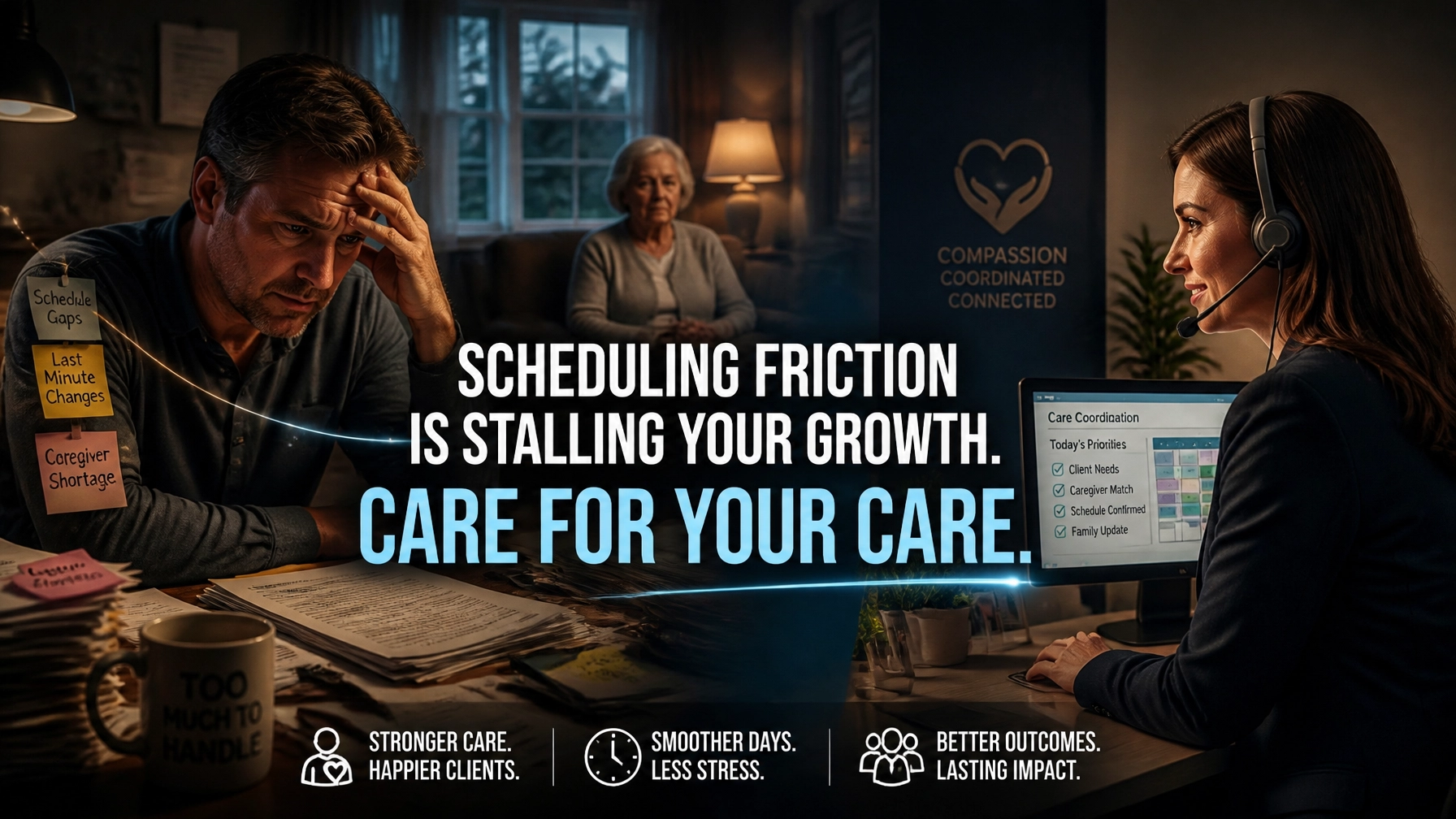
This is the "Care Gap." It isn't a failure of your caregivers or your clinical expertise. It is the painful space between a family's urgent need and your agency's ability to respond. In senior care, the distance between "we can help" and "we are helping" often gets clogged by administrative friction that drains your growth, frustrates your staff, and sends overwhelmed families to the competitor who simply answered faster. At Virtual Nexgen Solutions, we see this pattern daily: agencies with hearts of gold but back offices moving like they are stuck in wet cement.
The High Cost of Administrative Friction
When families look for senior care, they aren't just buying hours of service; they are buying peace of mind. Every time a scheduling conflict occurs, a billing error arrives in the mail, or an intake call is handled with hesitation, that peace of mind erodes. Administrative friction is the silent killer of the "Review-Referral" loop that fuels successful agencies.
Administrative debt accumulates when your highly trained, $60,000-a-year office coordinator spends four hours a day playing "phone tag" with caregivers to fill a single Saturday shift. It grows when your intake process is a disorganized scramble of paper forms and unreturned emails. According to recent industry research, nearly one-third of older adults and their families report significant gaps in care coordination. These gaps rarely stem from the caregiver at the bedside; they stem from the desk where the coordination is supposed to happen.
If your office staff is buried in spreadsheets and manual data entry, they aren't talking to families. They aren't building relationships with hospital discharge planners. They are simply surviving. This operational survival mode creates a "friction tax" on every new lead you generate.
Why 9-to-5 Staffing Fails a 24/7 Industry
Senior care is not a Monday-through-Friday business. Crises don't respect business hours. Falls happen at 2:00 AM on Sundays. Families have their "come to Jesus" realizations about needing help during the weekend. If your agency operates on a traditional 9-to-5 administrative schedule, you are effectively closed for 70% of the week when families are most likely to be searching for your services.
Relying solely on an in-house office team creates a bottleneck. When your office coordinator is out sick or on vacation, who manages the intake? Who updates the caregiver schedules? Usually, the owner steps in, dragging you away from strategic growth and back into the weeds of daily operations.
By implementing specialized virtual support through Virtual Nexgen Solutions, you can bridge this gap. Picture an agency where every inquiry gets a prompt response, even after hours, and every scheduling change gets handled quickly without your local team running around like their coffee never kicked in.
The Emotional Weight of Slow Response Times
For a family in the middle of a care crisis, every minute of silence from an agency feels like an eternity of neglect. They are scared, overwhelmed, and looking for a leader. When your administrative process is clunky, you communicate that you aren't ready to lead.
Responsiveness is the highest form of empathy in this industry. If a family has to call three times to get a quote or a start date, they assume your actual care will be just as disorganized. Disorganized intake processes lead families to choose competitors who have tightened up their communication. You might offer the best care in the state, but if your "front door" is locked behind administrative hurdles, they will never see it.
The Financial Reality: Why Your Current Staffing Model is Leaking Profit
Many agency owners believe they need an in-house, full-time office coordinator to manage the chaos. However, the math rarely favors this approach for a scaling agency. A competent in-house office coordinator in the U.S. will usually cost you $50,000 or more per year before you even count benefits, payroll taxes, office space, and equipment. By the time you stack on those extra costs, you are paying a premium for work like intake follow-up, calendar wrangling, billing coordination, and caregiver scheduling. A specialized Virtual Assistant at $8 to $10 per hour changes that equation fast. Instead of carrying a heavy fixed overhead load, you get focused support for the exact tasks that keep your agency responsive and organized. The savings can easily top $40,000 a year, and that gives you room to invest in caregiver retention, community partnerships, and better client service instead of pouring money into back-office drag.
By utilizing specialized medical and administrative support, you shift from a high-fixed-cost model to a lean, scalable operation. You stop paying "Executive Director" prices for data entry and scheduling.
Tactical SOP: Streamlining the New Family Intake Process
To eliminate friction, you must standardize the intake. Here is a step-by-step procedure your team, or your Virtual Nexgen Solutions VA, should follow to ensure no lead is left behind.
SOP: The 15-Minute Response Protocol
- Immediate Lead Capture: Ensure all website inquiries and calls are funneled into a central CRM or tracking sheet.
- The Initial Contact: Within 15 minutes of an inquiry, place the first call. If they don't answer, send a standardized, empathetic text message and email.
- The Discovery Phase: Use a standardized digital intake form to collect essential data: level of care needed, location, timeline, and funding source (Private Pay, Long-Term Care Insurance, etc.).
- The Scheduling Hook: Never end the first call without a firm date for a home assessment or discovery call.
- The Follow-Up Sequence: Immediately send a "What to Expect" digital packet that includes caregiver bios, pricing transparency, and a link to your about page to build trust.
- Internal Hand-off: Log all notes in your Agency Management System (AMS) and tag the supervisor for the assessment.
By following this script, you eliminate the "I'll get back to you" culture that kills conversions.
Solving the Scheduling Puzzle
Scheduling is the most significant source of friction in senior care. Caregivers call out, clients change their hours, and the puzzle pieces never seem to fit. This is where "Admin Debt" becomes a physical burden.
A dedicated Virtual Assistant can manage your scheduling software 24/7. They can handle the "call-around" when a caregiver is sick, ensuring that the client is never left without care and the family isn't the one calling you to ask where their aide is. This level of proactive coordination is what separates the elite agencies from the struggling ones.
Tactical SOP: Proactive Caregiver Coordination
- Morning Check-ins: Your VA contacts every caregiver scheduled for the day two hours before their shift via a messaging app to confirm they are on their way.
- The "Gap" Alert: If a caregiver doesn't respond or calls out, the VA immediately identifies the next three closest caregivers with matching skill sets.
- Family Notification: Before the family realizes there is a delay, the VA sends a professional update: "We are currently navigating a minor scheduling shift and will have a confirmed update for you in 20 minutes."
- Resolution: The VA secures the replacement and updates the schedule in the system.
This proactive approach stops the "Care Gap" before it starts, preserving your agency’s reputation.
Why Virtual Nexgen Solutions is the Strategic Choice
We don't just provide "help"; we provide an operational engine. Our VAs are trained to understand the nuances of senior care, from HIPAA compliance to the importance of empathy in every interaction. We focus on the top 10 US industries where administrative support is the difference between stagnation and scaling, and senior care is at the top of that list.
When you work with us, you aren't just hiring a remote worker. You are implementing a system that allows you to focus on the mission of care while we handle the friction of the office. Our $8/hour rate is designed to help independent agencies and franchisees outcompete the "big box" corporations who are bogged down by their own internal bureaucracy.
Stop letting administrative friction stall your growth. It is time to care for your care.
Frequently Asked Questions
1. How can a virtual assistant handle senior care scheduling without being in my local office?
With modern Agency Management Systems (AMS), our VAs can access your scheduling dashboard in real-time. They use integrated VOIP phone systems and messaging apps to communicate directly with your local caregivers and families, functioning just like an in-house coordinator would.
2. Is it safe to share sensitive family and medical information with a remote assistant?
Absolutely. We prioritize security and follow strict data handling protocols. Our VAs are trained in privacy best practices to ensure that all client and caregiver information remains secure and compliant with industry standards.
3. Can a VA help with our billing and long-term care insurance claims?
Yes. Our VAs can assist with invoice generation, following up on unpaid bills, and coordinating the necessary documentation for Long-Term Care (LTC) insurance claims, which is often a major pain point for families.
4. How do I know if my agency is ready for a Virtual Assistant?
If you or your office manager are spending more than 10 hours a week on scheduling, data entry, or initial phone screens, you are already "overpaying" for those tasks. Bringing on a VA at $8/hour allows your local team to focus on high-value tasks like home assessments and community networking.
5. How long does it take to get a VA up and running?
We aim for a fast onboarding process. Once we understand your specific software and workflows, we can typically have your dedicated support person integrated into your systems within a few days.
6. Will a VA understand the "human" side of senior care?
We specifically select assistants with high emotional intelligence. While they handle administrative tasks, they understand that they are the voice of your agency during some of a family's most stressful moments.
7. Can a VA assist with caregiver recruitment and onboarding?
Yes. A VA can post job ads, screen initial resumes, schedule interviews for you, and manage the collection of onboarding documents like background checks and certifications, significantly speeding up your hiring funnel.
8. What happens if I need to change my VA or scale up?
Virtual Nexgen Solutions is built for scale. Whether you need one person for 20 hours a week or a team of five to manage multiple locations, we can adjust your support level as your agency grows.
Are you ready to close the Care Gap in your agency? Book a 30-minute strategy call with Virtual Nexgen Solutions today and get your administrative engine running smoothly.