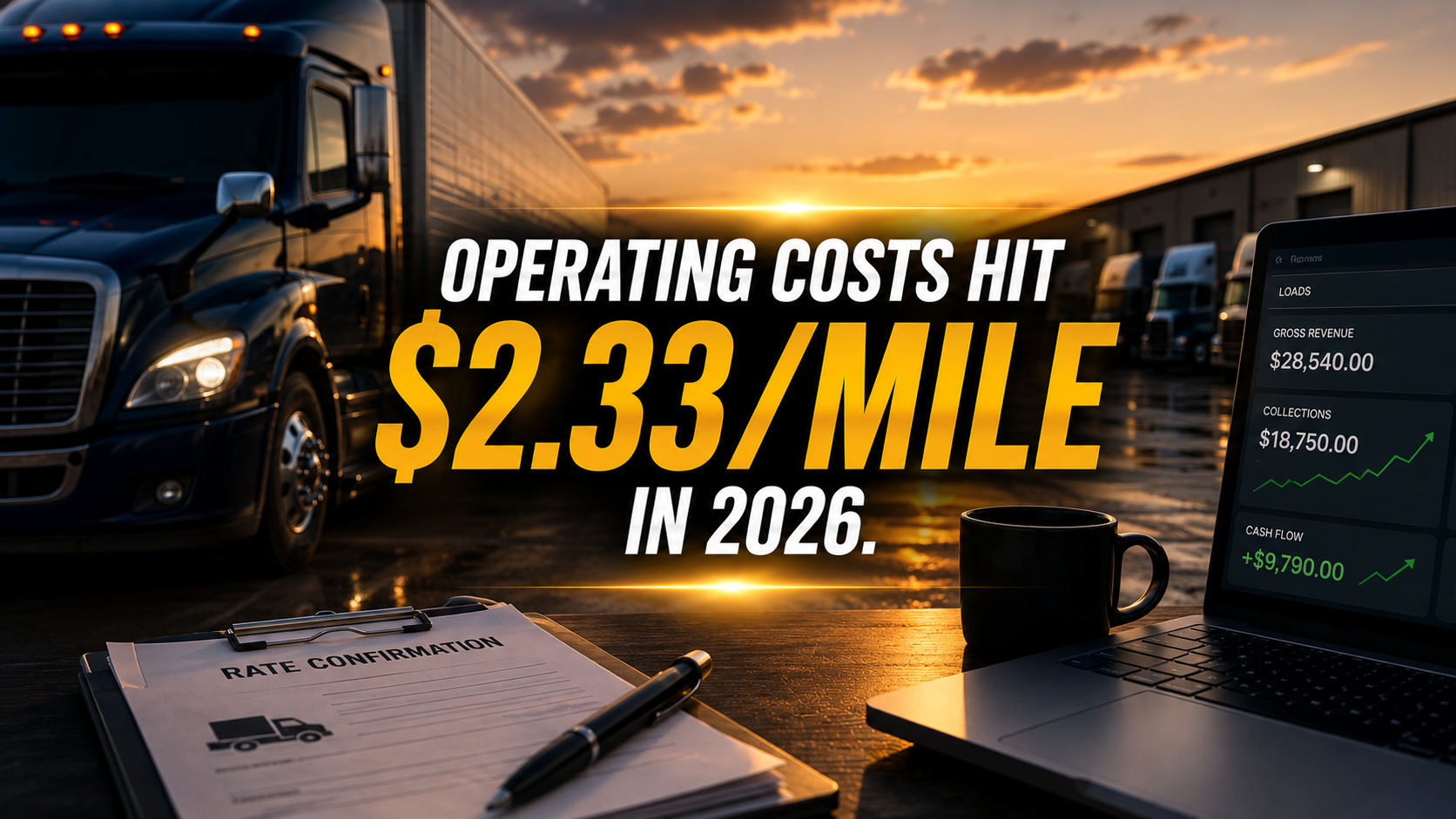
The trucking industry in 2026 is navigating a perfect storm of operational pressure. According to the latest ATRI data, the average cost to operate a heavy-duty truck has surged to a record $2.336 per mile. This represents a 3.4% increase from the previous year, driven primarily by non-fuel expenses like insurance, maintenance, and driver benefits. While fuel prices fluctuate, the structural costs of keeping a fleet on the road are higher than they have ever been.
For most fleet owners, the problem isn't just the cost, it's the timing. You pay for fuel today. You pay for tires today. You pay your drivers this Friday. But the broker? The broker might not pay you for 30, 45, or even 60 days. This "Cash Flow Gap" is where small to mid-sized trucking companies go to die.
When your margins are squeezed between a $2.33/mile cost and stagnant freight rates, there is zero room for error. A single lost Proof of Delivery (POD), a missed detention charge, or a delayed factoring submission can snowball into a liquidity crisis. This is no longer just a "back office" issue; it is a survival issue.
The Invisible Enemy: Admin Debt and Profit Leakage
In the trucking world, Admin Debt is the compound interest of unorganized paperwork. It is the stack of rate confirmations sitting on the dashboard, the unbilled detention hours from three weeks ago, and the IFTA data that hasn't been reconciled.
Admin Debt leads directly to Profit Leakage. Every time a driver fails to send a clear BOL photo, or a broker "forgets" to include an accessorial charge, money leaks out of your business. Most carriers lose 1% to 4% of their gross revenue to these minor administrative frictions. On a 10-truck fleet doing $2 million in revenue, that is an $80,000 annual loss, money that should be in your pocket, not left on the broker's balance sheet.
You cannot out-hustle a broken system. If you are spending your nights chasing Bill of Ladings or arguing with factoring companies about "missing paperwork," you are not growing your fleet. You are performing $15-an-hour tasks while your $2.33/mile asset sits idle or underperforms.
What Is a Trucking Virtual Assistant? (The 2026 Definition)
A trucking virtual assistant is not a general clerical worker. They are specialized administrative professionals trained specifically in the workflows of the US logistics industry. They understand the difference between a BOL and a POD. They know how to navigate DAT and Truckstop. They understand the urgency of a "clean" factoring submission.
At Virtual Nexgen Solutions, our trucking VAs operate at a rate of $8 per hour, providing a cost-effective alternative to hiring an in-house office manager which typically costs $55,000 to $65,000 per year plus benefits.
These specialists act as your "Back Office Engine," handling the repetitive, detail-oriented tasks that allow you to focus on dispatching, driver retention, and scaling your business. They integrate directly into your existing software, whether it's McLeod, TruckMate, Samsara, or QuickBooks, ensuring that every mile your trucks run is documented, billed, and paid.
The $60,000 Cash Flow Leak You’re Ignoring
Most fleet owners view administrative costs as a fixed necessity. They hire a local office manager for $60,000 a year, give them a desk, and hope for the best. But when you factor in taxes, insurance, office space, and "slow time," that employee is actually costing you closer to $80,000.
Worse, if that person isn't a specialist, they might be missing the very things that cause profit leakage.
Where the $60,000 vanishes:
- Factoring Fee Waste: Factors charge extra for "high-risk" brokers or delayed payments. A VA who vets brokers and submits clean paperwork reduces these surcharges.
- Unclaimed Accessorials: Detention, layovers, and TONU (Truck Order Not Used) often go unbilled because the paperwork is messy.
- Driver Settlement Errors: Overpaying or underpaying drivers leads to disputes, which leads to turnover. Replacing one driver in 2026 costs an average of $12,000 in recruiting and downtime.
- Late Payment Penalties: Missing a truck payment or an insurance premium because "the check is in the mail" results in massive penalties and credit damage.
By switching to a specialized VA from Virtual Nexgen Solutions, you replace that $60,000 salary with a flexible, $8/hour high-performance engine.
25 Essential Tasks a Trucking VA Handles for Your Fleet
A specialized VA handles the "heavy lifting" of the back office. Here is exactly what they manage to ensure your $2.33/mile costs don't outpace your revenue:
Factoring & Collections
- Daily Invoice Submission: Submitting every load to the factor within 2 hours of POD arrival.
- Broker Credit Checks: Vetting every load on DAT/Truckstop to ensure the broker is creditworthy.
- Aging Report Management: Chasing brokers who are past the net-30 window.
- Short-Pay Resolution: Investigating why an invoice was paid for less than the rate confirmation.
- POD Auditing: Ensuring every POD is legible and signed before submission to prevent rejections.
Rate Confirmation & Billing
- Rate Con Verification: Matching the rate con to the actual BOL to find discrepancies.
- Accessorial Tracking: Documenting detention times using ELD data from Samsara or Motive.
- Manual Invoicing: Creating professional invoices for direct shippers who don't use factoring.
- Lumper Fee Recovery: Processing lumper receipts and ensuring they are reimbursed immediately.
- TONU/Layover Claims: Filing claims for cancelled loads or excessive wait times.
Driver Settlements & Payroll
- Weekly Settlement Prep: Calculating driver pay based on miles, percentage, or flat rate.
- Expense Reimbursement: Auditing fuel receipts and toll charges for accuracy.
- Driver Communication: Sending settlement sheets to drivers and explaining any deductions.
- Escrow Management: Tracking driver escrow accounts for repairs or lease-purchases.
- Per Diem Tracking: Managing the tax-free per diem portions of driver pay.
Compliance & Safety
- IFTA Reconciliation: Collecting fuel receipts and matching them to state mileage reports.
- ELD Monitoring: Checking for HOS (Hours of Service) violations and alerting the owner.
- DQ File Management: Maintaining Driver Qualification files to ensure DOT compliance.
- Permit Renewals: Tracking and renewing IRP, UCR, and heavy vehicle use taxes (2290).
- Insurance Certificates: Requesting and sending COIs (Certificates of Insurance) to new brokers.
Dispatch & Admin Support
- Carrier Packet Completion: Filling out 20-page broker packets so you can book loads faster.
- Load Board Scrubbing: Finding high-paying lanes that fit your fleet's specific needs.
- Email Management: Filtering out the noise and highlighting "Urgent" broker communications.
- Maintenance Scheduling: Reminding drivers of PM (Preventative Maintenance) intervals based on mileage.
- Customer Service: Providing status updates to shippers so you don't have to take "Where's my truck?" calls.
Operational Transformation: Before vs. After Hiring a VA
Most trucking companies operate in a "reactive" state. They react to breakdowns, they react to late payments, and they react to driver complaints. Hiring a VA shifts your operation into a "proactive" state.
Scenario A: The Reactive Fleet (No VA)
- Billing: PODs sit in the truck for 5 days. Factoring submission happens "when we have time."
- Cash Flow: 45-day wait for money. Frequent overdrafts.
- Drivers: Constantly calling to ask about their settlements. 15% turnover rate.
- Profit: Margin is eaten by factoring rejections and missed detention.
Scenario B: The Proactive Fleet (With a Virtual Nexgen Solutions VA)
- Billing: Driver uploads BOL via app. VA audits and submits to factor within 60 minutes.
- Cash Flow: Money in the bank within 24 hours of delivery.
- Drivers: Receive digital settlement sheets every Tuesday. 4% turnover rate.
- Profit: 100% recovery of detention and accessorials. Factoring fees minimized through broker vetting.
5 Actionable SOPs to Systematize Your Trucking Operations
To truly reclaim your cash flow, you must move from "doing things" to "running a system." Here are five Standard Operating Procedures (SOPs) you can hand to a Virtual Nexgen Solutions VA today.
SOP 1: Daily Rate Confirmation Audit & Factoring Submission
- Monitor Inbox: Every time a new Rate Con is signed, the VA saves it to the cloud (Google Drive/Dropbox).
- Verify Rate: Match the Rate Con total against the final BOL.
- Check for "Clean" POD: Ensure the POD is signed, dated, and legible. If not, the VA immediately calls the driver.
- Submit to Factor: Upload the Rate Con and POD to the factoring portal within 2 hours of delivery.
- Log Status: Update the internal "Load Tracker" to "Factored - Pending Funds."
SOP 2: POD Collection & Invoice Follow-Up (48-Hour Standard)
- Scan "Missing POD" Report: Every morning, the VA identifies loads delivered 48 hours ago that lack a POD.
- Driver Outreach: Call/Text the driver to secure the photo.
- Broker Outreach: If the driver cannot provide it, contact the receiver to request a signed copy.
- Escalate: If the POD is not secured within 72 hours, alert the owner to prevent payment forfeiture.
SOP 3: Driver Settlement Calculation & Reconciliation
- Gather Data: Pull mileage reports from the ELD and rate data from the TMS.
- Deduct Expenses: Calculate fuel card usage, toll charges, and any advances.
- Apply Bonuses: Add safety or performance bonuses based on company policy.
- Final Review: Send the draft settlement to the driver for approval before processing.
- Pay Release: Once approved, submit the payroll file to the bank.
SOP 4: Detention & Accessorial Charge Recovery
- ELD Audit: For every load, the VA checks the GPS timestamps at the shipper and receiver.
- Identify Detention: If the truck was on-site for more than 2 hours (standard), calculate the detention hours.
- Request Correction: Email the broker with the ELD proof and a revised Rate Con request.
- Persistent Follow-up: If the broker doesn't respond within 4 hours, call the broker's accounting department.
- Submit: Do not factor the load until the detention is added to the total.
SOP 5: Monthly IFTA Fuel Tax Reconciliation
- Download Reports: Export state-by-state mileage from the ELD (Samsara/Motive).
- Aggregate Receipts: Pull all fuel purchase data from the fuel card portal (Comdata/WEX).
- Audit Discrepancies: Identify any fuel purchases that don't match the truck's location.
- Calculate Net Tax: Use IFTA software to determine the tax due for each jurisdiction.
- Submit Filing: Prepare the final IFTA return for the owner's signature.
Case Studies: Real ROI in the Field
Case Study 1: The 12-Truck Fleet in Texas
Scenario: A general freight carrier in Texas was drowning in "Admin Debt." The owner was spending 20 hours a week on billing and collections. Factoring rejections were high because of poor POD quality, and the company was losing an estimated $2,500 a month in unbilled detention.
The Solution: They hired two specialized VAs from Virtual Nexgen Solutions at $8/hr.
The Result:
- Time Reclaimed: The owner's admin time dropped from 20 hours to 2 hours per week.
- Cash Flow: Factoring turnaround time dropped from 5 days to 24 hours.
- Revenue Recovery: The VAs recovered $3,100 in detention pay in the first 30 days.
- ROI: For an investment of roughly $2,600/mo, they recovered $3,100 in leakage and saved $4,000 in owner-labor value.
Case Study 2: The Owner-Operator in Ohio
Scenario: A high-end reefer owner-operator was struggling with driver settlements for his three sub-contracted trucks. Disputes over fuel surcharges were leading to tension and one driver had already quit.
The Solution: A Virtual Nexgen Solutions VA took over all back-office settlements and broker vetting.
The Result:
- Settlement Accuracy: Errors dropped to zero.
- Broker Quality: By vetting brokers, the VA increased the average rate-per-mile by $0.12 by avoiding low-credit "slow pay" brokers.
- Growth: With the back office systematized, the owner added two more trucks in 90 days without increasing his own workload.
Expert Opinions & Industry Insights
Industry consultants are increasingly vocal about the need for "Fractional Operations" in trucking. The consensus is that the traditional "husband and wife" or "owner-operator does it all" model is no longer viable at $2.33/mile.
"Efficiency is the only lever left for trucking companies in 2026," says one senior logistics analyst. "You cannot control fuel prices, and you have limited control over rates. The only thing you can control is the speed of your cash flow and the cost of your administration. Companies that continue to pay $60,000 for a local admin while their competitors pay $8/hour for specialized VAs are at a massive competitive disadvantage."
The data supports this. Fleet owners who leverage specialized remote support report 20% higher net margins than those who maintain traditional in-house back offices.
Common Mistakes When Hiring a Logistics Assistant
- Hiring for "General" Skills: Do not hire a VA who doesn't know what a BOL is. You will spend 40 hours training them, which defeats the purpose.
- Lack of SOPs: If you don't give the VA a process, they will invent their own, usually a messy one. Use the SOPs provided above.
- Micromanagement: Hiring a VA is about delegation. Trust the system, but audit the results weekly.
- Poor Communication Tools: Ensure your VA has access to your ELD and TMS from Day 1.
- Ignoring the "Culture": Treat your VA as a member of your team. Even at $8/hr, a VA who feels valued will work harder to find that missing $500 detention payment.
Future Trends: The Trucking Fleet of 2027
As we look toward 2027, the "Digital Back Office" will become the standard. Expect to see:
- Instant Verification: Real-time POD verification where the VA and the broker's system communicate instantly to release funds.
- Predictive Maintenance Admin: VAs will use telematics to book repair appointments before a breakdown occurs, minimizing downtime.
- Total Transparency: Brokers will prioritize carriers who have clean, VA-managed administrative records, as it reduces the broker's own administrative load.
Top FAQs About Trucking Virtual Assistants
1. How much does a trucking virtual assistant cost?
At Virtual Nexgen Solutions, our specialized trucking VAs are available for $8 per hour.
2. Do I need to provide them with a computer?
No. Our VAs are fully equipped with their own high-speed internet and professional workstations.
3. Which software can they use?
They are proficient in DAT, Truckstop, McLeod, Samsara, Motive, QuickBooks, OTR Solutions, and more.
4. Can a VA handle dispatching?
Yes, they can assist with load booking, carrier packets, and driver check-calls to streamline your dispatching.
5. How do they get the PODs from my drivers?
Drivers can upload photos to a shared app (like DriveAxle or a simple WhatsApp/Email thread), which the VA monitors.
6. Is my data secure?
Yes. We use enterprise-grade security protocols and non-disclosure agreements (NDAs) to protect your fleet's data.
7. Can they help with IFTA?
Absolutely. They can reconcile fuel receipts against ELD mileage reports for accurate state-by-state filing.
8. Do they speak English?
All Virtual Nexgen Solutions VAs are fluent in English and have experience communicating with US brokers and drivers.
9. How many hours a week can I hire a VA for?
We offer flexible scaling, from part-time support to 24/7 dedicated fleet administration.
10. Can they vet brokers for me?
Yes. They check credit scores and days-to-pay on major load boards before you book a load.
11. What happens if a broker denies a detention claim?
Your VA will persistently follow up with ELD proof and escalate the issue to the broker’s management if necessary.
12. Can they handle my company's social media?
Yes, many VAs are also skilled in managing LinkedIn or Facebook pages to help with driver recruiting.
13. Do they work on US time zones?
Yes, we align our VAs' schedules with your operational hours, whether you are in EST, CST, MST, or PST.
14. How long does it take to get started?
Most fleets can have a VA integrated into their operations within 48 to 72 hours.
15. Can they help with driver recruiting?
Yes, they can post ads, screen initial applications, and verify employment history.
16. What is "Admin Debt" in trucking?
It is the accumulation of unorganized paperwork and unbilled tasks that slows down your cash flow.
17. Can a VA manage my factoring portal?
Yes, they can handle all uploads, rejections, and communication with your factoring company.
18. Do they know how to handle Lumper fees?
Yes, they will collect the receipt and ensure the broker adds the reimbursement to the rate confirmation.
19. Can they help me switch to a new TMS?
Yes, VAs can assist with data entry and migration when moving to a more modern management system.
20. Why should I choose Virtual Nexgen Solutions?
We provide pre-trained, industry-specific experts at an unbeatable $8/hr rate with a proven track record in US logistics.
Conclusion
The 2026 trucking landscape does not reward "busy-ness"; it rewards efficiency. With operating costs at an all-time high of $2.33 per mile, you cannot afford to let your cash flow be strangled by administrative friction. Admin Debt and Profit Leakage are silent killers of the modern fleet.
By integrating a specialized trucking virtual assistant from Virtual Nexgen Solutions, you are not just "hiring a helper." You are installing a high-performance administrative engine designed to recover your margins and accelerate your cash flow: all for a fraction of the cost of in-house staff.
Stop chasing PODs. Start chasing growth.