Insurance agencies lose time in tiny leaks that stack up fast. A certificate request interrupts a producer. A renewal follow-up sits untouched. A carrier download never gets indexed. A claim note lives in someone’s inbox instead of the AMS.
That pressure hits hard when you run a lean independent agency, broker, MGA, risk management firm, wholesaler, or Farmers Insurance office. Your licensed team should spend more time selling, advising, and retaining accounts. Instead, they get buried in service work that keeps the business moving but slows growth.
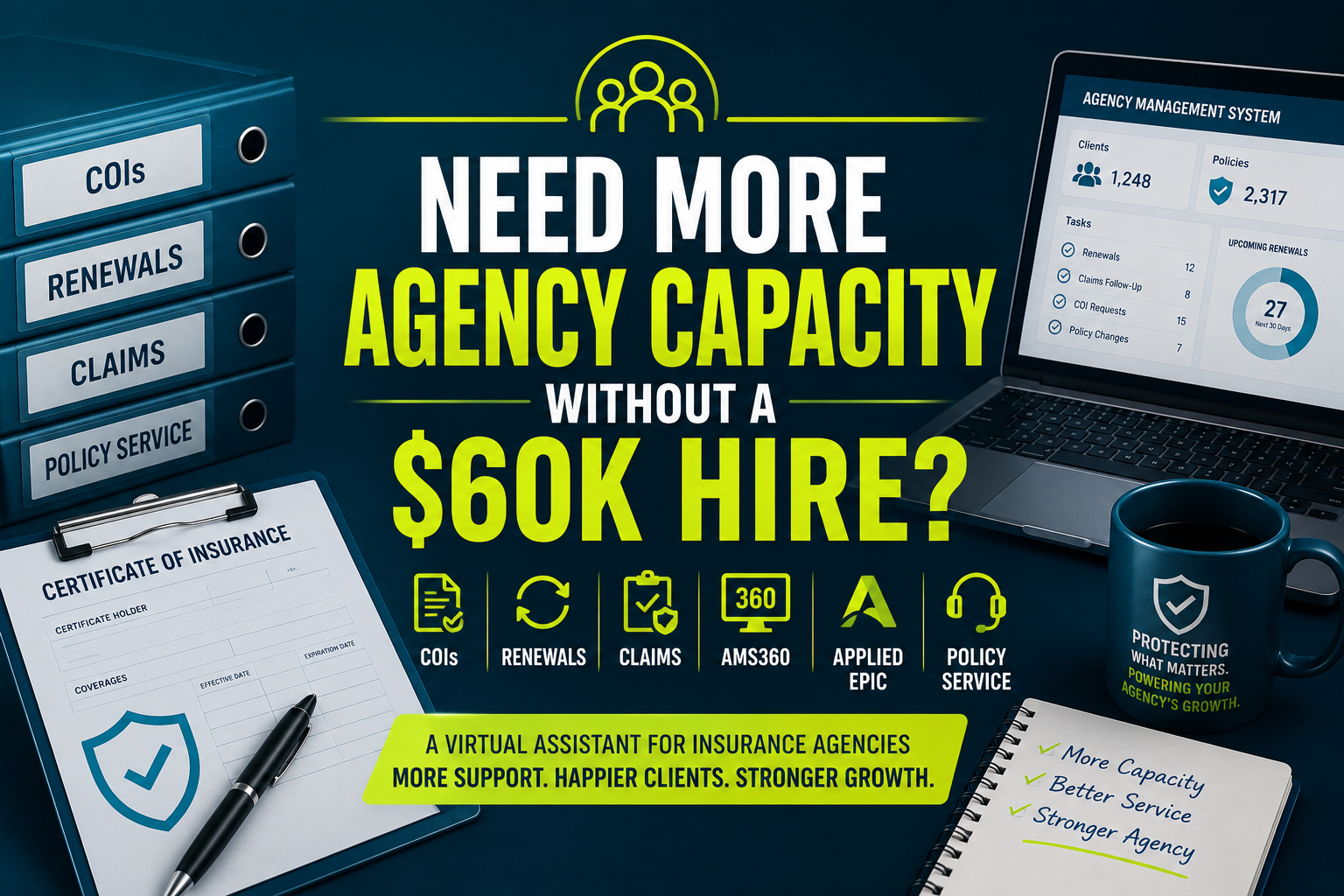
That is where a virtual assistant for insurance agencies creates real value. Virtual Nexgen Solutions provides trained insurance support professionals for $8 per hour, giving you extra capacity without jumping straight to an in-house admin hire that can cost about $60,000 per year before overhead.
What Is an Insurance Virtual Assistant?
An insurance virtual assistant is a remote professional who handles repeatable agency support work. The role focuses on process-heavy admin tasks, not licensed advice or coverage decisions.
A strong insurance VA can work inside systems such as Applied Epic, AMS360, EZLynx, HawkSoft, QQ Catalyst, and Salesforce Financial Services Cloud. The goal is simple: keep records clean, keep requests moving, and keep your producers out of low-value admin work.
What Tasks Can a Virtual Assistant for Insurance Agencies Handle Daily?
A virtual assistant for insurance agencies works best when you assign clear, repeatable tasks with a review path for exceptions.
1. Certificate of Insurance processing
Monitor COI requests, gather missing details, prepare files for review, log delivery, and maintain certificate-holder records.
2. Policy checking and document review
Compare quotes, binders, declarations, and endorsements. Flag missing forms, wrong dates, and named-insured issues before they create rework.
3. Endorsement follow-up
Track address changes, driver updates, vehicle changes, mortgagee requests, and additional insured requests through completion.
4. Carrier portal downloads
Pull policy documents, name files correctly, attach them in the AMS, and log the activity so the record stays complete.
5. Renewal tracking
Manage renewal lists, request updated exposures, chase loss runs, document touches, and prepare clean files for account managers or producers.
6. Claims coordination
Capture first notice details, organize supporting documents, log claim numbers, and track follow-up steps without giving claim or coverage advice.
7. New business setup
Create records, index forms, check signatures, and organize submission files so the account starts clean.
8. Commission reconciliation support
Match statements to transactions, flag discrepancies, and send exceptions to the accounting or leadership team.
9. Inbox triage and client communication
Sort requests by urgency, acknowledge receipt with approved language, route items to the right person, and track deadlines.
10. Data quality and file maintenance
Clean up duplicate contacts, incomplete fields, missing expiration dates, and unattached documents so your AMS stays usable.
How Do Insurance VAs Support AMS and Agency Workflows?
Your agency management system should stay the source of truth. A VA should work inside your existing process, not outside it.
In Applied Epic and AMS360, a VA can support account updates, activity creation, document indexing, renewal tracking, certificate prep, and service follow-up. In EZLynx, HawkSoft, QQ Catalyst, and Salesforce Financial Services Cloud, the same principle applies: define what the VA may touch, what requires review, and where every action gets documented.
Keep access tight. Use individual credentials. Limit permissions. Require clear escalation for anything involving coverage interpretation, binding, legal sensitivity, or claims decisions.
That structure matters. The Bureau of Labor Statistics overview of insurance sales agents makes the business case clear: selling and client advising drive value. Admin overload pulls licensed staff away from revenue-producing work.
How Much Does a Virtual Assistant for an Insurance Agency Cost?
Virtual Nexgen Solutions provides dedicated support at $8 per hour.
Here is the practical math:
- 10 hours per week equals about $4,160 per year
- 20 hours per week equals about $8,320 per year
- 30 hours per week equals about $12,480 per year
- 40 hours per week equals about $16,640 per year
Compare that with an in-house admin employee at roughly $60,000 per year before payroll taxes, benefits, paid time off, equipment, recruiting, and office costs.
Measure results with simple operational metrics:
- COI turnaround time
- Renewal files prepared
- Claims follow-ups completed
- Documents indexed
- Producer hours returned
- Open service requests reduced
- Rework and error rates
If a VA gives a producer back 10 to 15 hours per week, that regained time can go into account reviews, referrals, remarketing, and new business conversations.
What Guardrails Should Insurance Agencies Use?
Outsourcing admin support does not remove your compliance responsibilities. Your agency still owns supervision, licensing decisions, and record quality.
Use these guardrails:
- Separate admin work from licensed advice
- Give the VA individual credentials
- Limit system access to assigned tasks only
- Use written checklists and approval rules
- Require factual activity notes in the AMS
- Protect client data and approved communication channels
- Review sampled work every week
The National Association of Insurance Commissioners consumer resources and Big “I” resources for independent agents both reinforce the importance of documentation, oversight, and proper handling of policy and claims information.
How Does Virtual Nexgen Solutions Support Insurance Agencies?
Virtual Nexgen Solutions supports independent agencies, brokers, MGAs, risk management firms, wholesalers, and growing insurance teams with dedicated back-office help.
You can delegate repetitive insurance workflows without handing over coverage authority. Support can include COIs, renewals, claims follow-up, AMS data entry, document indexing, inbox triage, and commission support across Applied Epic, AMS360, EZLynx, HawkSoft, QQ Catalyst, Salesforce Financial Services Cloud, carrier portals, and ACORD-related workflows.
Virtual Nexgen Solutions has served businesses since 2016 and builds support around your actual workflow, not a generic script. That matters because a Texas P&C broker, a Florida personal-lines agency, and a Midwest MGA do not run the same desk.
Frequently Asked Questions
What is a virtual assistant for insurance agencies?
A virtual assistant for insurance agencies is a remote professional who supports admin workflows such as COIs, renewals, claims follow-up, AMS updates, and document management.
What does an insurance virtual assistant do?
An insurance virtual assistant handles repeatable agency support work like data entry, document indexing, inbox triage, renewal tracking, certificate prep, and service follow-up.
How much does a virtual assistant for an insurance agency cost?
Virtual Nexgen Solutions offers dedicated insurance virtual assistant support at $8 per hour. A 20-hour-per-week setup costs about $8,320 per year before any agreed service fees.
Can a virtual assistant work in Applied Epic?
Yes. A trained VA can support Applied Epic workflows such as account updates, activity creation, document indexing, renewal tracking, and certificate preparation with limited permissions and review rules.
Can a virtual assistant work in AMS360?
Yes. An AMS360 virtual assistant can help with policy records, document filing, downloads, activities, certificates, and renewal support when the agency provides approved access.
Is it legal to outsource insurance agency administrative work?
Administrative insurance work can be outsourced, but rules vary by state, carrier, line of business, and task. Keep coverage advice, binding decisions, and regulated communications with authorized staff.
How does an insurance virtual assistant reduce E&O risk?
A VA can reduce service mistakes by following checklists, documenting actions, tracking deadlines, and escalating missing information fast. Your agency must still supervise the work.
How do I hire a virtual assistant for my insurance agency?
Start with repeatable tasks, define permissions, document review rules, and begin with one controlled workflow such as COIs, renewals, or document indexing.
You do not need to move every agency task to a remote professional on day one. Start with the queue that creates the most delay: COIs, renewals, AMS data quality, claims follow-up, policy documents, or commission reconciliation.
Book a 30-minute consultation with Virtual Nexgen Solutions to review your workflow, identify the best starting queue, and discuss dedicated insurance virtual assistant support at $8 per hour.