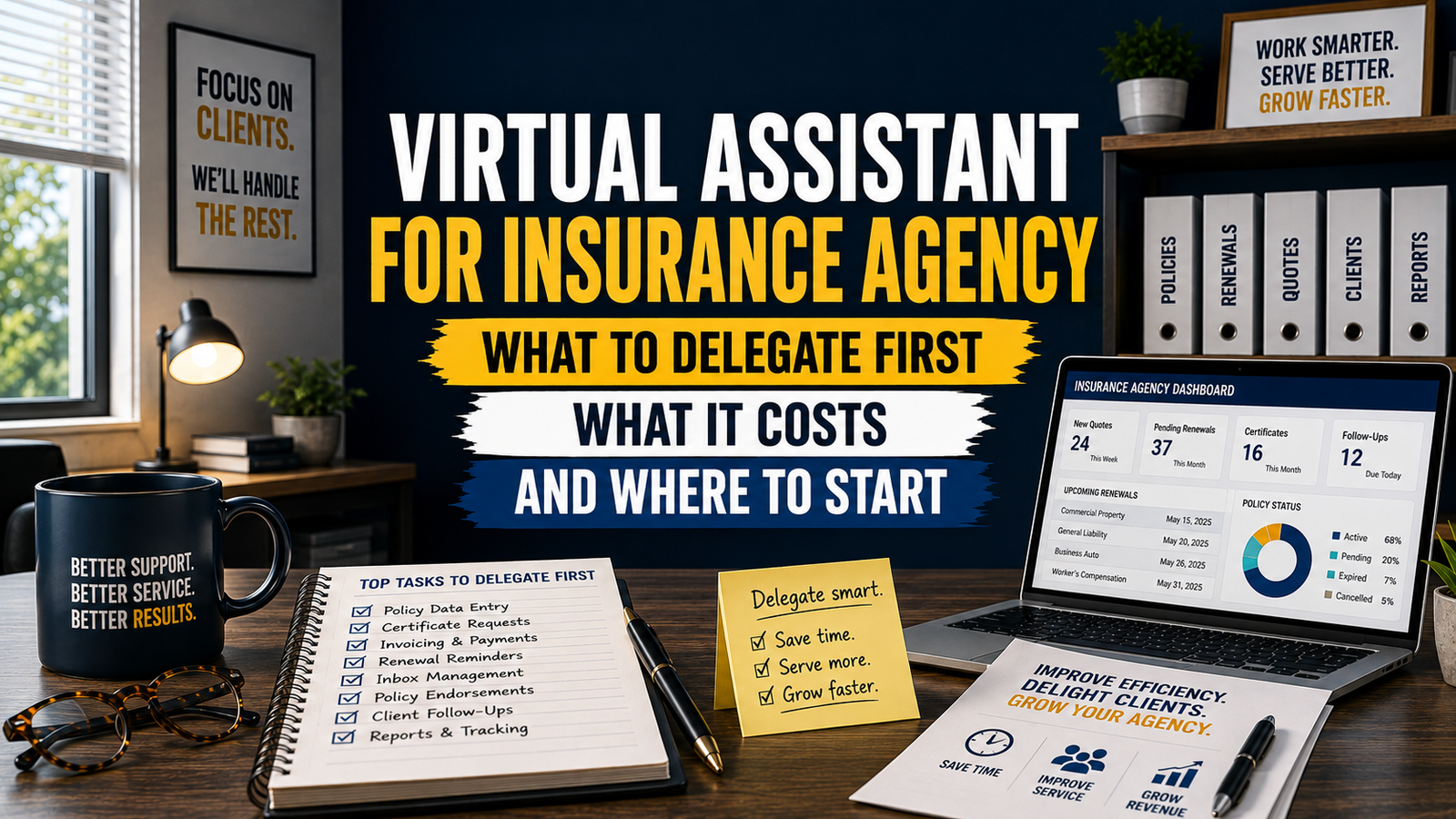
You open your independent agency's inbox before 8:00 a.m. A commercial client needs a certificate of insurance. A contractor wants an additional insured update. Three renewals need loss runs. A carrier portal shows a pending document. Your AMS contains duplicate contacts, missing activities, and policy files waiting to be indexed.
By lunchtime, you have answered service calls, checked quote status, chased signatures, and reviewed endorsement requests. Your producers have spent valuable selling time on paperwork. Your CSR has become a professional inbox firefighter.
That is the real decision behind hiring a virtual assistant for an insurance agency. You are not simply buying extra hours. You are deciding which work should leave your licensed team first.
What a Virtual Assistant for an Insurance Agency Actually Does
An insurance VA usually begins with client service support. They organize policy documents, prepare change-request information, track endorsement status, and route questions to the correct licensed professional. They can also maintain clean account notes and ensure every contact has a next action.
The next phase often involves certificates of insurance. A VA can monitor the COI queue, verify that the request includes the holder and required wording, prepare a draft using approved agency procedures, and route it for licensed review. Your agency must define who can approve and issue each certificate.
Renewal preparation is another strong fit. Your VA can pull 90-, 60-, and 30-day reports, request updated exposures, gather loss runs, download declarations pages, prepare renewal folders, and follow up on missing information. Your producer or licensed CSR keeps responsibility for coverage recommendations and final client advice.
Claims support should remain documentation-focused. A VA can record first-notice details, organize photos and correspondence, update claim activities, and follow up for status information. They should never interpret coverage or negotiate a settlement.
New business support may include collecting application information, checking for missing fields, preparing quote summaries, coordinating signatures, and organizing submission packets. For Farmers agencies, support may include approved data-entry work in Apex and eAgent, subject to agency rules and licensing limits.
For a deeper cost-and-scope breakdown, review the insurance virtual assistant cost guide.
What an Insurance VA Should Not Do
Set the boundary before work begins. An unlicensed VA should not:
- Bind or cancel coverage.
- Recommend limits, exclusions, or carriers.
- Give coverage advice.
- Make premium or commission decisions.
- Negotiate claim settlements.
- Approve legal, compliance, or E&O responses.
- Sign documents as a licensed producer.
- Make underwriting decisions.
Licensing rules vary by state. Review your state department of insurance guidance and obtain professional advice when the role involves regulated activity.
Where to Start: The First 90 Days
During days 1–14, document your intake rules, email categories, escalation triggers, naming conventions, and approved client scripts. Give your VA a limited queue and require daily activity notes.
During days 15–30, focus on AMS cleanup, document indexing, carrier downloads, and the COI queue. Use the Complete 2026 Insurance VA Hiring Guide to formalize access, training, and quality checks.
During days 31–60, add renewal preparation and claims documentation. Keep all recommendations, approvals, and coverage decisions with licensed staff.
During days 61–90, introduce new business packet preparation, e-signature follow-up, and approved marketing support. Expand only after accuracy and escalation habits are consistent.
Software an Insurance Agency VA Can Support
A trained insurance agency VA can work inside:
- Applied Epic and AMS360 for account updates, activities, downloads, and document filing.
- HawkSoft, EZLynx, Sagitta, CSR24, and comparative raters for queue management and data preparation.
- Salesforce and HubSpot for contact records, tasks, pipeline notes, and follow-up tracking.
- DocuSign for sending, monitoring, and routing signature packets.
- Google Workspace for inbox management, calendars, shared drives, and approved templates.
- Carrier portals for document retrieval, status checks, and submission tracking.
- Farmers Apex and eAgent for approved administrative support.
Use individual logins, multi-factor authentication, role-based permissions, and a written access-removal process.
How Much a Virtual Assistant for an Insurance Agency Costs
Virtual Nexgen Solutions charges $8 per hour for insurance virtual assistant support.
At 10 hours per week, using 4.33 weeks per month, the monthly estimate is $346.40. At 20 hours per week, it is $692.80. At 40 hours per week, it is $1,385.60.
Some managed insurance support models advertise full-time packages near $1,300 per month, while other providers use higher flat retainers for supervision, backup staffing, security certifications, and broader service coverage. Onshore or licensed specialists may cost substantially more per hour.
Compare scope, access controls, training, oversight, and flexibility: not just the headline rate. Read the insurance back-office support cost guide before choosing a model.
The True Cost of an In-House Agency CSR
The Bureau of Labor Statistics reported a $60,370 median annual wage for insurance sales agents in May 2024 and projects about 47,000 annual openings over the 2024–2034 period. That data applies to insurance sales agents, not directly to every CSR or account manager, but it shows the labor market pressure surrounding insurance talent.
Your real in-house cost also includes payroll taxes, benefits, recruiting, training, equipment, office space, paid leave, and management time. SHRM's recruitment cost guidance recommends counting both internal and external hiring costs.
A VA does not replace licensed expertise. A VA helps protect it from low-value administrative work.
How to Choose Between a Managed VA Service and a Flexible Hourly VA
Choose a managed service when you need formal supervision, backup coverage, standardized security controls, and predictable monthly capacity. This model may suit larger agencies with stable volume and multiple workflows.
Choose a flexible hourly VA when your workload changes by season, you want a lower entry point, or you prefer direct control over priorities. This model fits many small agencies, brokers, MGAs, wholesalers, and risk management firms testing support for the first time.
Ask who trains the VA, who reviews work, how access is handled, and what happens when volume changes.
Red Flags to Avoid
Avoid providers that promise specific retention, commission, or sales results. Reject any arrangement without an NDA, written scope, licensing boundaries, and an E&O-aware review process.
Never share passwords. Do not accept vague promises that a VA "handles everything." Require named workflows, escalation rules, audit trails, and a clear definition of licensed versus non-licensed work.
How to Measure Success
Track the baseline before the VA starts. Review COI turnaround, renewal files ready on time, AMS data quality, claims documentation completeness, producer hours reclaimed, and new business submissions prepared.
Case study: P&C agency in Texas: The owner assigns 20 hours per week to COI preparation, renewal folders, and AMS cleanup. The planning cost is $692.80 per month at $8 per hour. Measure queue age, rework, missing documents, and licensed-review time at days 30, 60, and 90. This is a planning example, not a client result.
Case study: MGA in Florida: The operations manager starts with 10 hours per week for submission packets and carrier portal follow-up. The planning cost is $346.40 per month. Measure packet completeness, status-update frequency, and time spent searching for documents. Treat the numbers as internal benchmarks, not guaranteed outcomes.
A 30-Day Pilot Plan
Use days 1–5 to select one queue and approve access. Use days 6–12 to train on sample files. Use days 13–20 to process live work with daily review. Use days 21–30 to compare baseline metrics, document exceptions, and decide whether to maintain, change, or expand the pilot.
Keep the first pilot narrow. A focused queue produces clearer evidence than a long list of loosely defined duties.
Frequently Asked Questions
What does a virtual assistant for an insurance agency do?
A VA handles non-licensed administrative work such as document organization, AMS updates, renewal preparation, COI drafting support, inbox triage, claims documentation, and signature follow-up.
Does an insurance agency virtual assistant need a license?
Not always. Licensing depends on the task and state rules. Keep binding, coverage advice, underwriting decisions, and settlement discussions with licensed professionals.
Can a virtual assistant issue certificates of insurance?
A VA may prepare COI information or drafts under agency procedures. Final approval and issuance must follow your state requirements and licensed review policy.
Can an insurance VA use Applied Epic?
Yes. An insurance VA can support Applied Epic with approved access for activities, document filing, account updates, renewal preparation, and queue management.
How much does a virtual assistant for an insurance agency cost?
Virtual Nexgen Solutions charges $8 per hour. At 10, 20, and 40 hours per week, estimated monthly costs are $346.40, $692.80, and $1,385.60.
What is the difference between an hourly insurance VA and a managed service?
An hourly VA offers flexible capacity and direct control. A managed service usually adds supervision, backup staffing, security controls, and a larger monthly commitment.
Can an insurance virtual assistant handle claims?
A VA can support claim intake documentation, activity updates, file organization, and status follow-up. They should not interpret coverage or negotiate settlements.
How fast can an insurance agency start with a VA?
Many agencies can begin after defining the first workflow, access requirements, scripts, and review process. A narrow pilot usually starts faster than a full operational rollout.
What should an insurance agency virtual assistant not do?
A VA should not bind coverage, give advice, select limits, make premium decisions, settle claims, or provide legal or compliance sign-offs.
Why Choose Virtual Nexgen Solutions
Virtual Nexgen Solutions has provided virtual assistant support since 2016. Our tailored approach begins with your agency's queues, software, service standards, and compliance boundaries: not a generic task list.
At $8 per hour, our insurance-trained support can help independent agencies, brokers, MGAs, wholesalers, risk management firms, and Farmers agencies organize the back office while licensed professionals retain decision authority.
Ready to decide what your agency should delegate first? Book a 30-minute consultation with Virtual Nexgen Solutions to review your workflow, estimate the right number of hours, define licensing boundaries, and plan a focused insurance VA pilot at $8 per hour.