Your plumbing business may have three to six trucks, a full appointment book, and a phone that never stops ringing. Yet every missed call, unreturned estimate, delayed permit, and unpaid invoice still lands on your desk.
That is why the search for a virtual assistant for plumbing business support is not simply a staffing decision. You must choose between a full-time managed VA service, an AI receptionist, and flexible hourly human support.
Choose the wrong model and you may pay for capacity you do not use, or receive call coverage without the judgment needed for emergency plumbing, warranty issues, dispatch exceptions, and customer follow-up.
The Plumbing Owner's Three Options
Consider this illustrative example: You own a plumbing company with four trucks. You need someone to answer calls, book routine work, route urgent requests, follow up on estimates, and keep invoices moving.
A managed human VA service may provide dedicated staff, supervision, backup coverage, and industry training for approximately $1,200 to $2,800 per month. An AI receptionist may provide basic call answering and scheduling for under $50 to approximately $279 or more per month, depending on the provider and plan. A flexible hourly human VA gives you trained support at $8 per hour without a large monthly commitment.
What a Virtual Assistant for a Plumbing Business Actually Does
A plumbing VA supports the work between the phone call and the completed payment.
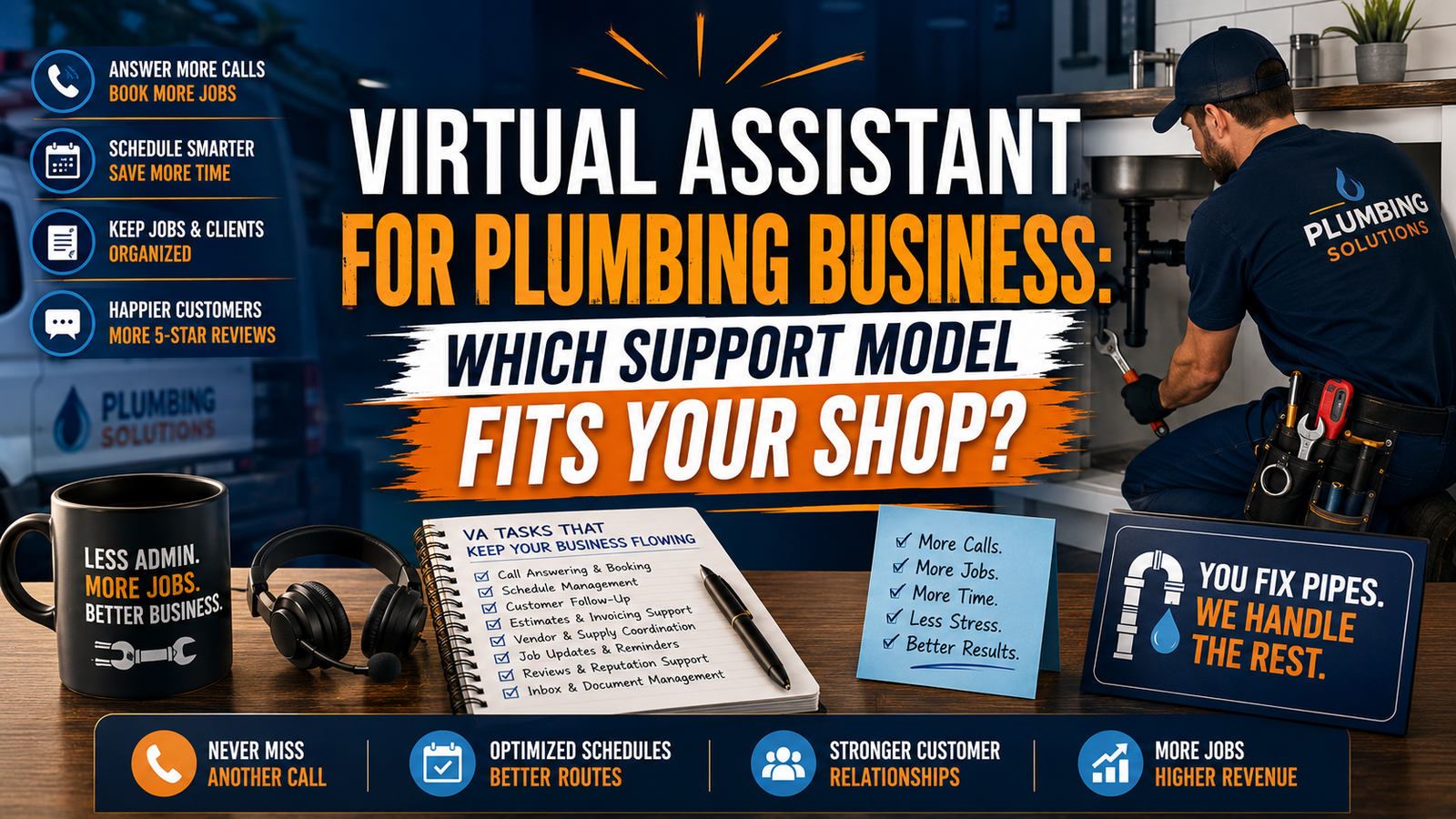
They can collect caller details, identify emergency indicators, create jobs, book appointments, confirm arrival windows, and update customer records. They can follow up on repair, water heater, repipe, and drain-cleaning estimates without pulling technicians away from the field.
They can also track permit applications, coordinate inspection dates, manage warranty and callback queues, request reviews, support maintenance memberships, prepare invoices, and follow up on outstanding balances.
Keep the owner, operations manager, or master plumber responsible for diagnostics, pricing approval, emergency priority decisions, code interpretation, and technical recommendations. A VA should execute your approved process, not invent one.
What a Plumbing VA Should Not Do
Set clear boundaries before granting access. A VA should not:
- Provide diagnostic or safety advice beyond your approved script.
- Give unapproved pricing or negotiate discounts.
- Decide whether an emergency receives priority.
- Dispatch a plumber independently outside your escalation rules.
- Make legal, code, permitting, or compliance decisions.
- Promise arrival times that the dispatch board does not support.
- Approve warranty claims or determine liability.
Use escalation tags such as Emergency Review, Pricing Approval, Permit Question, and Master Plumber Callback. Make judgment calls visible to the right person.
Option 1: Full-Time Managed VA Services
A managed service may include a dedicated assistant, team supervision, backup coverage, quality reviews, and structured training. Providers such as Hard Hat Helpers, VirtuHire, Armasourcing, and Pineapple represent the type of managed model contractors may encounter while researching the market.
Expect a larger monthly commitment, defined service hours, and a more formal onboarding process. This option makes sense when you have stable call volume, several trucks, recurring administrative queues, and enough work to keep the VA consistently busy.
Choose this model when continuity and coverage matter more than short-term flexibility. Confirm whether the quoted fee includes backup staffing, supervision, call handling, software training, and holiday coverage.
Option 2: AI Receptionists
An AI receptionist can help with missed-call coverage, simple FAQs, basic appointment requests, and after-hours message capture. This may suit a small shop that needs a digital safety net rather than a full back-office role.
The limitations appear when a caller says, "There is water everywhere, but I am not sure where it is coming from." Emergency triage requires context. Upset customers need empathy. Warranty conversations require account history. Multi-trade coordination requires judgment. Estimate follow-up often requires understanding objections rather than repeating a reminder.
Use an AI receptionist for narrow, predictable intake. Do not treat it as a replacement for a trained dispatcher or office manager when the workflow involves risk, urgency, or exceptions.
Option 3: Flexible Hourly Human VA at $8 per Hour
Hourly human support provides the middle ground. You receive human judgment without committing to a full managed-service package.
A plumbing VA can work inside ServiceTitan, Jobber, Housecall Pro, Workiz, or FieldEdge. They can manage defined queues, update customer records, prepare follow-ups, and scale their hours around seasonal demand.
Use 10 hours per week during a slower period. Increase to 20 hours when estimate volume rises. Add more capacity during severe weather, promotional campaigns, or peak repair seasons. Keep approval authority with your team while the VA handles execution.
How Do You Decide?
Use these decision rules:
- Choose a managed VA service when call volume is consistently high and you need dedicated coverage, supervision, and backup.
- Choose an AI receptionist when your main problem is after-hours overflow, missed calls, and simple booking.
- Choose a flexible hourly human VA when workload changes, you want direct control, or you are testing support before making a larger commitment.
Start with the narrowest model that solves the actual bottleneck. Expand only after you measure the workload.
What Software Can a Plumbing VA Support?
A trained plumbing VA can support:
- ServiceTitan: job creation, dispatch-board updates, estimate follow-up, membership records, customer notes, and invoice status.
- Housecall Pro: appointment booking, reminders, customer communication, estimates, and payment follow-up.
- Jobber: requests, quotes, scheduling, invoices, and client updates.
- Workiz and FieldEdge: job records, dispatch coordination, call notes, and service follow-up.
- QuickBooks: invoice preparation, payment tracking, and accounts receivable reminders.
- Google Workspace: inboxes, calendars, shared files, and reporting.
- DocuSign: sending and tracking approved documents.
- Google Business Profile, Local Services Ads, and review platforms: lead tracking, response coordination, and review-request follow-up.
Follow least-privilege access. Use individual logins and remove access when responsibilities change.
How Much Does Flexible Plumbing VA Support Cost?
Virtual Nexgen Solutions charges $8 per hour.
At 10 hours per week, your estimated monthly cost is $346.40, using 4.33 weeks per month. At 20 hours per week, the estimate is $692.80. At 40 hours per week, the estimate is $1,385.60.
That compares with managed support commonly ranging from $1,200 to $2,800 per month. AI receptionist subscriptions may cost less, often under $50 to approximately $279 or more monthly, but they generally cover a narrower set of tasks.
Compare total scope, human judgment, supervision, software access, and escalation support, not price alone.
Which Red Flags Should You Avoid?
Avoid providers that guarantee bookings, lead volume, or revenue. Reject any service that provides no NDA, uses shared passwords, or cannot explain its escalation path.
Require written pricing boundaries, emergency scripts, response standards, and software permissions. Treat "handles everything" as a warning sign. Good support begins with a specific queue, clear ownership, and measurable outcomes.
How Should You Measure Success?
Record a baseline before the pilot. Review performance at 30, 60, and 90 days.
Track answer rate, booking rate, estimate follow-up completion, no-show rate, dispatch exception closure, permit status updates, review requests sent, invoice turnaround, and overdue-payment follow-up.
Measure time saved for owners, plumbers, and office managers. Do not use unverified revenue claims. Let your own operational data determine whether the support model works.
What Should a 30-Day Pilot Include?
Days 1–5: Define the queue
Choose one workflow, such as estimate follow-up, appointment confirmations, or invoice reminders. Document scripts, access rules, escalation triggers, and success metrics.
Days 6–12: Train with sample records
Use closed jobs and approved examples. Review how the VA creates notes, updates statuses, and escalates unusual requests.
Days 13–20: Process live work
Start with daily quality checks. Correct errors quickly. Keep emergency, pricing, and technical decisions with your internal team.
Days 21–30: Review the evidence
Compare baseline metrics with pilot results. Identify rework, unanswered questions, and unused capacity. Then maintain, adjust, or expand the role.
Frequently Asked Questions
What does a virtual assistant for a plumbing business do?
A plumbing VA handles administrative work such as call intake, scheduling, estimate follow-up, permit tracking, customer updates, invoicing, payment reminders, and review requests.
Can a plumbing virtual assistant handle emergency calls?
Yes, a VA can collect emergency details and follow your approved escalation process. Keep safety guidance, priority decisions, and technical advice with qualified personnel.
Can a plumbing VA use ServiceTitan?
Yes. With approved permissions, a VA can create jobs, update customer records, support dispatch queues, follow up on estimates, and track invoices in ServiceTitan.
How much does a virtual assistant for plumbers cost?
Virtual Nexgen Solutions charges $8 per hour. Estimated monthly costs are $346.40 for 10 hours per week, $692.80 for 20 hours, and $1,385.60 for 40 hours.
What is the difference between a managed VA, AI receptionist, and hourly human VA?
A managed VA provides structured staffing and supervision. An AI receptionist handles predictable intake. An hourly human VA provides flexible support for detailed administrative workflows.
Can a plumbing VA dispatch plumbers?
A VA can support dispatch using your rules, schedules, and escalation path. Keep independent priority decisions and technical judgment with your dispatcher or operations manager.
Can a plumbing VA follow up on estimates?
Yes. A VA can contact customers, answer approved process questions, record objections, update quote statuses, and route pricing or technical questions to your team.
How quickly can a plumbing business start with a VA?
Start after defining one workflow, preparing access, approving scripts, and completing basic training. A focused pilot usually begins faster than a full operational rollout.
What should a plumbing virtual assistant not do?
A VA should not diagnose problems, approve pricing, make emergency decisions, interpret code, provide legal advice, or authorize warranty outcomes.
Why Choose Virtual Nexgen Solutions?
Virtual Nexgen Solutions has provided virtual assistant services since 2016. We begin with your actual queues, software, approval rules, and service standards instead of forcing your company into a generic package.
At $8 per hour, you can test focused human support for dispatch coordination, plumbing customer service, estimate follow-up, permit tracking, invoicing, and administrative work.
Final CTA
Choose support based on your actual call volume, dispatch complexity, and administrative backlog. Book a 30-minute consultation with Virtual Nexgen Solutions to review your plumbing workflows and evaluate flexible VA support at $8 per hour.