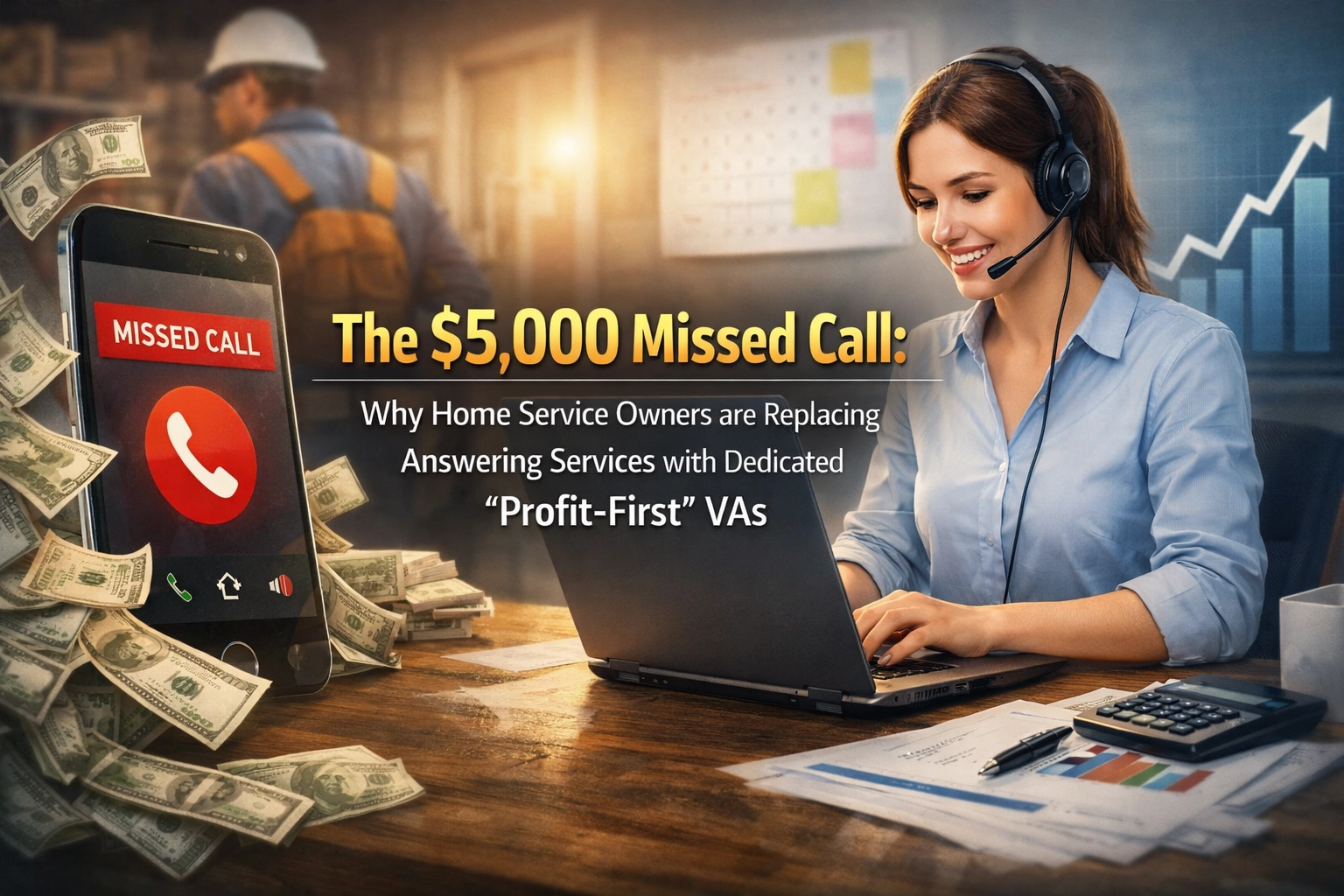
You're under a kitchen sink fixing a slab leak when your phone buzzes for the third time. It's 2 PM on a Tuesday: prime emergency call time. You ignore it because your hands are covered in pipe dope and you're racing against a homeowner's patience.
That call? It was a $5,000 AC replacement job. The homeowner called your competitor next. They answered. They booked it.
This is the hidden profit leak killing home service businesses in 2026.
Most HVAC, plumbing, and electrical business owners think they've "solved" this problem with an answering service. They haven't. They've just put a band-aid on a gunshot wound.
The Answering Service Trap: Why Messages Don't Equal Money
Let's be brutally honest about what most answering services actually do: they take a message and email it to you.
That's it.
They don't book the job. They don't check your ServiceTitan calendar. They don't know if your lead tech can squeeze in an emergency call at 4 PM or if you're already maxed out for the day.
Here's what really happens:
- Customer calls with a flooded basement at 11 AM
- Answering service takes their name and number
- You get the message at 1:30 PM when you check your email
- You call back at 2 PM
- Customer already booked with the competitor who answered live and gave them a 3 PM arrival window
The homeowner didn't want a callback. They wanted a solution timeline. And while your answering service was typing up a message, your competitor's dispatcher was already assigning a tech and texting the customer an ETA.
A message isn't a check. It's a missed opportunity with your business card on it.
The 'In-the-Truck' Burnout: Why You Can't Be Everywhere at Once
If you're a home service owner, you know this feeling intimately: You're the technician, the salesman, the bookkeeper, and the phone operator: all at the same time.
You're elbow-deep in a breaker panel when your phone rings. Do you:
- Answer and risk looking unprofessional to the customer in front of you?
- Ignore it and potentially lose a $3,000 furnace replacement?
- Step away and add 20 minutes to the current job?
All three options cost you money.
The math is simple but painful: According to home service industry data, the average missed call in the trades represents $1,200–$5,000 in lost revenue. If you're missing 3–5 calls per week because you're on a job site, that's $15,000–$25,000 per month walking out the door.
Most owners try to solve this by working longer hours. You start answering calls at 9 PM. You respond to texts during family dinner. You become a 24/7 call center: except you're also trying to run a business.
That's not scalability. That's a mental breakdown with a tool belt.
Why 'Administrative Support' Isn't Enough Anymore
Here's where most virtual assistant companies completely miss the mark for home service businesses: they offer "administrative support."
But you don't need someone to answer emails and file paperwork. You need a profit dispatcher: someone who actively drives revenue by optimizing your schedule, converting estimates, and maximizing jobs per day.
The Difference Between a Secretary and a Profit-First VA
Traditional "Admin" VA:
- Takes messages
- Enters data into your CRM
- Schedules callbacks for you to handle
Profit-First Home Services VA:
- Books jobs in real-time using ServiceTitan, Housecall Pro, or Jobber
- Knows your service area, tech availability, and pricing tiers
- Rescues dying estimates by following up on proposals sitting in "pending" status
- Handles emergency triage (burst pipe vs. slow drain) to prioritize high-value calls
- Chases customer reviews to boost your local SEO and Google ranking
One is a cost center. The other is a revenue generator.
This is the shift that home service owners are finally waking up to in 2026: the right person on your phones isn't an expense: it's your highest-ROI team member.
The Human Nuance That Scripts and Robots Can't Replicate
Let's talk about something most VA companies ignore: emotional intelligence in crisis moments.
When someone calls about a flooded basement at midnight, they're not looking for a robot to run through a script. They're scared, stressed, and need a real human who can:
- Assess urgency with good judgment (actual emergency vs. "it can wait until morning")
- Provide calm reassurance without over-promising
- Navigate pricing conversations with empathy but firmness
A homeowner with no heat in January and a newborn baby doesn't want to hear: "I'll leave a message for the owner." They want: "I'm getting Jake to your house within 90 minutes. Here's his direct number and a text confirmation."
That's the difference between a call center script and a dedicated human VA who understands your business, your techs, and your customers.
AI chatbots and automated answering systems are flooding the market right now, promising to "solve" this problem with technology. But here's the reality check: when Mrs. Johnson calls panicking because her AC died during a Texas heat wave, she doesn't want to navigate a phone tree. She wants a human being who listens and solves.
The businesses winning in 2026 are the ones doubling down on the human element while competitors chase shiny tech that frustrates customers.
The Software Mastery Advantage: Day-One Productivity
One of the biggest frustrations home service owners face when hiring: whether it's in-house staff or overseas VAs: is training time. You spend weeks getting someone up to speed on ServiceTitan or Jobber, only to have them quit or underperform.
Here's what changes the game: specialized VAs who already know your dispatch software.
At Virtual Nexgen Solutions, our home services VAs come trained on:
- ServiceTitan (the gold standard for larger HVAC/plumbing operations)
- Housecall Pro (the favorite for growing electrical and plumbing businesses)
- Jobber (the go-to for multi-trade service companies)
They don't need a 30-day ramp-up period. They log in on Day 1, see your schedule, and start dispatching jobs like they've been with your company for months.
This is the same concept we've proven with insurance agencies: when someone already speaks your industry's language and knows your tools, they become revenue-positive in week one instead of month three.
The 'Jobs Per Day' Multiplier Effect
Let's talk about the metric that actually matters: jobs per technician per day.
Most home service businesses run at 3–4 jobs per tech per day. Elite operations? They're hitting 5–6.
What's the difference? Dispatch optimization.
A dedicated VA watching your schedule in real-time can:
- Route techs efficiently to minimize drive time between jobs
- Fill schedule gaps by calling customers with pending estimates and offering same-day slots
- Upsell maintenance plans during booking confirmations
- Reduce no-shows with confirmation calls and text reminders
If you're currently running 4 jobs per tech per day, and a dedicated dispatcher helps you hit 5 jobs per tech per day, the math is simple:
- 3 techs × 1 extra job per day × $400 average ticket × 20 working days = $24,000 additional monthly revenue
That's not a cost. That's a 6-to-1 ROI on a dedicated VA at $4,000/month.
Why Dedicated Beats 'Shared' Every Single Time
Here's a trap many business owners fall into: they hire a "virtual receptionist service" where calls are handled by whoever's available in a call center pool.
The problem? Nobody owns your business.
When you have a dedicated VA, they become an extension of your team. They know:
- That Mike is your best tech for complex electrical diagnostics
- That you don't service calls more than 45 minutes outside the city
- That Mrs. Rodriguez is a repeat customer who should get priority scheduling
- That you're running a promotion on water heater replacements this month
A shared answering service knows none of this. They're reading from a generic script, and your business is just "Account #4729" in their queue.
Dedicated = Ownership. Shared = Transactional.
The businesses scaling past $2 million in revenue understand this difference intimately.
The Revenue Recovery System: Turning 'Pending' Into Paid
Here's a profit leak most home service owners don't even realize exists: pending estimates sitting in your CRM.
You go out, give a quote for a $6,000 HVAC system, and the homeowner says "let me think about it." That estimate goes into your system as "pending," and then... nothing.
Most businesses never follow up. The estimate dies. The customer either forgets, goes with a competitor, or just keeps limping along with their broken system.
A profit-first VA changes this equation entirely.
They run a daily report of pending estimates and start making follow-up calls:
- "Hi Mrs. Thompson, just checking in on that furnace quote we sent over last week. We actually have an opening this Thursday if you'd like to move forward..."
Industry data shows that 35–40% of "dead" estimates can be revived with a single human follow-up call within 7 days.
If you have $50,000 in pending proposals sitting in your ServiceTitan right now, that's $17,500–$20,000 in recoverable revenue just waiting for someone to pick up the phone.
This is what we mean by "profit-first." It's not about answering phones: it's about actively hunting revenue that's already in your pipeline.
The Home Service Growth Audit: See Your Profit Leaks in Real-Time
Here's what most home service owners don't realize until it's too late: you're not just losing the $5,000 call you missed. You're losing the lifetime value of that customer.
A homeowner who books an AC repair today might also need:
- Annual HVAC maintenance ($300/year)
- Plumbing services ($2,000 over 5 years)
- Electrical panel upgrades ($3,500)
- Word-of-mouth referrals to 3 neighbors ($15,000 in downstream revenue)
That single missed call? It's actually a $25,000+ loss when you factor in lifetime customer value.
We've built a free "Home Service Growth Audit" that shows you exactly where these profit leaks are happening in your business:
- How many calls you're missing per week
- What your current "jobs per tech per day" number is vs. what it should be
- How much revenue is sitting in "pending" estimates waiting to be closed
Book your free 30-minute audit here and we'll walk through your ServiceTitan or Jobber account live to show you the exact dollar amount you're leaving on the table.
The Bottom Line: Messages Don't Pay Bills, Booked Jobs Do
The home service industry is at an inflection point right now. The businesses that win over the next 3 years won't be the ones with the most trucks or the fanciest equipment.
They'll be the ones who answer the phone, book the job, and maximize every tech's schedule with military precision.
You can keep using an answering service that takes messages. You can keep trying to be the tech and the dispatcher and the owner all at once.
Or you can bring in a dedicated profit-first VA who treats every call like a $5,000 opportunity: because that's exactly what it is.
The choice is yours. But your competitors are already making theirs.
Ready to stop losing $15K–$25K per month to missed calls? Schedule your free Home Service Growth Audit here and let's build you a dispatch system that actually drives profit.
Or explore our specialized Home Services VA solutions to see exactly how we help HVAC, plumbing, and electrical businesses scale past 7 figures.