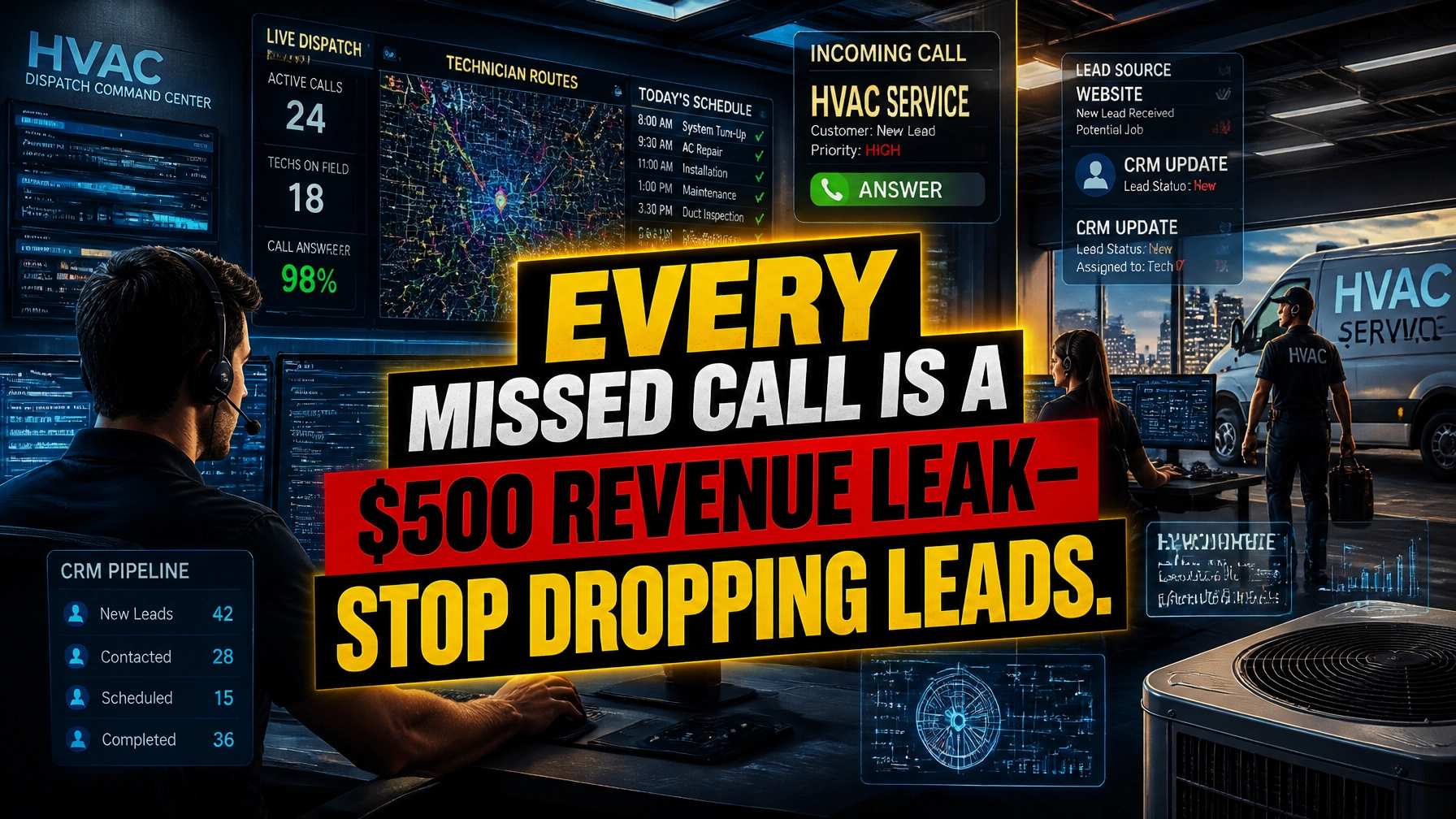
The HVAC industry in 2026 is no longer just about who has the best wrenches; it is about who has the best systems. Most shop owners hit a "Growth Ceiling" somewhere between five and ten trucks. You have the demand, your technicians are skilled, and the phones are ringing, yet the profit margins remain stubbornly flat. This stagnation is rarely a market problem, it is a dispatch dilemma. When your high-value technicians are sitting idle because of a scheduling error, or worse, when a $500 service call goes to voicemail because your office staff is overwhelmed, you are experiencing "Profit Leakage."
The "Seasonality Trap" is the primary predator of HVAC profitability. During the peak summer heat or the first winter freeze, your call volume spikes 400%. If you staff your office for these peaks, you bleed cash during the shoulder seasons. If you staff for the "average" day, you lose thousands in unclaimed revenue during the surges. An HVAC Virtual Assistant from Virtual Nexgen Solutions provides the elastic capacity you need to scale without the $60,000-per-year overhead of an in-house administrative hire. By shifting the administrative weight to a specialized professional for just $8 per hour, you decouple your growth from your payroll liability.
The 2026 HVAC Landscape: Efficiency Over Everything
The US HVAC market is projected to grow steadily through 2029, but the complexity of the business is increasing. With the transition to low-GWP refrigerants and the massive shift toward heat pump electrification, your dispatchers now need to be more than just "call takers." They must be air-traffic controllers for technical expertise.
A "Truck Roll" in 2026 costs more than ever, fuel, insurance, and labor are at all-time highs. Every time a technician arrives at a job that isn't ready or was misdiagnosed over the phone, your "Truck Roll Efficiency" plummets. Top-performing residential and commercial firms are now utilizing decentralized, 24/7 dispatch models to ensure that every lead is scrubbed, every appointment is confirmed, and every maintenance agreement is renewed proactively. This is how you move from being an owner-operator to a scaling CEO.
6 Daily Pain Points Killing Your HVAC Profitability
- The $500 Missed Call: Every missed call during peak hours is a direct revenue leak. If a customer in a 95-degree heatwave reaches your voicemail, they are calling your competitor five seconds later.
- Dispatch Lag: When your technicians finish a job early but wait 20 minutes for the office to assign the next ticket, you are losing billable hours every single day.
- The Shoulder Season Slump: Your fixed office overhead stays high while service calls drop, leading to a cash flow crunch in the spring and fall.
- Admin Debt in the AMS: Systems like ServiceTitan or FieldEdge are only as good as the data entered into them. Messy lead tracking and incomplete job notes lead to billing disputes and lost parts.
- Low Maintenance Agreement Retention: You are so busy chasing new emergency calls that you forget to schedule the "easy money" tune-ups, leading to a high churn rate of your most profitable recurring customers.
- Permit and Compliance Backlog: Growth requires more paperwork. If your project completions are delayed because permits weren't filed on time, your cash conversion cycle slows down.
The Architecture of a Scalable Shop: The VA Solution
A specialized HVAC Virtual Assistant serves as the operational engine of your business. They do not just "answer phones"; they manage the entire lifecycle of a service call. By integrating a VA into your workflow, you ensure that your in-house team focuses on high-level strategy and face-to-face customer service, while the VA handles the high-volume, repetitive tasks that cause administrative debt.
Whether you are running a residential shop in Phoenix or a commercial mechanical firm in Chicago, the goal is the same: maximize the "Call-to-Appointment Ratio" and minimize "Unbilled Technician Time."
10 Tasks Your HVAC Virtual Assistant Can Handle
- 24/7 Lead Intake & Scrubbing: Qualify leads from LSAs, Yelp, and your website to ensure technicians only visit viable jobs.
- ServiceTitan/FieldEdge Management: Real-time updates of job statuses, technician notes, and customer history.
- Proactive Maintenance Scheduling: Outbound calling to membership customers to book their seasonal tune-ups during shoulder months.
- Permit Application & Tracking: Coordinating with local municipalities to file permits and schedule inspections.
- Equipment Warranty Registration: Ensuring every install is registered with the manufacturer to protect the customer and the shop.
- Technician Dispatch & Routing: Optimizing routes based on traffic and technician skill set to reduce drive time.
- Vendor Invoice Reconciliation: Verifying that the parts charged by the supply house match the job tickets.
- Customer Review Management: Following up after every job to secure 5-star Google and Yelp reviews.
- AR/AP Support: Following up on unpaid invoices and processing technician timesheets for payroll.
- Parts Procurement Tracking: Monitoring backordered parts and updating customers on arrival times to prevent frustration.
12 Tactical SOPs for HVAC Operational Excellence
1. Emergency Dispatch Intake Procedure
Action: Filter emergency calls based on "Life/Safety" criteria.
- Open your CRM (e.g., ServiceTitan).
- Identify the caller’s equipment type and age.
- Check the current technician proximity map.
- Best Practice: Always offer a specific "Arrival Window" rather than "Sometime this afternoon."
2. ServiceTitan Lead Management
Action: Convert every digital lead into a booked job or a "Dismissed" status within 5 minutes.
- Monitor the incoming lead dashboard.
- Call the customer immediately to confirm details.
- Tag the lead source (LSA, Google, Facebook) for marketing ROI tracking.
- Best Practice: Never leave a lead in "Pending" for more than 10 minutes.
3. Permit Application Filing
Action: Submit permit requests within 24 hours of a signed install contract.
- Access the municipal online portal.
- Upload the signed contract and equipment specs.
- Pay the fee using the authorized company card.
- Best Practice: Keep a master spreadsheet of "Inspection Pending" statuses to ensure jobs are closed out.
4. Equipment Warranty Registration
Action: Register all new HVAC units within 48 hours of installation.
- Gather the model and serial numbers from the technician’s job photos.
- Log into the manufacturer portal (Carrier, Trane, Rheem).
- Input customer data and installation date.
- Best Practice: Email the registration certificate to the customer as a "Value-Add" service.
5. Maintenance Agreement Retention Outreach
Action: Call existing members 30 days before their agreement expires.
- Export a "Membership Expiration" report.
- Contact the customer to schedule their next "Peace of Mind" inspection.
- Update payment information if the card on file is expired.
- Best Practice: Use a script that emphasizes "Protecting your investment" rather than "Paying a fee."
6. Technician Schedule Optimization
Action: Review the next day's schedule at 4:00 PM to eliminate "Dead Time."
- Group calls by geographic zone.
- Assign "Early Bird" calls to technicians who live closest to the job site.
- Ensure "Maintenance" calls are sandwiched between "High-Value" diagnostic calls.
- Best Practice: Account for a 15% buffer for emergency "Add-ons."
7. Vendor Invoice Verification
Action: Audit weekly supply house invoices against job tickets.
- Cross-reference the PO number on the vendor invoice with the ServiceTitan job ID.
- Flag any parts that were charged but not listed on the job record.
- Best Practice: Weekly audits prevent thousands of dollars in "Phantom Costs" over a year.
8. Customer Review Management
Action: Request a review within 1 hour of job completion.
- Send a personalized text or email via the CRM.
- Monitor for negative feedback and alert the Service Manager immediately.
- Best Practice: Respond to every 5-star review with the customer's name to boost local SEO.
9. Outbound Lead Follow-up (LSAs)
Action: Call back "Incomplete" leads from Local Service Ads.
- Check the LSA dashboard for missed calls or messages.
- Dial the customer within the hour.
- Best Practice: If they already booked elsewhere, offer to be their "Backup" or schedule a maintenance visit.
10. Job Costing Data Entry
Action: Input labor hours and material costs into the job file daily.
- Review technician timesheet logs.
- Assign costs to the specific job ID.
- Best Practice: Accurate daily costing allows the owner to see real-time gross profit margins.
11. Parts Procurement Tracking
Action: Update customers on backordered parts every Tuesday and Thursday.
- Contact the vendor for status updates on "Special Order" items.
- Call the customer with a status update, even if the part hasn't arrived.
- Best Practice: Proactive communication prevents "Where is my part?" angry calls.
12. GPS/Fleet Monitoring Audit
Action: Run a daily report on "Idle Time" and "Off-Route" alerts.
- Use the fleet tracking software (Samsara, Verizon Connect).
- Flag any vehicle idling for more than 20 minutes.
- Best Practice: Use this data for technician coaching rather than just discipline.
Tools & Software Our VAs Master
- ServiceTitan: The gold standard for HVAC business management.
- FieldEdge: Robust scheduling and dispatching for service-heavy shops.
- Housecall Pro: Streamlined dispatching for residential contractors.
- Jobber: Simple, effective quote and invoice management.
- Samsara/Verizon Connect: For real-time fleet and GPS tracking.
- RingCentral/Aircall: For professional, recorded phone communication.
HVAC Success Stories: From Chaos to Capacity
Case Study 1: Residential Scaling in Phoenix, AZ
Challenge: A high-volume residential shop was losing 30% of its emergency calls after 6:00 PM and on weekends. The owner was answering the phone at the dinner table, leading to burnout.
Action: Virtual Nexgen Solutions integrated a 24/7 VA Dispatcher trained in ServiceTitan. The VA handled all after-hours intake, qualified the emergencies, and dispatched the on-call technician only when a job was "Service-Ready."
Result: Monthly emergency service revenue increased by $45,000, and the owner regained 20 hours of personal time per week.
Case Study 2: Commercial Mechanical Efficiency in Chicago, IL
Challenge: A commercial firm was struggling with an administrative backlog. Permits were delayed, and equipment procurement was messy, causing a 15-day lag in project completion cycles.
Action: We placed a dedicated Administrative VA to act as a Project Coordinator. The VA specialized in municipal permit filing and vendor parts tracking.
Result: Project completion cycles were shortened by 20%, and the firm avoided $12,000 in municipal "Late Filing" penalties over six months.
Case Study 3: Franchise Retention Growth (Multi-State)
Challenge: A multi-state HVAC franchise had a massive database of maintenance agreement customers but a retention rate of only 45% because they lacked the staff to call and schedule tune-ups.
Action: A team of Virtual Nexgen VAs began a proactive "Stay Cool/Stay Warm" outreach campaign, calling every customer 30 days before their renewal date.
Result: Maintenance agreement retention skyrocketed by 300%, creating a predictable $1.2M annual recurring revenue stream that increased the company's valuation.
Why Virtual Nexgen Solutions is Your Operational OS
We don't just provide "help"; we provide a standard operating procedure for growth. While other virtual assistant firms offer generalists, Virtual Nexgen Solutions provides industry-specific professionals who understand that a broken furnace in January is a crisis, not a task.
By utilizing our $8/hour VAs, you aren't just saving money, you are buying back your focus. You can spend your day on fleet expansion, technician training, and high-level marketing while our VAs ensure the machine keeps running behind the scenes. We remove the "Admin Debt" that holds your shop back from hitting that $10M or $20M revenue mark.
Frequently Asked Questions
How does a VA access my ServiceTitan or FieldEdge?
We utilize secure, remote access protocols or direct user seats within your CRM. Our VAs are trained to operate within your existing ecosystem, ensuring all job notes and schedules are updated in real-time as if they were sitting in your office.
Can a VA handle "angry" customers during a heatwave?
Yes. Our VAs are trained in empathy-led communication and conflict resolution. They follow your specific "Escalation SOP" to ensure that frustrated customers feel heard while protecting your technicians from unnecessary stress.
Is there a language barrier?
Virtual Nexgen Solutions hires only high-level, fluent English speakers with neutral accents. In the HVAC industry, clear communication is vital for dispatching, and our VAs are vetted for their professional verbal and written skills.
What if I only need help during the summer peak?
Our model is built for the "Seasonality Trap." We offer flexible scaling, allowing you to increase your VA support during peak months and adjust during shoulder seasons, providing the elastic capacity a traditional in-house hire cannot match.
How do you handle local knowledge for dispatching?
Your dedicated VA uses GPS and mapping tools integrated with your CRM. During the onboarding process, we map out your service zones and technician home bases to ensure the VA understands the "flow" of your local area.
Does a VA understand HVAC technical jargon?
We provide our VAs with foundational HVAC industry knowledge, from understanding the difference between a capacitor and a compressor to knowing what a "Manual J" calculation is. This ensures they can scrub leads effectively and provide technicians with accurate information.
How much can I actually save compared to a local hire?
A local office manager or dispatcher typically costs $45,000–$60,000 annually plus benefits and payroll taxes. A Virtual Nexgen VA costs $8/hour with zero overhead. For most shops, this represents a 70% reduction in administrative costs.
Ready to reclaim your time and scale smarter? Book your free discovery call with Virtual Nexgen today : let's talk about how our VAs can transform your HVAC business.