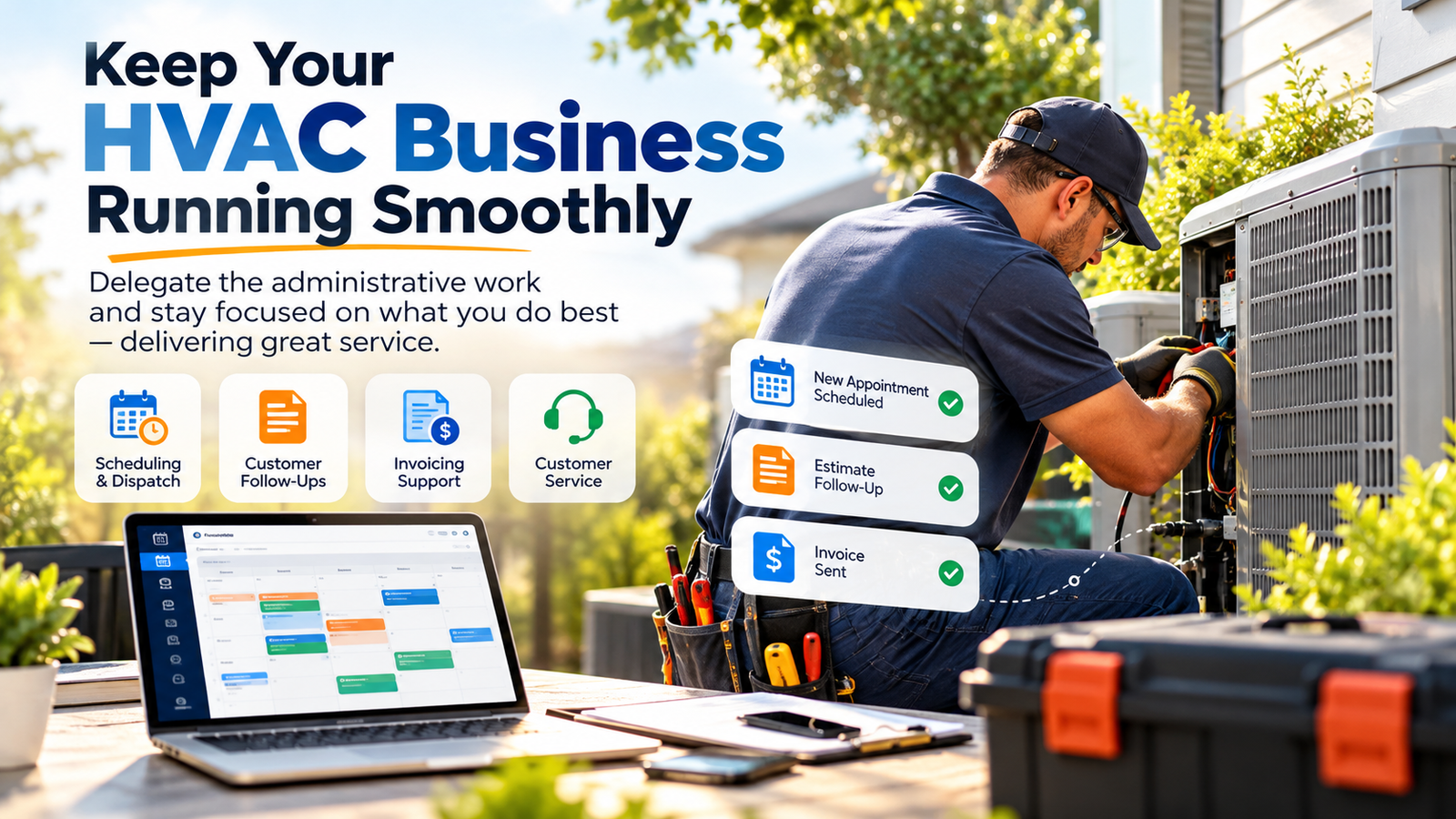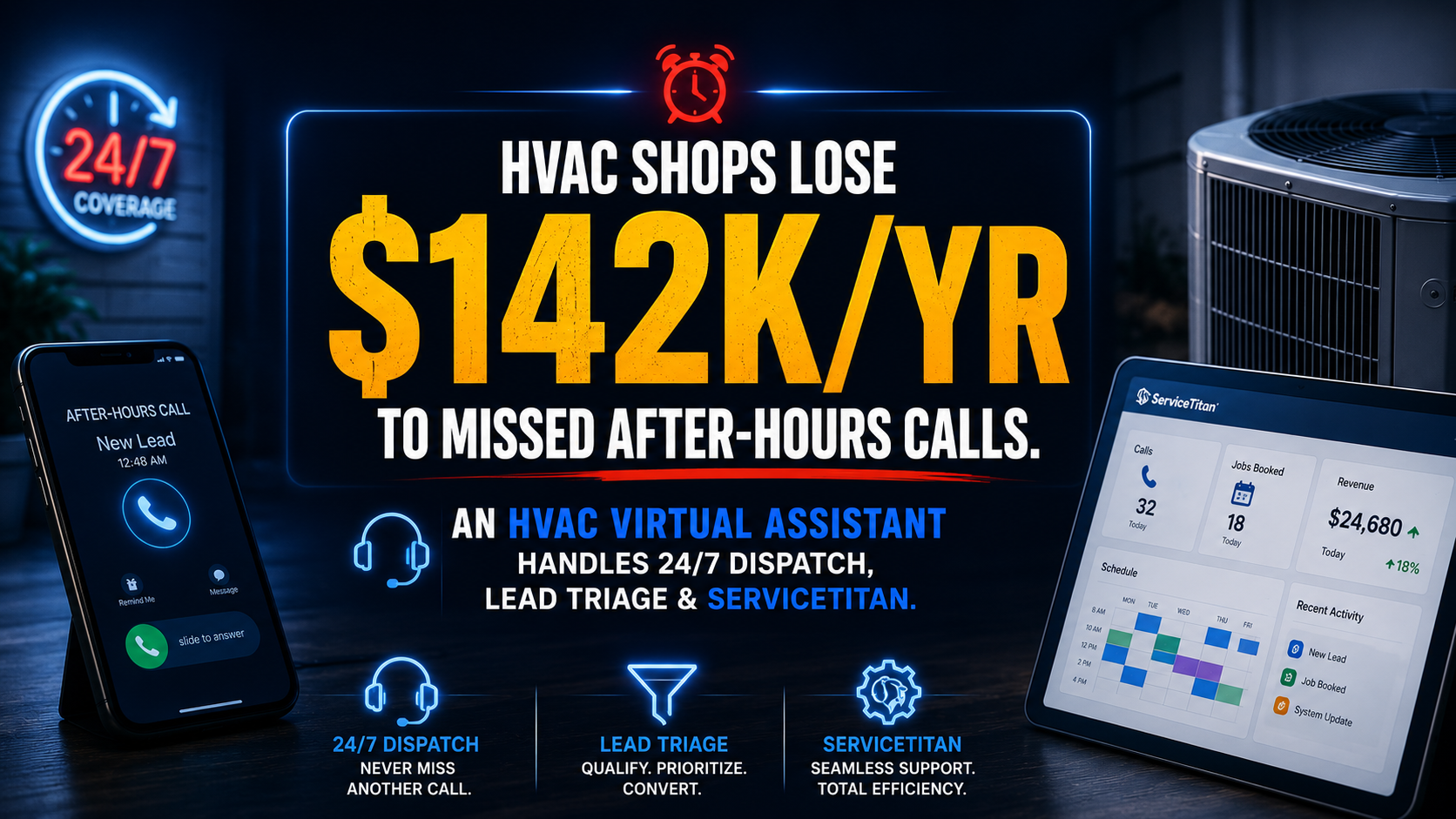
The phone rings at 8:45 PM on a Tuesday. Your office is dark. Your service manager is at dinner. You are at your daughter’s soccer game. That ringing phone is the sound of a $1,200 check being written directly to your competitor.
In the HVAC industry, silence isn't golden, it’s expensive. Industry data confirms that the average missed HVAC service call represents roughly $1,200 in immediate and downstream revenue. Yet, most shops miss between 25% and 38% of their inbound calls year-round. During the peak "no-cool" or "no-heat" seasons, that miss rate often spikes past 50%.
But there is a deeper, more insidious problem than just the missed calls. It’s what we call Dispatch Debt.
The Hidden Cost of Dispatch Debt and Profit Leakage
Dispatch Debt occurs when your most expensive assets, your technicians and your service manager, are forced to perform administrative labor. When a tech earns $35–$45 per hour but spends 10 hours a week on paperwork, invoicing, and rescheduling, you aren't just losing their hourly wage. You are losing the $300–$500 per hour in billable revenue they should be generating.
This "Admin Debt" creates a ceiling on your truck count. You can’t add a sixth or seventh truck because your office can’t handle the dispatch load, yet you can’t afford a $60,000-a-year full-time office manager to fix the bottleneck.
Virtual Nexgen Solutions provides the bridge. By integrating a specialized HVAC virtual assistant at just $8 per hour, you eliminate the debt and reclaim your billable hours.
The Math of the $142,000 Revenue Leak
Let's look at the cold, hard numbers for a typical 5-truck HVAC shop.
If you receive 400 inbound calls per month and miss 30% of them, you are losing 120 opportunities. Even if only half of those are high-value service calls or replacements, and the other half are general inquiries, the weighted loss is staggering. At a conservative $450 average ticket, you are leaking $27,000 every single month. Over a year, that is $324,000 in top-line revenue that never hit your bank account.
Furthermore, 42% of HVAC demand occurs after hours. When homeowners face a 95-degree night with a dead AC unit, they don't leave voicemails. 85% of callers who hit a voicemail will hang up and call the next listing on Google.
A Virtual Nexgen Solutions VA ensures that 100% of these calls are answered, triaged, and dispatched in real-time. We don't just "take a message"; we book the job into your system and notify the tech on call.
Systematizing Your Dispatch with Expert VA Integration
A Virtual Nexgen Solutions VA isn't a generalist; they are trained in the technical workflows of the HVAC industry. They act as the administrative engine that powers your growth, ensuring your technicians stay focused on the wrench, not the tablet.
Software Mastery
Our VAs arrive ready to work within your existing tech stack. We specialize in the industry-leading platforms that run modern HVAC shops:
- ServiceTitan: Managing the full lifecycle from lead to invoice.
- Housecall Pro: Streamlining scheduling and customer notifications.
- FieldEdge: Optimizing dispatch and price book management.
- Jobber: Real-time quote follow-ups and payment collection.
By leveraging these tools, a VA can handle the "heavy lifting" of the office. They monitor the dispatch board, identify "tech drift" (when a tech stays at a job too long), and proactively call customers to confirm arrival windows. This keeps your Google Local Services Ads (LSA) ranking high because your responsiveness is flawless.
11 Tasks Your HVAC VA Will Handle Starting Day One
To eliminate Dispatch Debt, you must delegate the repetitive tasks that clog your brain. Here is the technical checklist of what a Virtual Nexgen Solutions VA manages for our HVAC clients:
- 24/7 After-Hours Dispatch: Capture emergency calls while you sleep and book them directly into your dispatch board.
- Lead Triage: Screen "tire kickers" from high-priority emergency repairs and replacement leads.
- Tech Routing & Optimization: Use GPS and traffic data to reroute techs for maximum density and fuel efficiency.
- Quote Follow-Up: Call every pending estimate within 24 hours to increase your "close rate" on replacements.
- Invoicing & Payment Collection: Ensure every job is closed out and paid before the tech leaves the driveway.
- Review Generation: Proactively call satisfied customers to secure 5-star Google reviews, boosting your SEO.
- Maintenance Agreement (Club Member) Calls: Reach out to your existing database to schedule seasonal tune-ups during slow months.
- Permit Management: Handle the paperwork and coordination with local municipalities for new installs.
- Vendor Coordination: Track parts orders and ensure equipment is ready at the supply house for the tech's morning pickup.
- LSA and Lead Platform Management: Respond to messages on Angi, Thumbtack, and Google Business Profile instantly.
- Administrative Reporting: Provide a daily summary of calls taken, jobs booked, and revenue generated.
ROI Comparison: In-House vs. Virtual Nexgen Solutions
Hiring an in-house administrative assistant in the U.S. typically costs $20–$25 per hour. When you factor in payroll taxes, workers' comp, health insurance, and office space, the "all-in" cost is often north of $60,000 per year.
A Virtual Nexgen Solutions VA costs just $8 per hour.
For the price of a single in-house employee, you can have nearly three VAs providing 24/7 coverage for your shop. This isn't just about saving money; it’s about scalability. You can add a VA to handle the summer rush and scale back in the shoulder season without the "trauma" of hiring and firing local staff.
Stop Guessing and Start Scaling
If your truck count hasn't moved in two years, the problem isn't your technicians. It’s your infrastructure. You are suffering from Profit Leakage because you are trying to be the owner, the dispatcher, and the bookkeeper all at once.
Virtual Nexgen Solutions provides the specialized, industry-specific support you need to reclaim your time. We don't just provide a person; we provide a system. We analyze your specific HVAC business needs, strategize a customized dispatch workflow, and implement it with 24/7 reliability.
Do not let another $1,200 call go to your competitor tonight.
Eliminate your Admin Debt today.
Schedule Your 30-Minute Efficiency Audit Here
Frequently Asked Questions
1. How quickly can a Virtual Nexgen Solutions VA learn our HVAC software?
Our VAs are already proficient in platforms like ServiceTitan, Housecall Pro, and Jobber. They typically complete the transition into your specific company workflows and price book within 3 to 5 business days.
2. Can an $8/hour VA really handle technical HVAC calls?
Yes. We use a technical "Lead Triage" script that identifies common issues (blown capacitor, frozen coil, dirty filter) to help prioritize emergency calls and provide the tech with accurate job notes before they arrive.
3. What happens to my after-hours calls?
The VA takes the call live, determines if it is a true emergency, and follows your specific SOP for dispatching. If it’s an emergency, they book it and alert the tech on call. If not, they schedule it for the next business morning.
4. Will my customers know the VA is remote?
We use high-quality VOIP systems and professional US-centric communication training. Customers experience a seamless, professional interaction that reflects the high standards of your brand.
5. How do I track the VA’s productivity?
Virtual Nexgen Solutions provides daily performance reports showing calls handled, jobs booked, and tasks completed. You also have full visibility via your dispatch software logs.
6. Can the VA help with seasonal slow periods?
Absolutely. During "shoulder" months, your VA proactively calls your maintenance agreement database to schedule tune-ups, keeping your trucks moving and your revenue consistent year-round.
7. Is there a long-term contract required?
We focus on proven reliability and ROI. We offer flexible terms designed to help you scale up during the peak summer and winter seasons and adjust based on your truck count.
8. How do we start the integration process?
Start with a 30-minute discovery call. We analyze your current call volume and dispatch bottlenecks, then present a tailored plan to integrate a VA into your operations.