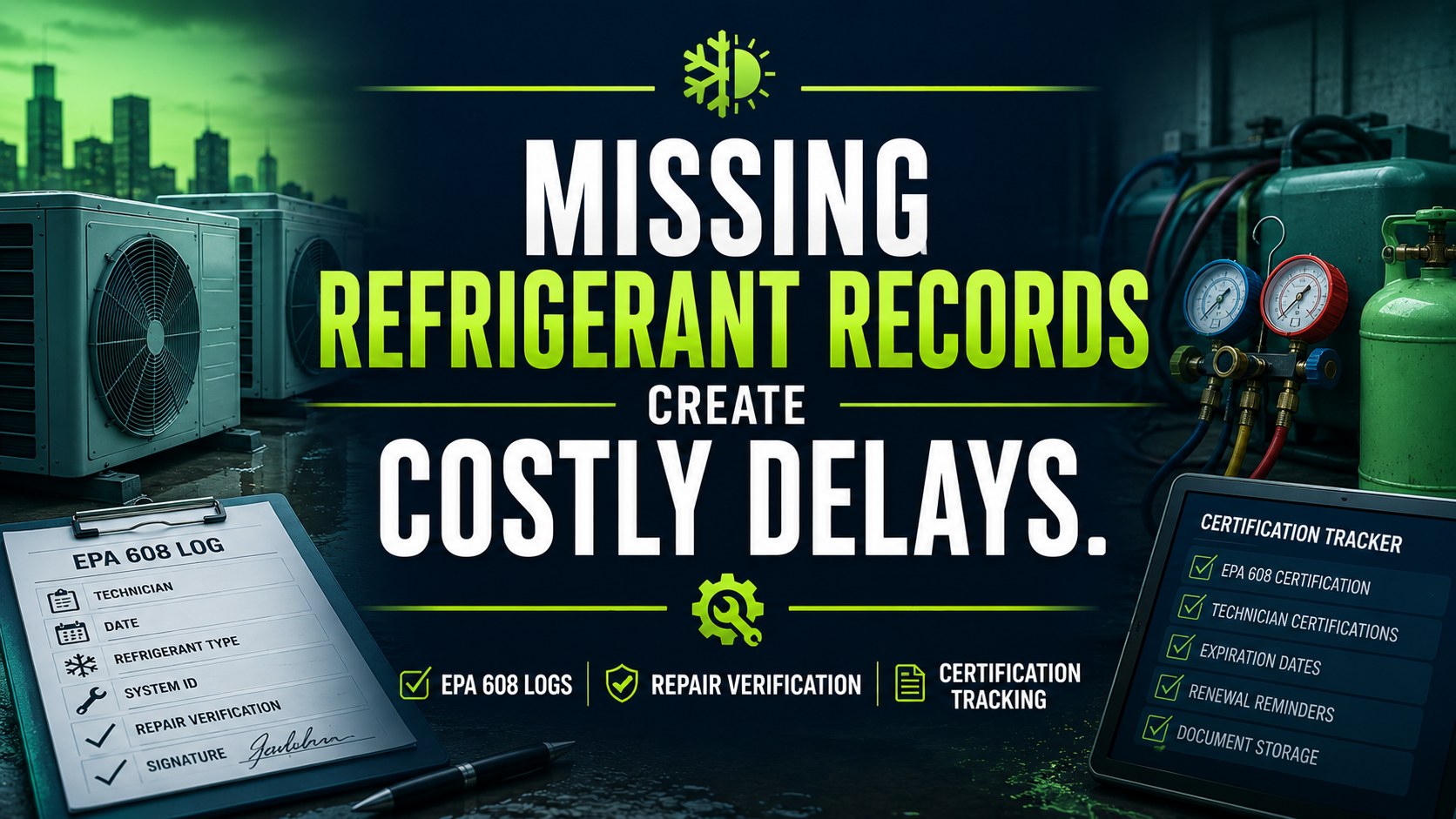
An HVAC virtual assistant can protect the administrative side of your refrigerant program before a missing invoice, incomplete service note, or expired certification creates a problem.
Your technicians may perform excellent work in the field. However, EPA reviewers, customers, facility managers, and insurance representatives often judge that work through the file. If the file cannot show what happened, when it happened, how much refrigerant was added, and whether a repair was verified, your company may spend hours reconstructing the job.
That work creates pressure in the office. Dispatchers chase technicians for old notes. Service managers search through photos. Owners review spreadsheets late at night. Meanwhile, your team delays billing, renewals, and profitable customer work.
The risk becomes more serious when you service stationary appliances with a full charge of 50 or more pounds of ozone-depleting refrigerant. EPA Section 608 requirements can involve leak-rate calculations, corrective action, repair verification, invoices, technician certification records, and retention of service documentation.
Treat the refrigerant logbook as an operating system for compliance. Do not treat it as a folder that someone checks once a year.
What does EPA Section 608 require from commercial HVAC contractors?
EPA’s current guidance states that owners or operators must take corrective action when an appliance with a full charge of 50 or more pounds is found to be leaking ozone-depleting refrigerant above the applicable trigger rate.
The trigger rate depends on the equipment category:
- Industrial process refrigeration: 30% annual leak rate.
- Commercial refrigeration: 20% annual leak rate.
- Comfort cooling and other appliances: 10% annual leak rate.
When the applicable threshold is exceeded, the owner or operator generally must repair the leak within 30 days or develop a retrofit or retirement plan within that period. Industrial process refrigeration may receive a 120-day repair period when an industrial process shutdown is required.
After repair work, the contractor must document initial and follow-up verification testing. The initial test occurs after the leak is repaired and before refrigerant is added back or the system returns to service. The follow-up test occurs after the appliance returns to normal operating conditions.
Avoid one common mistake: do not assume that EPA creates a universal 10-day deadline for every follow-up test. Current EPA guidance says there is no minimum timeframe for the follow-up verification test. Your company can still set an internal 10-day review target to prevent open files from aging, but label that as your operating standard rather than an EPA deadline.
Review the EPA stationary refrigeration leak repair requirements and consult the current regulation for the equipment and refrigerant categories that apply to your work.
Why do refrigerant records become a profit problem?
Compliance paperwork does not only affect regulatory exposure. It also affects cash flow, customer retention, and technician productivity.
A missing refrigerant quantity can delay an invoice. An incomplete verification record can create a callback from a facility manager. A certification file that cannot be located can slow a vendor approval process. A maintenance agreement may renew without the required service documentation, weakening your position during a dispute.
The most common sources of recordkeeping gaps include:
- Technicians entering “added refrigerant” without recording the exact quantity.
- Service notes using different equipment names than the asset register.
- Repair photos saved to personal phones or unrelated job folders.
- Follow-up tests assigned verbally but not placed on a dated task list.
- Certification cards stored in email instead of a central employee file.
- Recovery records separated from the original work order.
- Invoices sent before the service documentation is complete.
- Retired equipment remaining active in the refrigerant inventory.
- Seasonal maintenance visits failing to update the leak history.
- Managers relying on memory to identify files that need review.
The EPA recordkeeping and reporting requirements state that owners or operators must keep servicing records showing the date and type of service and the quantity of refrigerant added. They must also maintain records of leak inspections and tests performed to verify repairs.
The basic rule is simple: capture the record at the point of work, validate it in the office, and retain it where your team can retrieve it quickly.
How does an HVAC virtual assistant run a refrigerant logbook desk?
Assign the work to a trained HVAC virtual assistant with a defined queue, approval process, and escalation path. Keep technical judgments with qualified technicians and managers. Give the VA ownership of the administrative controls around those judgments.
1. Build the equipment inventory
Create one master record for every covered appliance. Include:
- Customer and site name.
- Equipment ID and location.
- Manufacturer and model.
- Refrigerant type.
- Full charge size.
- Equipment category.
- Installation and retirement status.
- Assigned technician or service team.
- Last leak inspection date.
- Last refrigerant addition date.
- Open repair or verification task.
Match the equipment name in your inventory to the asset name in ServiceTitan, BuildOps, Housecall Pro, FieldEdge, or your chosen field-service platform. Eliminate duplicate names such as “RTU-1,” “Rooftop Unit 1,” and “Unit A” when they refer to the same equipment.
2. Reconcile every refrigerant addition
Require the VA to review each completed work order for:
- Date of service.
- Refrigerant type.
- Pounds added.
- Reason for adding refrigerant.
- Leak location or inspection result.
- Technician name.
- Customer approval.
- Invoice status.
- Supporting photos and notes.
Flag incomplete records instead of guessing. Send a precise request to the technician or service manager: “Please confirm the refrigerant type, quantity added, and leak inspection result for asset RTU-04 on Work Order 21876.”
That single habit produces better records than a vague message asking a technician to “finish the paperwork.”
3. Maintain the leak-rate calculation queue
When refrigerant is added to a covered appliance, place the work order into a review queue. The VA can prepare the calculation using the information supplied by your qualified team.
The annualized calculation generally considers:
- Pounds of refrigerant added.
- Full charge of the appliance.
- Number of days since the previous addition.
- Applicable equipment category.
Use the formula required by the applicable regulation and have a designated manager or compliance professional approve exceptions. Do not ask a VA to make a technical determination when the source data is unclear.
4. Track repair and verification milestones
Create a dated task sequence:
- Record the discovery date.
- Identify the applicable corrective-action deadline.
- Assign the repair to the responsible team.
- Collect the initial verification result.
- Record whether the test passed or failed.
- Schedule the follow-up verification after normal operating conditions return.
- Attach the final report, photos, and invoice.
- Escalate any overdue item to the service manager.
Set an internal 10-day documentation review target if it fits your operation. Use it to catch missing follow-up records early. Do not present it to customers or employees as a universal EPA requirement.
5. Keep technician certification records current
EPA Section 608 technicians must maintain proof of certification. Your VA can create a secure certification register containing:
- Technician name.
- Certification type.
- Issuing organization.
- Certification number.
- Issue date.
- Expiration date, if applicable.
- Card or certificate location.
- Assigned work categories.
- Review status.
The VA should send renewal or document-review reminders according to your internal policy. A manager should approve the technician’s eligibility for specific work.
Review the EPA technician certification information when building your company’s certification SOP.
6. Close the file before billing
Make documentation completeness a billing checkpoint. Before the invoice moves to “ready to send,” confirm that the file contains the required service details, refrigerant quantity, repair notes, verification records, and customer-facing attachments.
This approach supports compliance and reduces invoice disputes. It also gives facility managers a professional service history they can use during budgeting, capital planning, and vendor reviews.
Which HVAC software can a virtual assistant support?
A specialized HVAC virtual assistant can work inside your existing systems rather than forcing your company to adopt another platform.
- ServiceTitan: Review completed calls, update equipment records, check refrigerant quantities, attach photos, create follow-up tasks, support maintenance agreement records, and prepare documentation for invoice review.
- BuildOps: Organize commercial service tickets, verify technician notes, track equipment-level records, and maintain open repair queues.
- Housecall Pro: Review job summaries, attach customer documents, update service history, and flag incomplete refrigerant entries.
- FieldEdge: Reconcile service agreements, review work orders, and maintain equipment and customer records.
- Jobber: Track recurring service visits, organize client files, and support follow-up communication.
- QuickBooks Online: Match approved service documentation with invoices, identify billing holds, and prepare exception lists for accounting review.
- Google Drive or SharePoint: Maintain standardized folders for certifications, inspection reports, repair verification, invoices, photos, and retirement records.
Use least-privilege access. Give your VA access to the functions required for the role. Keep final technical approvals, regulatory decisions, and high-risk edits with your authorized manager.
What does an HVAC virtual assistant cost?
Virtual Nexgen Solutions provides virtual assistant support at $8 per hour.
At 20 hours per week, the labor cost equals approximately $8,320 per year. At 40 hours per week, it equals approximately $16,640 per year, before any agreed service terms or platform costs.
Compare that with an in-house administrative position that may cost about $60,000 per year before considering benefits, payroll taxes, paid time off, office space, equipment, recruiting, and turnover. Use your own wage and overhead assumptions for a precise comparison. The Bureau of Labor Statistics HVAC mechanics and installers page can help you review current occupation-level wage and employment data.
Start with the workload that creates the most exposure. A 10-hour weekly queue may cover certification tracking and completed-work-order review. A 20-hour weekly queue may include equipment inventory, leak-rate calculation preparation, verification follow-up, maintenance agreement administration, and invoice readiness checks.
Case study 1: Commercial HVAC contractor in Arizona
An illustrative commercial HVAC contractor with 18 technicians and 74 tracked rooftop units had nine months of records spread across ServiceTitan, email, shared folders, and paper packets.
A VA worked 20 hours per week for six weeks at $8 per hour. The work included:
- Matching 312 completed work orders to equipment records.
- Identifying 11 missing refrigerant quantities.
- Locating 27 technician certification documents.
- Creating 19 verification follow-up tasks.
- Removing 8 retired assets from the active inventory.
- Preparing a manager review queue with 34 exceptions.
The modeled labor investment was $960. The contractor did not receive a guaranteed compliance outcome. Instead, management gained a documented exception list, a repeatable review process, and a central location for future records.
Case study 2: Mechanical service company in Ohio
An illustrative mechanical service company with 12 field technicians managed commercial maintenance agreements for food-service and light-industrial customers. The company had 39 equipment records requiring regular documentation review and 46 active agreements.
The VA worked 15 hours per week for eight weeks at $8 per hour. The workflow produced:
- A standardized asset naming convention for all 39 records.
- 100% review of eight months of service notes.
- Reduction of open documentation exceptions from 41 to 6.
- 23 maintenance agreement visits moved from “completed” to “invoice-ready.”
- 14 overdue follow-up contacts assigned to the service manager.
- A certification register with one review date per technician.
The modeled labor investment was $960. The result was not a promise of regulatory approval. It was a cleaner administrative control system that helped the company see what was missing before customers, auditors, or managers had to find it.
How should you launch the compliance logbook desk?
Follow a controlled 30-day implementation plan.
Days 1–5: Define the scope. Identify covered equipment, refrigerant categories, systems of record, responsible managers, and the documents your company must retain.
Days 6–10: Build the templates. Create the equipment inventory, refrigerant addition review checklist, certification register, repair-verification queue, and exception log.
Days 11–20: Reconcile the backlog. Start with current and high-value commercial accounts. Match work orders, invoices, photos, technician notes, and equipment records.
Days 21–25: Train the team. Show technicians exactly where to record refrigerant type, pounds added, inspection results, repair details, and verification information.
Days 26–30: Start weekly control reviews. Review incomplete records, overdue tasks, certification items, and billing holds. Measure the number of files reviewed, exceptions found, exceptions closed, and average resolution time.
Why choose Virtual Nexgen Solutions for HVAC back-office support?
Virtual Nexgen Solutions has supported businesses since 2016 with tailored administrative services, software-based workflows, and dedicated virtual assistant teams. Your VA can work from your checklists, access permissions, naming conventions, and escalation rules.
The goal is not to replace your technicians or compliance professionals. Give your field team a reliable administrative engine. Let qualified technicians make technical observations, let managers approve high-risk decisions, and let the VA keep the records complete, organized, searchable, and moving toward closure.
You can learn more about Virtual Nexgen Solutions or review the company’s about page before defining your support plan.
Ready to make your refrigerant records easier to defend?
Tell Virtual Nexgen Solutions how many technicians, commercial accounts, covered appliances, work orders, and open documentation items your team manages. Book a 30-minute consultation to discuss an HVAC virtual assistant at $8 per hour and determine whether a refrigerant compliance logbook desk fits your operation.
FAQ
What is an HVAC virtual assistant?
An HVAC virtual assistant is a remote administrative professional who supports HVAC operations. The role can include work-order review, refrigerant logbook management, technician certification tracking, maintenance agreement administration, customer documentation, invoice preparation, and follow-up task management. The VA supports your qualified field and management team without making technical compliance decisions.
How can an HVAC virtual assistant manage EPA 608 refrigerant records?
An HVAC virtual assistant can review completed work orders, record refrigerant type and quantity, match service notes to equipment assets, organize inspection photos, prepare leak-rate calculation worksheets, track repair verification tasks, and maintain certification files. A qualified manager should approve technical conclusions and regulatory decisions before records are finalized.
Does EPA Section 608 apply to HVAC systems with 50 pounds of refrigerant?
EPA leak-repair requirements generally apply to stationary appliances with a full charge of 50 or more pounds of ozone-depleting refrigerant when the applicable leak-rate trigger is exceeded. Current rules treat substitute refrigerants differently for leak-repair requirements. Review the current EPA guidance and applicable regulation for your equipment and refrigerant type.
What records are required for EPA Section 608?
Owners or operators of covered appliances generally need servicing records showing the service date, service type, and quantity of refrigerant added. They must also maintain records of leak inspections and repair-verification tests. Technicians must provide required information to the owner or operator and maintain proof of Section 608 certification.
How long must HVAC refrigerant records be kept?
EPA guidance generally requires owners or operators to maintain covered appliance servicing, leak inspection, and verification records for at least three years. Your company may choose a longer retention period based on customer contracts, state requirements, insurance requirements, warranty terms, or internal policy. Confirm retention rules with qualified counsel or compliance personnel.
What is an HVAC leak-rate calculation?
An HVAC leak-rate calculation estimates the annualized percentage of an appliance’s full refrigerant charge that has leaked. The calculation uses information such as refrigerant added, full charge, and the time between additions. The applicable trigger rate depends on the equipment category. Have a qualified person review calculations when source records are incomplete.
Can a virtual assistant work in ServiceTitan?
Yes. A trained HVAC virtual assistant can support ServiceTitan tasks such as reviewing completed calls, checking equipment records, attaching photos, identifying missing refrigerant quantities, creating follow-up tasks, organizing maintenance agreement documentation, and preparing invoice-review queues. Use role-based permissions and manager approval for sensitive edits or technical determinations.
How much does an HVAC virtual assistant cost?
Virtual Nexgen Solutions provides virtual assistant support at $8 per hour. A 20-hour weekly schedule equals approximately $8,320 per year in labor, while a 40-hour weekly schedule equals approximately $16,640 per year. Compare those figures with your in-house salary, benefits, payroll taxes, equipment, office, recruiting, and turnover costs.