You’ve had a killer month. The Shopify dashboard is glowing green, your Amazon sales rank is climbing, and the "cha-ching" notification on your phone is basically the soundtrack to your life. But when you log into your bank account, the numbers don’t match the hype.
Where did the money go?
You aren't overspending on ads. Your COGS are stable. Yet, your cash flow feels like a leaky bucket. Most e-commerce founders assume they just need to sell more to fix it. They double down on "scaling," hire a basic VA to list more products, and hope the volume solves the problem.
Spoiler alert: It won’t.
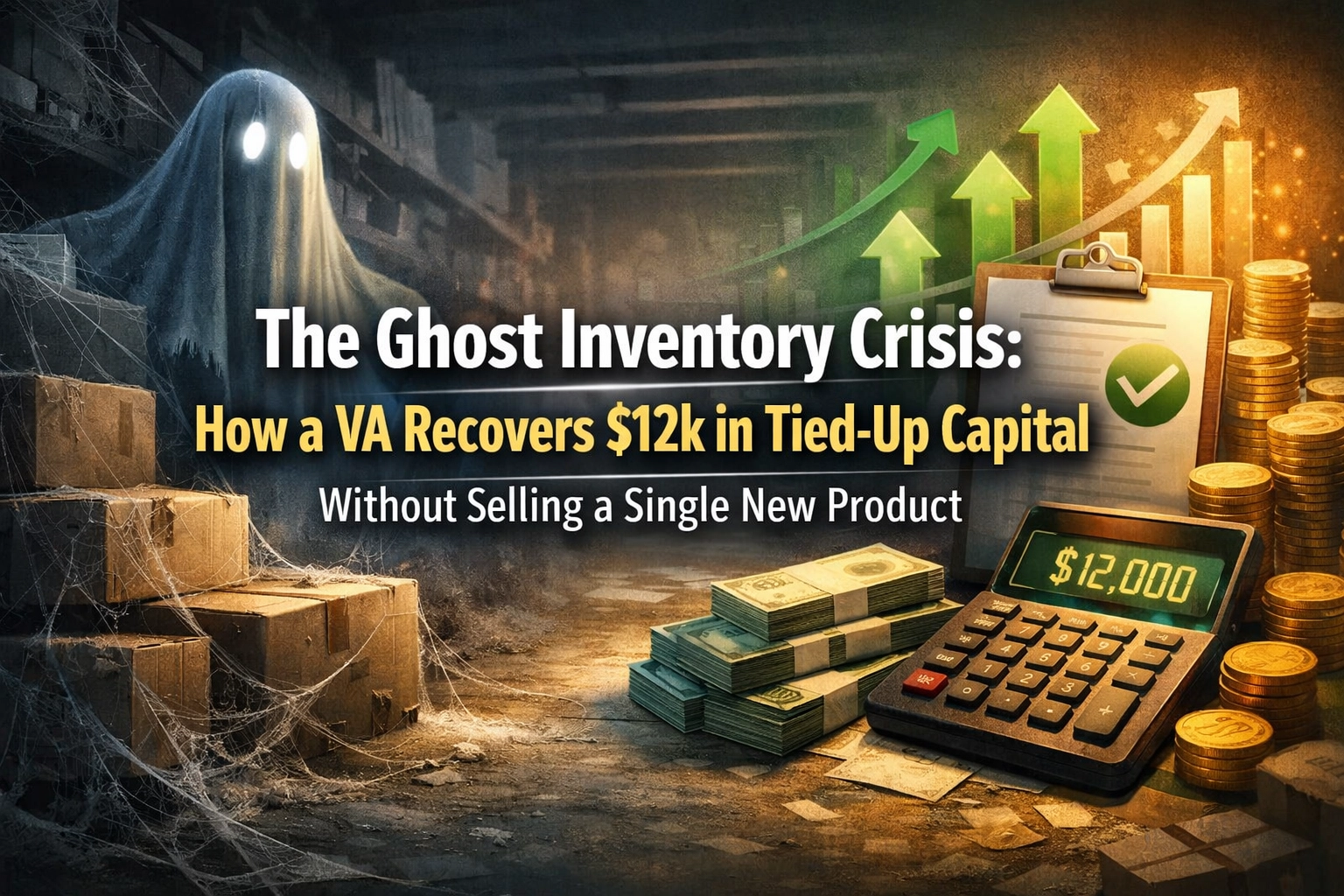
The problem isn't your sales volume; it’s your Ghost Inventory. There is a phantom in your P&L, and it’s quietly eating your margins. In fact, for many mid-sized brands, there is roughly $12,000 (or more) in tied-up capital sitting in un-reconciled returns, dead SKU storage fees, and missed supplier credits.
Here is how an expert E-commerce Virtual Assistant: specifically a "Profit Recovery Agent" from Virtual Nexgen: finds that money and puts it back where it belongs: in your pocket.
What is Ghost Inventory? (And Why It’s Killing Your Cash Flow)
Ghost inventory is the financial discrepancy between what your system says you have and what is actually available for sale. It’s the "phantom stock" that exists on paper but can’t be shipped to a customer.
It happens in three main ways:
- The Return Abyss: A customer returns a product. It arrives at the warehouse, but it’s never inspected, never restocked, and the credit is never reconciled.
- The Dead SKU Weight: You have 500 units of a product that hasn't sold in six months. You are paying Amazon or your 3PL "rent" to house a ghost.
- The Supplier Shortage: You ordered 1,000 units. You received 980. You paid for 1,000.
A standard VA will just keep clicking "add new product" and ignore these leaks. An expert Amazon Seller VA, however, views your inventory as a ledger of cash. Every unit that isn't moving or accounted for is a $20 bill pinned to a warehouse wall.
The $12,000 Recovery: A Breakdown
Let’s look at a real-world scenario. A typical 7-figure brand owner feels the "tightness" in their cash flow. They hire a Virtual Nexgen E-commerce VA for $8/hour. Instead of just managing support tickets, the VA performs a "Profit Recovery Audit."
1. Reconciling the "Return to Sender" Abyss ($4,500 Recovered)
When you sell at scale, returns are a fact of life. But for many sellers, the return process is a black hole. Products sit in a "damaged" or "unfulfillable" bin for months.
Our VAs don't just see a return; they see a recovery opportunity. They systematically audit the 3PL reports against Shopify or Amazon records. They identify items that were returned but never restocked. They file claims for items damaged in transit by the carrier.
In our $12k example, the VA discovered that 15% of returns were perfectly fine but were never moved back to "Active" status due to a warehouse clerical error. That’s $4,500 in retail value unlocked without spending a dime on manufacturing.
2. Nuking the Dead SKU Storage Fees ($3,500 Saved)
Amazon loves charging you for the privilege of letting your slow-moving products gather dust. Long-term storage fees can skyrocket before you even realize your "best seller" from 2024 is now a liability.
A skilled Amazon Seller VA monitors your Inventory Age reports weekly. They don't just report the news; they take action. They set up removal orders, coordinate "Fire Sales" to liquidators, or create strategic bundles to move "Ghost Stock" before the next billing cycle hits.
By clearing out 300 units of dead stock and stopping the storage bleed, our VA saved the brand $3,500 in projected annual fees. For more on how specialized VAs handle these logistics, check out our guide on affordable e-commerce virtual assistants.
3. Chasing Supplier Credits ($4,000 Recovered)
This is the most overlooked area of e-commerce. Did you get the 5% discount promised for that bulk order? Did the factory reimburse you for the 2% defect rate on the last shipment?
Most founders are too busy growing to check the fine print on a supplier invoice. A Virtual Nexgen VA acts as your "Accounts Payable Police." They cross-reference every Bill of Lading with the actual Warehouse Receiving report. If there’s a shortage, they don't just "note it": they open a ticket, send the photos, and follow up until the credit memo is issued.
Why a Standard VA Isn't Enough
If you hire a "generalist" VA from a platform that focuses on speed over strategy, you are getting a data entry clerk. They will follow a checklist: Check email. Post to Instagram. Upload listing.
But e-commerce in 2026 requires a "Profit Recovery Agent." You need someone who understands the nuances of Amazon AI policies and knows that a single inventory error can lead to an account shutdown or a massive financial leak.
At Virtual Nexgen Solutions, we train our VAs to think like owners. We know that as an e-commerce brand owner, you don't need another person to manage; you need someone to manage your money.
The ROI of an $8/Hour Profit Recovery Agent
Let’s do the math.
You hire a Virtual Nexgen E-commerce Virtual Assistant for 40 hours a week at $8/hour.
Your monthly investment: ~$1,280.
In their first 90 days, they recover $12,000 in tied-up capital from the "Ghost Inventory" sources mentioned above.
That is a 312% Return on Investment.
And that’s before they even start listing new products, managing your customer service, or optimizing your PPC. You aren't just hiring "help"; you are hiring a self-funding team member. This is the same logic we apply across all our departments, whether it's media production or insurance administration.
How to Start Your Profit Recovery Audit Today
If your warehouse feels full but your bank account feels empty, it’s time to stop the "scaling" madness and start the recovery process. Here is a quick 3-step checklist you can give to a VA today:
- Inventory Reconciliation: Compare your Shopify/Amazon "Units Sold" vs. "Inventory Deducted" vs. "Warehouse Physical Count." If the numbers don't match, you have a ghost.
- The 90-Day Rule: Pull a report of every SKU that hasn't sold a unit in 90 days. Calculate the storage cost. If the storage cost over the next 6 months exceeds the profit margin, liquidate it immediately.
- The Refund Audit: Export your refund list for the last 60 days. Cross-reference it with your "Restocked" report. If an item was refunded but not restocked (and not marked as "Destroyed"), ask your 3PL where it is.
Stop Leaving Money on the Warehouse Floor
You worked too hard to build your brand to let it be bled dry by clerical errors and "phantom" costs. Your Amazon store or Shopify site should be a wealth-building machine, not a leaky bucket.
At Virtual Nexgen Solutions, we specialize in providing high-level administrative support that goes beyond basic tasks. Whether you need a dedicated Amazon Seller VA to handle your account health or an E-commerce specialist to manage your multi-channel logistics, we provide the human expertise to solve real business problems.
Don't let $12,000 (or more) stay tied up in your inventory. Let’s get it back.
Ready to find your hidden profit?
Book a 30-minute strategy call with the Virtual Nexgen team and let’s talk about how a Profit Recovery Agent can audit your backend and free up your cash flow for real growth.
No more ghosts. Just growth.