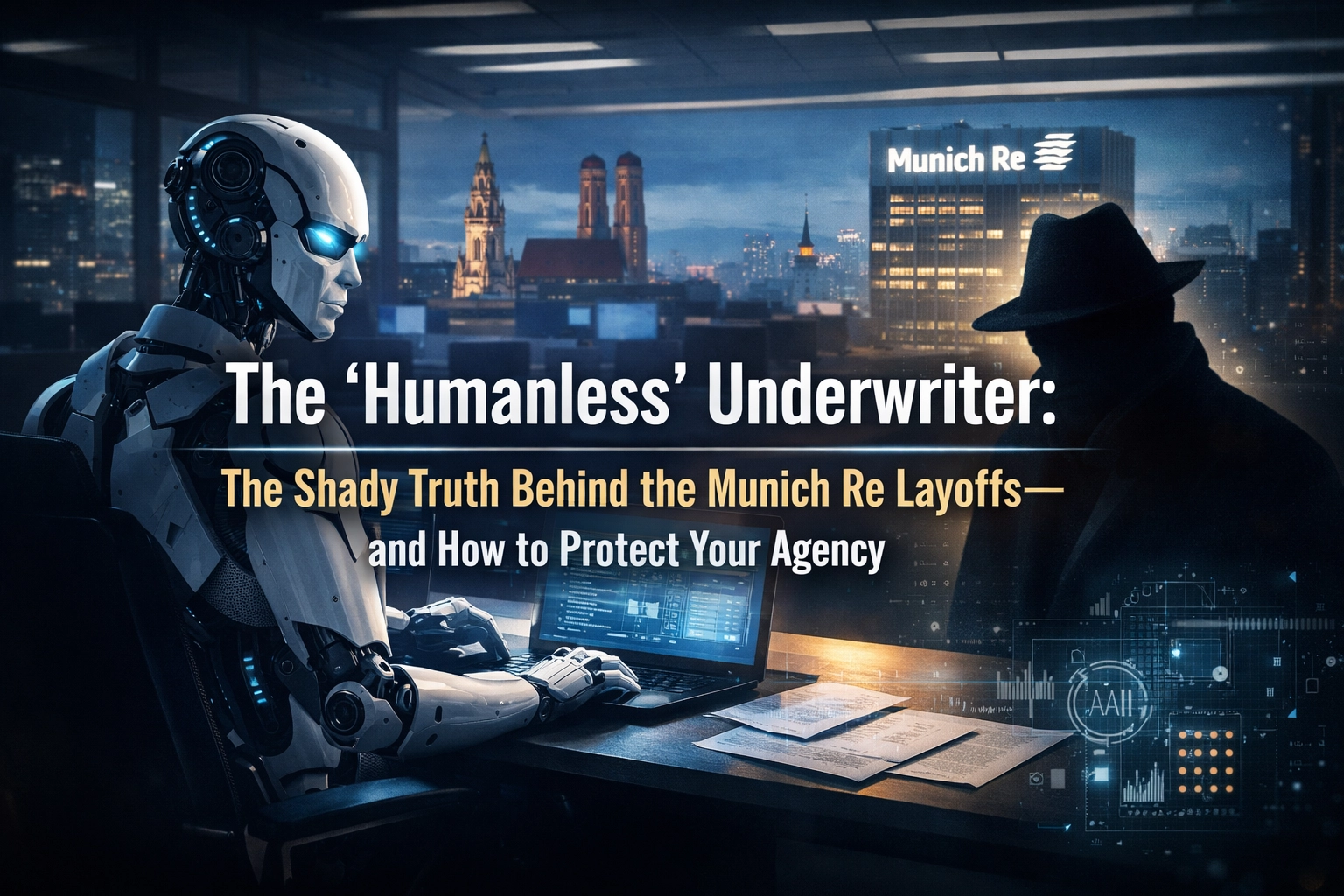
The headlines in February 2026 have sent a shiver through the corridors of the insurance world. Munich Re’s primary insurance unit, Ergo, just announced a move that many saw coming but few were prepared for: the elimination of 1,000 jobs. While the corporate press release uses polished terms like "digital transformation" and "restructuring," the reality for the local agency owner is far more unsettling. We are witnessing the birth of the "Humanless" Underwriter.
As an agency owner, you might think these massive shifts in the upper echelons of global reinsurance don’t affect your day-to-day operations. But that is exactly what they want you to think. The truth is, the gap between the "Big Tech" insurers and the local, human-centric agency is widening. To survive, you don't need to replace your staff with robots: you need a way to out-human the giants while maintaining their level of efficiency.
This is where the strategic use of an Insurance Virtual Assistant becomes your ultimate defensive play.
The February 2026 Shocker: What Really Happened at Munich Re?
In a move that marks a definitive turning point for the P&C (Property & Casualty) space, Ergo is slashing roughly 1,000 positions by 2030. The targets? "Simple and repetitive tasks" in telephony and claims processing. While the company has promised no forced redundancies and a robust retraining program for 500 employees, the message to the market is loud and clear: The human element is being engineered out of the process.
For the global giants, humans are increasingly viewed as "friction." They are moving toward a model where data points, not conversations, determine risk and payouts. But here is the cliffhanger: as the industry moves toward this "Humanless" model, consumers are beginning to feel the coldness of the machine. They are losing the "2-minute lead leak" battle because they have no one to talk to when things go wrong.
The "Efficiency Trap" for Independent Agencies
When you see a giant like Munich Re pivot, the temptation is to follow suit. You might think that to compete, you need to strip away your service layers and go fully digital. This is the "Efficiency Trap."
If you remove the human touch, you are no longer a trusted advisor; you are a commodity. And in a price war against a multi-billion dollar AI-driven corporation, the small agency loses every single time. Your only competitive advantage in 2026 is your ability to provide a personalized, high-touch experience that a machine cannot replicate.
However, you can’t provide that experience if you are buried under the very "repetitive tasks" that Munich Re is automating. This is the paradox of the modern agency. You need to be human, but you also need to be fast.
Why the "Humanless" Model is Your Biggest Opportunity
While the big carriers are firing their front-line staff, they are creating a massive void in customer service. Clients are frustrated. They don't want to talk to a chatbot when their basement is flooded or their car is totaled. They want a person who knows their name.
By bringing on a specialized Insurance Agency VA, you can bridge this gap. You can offload the "simple and repetitive" tasks: the exact ones Munich Re is cutting: to a dedicated human professional who operates at a fraction of the cost of a local hire. This allows you, the agent, to be the "human" face of your business while your VA handles the back-end machinery.
> Snippet Hook: The 2026 Agency Survival Ratio
> In the current P&C climate, successful agencies are maintaining a 70/30 split. 70% of the administrative, data-entry, and claims-prep work is handled by an Insurance Virtual Assistant, while 30% of the time is spent on high-value human interaction and relationship building. Agencies that flip this ratio are seeing a 40% loss in closings due to lead leaks.
How an Insurance Virtual Assistant Protects Your Agency
The Munich Re layoffs are just the tip of the iceberg. As more carriers move toward parametric insurance and automated payouts (which you can read about in our Parametric vs. Traditional Insurance guide), the workload for your agency will actually increase. Why? Because someone still has to explain these complex new products to the client.
Here is how a human VA from Virtual Nexgen Solutions protects your territory:
1. Stopping the Lead Leak
When a prospect calls because they are tired of the "Humanless" experience at a big carrier, you cannot afford to let them go to voicemail. A human VA ensures that every call is answered by a real person. This prevents the "2-minute lead leak" where a frustrated prospect moves on to the next Google result within 120 seconds of not reaching a human.
2. Specialized P&C Knowledge
Unlike general assistants, a specialized Insurance Agency VA understands the nuances of the P&C world. They can handle certificate of insurance (COI) requests, follow up on missing signatures, and prep renewals. They are the backbone that allows you to focus on closing the $10,000 premium accounts while they handle the $500 policy changes.
3. Maintaining the Human Touch in a Cold Market
The most "shady" part of the Munich Re layoffs isn't just the job cuts: it's the assumption that customers don't value human interaction. By leveraging a VA, you can actually increase your touchpoints. Your VA can send personalized "thank you" notes, birthday greetings, and proactive policy review reminders. To the client, your agency feels more attentive than ever, even as the "Big Tech" insurers become more distant.
The Cost of Staying Local-Only
Hiring a full-time, in-office administrative assistant in 2026 is becoming prohibitively expensive. Between rising healthcare costs, office space overhead, and the competitive talent market, many agencies are finding their margins squeezed to the breaking point.
When you look at the Farmers Agent secret to 1% growth, it isn't about working harder: it's about working smarter with specialized VAs. These agents aren't firing their local staff; they are empowering them. By giving the local staff a VA to handle the "grunt work," the local team can focus on sales and high-level service.
The Cliffhanger: What Happens When the Machines Fail?
We are entering an era of "Agentic AI" in underwriting. But data is only as good as the human who interprets it. In February 2026, we are already seeing cases where automated underwriting systems are mispricing risk in climate-volatile areas. When the machine gets it wrong, the client is the one who suffers.
Your agency’s role in 2026 is to be the safeguard. You are the one who double-checks the work. You are the one who fights for the client. But you can't do that if you are busy typing data into a CRM for six hours a day.
If you don't adapt your staffing model now, you will be caught in the middle: too small to compete with the big guys on tech, and too busy to compete with them on service.
The Virtual Nexgen Solution
At Virtual Nexgen Solutions, we don't believe in "Humanless" service. We believe in "Human-Empowered" service. Our VAs are trained specifically for the office administration needs of modern agencies. Whether you are in HVAC/Plumbing or Real Estate, or specifically in the P&C Insurance space, our mission is to give you your time back.
We help you navigate the shifts in the industry: like the Munich Re layoffs: by providing the specialized support you need to stay competitive. Don't let your agency become a casualty of the "Humanless" trend.
Ready to Build Your 2026 Defense Strategy?
The Munich Re layoffs are a warning shot. The big carriers are betting that you won't be able to keep up. Prove them wrong by scaling your agency with a professional Insurance Virtual Assistant.
Book your 30-minute configuration call with Virtual Nexgen Solutions today and let’s discuss how to insulate your agency from the industry's biggest shifts.
Want to learn more about how we help agencies grow? Check out our About Us page or explore our specialized department services to find the perfect fit for your business.