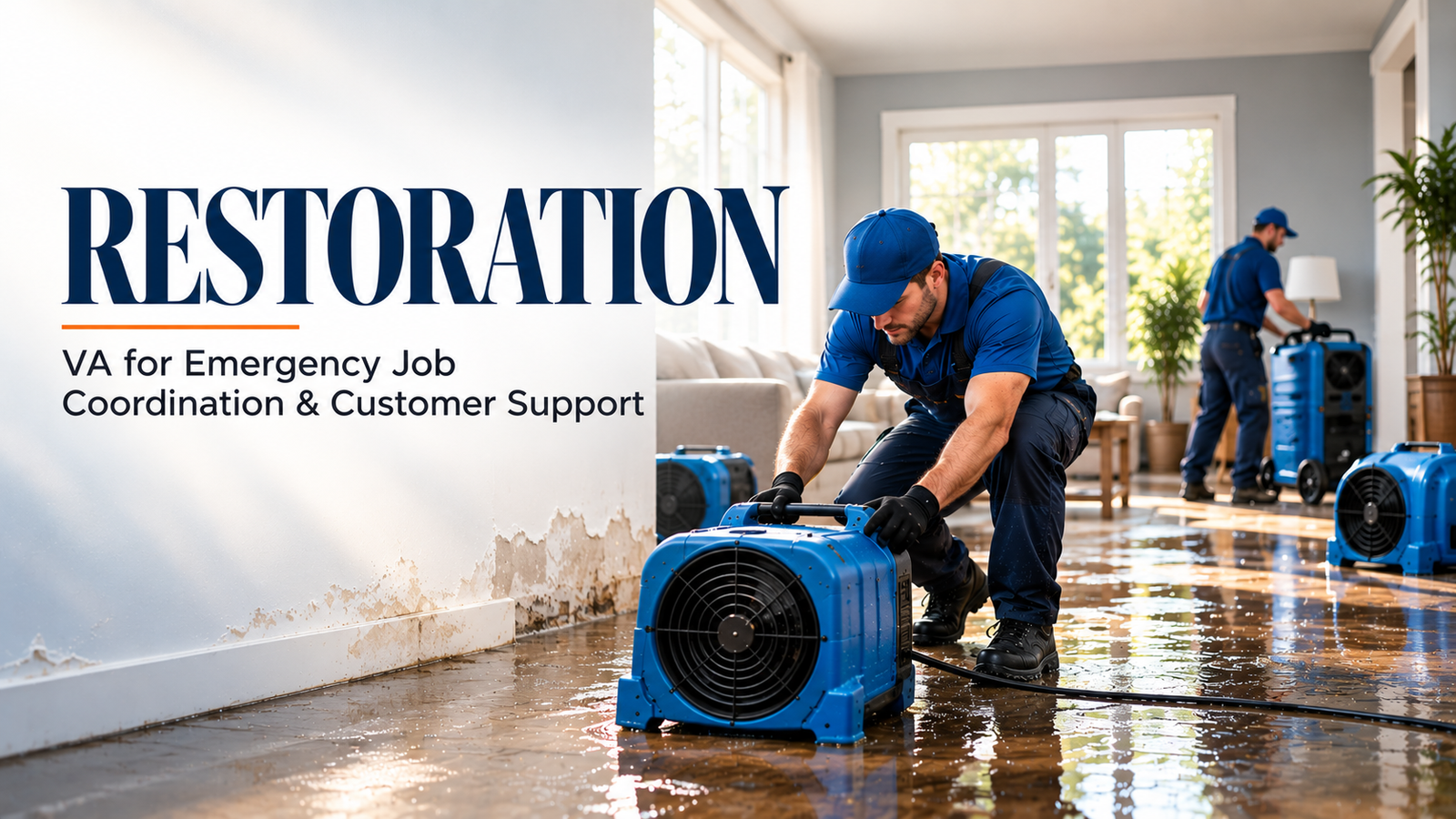
A burst pipe, a flooded basement, a kitchen fire, or severe storm damage can turn a property owner's day upside down. For restoration companies, these incidents create an immediate operational challenge: responding to incoming calls, coordinating field teams, documenting damage, communicating with customers, and keeping job records organized—all while new service requests continue to arrive.
In the restoration industry, effective coordination is just as important as the physical restoration work. Delayed communication, incomplete documentation, or missed administrative follow-ups can create additional pressure on technicians, project managers, and business owners.
For restoration contractors across the United States, a Restoration Virtual Assistant (VA) can provide dedicated administrative support for emergency job coordination, customer communication, scheduling, documentation, and back-office operations.
The goal is simple: help restoration teams manage the information and administrative work surrounding each job so they can focus on property recovery, customer service, and operational execution.
The Restoration Business Challenge: Managing Urgency Without Losing Organization
Restoration companies often operate in unpredictable conditions. A team may be handling a water damage emergency while another project requires documentation, equipment coordination, customer updates, and insurance-related paperwork.
At the same time, the office may receive additional calls from property owners, property managers, insurance representatives, and referral partners.
Without clear administrative processes, several problems can develop:
- Incoming service requests are difficult to prioritize.
- Customer information is incomplete or scattered.
- Technicians and project managers spend time chasing updates.
- Job documentation accumulates faster than it can be organized.
- Customers wait for routine status updates.
- Insurance-related documents remain outstanding.
- Completed jobs still require substantial administrative follow-up.
- These challenges do not necessarily mean the restoration team needs more field technicians. Sometimes, the business needs additional administrative capacity to keep information moving between customers, office staff, project managers, and field teams.
That is where a specialized restoration VA can help.
Six Ways a Restoration Virtual Assistant Supports Daily Operations
1. Emergency Call Intake and Job Coordination
When a property owner experiences water damage, fire damage, or another property emergency, the first administrative interaction can set the tone for the service experience.
A restoration VA can handle assigned calls, collect essential information, record the reported incident, and notify the appropriate team according to established escalation procedures.
Typical responsibilities include:
- Recording customer names, contact details, and property addresses.
- Documenting the reported type of damage.
- Capturing the time and basic circumstances of the incident.
- Identifying immediate scheduling and communication needs.
- Notifying the designated emergency response team.
- Maintaining an organized record of incoming requests.
For example, when a homeowner reports a burst pipe, the VA can capture the relevant information and immediately route the request to the designated emergency contact.
The operational benefit: Restoration teams receive organized information and can respond according to established priorities without having to manage every administrative detail themselves.
Emergency calls must follow clear escalation protocols. A VA should not independently assess property hazards, provide technical remediation advice, or delay urgent escalation while processing routine information.
2. Scheduling and Field-Team Coordination
Restoration projects may involve inspections, mitigation, equipment placement, monitoring visits, demolition, reconstruction, and final walkthroughs.
Coordinating these activities requires communication among office staff, project managers, technicians, and customers.
A Restoration Virtual Assistant can help maintain schedules, confirm appointments, record approved changes, send reminders, and communicate updates to the appropriate people.
The assistant can also maintain administrative trackers showing upcoming site visits, pending appointments, and outstanding coordination tasks.
The operational benefit: Better visibility into scheduled activities and fewer administrative gaps between the office and field teams.
Project managers and operations leaders remain responsible for technical priorities, resource allocation, and decisions that require professional judgment.
3. Job Documentation and Photo Organization
Restoration projects generate substantial documentation. Depending on the job, records may include photographs, inspection notes, moisture readings, equipment logs, work authorizations, estimates, and supporting reports.
When these records are spread across emails, folders, and mobile devices, retrieving the correct information can become time-consuming.
A trained VA can help organize approved files, maintain job folders, update document registers, track missing records, and follow established naming conventions.
Administrative support may include:
- Organizing project photographs and supporting documents.
- Maintaining job documentation checklists.
- Tracking missing information.
- Updating administrative job records.
- Coordinating document requests.
- Preparing files for review by authorized team members.
Technical assessments, moisture interpretations, damage evaluations, and professional remediation decisions must remain with qualified personnel.
The operational benefit: More organized job records and less time spent searching for documentation.
4. Insurance-Related Administrative Support
Many restoration projects involve communication with insurance carriers, adjusters, property owners, or other stakeholders. The documentation and administrative requirements can vary by project and payer.
A restoration VA can help track outstanding documents, organize approved estimates and reports, maintain communication logs, and coordinate administrative follow-ups.
For companies using tools such as Xactimate, Encircle, or Dash, a VA may be trained to assist with permitted documentation and administrative workflows.
The scope should be clearly defined. For example, a VA may organize files and flag missing information for review, while qualified personnel handle damage estimates, technical assessments, coverage questions, and other decisions requiring professional expertise or authorization.
The operational benefit: Better visibility into outstanding paperwork and more systematic administrative coordination.
5. Customer Communication and Project Updates
Property damage can be stressful for homeowners and commercial property managers. Customers may need updates about appointments, inspections, next steps, and documentation requests.
When project managers are focused on field operations, responding to every routine administrative inquiry can be difficult.
A restoration VA can help coordinate customer communication by confirming appointments, sending authorized updates, recording requests, and routing technical questions to the responsible person.
The assistant can also maintain a follow-up list so outstanding customer inquiries remain visible.
The operational benefit: More consistent communication and fewer routine requests competing with field priorities.
Customer communications involving safety, technical findings, project commitments, or insurance coverage should be escalated to the appropriate professional.
6. Back-Office Administration and Job Tracking
A restoration job involves more than the initial emergency response. Businesses also need to manage purchase documentation, invoices, job statuses, subcontractor communication, and administrative closeout tasks.
A VA can support these activities by maintaining job trackers, organizing invoices, following up on missing paperwork, updating authorized systems, and preparing administrative summaries.
Depending on the business's procedures, the assistant may also help track open estimates, pending approvals, outstanding customer information, and completed jobs requiring further administrative action.
The operational benefit: Better visibility into the administrative status of projects from intake through closeout.
How Restoration Virtual Assistants Fit Into Different Business Models
Restoration companies have different operational requirements depending on the services they provide.
|
Restoration business |
Potential VA responsibilities |
|---|---|
|
Water damage restoration |
Emergency intake, scheduling, documentation tracking |
|
Fire and smoke restoration |
Customer coordination, job records, appointment management |
|
Mold remediation |
Administrative scheduling and approved document organization |
|
Storm damage restoration |
Inquiry tracking, customer updates, and job coordination |
|
Commercial restoration |
Project administration, reporting support, and stakeholder communication |
|
Multi-location restoration companies |
Centralized call intake, administrative tracking, and workflow coordination |
A business handling frequent emergency calls may prioritize call intake and escalation. A company managing numerous concurrent projects may benefit more from documentation tracking and administrative coordination.
The best arrangement reflects the company's actual workflow rather than relying on a generic list of tasks.
Restoration Software and Administrative Workflow Support
Technology plays an important role in managing restoration projects, documentation, and communication.
With appropriate training and authorized access, a Restoration Virtual Assistant can support approved administrative workflows in platforms such as:
- Xactimate: Permitted documentation coordination and administrative tracking.
- Encircle: Approved file organization and documentation support.
- Dash: Administrative job tracking and workflow updates.
- CRM platforms: Customer information and follow-up management.
- Project management tools: Task tracking, scheduling, and status updates.
- Microsoft Excel and Google Sheets: Job trackers, administrative reports, and checklists.
Specific responsibilities depend on the company's software configuration, training process, and access permissions.
Data Security and Customer Confidentiality
Restoration companies may handle property photographs, customer contact information, access details, insurance-related documents, and other sensitive records.
Before delegating administrative work, businesses should establish confidentiality agreements, individual user accounts, role-based access, secure authentication, approved file-sharing procedures, and clear incident-reporting policies.
Only the information needed for assigned tasks should be accessible to the VA. Companies should also evaluate applicable privacy, contractual, and insurance-related requirements before engaging an external service provider.
A documented security process helps establish accountability while supporting consistent administrative operations.
How to Introduce a Restoration VA Into Your Workflow
A practical implementation process begins with identifying the administrative responsibilities that create the most pressure.
Step 1: Map your job lifecycle. Review the process from the initial customer call through scheduling, documentation, project updates, and closeout.
Step 2: Identify repeatable tasks. Select activities such as call intake, appointment confirmations, document tracking, and customer follow-ups.
Step 3: Establish escalation rules. Document who receives emergency calls, technical questions, safety concerns, and urgent project updates.
Step 4: Create standard operating procedures. Define how records are entered, files are organized, communication is handled, and tasks are tracked.
Step 5: Provide software training and controlled access. Train the VA on the specific platforms and workflows they will use.
Step 6: Measure performance. Monitor call intake accuracy, follow-up completion, documentation completeness, scheduling accuracy, and outstanding administrative tasks.
Starting with a defined set of responsibilities helps restoration businesses assess the arrangement before expanding the VA's role.
Frequently Asked Questions
What does a Restoration Virtual Assistant do?
A Restoration VA supports restoration contractors with emergency call intake, scheduling coordination, job documentation, customer communication, insurance-related administrative tracking, and back-office operations.
Can a VA help coordinate emergency restoration jobs?
Yes. A VA can collect essential information, maintain administrative records, and route incoming requests according to established escalation procedures. Technical assessments and emergency response decisions remain with the appropriate qualified personnel.
Can a Restoration VA work with Xactimate or Encircle?
A trained VA can assist with authorized administrative and documentation workflows in these platforms. Access and responsibilities should be limited to tasks permitted by the restoration company and its applicable requirements.
Is a Restoration VA useful for a small restoration company?
Yes. Small restoration contractors may benefit when emergency calls, customer updates, documentation, and job tracking compete with fieldwork and management responsibilities.
How can a restoration company measure VA performance?
Relevant indicators include intake accuracy, scheduling accuracy, follow-up completion, document completeness, administrative turnaround time, and the number of outstanding tasks.
Conclusion: Better Coordination Supports Better Restoration Operations
Restoration companies operate in an environment where priorities can change quickly. Emergency calls, field-team scheduling, documentation, customer communication, and insurance-related administration all require dependable coordination.
A dedicated Restoration Virtual Assistant can help manage these administrative responsibilities and maintain better visibility into the work surrounding each project.
For water damage restoration companies, fire and smoke restoration contractors, mold remediation businesses, and commercial restoration providers across the United States, specialized virtual assistant support can create additional administrative capacity while allowing qualified teams to concentrate on property recovery and service delivery.
Ready to delegate the busywork and give your team more time to grow?
Partner with Virtual Nexgen Solutions for reliable, industry-focused Virtual Assistant support tailored to your restoration business.