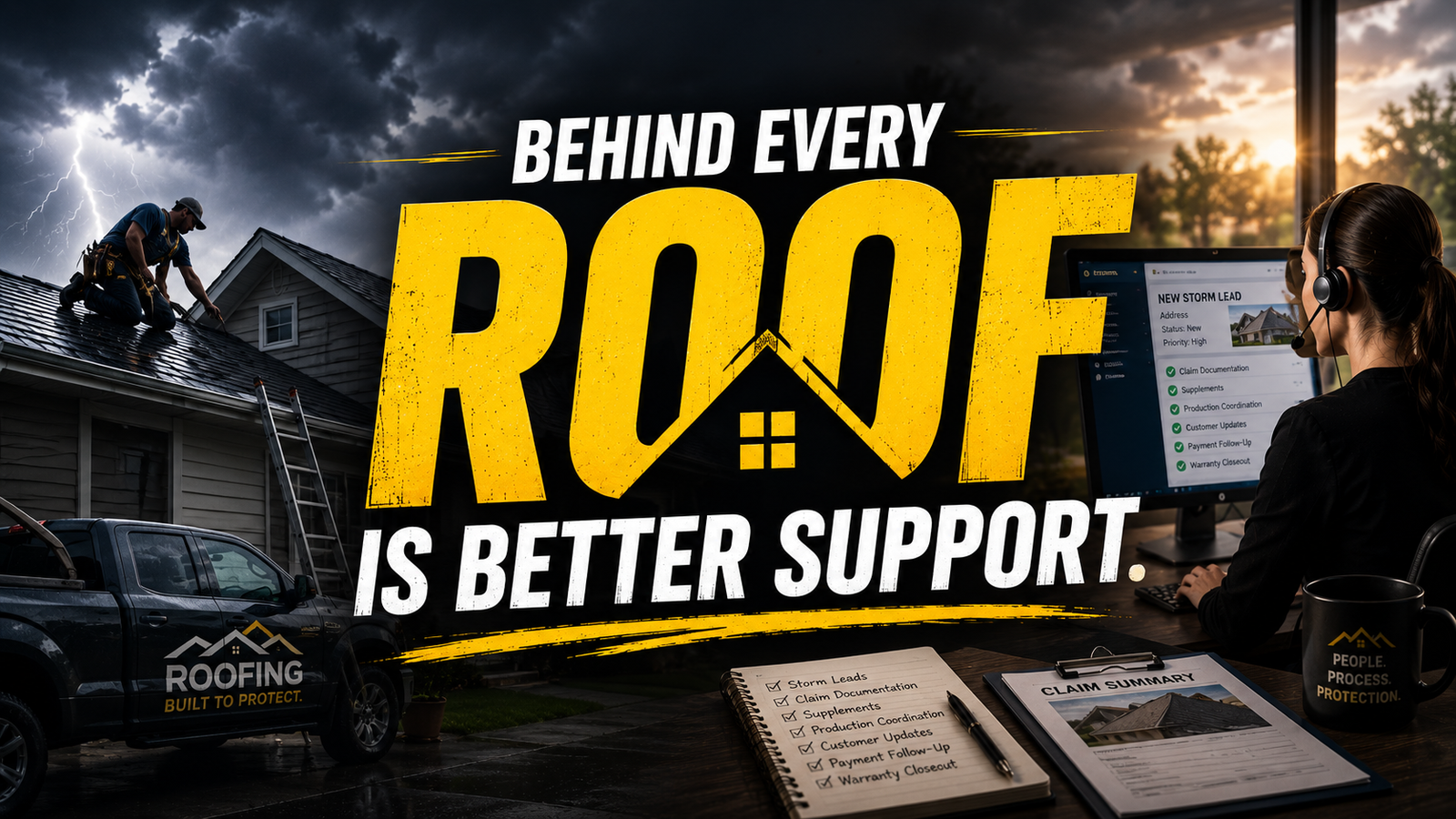
A roofing virtual assistant can become the steady back-office support your team needs when storm calls arrive faster than you can answer them. Picture this illustrative scenario: you are coordinating emergency calls, documenting roof damage, chasing claim supplements, updating homeowners, and collecting final payments while crews are already working across several neighborhoods.
That pressure creates missed follow-ups, incomplete claim files, delayed invoices, and customers who feel forgotten. The work may look administrative, but every delay can affect production schedules, cash flow, and referrals.
A roofing and restoration VA gives you a dedicated operating layer without asking your estimator or production manager to spend the evening inside a CRM.
What a Roofing & Restoration Virtual Assistant Does
A specialized VA supports the complete job-to-cash lifecycle:
- Storm lead response: Capture calls, emails, web inquiries, and Google Local Services Ads leads. Tag storm type, property address, damage concern, and source.
- Inspection scheduling: Coordinate inspectors, confirm homeowner availability, send reminders, and record changes in JobNimbus or AccuLynx.
- Claim documentation support: Organize photos, measurements, scopes, authorizations, invoices, and estimate files. Your estimator retains technical judgment.
- Supplement tracking: Build document checklists, log submission dates, monitor carrier responses, and escalate stalled items.
- Production coordination: Track materials, permits, crew schedules, inspection dates, and job-stage changes.
- Customer communication: Send milestone updates so homeowners know what happens next.
- Carrier and adjuster follow-up: Maintain a documented contact cadence without negotiating scope or coverage.
- Payment follow-up: Monitor invoices, payment status, aging, and missing customer documents.
- Warranty and review capture: Send warranty packets, confirm closeout, request reviews, and record referral opportunities.
Use your VA as a roofing dispatcher for information flow, not as a substitute for licensed or technical decisions.
The Claim-to-Cash Workflow: Where Roofing & Restoration Teams Leak Revenue
Revenue leakage often starts at intake. A lead waits while you are on a roof. The inspection gets booked, but the authorization is not uploaded. Photos sit on a phone. The first estimate goes out without a complete documentation package. Then the supplement remains open because nobody owns the next follow-up.
A VA closes these handoff gaps. They can log every new lead, create the inspection task, confirm the appointment, and prepare the claim file for review. They can also compare the required documents against your internal checklist before your estimator submits the package.
Use a 30/60/90-day cash-cycle lens for planning, not as a promise. Around day 30, a job may be in production or initial claim review. Around day 60, unresolved supplements and missing documents deserve escalation. Around day 90, aging invoices require an owner-level decision. Actual timing varies by carrier, customer, project scope, and local requirements.
For restoration work, align documentation practices with guidance from the IICRC and claims communication principles from the Restoration Industry Association. A VA maintains the file. Your professionals approve the work.
What Stays With the Roofing Professional
Keep these decisions with the owner, estimator, licensed professional, or production manager:
- Pricing and margin decisions
- Technical scope of work
- Coverage interpretation
- Insurance negotiation
- Supplement approval
- Change-order approval
- Safety decisions
- Final quality-control sign-off
- Final customer dispute resolution
Assign the VA the coordination layer: collect documents, update records, schedule appointments, prepare draft correspondence, track deadlines, and flag exceptions. This boundary protects your business and keeps accountability clear.
Software a Roofing & Restoration VA Can Support
A capable roofing company back office may work across:
- JobNimbus and AccuLynx: Lead entry, pipeline stages, task assignments, job notes, scheduling, and status reporting.
- CompanyCam: Photo organization, project folders, labels, and closeout records.
- HailTrace: Storm-area research and lead list preparation, subject to your outreach policies.
- Xactimate: Estimate file organization, line-item reference gathering, document uploads, and supplement tracking. Your estimator approves the scope.
- ServiceTitan: Customer records, appointment coordination, job status, invoice follow-up, and reporting where restoration or service divisions use the platform.
- Google Workspace and Gmail: Shared inboxes, calendars, templates, drive folders, and reporting.
- DocuSign: Signature tracking and document reminders.
- QuickBooks: Invoice status checks, payment records, and administrative reconciliation support.
- Google Business Profile and review platforms: Review requests, photo updates, and response drafts.
- Google Local Services Ads: Lead logging, outcome tracking, and documentation of invalid-lead disputes.
For broader task coverage, review Virtual Nexgen Solutions’ administrative support service.
Milestone Communication: The Customer Experience That Wins Referrals
Set a clear communication path:
Inspection booked → estimate ready → contract signed → materials ordered → work scheduled → job started → job complete → warranty sent → review requested.
Your VA can send approved templates, confirm receipt, answer routine status questions, and flag exceptions for the production manager. Keep every message linked to the job record.
A homeowner who receives a clear update is less likely to call repeatedly, complain online, or assume the project has stalled. Consistent communication also creates a natural moment for review and referral requests after successful closeout.
How Much a Roofing & Restoration VA Costs
Virtual Nexgen Solutions’ rate is $8 per hour. Using 4.33 weeks per month:
- 10 hours per week: about $346.40 per month
- 20 hours per week: about $692.80 per month
- 40 hours per week: about $1,385.60 per month
These figures cover VA time. Your software subscriptions remain separate.
For context, Wishup publicly presents roofing VA tiers of approximately $1,299, $1,999, and $2,999 per month. Managed providers may include recruiting, supervision, replacement coverage, or broader scope. Compare the hours, ownership, software experience, reporting, and escalation process: not only the headline price.
The True Cost of an In-House Roofing Office Hire
The Bureau of Labor Statistics reports a national median annual wage of $48,310 for secretaries and administrative assistants in May 2025. That figure does not represent the full employer cost.
Add payroll taxes, benefits, recruiting, equipment, workspace, training, paid time off, and management time. A fully loaded office hire can move toward $60,000 annually, depending on location and benefits. SHRM reports an average cost per hire of approximately $4,683.
How to Choose a Roofing & Restoration VA Provider
Check for:
- Roofing and restoration workflow experience
- JobNimbus, AccuLynx, and CompanyCam familiarity
- Claim-document organization skills
- Clear written and phone communication
- NDA and secure-access procedures
- A documented escalation path
- A small pilot before full deployment
- Weekly reporting tied to operational KPIs
Red Flags to Avoid
Avoid providers that promise claim approvals, guaranteed revenue, or guaranteed lead volume. Reject shared logins, vague “handles everything” scopes, no NDA, no claim-workflow training, and no time tracking.
Never allow a VA to make coverage decisions, approve pricing, negotiate insurance scope, or provide technical conclusions without professional review.
How to Measure Success
Track lead response time, inspection booking rate, supplement cycle time, completed milestone updates, carrier follow-up cadence, invoice aging, review velocity, and owner hours reclaimed.
Review the baseline before launch. Compare performance at 30, 60, and 90 days. Do not assume improvement; verify it through CRM records, task reports, and payment data.
Go Live in 7–10 Days
- Days 1–2: Define scope, permissions, escalation rules, and priority workflow.
- Days 3–5: Train the VA in your software, templates, claim-file structure, and sample records.
- Days 6–8: Run a live pilot using storm lead follow-up, inspection scheduling, or milestone updates.
- Days 9–10: Review accuracy, adjust the SOP, and expand the assigned workflow.
Frequently Asked Questions
What does a roofing virtual assistant do?
A roofing virtual assistant manages lead intake, scheduling, CRM updates, claim-document organization, supplement tracking, customer communication, invoice follow-up, warranty delivery, and review requests.
Can a roofing virtual assistant handle storm calls?
Yes. A VA can answer or document storm inquiries, qualify basic information, schedule inspections, send confirmations, and escalate urgent or technical matters to your roofing professional.
Can a roofing virtual assistant support insurance claims and supplements?
Yes. A VA can organize photos, scopes, authorizations, estimates, and submission records. Your estimator or manager must approve scope, pricing, negotiation, and final submission decisions.
Can a roofing virtual assistant use JobNimbus or AccuLynx?
Yes. A trained VA can update contacts, job stages, notes, tasks, appointments, documents, and follow-up records in JobNimbus or AccuLynx.
How much does a roofing virtual assistant cost?
Virtual Nexgen Solutions charges $8 per hour. At 20 hours per week, the illustrative monthly cost is about $692.80 using 4.33 weeks per month.
Can a roofing VA communicate with customers?
Yes. A VA can send approved updates, confirmations, reminders, and document requests. Escalate complaints, disputes, technical questions, and scope changes to your team.
Can a roofing VA chase carrier payments?
A VA can track invoice and claim status, record follow-ups, request missing information, and flag aging items. They should not negotiate coverage or make claim decisions.
How fast can a roofing virtual assistant start?
A focused engagement can go live in 7–10 days after scope, access, training, and pilot tasks are confirmed.
What should a roofing virtual assistant not do?
A VA should not approve pricing, determine coverage, negotiate insurance scope, make safety decisions, provide technical advice, or provide final quality-control approval.
Why Choose Virtual Nexgen Solutions
Virtual Nexgen Solutions has served businesses since 2016 with tailored administrative, customer-support, scheduling, data-entry, and industry-specific VA services. The process begins with your workflow, software, access rules, and reporting needs: not a generic task list.
At $8 per hour, you can start with one revenue-sensitive workflow and expand as the results become visible. Request support through the Virtual Nexgen Solutions homepage or review the company’s restoration business operations guide.
If storm leads, claim files, supplement follow-up, customer updates, or payment tracking are competing for your attention, book a 30-minute consultation with Virtual Nexgen Solutions. Discuss your current workflow, software stack, role boundaries, and a practical 7–10 day launch plan through the Virtual Nexgen Solutions consultation calendar.