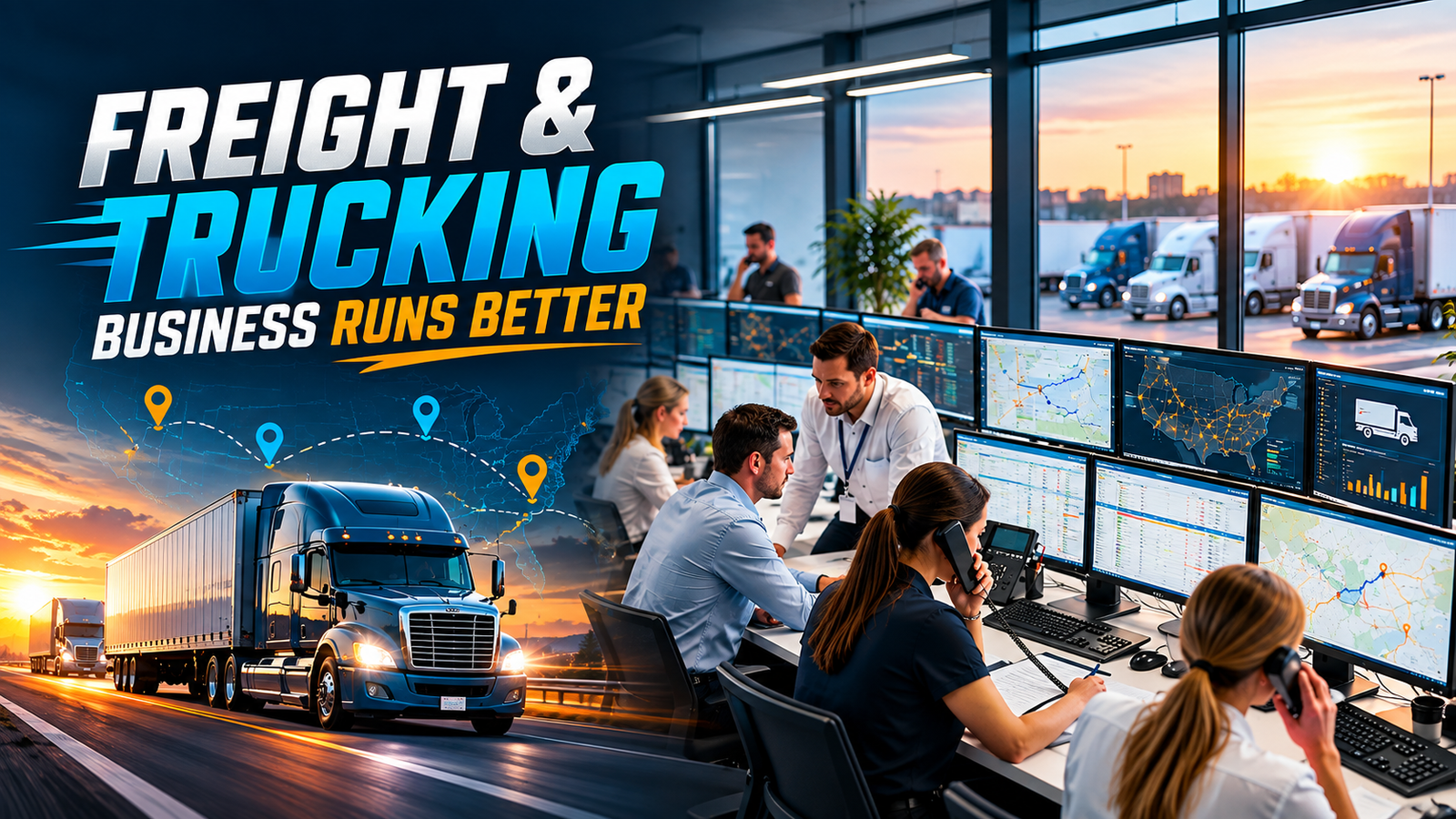
Logistics in 2026 is no longer just about moving freight from point A to point B. It is about managing a relentless flood of data, high-speed coordination, and razor-thin margins. If you are running a freight brokerage or a trucking company, you already know the feeling of "Paperwork Gridlock." You are staring at a screen filled with DAT load boards, McLeod dispatch software, and project44 tracking alerts, all while trying to answer fifteen different emails about "Where is my truck?"
This is what we call Admin Debt. It is the silent killer of growth in the logistics industry. When you or your high-value dispatchers are stuck manually entering BOLs, chasing down PODs, or refreshing load boards for hours, you aren't scaling. You are just treadmilling. Worse, this leads to Profit Leakage, those "Empty Miles" that occur simply because you didn't have the administrative bandwidth to book a backhaul in time.
At Virtual Nexgen Solutions, we have watched the logistics landscape shift. In 2026, the most successful firms aren't the ones with the largest office footprint. They are the ones operating via a "Remote Nerve Center." By integrating specialized Logistics Virtual Assistants into your workflow for just $8 per hour, you can reclaim your time and focus on your high-level strategy while we handle the operational grind.
The Problem of Paperwork Gridlock and Empty Miles
The logistics industry has always been heavy on documentation, but the digital requirements of 2026 have amplified the burden. Every shipment generates a trail of rate confirmations, insurance certificates, lumper receipts, and scale tickets. When these documents sit in an inbox or a driver’s phone for days, your cash flow stagnates. This is Paperwork Gridlock. It stops you from invoicing, it delays carrier payments, and it creates a massive backlog that your team has to fight through every Friday afternoon.
Then there is the issue of Empty Miles. In a world where fuel costs and equipment maintenance are at all-time highs, every mile your truck moves without a load is a direct hit to your bottom line. Often, these empty miles happen because your dispatchers are too busy with "check calls" and data entry to actively hunt for the next load on Truckstop or DAT.
You cannot solve a $60,000 problem with a $60,000 employee if your margins don't support it. An in-house operations assistant typically costs about $60,000 per year when you factor in salary, taxes, benefits, and office space. Compare that to a Virtual Nexgen Solutions specialized Logistics Virtual Assistant at $8 per hour. The ROI isn't just in the savings; it's in the ability to eliminate Admin Debt and plug the holes where Profit Leakage occurs.
The Remote Nerve Center: Your New Operational Model
In 2026, the concept of a "virtual assistant" has evolved. You aren't just hiring someone to check emails. You are building a Remote Nerve Center. This is a system where your specialized VA sits directly inside your Transportation Management System (TMS), whether that is Rose Rocket, McLeod, or a custom build, and manages the flow of information in real-time.
Your Logistics Virtual Assistant acts as the central hub for your operations. They monitor shipment visibility through project44, coordinate with drivers, and keep your customers updated before they even have to ask. This proactive management keeps your internal team focused on building relationships with shippers and negotiating better rates, rather than being reactive to every small fire that breaks out in the field.
Case Study: A Mid-Sized Freight Brokerage in Illinois
A freight brokerage in Illinois was struggling with a 15% error rate in their load entries, which led to frequent billing disputes and delayed payments. They were losing approximately 20 hours a week to manual "track and trace" calls. After partnering with Virtual Nexgen Solutions, they integrated two specialized VAs to manage their McLeod TMS and handle all check calls.
- Results: Within three months, their error rate dropped to less than 2%. They reclaimed 80 hours of monthly productivity for their lead brokers, leading to a 22% increase in new customer acquisitions. All of this was achieved at a fraction of the cost of one local hire.
Essential Tools Your Logistics VA Must Master
To operate effectively in 2026, a Logistics Virtual Assistant must be an expert in the industry's core technology stack. Our team at Virtual Nexgen Solutions is trained to navigate these tools to streamline your operations.
DAT and Truckstop
These are the lifeblood of freight sourcing. Your VA doesn't just search these boards; they monitor them. They set up saved searches, refresh truck posts every 15 minutes, and pre-qualify brokers by checking credit scores and days-to-pay. This ensures you only work with reliable partners and never leave a truck sitting longer than necessary.
McLeod and Rose Rocket
Whether you are a carrier or a broker, your TMS is your source of truth. Your VA manages the entire load lifecycle here, from creation and rate confirmation uploads to driver assignment and final invoicing. By maintaining a clean TMS, you ensure that your data-driven decisions are based on accurate, real-time information.
Project44
Real-time visibility is no longer a luxury; it is a requirement from shippers. Your VA monitors project44 for any "at-risk" shipments. If a truck is delayed at a geofence or stuck in traffic, your VA identifies the issue immediately, notifies the customer with a new ETA, and records the event in your TMS for potential detention claims.
Tactical SOP: Load Sourcing and Systematized Entry
Standard Operating Procedures (SOPs) are the only way to ensure your logistics business scales without chaos. Use this framework to delegate your load sourcing and TMS entry to your Virtual Nexgen Solutions VA.
Step 1: Define Your Lane Preferences
Provide your VA with a clear list of "Priority Lanes," equipment types (Dry Van, Reefer, Flatbed), and your minimum Rate Per Mile (RPM). Use a shared document or a dedicated field in your TMS to keep this updated.
Step 2: Continuous Search and Shortlist
Instruct your VA to run saved searches on DAT and Truckstop throughout the day. They should shortlist at least 5-10 loads that meet your criteria and enter them into a "Prospect" sheet or directly into Rose Rocket.
Step 3: Pre-Qualification and Documentation
For each shortlisted load, have the VA verify the broker’s credit score. If the broker is approved, the VA calls to confirm availability and basic details (commodity, weight, pickup windows). They then draft the email for you or your lead dispatcher to finalize the negotiation.
Step 4: Load Setup
Once a load is won, the VA creates the load in your TMS. They must upload the Rate Confirmation immediately and ensure all reference numbers are accurately recorded. This prevents the "Where is that Rate Con?" scramble that happens during invoicing.
Tactical SOP: Exception Management and Customer Communication
Customer service in logistics is won or lost in the "Exception" phase. Use this SOP to standardize how your VA handles delays.
Step 1: Monitor Visibility Alerts
The VA monitors your visibility platform (like project44) for any "Delayed" or "At Risk" status updates.
Step 2: Verify the Delay
The VA contacts the driver or the carrier via SMS or the driver app to confirm the reason for the delay (weather, traffic, warehouse congestion).
Step 3: Standardized Communication
The VA uses a pre-approved template to notify the customer. The email must include the original ETA, the new ETA, and the reason for the change. This proactive approach builds trust and reduces inbound "status check" calls by 40%.
Step 4: Log for Detention
If the delay is at the shipper or consignee, the VA starts a "Detention Log." They record the arrival time, the time the truck was loaded/unloaded, and any communication with the facility. This documentation is essential for recovering detention costs later.
Case Study: A Regional Carrier in Texas
A 50-truck fleet in Texas was losing thousands of dollars every month in unclaimed detention and TONU (Truck Order Not Used) fees because their drivers weren't reporting delays properly and the office staff was too busy to follow up. Virtual Nexgen Solutions implemented an Exception Management SOP with a dedicated VA.
- Results: By having a VA monitor every load and proactively document delays, the carrier increased their detention recovery by 35%. This simple systematization added over $4,000 to their monthly bottom line, effectively paying for the VA three times over.
What a Logistics Virtual Assistant Can Handle for You
You should not be the one doing the heavy lifting of administration. Here is a specific list of tasks you can offload to your Virtual Nexgen Solutions VA today:
- Load Sourcing: Constant monitoring of DAT and Truckstop boards to find the best-paying freight for your lanes.
- Dispatch Support: Setting up loads in McLeod or Rose Rocket and assigning them to drivers based on Hours of Service (HOS).
- Check Calls: Handling all routine "track and trace" calls to carriers and drivers to ensure on-time performance.
- Appointment Scheduling: Calling shippers and consignees to book or reschedule pickup and delivery windows.
- Compliance Management: Monitoring carrier insurance and safety ratings (FMCSA) to ensure every load is moved by a compliant partner.
- Billing and Invoicing: Collecting BOLs and PODs, creating invoices in your accounting software, and uploading them to factoring portals.
- Driver Onboarding: Sending and collecting onboarding packets for new owner-operators or company drivers.
Framing the ROI: $8/Hour vs. The High Cost of Inaction
Many logistics business owners hesitate to hire because they fear the "overhead." However, you must look at the cost of your own time. If you are a brokerage owner or an agent, your time is worth at least $100 to $200 per hour when you are selling and negotiating. Every hour you spend on data entry is a $92 to $192 loss for your business.
By partnering with Virtual Nexgen Solutions, you are not just getting an assistant; you are getting a scalable system. As your freight volume grows, you don't need to worry about the logistics of office space or the high taxes of a local employee. You simply add another VA at the $8 per hour rate. This allows you to scale up during peak seasons and maintain lean operations during the slow months.
The logistics industry is regulated and complex. Organizations like the Federal Motor Carrier Safety Administration (FMCSA) set the standards for safety and compliance that your business must follow. A specialized VA helps you maintain these standards by ensuring every driver file is updated and every insurance certificate is valid before a truck leaves the yard.
Frequently Asked Questions
How does a Logistics VA access my systems like McLeod or DAT?
You provide your Virtual Nexgen Solutions VA with secure, restricted access to your software. Most modern TMS platforms allow for multi-user access with varying permission levels. Your VA can enter data and monitor shipments without having access to sensitive financial or administrative settings.
Is there a language barrier with international VAs?
No. Our VAs are selected for their high proficiency in English and their ability to communicate professionally with drivers, brokers, and shippers. They understand the specific industry jargon used in US logistics, from "deadhead" to "accessorials."
What happens if a load has a major issue in the middle of the night?
Virtual Nexgen Solutions offers 24/7 availability. Because our VAs operate in different time zones, we can provide round-the-clock coverage. This is especially valuable for "after-hours" dispatch and emergency track-and-trace, ensuring your "Remote Nerve Center" never sleeps.
How do I know the VA is actually working?
We use transparent tracking and reporting systems. You will receive regular updates on tasks completed, loads entered, and check calls made. Furthermore, the results will be visible directly in your TMS in real-time.
Can a VA help with my billing and factoring?
Yes. VAs are experts at the paperwork cycle. They can gather all necessary documents (BOL, POD, lumper receipts), create the invoice, and submit it to your factoring company or customer portal, significantly shortening your "days sales outstanding" (DSO).
Do I need to train the VA from scratch?
While every company has its own specific way of doing things, our VAs come with a foundational understanding of logistics and common industry tools. We work with you to refine your specific SOPs, but the VA will already know the basics of how a load board or a TMS works.
What is the minimum commitment for hiring a VA?
We offer flexible solutions tailored to your business needs. Whether you need a part-time assistant to help with peak-hour paperwork or a full team for 24/7 dispatching, we can customize a plan that fits your $8/hour budget.
How does a VA help with "Empty Miles"?
By continuously monitoring load boards and your truck's ETA, a VA can identify potential backhaul opportunities hours or days before the truck is empty. This proactive booking ensures that your equipment is always moving revenue-generating freight.
Scale Your Operations Today
The "Paperwork Gridlock" does not have to be your reality. You can eliminate Admin Debt and stop Profit Leakage by shifting to a system-driven model. At Virtual Nexgen Solutions, we provide the specialized human talent you need to navigate the complexities of 2026 logistics at a price that makes sense for your bottom line.
Do not let administrative tasks throttle your growth. Reclaim your margin, standardize your workflows, and focus on the big picture.