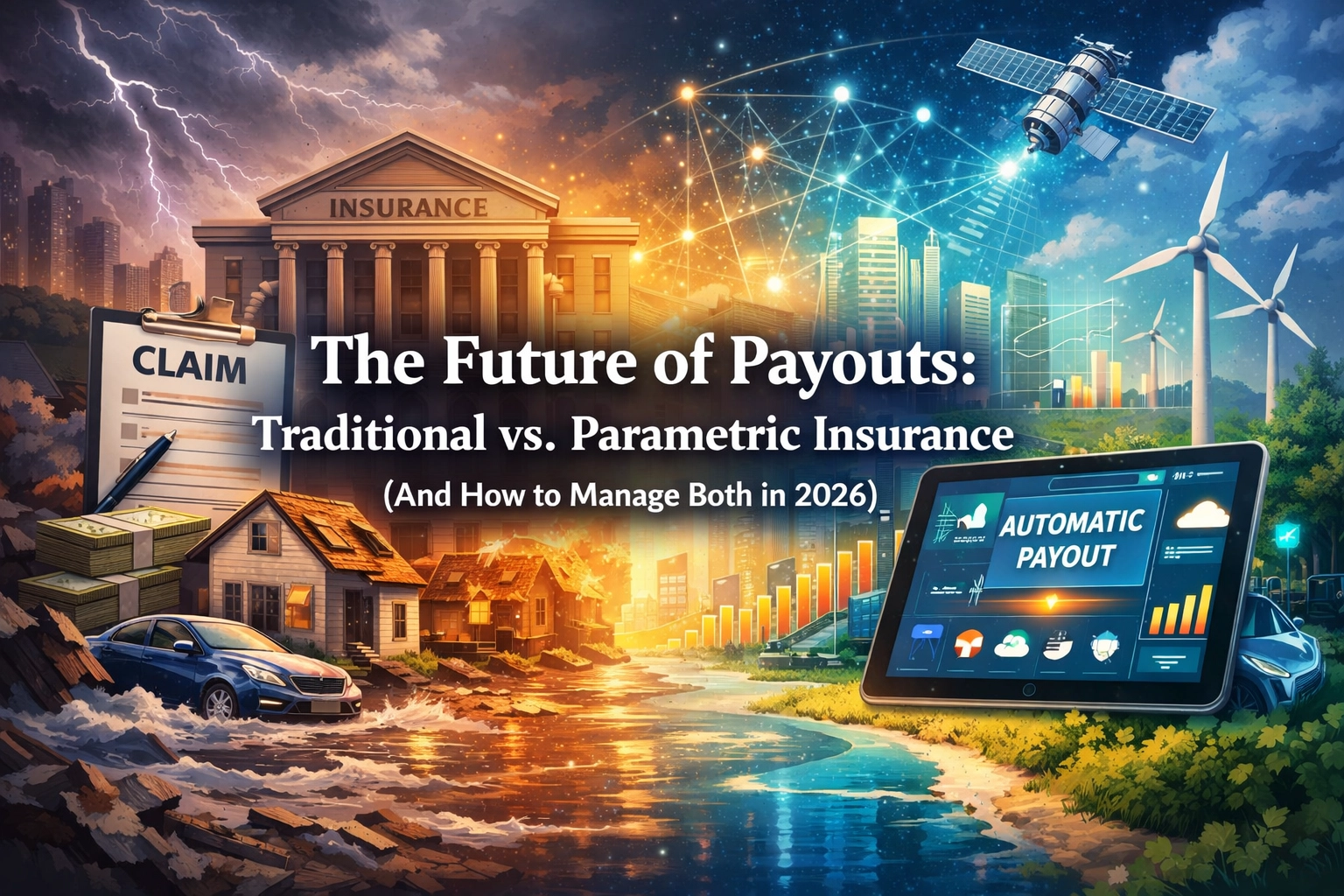
The insurance industry is experiencing its most significant shift in decades. As climate-related claims skyrocket and clients demand faster payouts, a new product is reshaping how agencies operate: parametric insurance. If your agency isn't prepared to manage both traditional and parametric policies by 2026, you're already behind the curve.
Here's the reality: parametric insurance isn't replacing traditional coverage, it's complementing it. And agencies that successfully navigate this dual-product landscape will dominate their markets. But there's a catch: managing both requires specialized knowledge, meticulous policy administration, and systems that most agencies simply don't have the bandwidth to handle.
Let's break down exactly what's changing, why it matters, and how specialized Insurance Virtual Assistants are becoming the secret weapon for forward-thinking agencies.
Traditional Insurance: The Foundation That's Showing Cracks
Traditional indemnity insurance has been the industry standard for over a century. The model is straightforward: a client experiences a loss, files a claim, an adjuster assesses the actual damage, and the insurer reimburses based on verified losses.
The problem? This process is painfully slow.
Traditional insurance claims can take months or even over a year to settle. There are site inspections, documentation reviews, negotiations, and sometimes litigation. For a business dealing with hurricane damage or a catastrophic event, waiting 6-12 months for a payout can be the difference between survival and bankruptcy.
The complexity goes beyond just timing. Traditional policies involve:
- Physical damage assessments
- Loss adjustment expenses
- Detailed documentation requirements
- Potential disputes over coverage interpretations
- Multiple rounds of negotiations
Every step adds administrative burden to your agency. And as claims become more frequent and complex due to climate change, the traditional model is buckling under pressure.
Parametric Insurance: The Speed Revolution
Enter parametric insurance, a fundamentally different approach that's gaining serious traction in 2026.
Instead of reimbursing actual losses, parametric insurance pays a predetermined amount when specific, measurable triggers are met. No adjusters. No damage assessments. No months of waiting.
Here's how it works: policies are tied to objective, independently measurable events:
- Hurricane coverage triggers at specific wind speeds (e.g., 120 mph)
- Flood policies activate at rainfall depth thresholds
- Earthquake protection pays out at measured magnitude levels
- Drought coverage triggers based on precipitation data
When the trigger hits, the payout happens automatically, typically within 20-30 days, sometimes as fast as 48-72 hours.
According to recent industry analysis, this speed advantage is transforming business continuity planning. A company doesn't wait for damage assessment; they receive immediate liquidity to protect employees, maintain operations, and begin recovery efforts.
The Basis Risk Reality: Why Parametric Isn't a Replacement
Before you think parametric insurance is the magic solution that eliminates traditional coverage, there's a critical limitation: basis risk.
Basis risk means the predetermined payout may be higher or lower than actual damages. Consider these scenarios:
Scenario 1: A hurricane hits with 125 mph winds (triggering your parametric policy for $500,000), but your actual property damage is only $200,000. You've received more than your loss, but you still have a payout to manage and reconcile.
Scenario 2: The same hurricane triggers your parametric policy at $500,000, but your business suffers $800,000 in damages. You're left with a $300,000 coverage gap.
This is why industry experts emphasize that parametric insurance "will never replace traditional insurance, it's designed to stand alongside traditional insurance and complement it."
The 2026 Strategy: Dual-Layered Coverage Architecture
The most sophisticated insurance agencies in 2026 aren't choosing between traditional and parametric, they're architecting dual-layered coverage for their clients.
Here's how smart agencies structure this:
Layer 1: Traditional Coverage handles detailed loss recovery, specific property damage, liability exposures, and long-tail claims that require thorough investigation.
Layer 2: Parametric Coverage provides immediate liquidity, covers uninsurable exposures (like business interruption beyond traditional limits), acts as a deductible buy-down, and ensures cash flow during crisis response.
A real-world example: A manufacturing client maintains traditional property coverage but adds parametric hurricane protection. When a Category 4 storm hits, the parametric policy triggers immediately, providing $750,000 within three weeks. This cash flow keeps payroll running and suppliers paid while the traditional claim works through the months-long adjustment process for actual building repairs.
This dual approach is particularly valuable in 2026's challenging market, where climate-related exposures make traditional coverage increasingly restrictive or expensive. Parametric products provide access to catastrophe coverage that may be unavailable or prohibitively costly in traditional markets.
The Administrative Challenge: Why This Creates Agency Bottlenecks
Here's where most agencies hit a wall.
Managing traditional insurance policies alone requires significant administrative infrastructure. Add parametric coverage to the mix, and you're facing:
- Dual policy tracking systems for different coverage types
- Trigger monitoring requiring real-time data feeds (wind speeds, rainfall measurements, seismic data)
- Coordination between coverages to avoid gaps or redundant coverage
- Client education since most policyholders don't understand parametric structures
- Claims documentation for traditional policies while simultaneously managing parametric trigger verification
- Reconciliation processes when both policies activate for the same event
A mid-sized agency managing 500 commercial clients might now be tracking 500 traditional policies plus 300 parametric policies, each with different triggers, thresholds, and payout schedules.
Your agents can't handle this volume while maintaining their sales and client relationship responsibilities. You need specialized support.
The Insurance Virtual Assistant Solution for Complex Product Management
This is exactly where specialized Insurance Virtual Assistants become invaluable for forward-thinking agencies.
At Virtual Nexgen Solutions, our Insurance VAs are trained specifically in managing multi-layered policy administration. Here's what they handle:
Policy Administration Across Product Types
Our VAs maintain organized systems tracking both traditional and parametric policies, ensuring every client's coverage architecture is current and coordinated. They manage renewals, endorsements, and documentation for both coverage types without mixing up the fundamentally different processes.
Trigger Monitoring and Alert Systems
For parametric policies, our Insurance VAs set up monitoring systems tied to reliable data sources (weather stations, seismic networks, satellite feeds). When a trigger threshold approaches, they alert your team immediately, ensuring no client misses a payout they're entitled to.
Claims Processing Coordination
When a catastrophic event occurs, our VAs coordinate the dual claims process: they initiate parametric trigger verification while simultaneously gathering documentation for traditional claims. This parallel processing ensures your clients receive both immediate parametric payouts and thorough traditional claims support.
Client Communication and Education
Parametric insurance requires client education. Our VAs handle explanation calls, send clear documentation about how triggers work, and provide regular updates on coverage status. This frees your agents to focus on sales and complex advisory services.
Data Management and Reporting
Our Insurance VAs generate reports showing policy coordination, coverage gaps, and payout scenarios. They maintain detailed records for compliance and audit purposes, critical as parametric products face evolving regulatory scrutiny.
Real-World Impact: Agency Efficiency Gains
A Florida-based independent agency serving coastal businesses recently partnered with Virtual Nexgen Solutions to manage their growing parametric portfolio. Within 90 days:
- Administrative time for policy management decreased by 40%
- Client response time for coverage questions dropped from 24 hours to 4 hours
- Trigger monitoring accuracy reached 100% (previously missed 3 parametric triggers)
- Agent productivity increased 35% as they focused on sales instead of administration
The agency's principal noted: "We couldn't scale our parametric offerings without specialized VA support. The technical knowledge required plus the monitoring systems, it would have required two full-time hires. The VA solution gave us enterprise-level capabilities at a fraction of the cost."
Similar results are happening across agencies that embrace specialized Insurance Virtual Assistant support. As products become more technical and data-dependent, generalist administrative staff simply can't keep up.
Implementation Considerations for Your Agency
If you're ready to position your agency for the traditional-parametric future, consider these strategic steps:
Audit Your Current Policy Mix: How many clients could benefit from parametric coverage? Where are coverage gaps that parametric products could fill?
Assess Administrative Capacity: Can your current staff effectively monitor triggers, coordinate dual claims, and maintain separate tracking systems? Most agencies answer "no."
Train or Outsource: You either need to hire specialized staff (expensive and hard to find) or partner with experts who already have the infrastructure. Virtual Nexgen's Insurance VAs come trained in both traditional and parametric policy administration.
Establish Clear Protocols: Create documented processes for how your agency handles dual-coverage claims, trigger verification, and client communication across both product types.
Invest in Technology Integration: Parametric policies require data feeds and monitoring tools. Our Insurance VAs integrate with industry-leading platforms to ensure seamless tracking.
Don't Let Administrative Complexity Hold Your Agency Back
The insurance industry's future isn't traditional or parametric: it's traditional and parametric. Agencies that master this dual-product approach will capture market share from competitors still stuck in single-product thinking.
But you can't scale without the right administrative infrastructure.
Virtual Nexgen Solutions' specialized Insurance Virtual Assistants give your agency enterprise-level policy management capabilities without enterprise-level overhead. We handle the intricate tracking, monitoring, and coordination so your agents can focus on what they do best: selling and advising.
Ready to streamline your agency's operations for the parametric era? Book a 30-minute strategy call with our team to discuss how specialized Insurance VAs can transform your policy administration. We'll show you exactly how agencies like yours are managing 2-3x more policies with the same internal headcount.
Schedule Your Free Consultation Now
The shift to parametric insurance is happening whether your agency is ready or not. The question is: will you lead this transition or scramble to catch up?
Virtual Nexgen Solutions provides specialized human Virtual Assistant services for insurance agencies, real estate firms, and professional services businesses. Our Insurance VAs are trained in policy administration, claims processing, and multi-product portfolio management. Learn more about our insurance-specific solutions at virtualnexgen.com.