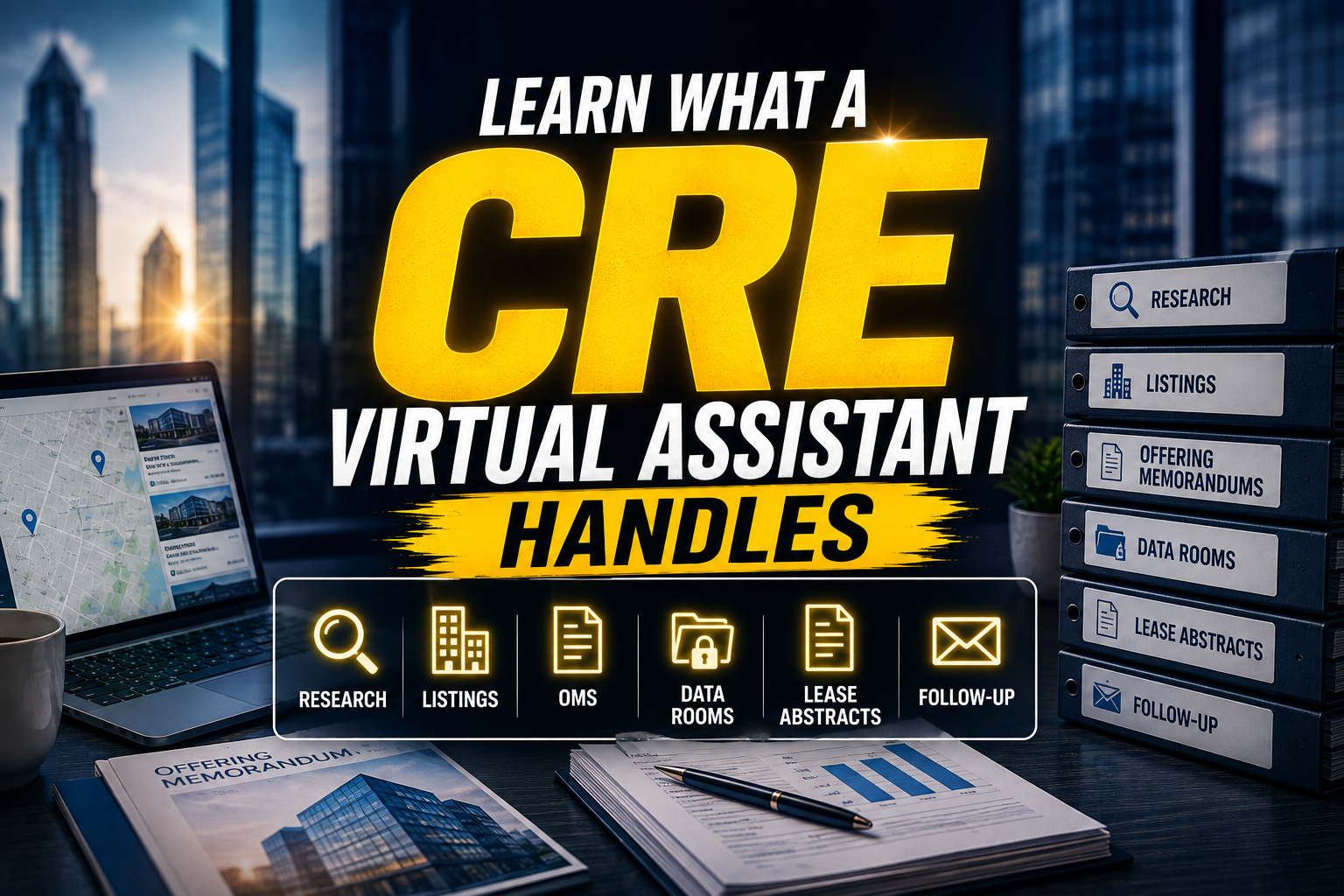
A virtual assistant for commercial real estate companies can keep a deal moving when your day is already packed with CoStar comps, an offering memorandum update, lease abstracting, data-room requests, and tour scheduling.
Without structured support, small delays multiply. A listing waits for updated financials. A prospect does not receive a follow-up. A missing lease document holds up diligence. Suddenly, you are managing files instead of managing relationships.
The right CRE virtual assistant does not replace your broker, analyst, or asset manager. The assistant coordinates the repeatable work around those professionals so they can focus on pricing, negotiation, underwriting judgment, and client trust.
What a Virtual Assistant for Commercial Real Estate Companies Does
A CRE virtual assistant supports the deal lifecycle from first prospect contact through closing and ongoing asset administration.
Sourcing and lead capture
Delegate contact research, owner-list preparation, CRM data entry, lead qualification, call notes, email follow-up, and appointment coordination. Keep final prospect strategy and relationship decisions with the broker.
Research and comparable sales
Assign property research across CoStar, LoopNet, CREXI, county records, and approved market sources. Ask the VA to collect addresses, property types, transaction dates, square footage, asking prices, lease rates, and source references.
Require the assistant to flag missing or conflicting data instead of guessing.
Offering memorandum and pitch support
A VA can collect approved property details, organize photos, update templates, format pages, check versions, and prepare draft marketing packages in Buildout or approved tools. Keep narrative claims, projections, pricing, and final approval with the broker or analyst.
Underwriting and data-room organization
Delegate file naming, document indexing, rent-roll entry, T-12 organization, checklist maintenance, and outstanding-item tracking. The VA may prepare clean inputs, but the analyst must own assumptions, valuation, cap rates, sensitivity analysis, and investment conclusions.
Tours and follow-up
Coordinate calendars, access instructions, tour confirmations, attendee lists, feedback collection, and post-tour follow-up. Maintain a clear record in Salesforce, HubSpot, or your chosen CRM.
LOI and closing support
A VA can track versions, route documents for review, monitor signatures through DocuSign, update milestone checklists, and maintain communication logs. Do not delegate negotiation, legal interpretation, pricing, or final LOI terms.
Lease administration and asset support
Support lease abstract data entry, renewal-date tracking, rent-roll maintenance, tenant correspondence logs, invoice organization, and recurring owner-report preparation. Require owner or asset-manager review for material lease terms.
For a deeper workflow view, connect this role with the commercial real estate virtual assistant scaling guide.
What Stays With the Broker and the Analyst
Set role boundaries before work begins.
The broker owns client relationships, negotiations, pricing recommendations, market positioning, LOI terms, and communication of professional advice. The analyst owns underwriting judgments, valuation assumptions, cap-rate selection, financial models, and investment conclusions.
The VA coordinates information, documents, records, and follow-up. That division protects quality while removing repetitive work from senior professionals.
CRE Software a Virtual Assistant Can Support
A capable commercial real estate virtual assistant can support:
- CoStar, LoopNet, CREXI, and Buildout: listing updates, comp research, property data entry, photo organization, and brochure preparation.
- Yardi, MRI, and AppFolio: approved property records, tenant data, document filing, recurring reports, and lease-calendar updates.
- Argus Enterprise: file organization, data gathering, checklist support, and model-input preparation under analyst direction.
- Salesforce and HubSpot: contact cleanup, pipeline stages, notes, tasks, lead tags, and follow-up queues.
- Excel and Google Sheets: rent-roll entry, comp logs, contact lists, data validation, and version-controlled trackers.
- DocuSign, Box, Dropbox, and Google Workspace: signature routing, folder structures, data-room indexing, permission requests, and document version control.
Confirm each platform’s licensing terms before granting access. Never share one login among multiple people.
Onboarding That Actually Works: Context Before Tasks
Most CRE VA failures begin before the first assignment. A task such as “update the listing” means little without your naming rules, approved data sources, description style, review process, and definition of complete.
Build a short context library that includes:
- Deal-stage definitions.
- Property-type terminology.
- Comp-report examples.
- OM templates and approved language.
- Data-room folder conventions.
- File naming and version rules.
- Escalation instructions.
- Screen recordings of real workflows.
- Weekly reporting expectations.
Use sample records before live client files. Ask the VA to complete one mock comp set, one sample listing update, and one document-indexing exercise. Review the work together and explain what “good” looks like.
If you need help defining the repeatable work first, review Virtual Nexgen Solutions’ administrative support services and map the service to your deal stages.
Data Security and Access for Institutional-Grade Firms
Treat remote access as part of your operating system, not an afterthought. Use an NDA, individual user accounts, least-privilege permissions, approved devices, secure password storage, and clear download rules.
Restrict data-room access by deal and role. Keep sensitive leases, tenant information, financial statements, and personal data inside approved systems. Review access quarterly and revoke it when a project ends.
Ask your IT and legal teams to approve the policy. A provider should explain how it handles confidentiality, access requests, offboarding, quality review, and incident escalation.
How Much a Virtual Assistant for Commercial Real Estate Costs
Virtual Nexgen Solutions’ rate is $8 per hour. Using 4.33 weeks per month, 10 hours per week costs about $346.40 monthly. Twenty hours per week costs about $692.80 monthly. Forty hours per week costs about $1,385.60 monthly.
Market pricing commonly ranges from roughly $8 to $20 per hour, with full-time offshore support often positioned around $1,000 to $2,000 per month, depending on skill, specialization, supervision, and service structure.
Use these figures as planning ranges, not promises. Match hours to a defined workflow. A focused 10-hour research and CRM desk can be more useful than a poorly scoped full-time role.
The True Cost of an In-House CRE Support Hire
BLS data places secretaries and administrative assistants in real estate at a mean annual wage of $44,280 in May 2023, with the occupation classified under SOC 43-6014. Your fully loaded cost can be higher after payroll taxes, benefits, equipment, recruiting, training, management time, and paid leave.
SHRM’s 2025 recruiting benchmark reports an average nonexecutive cost per hire of $5,475. Use that figure when planning the cost of a new internal position.
For an internal planning comparison, a $60,000 annual salary represents about $5,000 per month before additional employment costs. A VA gives you a smaller starting commitment and the ability to scale hours around deal volume.
How to Choose a CRE Virtual Assistant Provider
Evaluate the provider against these eight points:
- Confirm commercial real estate experience.
- Test CoStar, CREXI, LoopNet, or Buildout familiarity.
- Review writing, spreadsheet, and document quality.
- Require a written confidentiality process and NDA.
- Ask how the provider manages individual access.
- Define escalation rules for unclear or sensitive information.
- Start with a limited workflow trial.
- Require weekly reporting with hours, completed work, blockers, and next actions.
Choose managed support when you need recruiting, supervision, continuity, and quality oversight. Choose flexible hourly support when you already have strong internal management and need capacity for a defined workflow.
Red Flags to Avoid
Avoid providers that guarantee deal volume, refuse to sign an NDA, rely on shared logins, offer no context training, claim the VA “handles everything,” or provide no time tracking.
Also question vague promises about CoStar access. Your assistant should work through your approved account and follow the platform’s terms. Do not transfer credentials informally.
How to Measure Success
Measure operational outcomes over 30, 60, and 90 days:
- Comp-research turnaround time.
- OM version accuracy.
- Lease-abstract review accuracy.
- Data-room completeness.
- Follow-up completion.
- CRM record freshness.
- Tour-confirmation reliability.
- Broker hours reclaimed.
Set a baseline before the pilot. Do not judge the role only by the number of tasks completed. Measure whether your team receives cleaner information sooner and spends less time chasing routine details.
Go Live in 7-10 Days
Days 1-2: Define scope and access
Select one workflow. Document the owner, inputs, output, review point, deadline, and escalation path. Issue individual access only after approval.
Days 3-5: Teach context
Use sample records, templates, screen recordings, and naming examples. Test the VA on mock data before assigning live files.
Days 6-8: Run a live pilot
Assign one workflow such as comp preparation, listing maintenance, or data-room indexing. Review every deliverable and record recurring questions.
Days 9-10: Review and expand
Compare baseline results, correct the SOP, confirm security practices, and add a second workflow only when the first is stable.
Frequently Asked Questions
What does a commercial real estate virtual assistant do?
A CRE VA supports research, CRM updates, listing management, document organization, data-room tracking, tour scheduling, lease administration, and transaction coordination.
Can a virtual assistant use CoStar for commercial real estate research?
Yes, a VA can use CoStar through your approved account to collect and organize information. Follow your license terms and keep interpretation with the broker or analyst.
Can a CRE virtual assistant abstract commercial leases?
Yes. A VA can extract approved fields such as rent, escalations, options, CAM terms, and critical dates. A qualified professional should review the abstract for accuracy and significance.
Can a virtual assistant prepare offering memorandums?
Yes. A VA can collect approved data, populate templates, format pages, organize photos, and manage versions. The broker or analyst must approve claims, pricing, and projections.
How much does a commercial real estate virtual assistant cost?
Virtual Nexgen Solutions charges $8 per hour. Monthly cost depends on approved hours, with 20 hours per week equaling about $692.80 per month using 4.33 weeks.
How fast can a CRE virtual assistant start?
Most CRE teams can go live in 7-10 days when the first workflow is clearly scoped, access is approved, context is documented, and the pilot is reviewed closely before expansion.
Does a CRE virtual assistant need a real estate license?
Usually, a VA handling administrative coordination does not need a real estate license. Licensing rules vary by state and task, so consult qualified legal or regulatory counsel.
Can a virtual assistant manage commercial real estate data rooms?
Yes. A VA can organize folders, index documents, maintain checklists, track missing files, and route access requests under your security policy.
What should a commercial real estate virtual assistant not do?
Do not assign negotiation, legal advice, valuation judgment, cap-rate selection, final underwriting conclusions, or pricing decisions unless the person is properly qualified and authorized.
Why Choose Virtual Nexgen Solutions
Virtual Nexgen Solutions has supported businesses since 2016 with tailored virtual assistant services, administrative support, marketing coordination, and industry-specific workflows. The team begins with your process, software, access requirements, and review standards rather than forcing you into a generic package.
With support starting at $8 per hour, you can begin with one measurable CRE workflow and expand after review. Explore Virtual Nexgen Solutions’ real estate virtual assistant service or return to the Virtual Nexgen Solutions homepage to discuss your operating needs.
An illustrative ROI model is simple: if a 20-hour weekly support desk costs about $692.80 per month and returns 20 hours of broker or analyst capacity, evaluate that capacity against your internal hourly value. Treat the calculation as a planning exercise, not a promised result.
A second illustrative scenario involves a regional industrial brokerage using a VA for listing updates, comp logs, and data-room indexing. The firm would measure turnaround time, rework, and senior staff hours before expanding the assignment. Record your own baseline before making a decision.
Ready to identify the first CRE workflow worth delegating? Book a 30-minute consultation with Virtual Nexgen Solutions to review your software, task volume, access rules, and 7-10 day go-live plan.