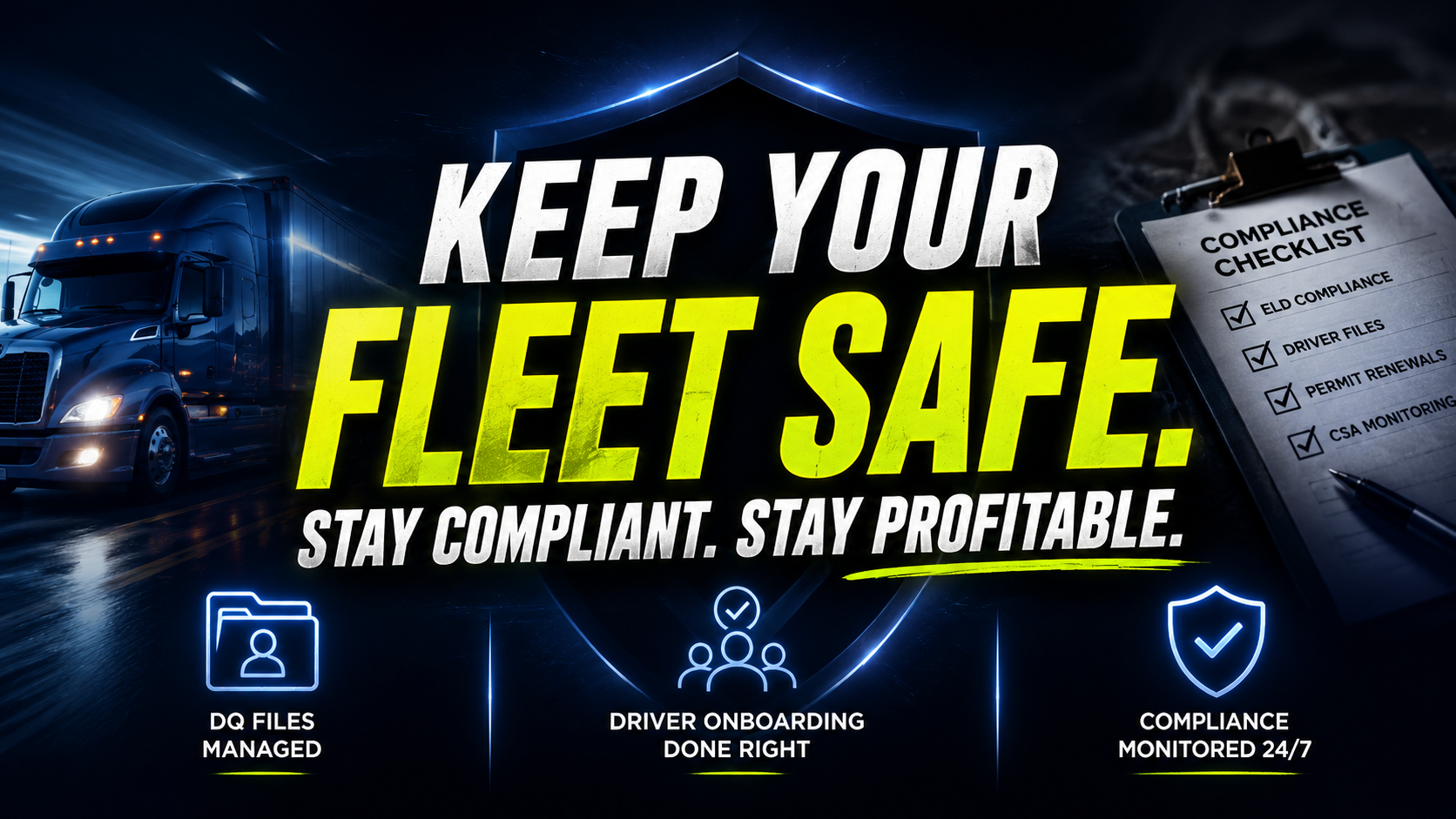
You are sitting on a ticking time bomb. Every day a driver operates a truck for your fleet without a fully compliant Driver Qualification (DQ) file, you are essentially betting $16,000 on a clerical error. In the trucking industry, "Admin Debt" isn't just a metaphor, it is a literal liability. For small to mid-sized fleet owners, the pressure to "seat the truck" often leads to a dangerous shortcut: putting a driver on the road before the paperwork is ironclad.
The FMCSA doesn’t care that you were short-staffed. They don’t care that your safety manager was out sick or that the previous employer took three weeks to respond to a reference check. If an auditor walks into your office today and pulls a file that is missing a single 3-year MVR, a signed application, or a valid medical certificate, the civil penalties can reach up to $16,550 per violation.
This is the hidden "Profit Leakage" that kills trucking companies from the inside out. You spend thousands on recruiting and sign-on bonuses, but your revenue engine stalls because your onboarding process is manual, fragmented, and slow. While you struggle to keep up with document collection, your trucks sit empty, costing you $800 to $1,200 per day in lost gross revenue.
The solution isn't to work harder or hire another $60,000-per-year safety coordinator. The solution is to systematize your compliance engine. By integrating a specialized virtual assistant for trucking company operations into your workflow, you can move from a 7-day onboarding lag to a 24-hour "Ready-to-Dispatch" standard for just $8 per hour.
The State of Trucking Compliance: A $16K Administrative Crisis
The trucking industry in 2026 is facing an unprecedented regulatory squeeze. With the FMCSA increasing its focus on data-driven audits and real-time compliance monitoring through ELD integrations like Motive and Samsara, there is no place for "paperwork to catch up."
Industry Problems: The Onboarding Bottleneck
Most trucking companies suffer from what we call "Onboarding Friction." You find a great driver with a clean record, but then the administrative wall hits. You need to collect a multi-page DOT application, verify their CDL, pull their Motor Vehicle Record (MVR), conduct a Drug & Alcohol Clearinghouse query, and wait for safety performance histories from every carrier they’ve worked for in the last three years.
This process usually involves dozens of emails, phone calls, and follow-ups. Because your in-house team is already overwhelmed with dispatching, IFTA filing, and maintenance scheduling, driver onboarding becomes a "whenever we get to it" task. This delay doesn't just frustrate drivers, who will often jump to a competitor who can seat them faster, it creates a massive hole in your compliance shield.
Industry Statistics: The High Price of Inaction
- The Fine Factor: FMCSA civil penalties for DQ file violations have been adjusted for inflation, now reaching up to $16,000+ per violation.
- The Audit Trap: Incomplete DQ documentation accounts for nearly 17% of all FMCSA violations discovered during audits.
- The Speed Gap: Manual driver onboarding takes an average of 5 to 7 days. A systematized process led by a virtual assistant for trucking company operations reduces this to 24-48 hours.
- The Growth Ceiling: 70% of fleets report that administrative burdens, specifically in recruiting and safety, are the primary limiters to their fleet expansion.
Revenue Leaks and Profit Erosion
Every day a truck sits idle because a DQ file isn't finished is a day of pure profit loss. If your average truck nets $1,000 a day and your onboarding takes 6 days instead of 2, you have lost $4,000 in top-line revenue per driver. Multiply that by a 10-driver expansion or a 90% turnover rate, and you are looking at hundreds of thousands of dollars leaking out of your business every year.
Furthermore, the "Admin Debt" accrued from messy files leads to higher insurance premiums. Insurance underwriters in 2026 use sophisticated algorithms to scan your safety data. If they see a pattern of late medical renewals or missing annual reviews, they label you "High Risk" and hike your rates by 15-25%.
Operational and Staffing Challenges: Why In-House Hiring Fails
Many owners try to solve this by hiring a full-time Administrative Assistant or Safety Manager. However, in the current US labor market, a qualified safety clerk commands a salary of $50,000 to $60,000 per year, plus benefits, taxes, and office space.
Even if you find someone, they are often prone to the "Trucking Chaos" cycle. They get pulled into answering phones, dealing with broken-down trucks, or helping with payroll. Compliance is a detail-oriented task that requires zero distractions. This is why a dedicated virtual assistant for trucking company support is the superior choice. Our VAs at Virtual Nexgen Solutions operate at $8 per hour, focused exclusively on the compliance workflows that protect your authority.
The Tech Stack: Industry Software for Modern Fleets
To eliminate Admin Debt, your virtual assistant for trucking company must be an expert in the software that drives modern logistics. We specialize in managing the backend of the industry's most critical tools:
- Tenstreet & Foley: For automated driver application intake and background screening.
- Motive (formerly KeepTruckin) & Samsara: For real-time document storage, medical card tracking, and ELD compliance.
- FleetRabbit & Truckstop: For fleet management and load-matching coordination.
- DAT & Drivewyze: For operational efficiency and scale.
- QuickBooks: For reconciling safety-related expenses and payroll.
A virtual assistant for trucking company doesn't just "watch" these systems; they drive them. They ensure that every document uploaded to Motive is legible, every "Need Help" ticket in Tenstreet is resolved, and every expiring medical card in Samsara triggers a proactive alert to the driver.
Actionable Industry SOPs: The 5 DQ File Workflows
To stop the $16K fines, you must move from "feeling" like you're compliant to knowing you're compliant. Here are the five Standard Operating Procedures (SOPs) that a Virtual Nexgen Solutions VA implements for your fleet.
SOP 1: Driver Application Intake & Document Collection
The biggest delay in onboarding is the "back-and-forth" of missing documents.
- Application Audit: The VA reviews the submitted application (via Tenstreet or PDF) to ensure every field is filled. Missing a previous employer's phone number or a gap in employment history is a red flag for auditors.
- Initial Document Request: Within 30 minutes of receiving an application, the VA sends a templated text and email to the driver requesting: Clear photos of CDL (front and back), current Medical Examiner’s Certificate (FedMed card), and Long-form Physical.
- The 24-Hour Rule: If documents aren't received within 4 hours, the VA calls the driver directly. This persistence ensures the driver feels prioritized and keeps the momentum moving.
SOP 2: DQ File Assembly & Compliance Verification
Once the documents are in, the file must be structured according to 49 CFR Part 391.51.
- Digital Folder Structure: The VA creates a standardized digital folder (e.g., in Motive or a secure cloud drive) labeled:
[Driver Name] - [CDL #] - [Hire Date]. - Compliance Checklist: The VA populates a 12-point checklist for each file, including the road test certificate, certificate of violations, and the inquiry to state agencies.
- Legibility Check: The VA verifies that every scan is legible. A blurry medical card is effectively a missing medical card in the eyes of the FMCSA.
SOP 3: Drug & Alcohol Clearinghouse Query & MVR Ordering
This is where most fines are triggered. You cannot dispatch a driver without a "Clear" query result.
- The Clearinghouse Gate: The VA initiates the "Full Pre-employment Query" in the FMCSA Clearinghouse. They monitor for the driver’s consent and download the result immediately.
- MVR Procurement: The VA orders the Motor Vehicle Record from every state the driver held a license in over the last 3 years.
- Safety History Inquiries: Per regulation, the VA sends out safety performance history requests to all previous employers. Since employers have 30 days to respond, the VA sets a 3-day follow-up cadence (Call-Email-Call) to ensure these are returned and documented.
SOP 4: Onboarding Follow-Up & Orientation Scheduling
A virtual assistant for trucking company operations acts as your "concierge" for new hires.
- Status Updates: The VA sends daily updates to your Dispatch team: "Driver John Doe is 80% compliant; pending drug test results. Estimated dispatch: Tuesday."
- Drug Test Coordination: The VA finds a testing facility near the driver, schedules the appointment, and follows up with the lab for results.
- Orientation Packets: The VA sends digital orientation materials (company policy, safety handbooks) to the driver via DocuSign to ensure they are signed before they arrive at your terminal.
SOP 5: DQ File Auditing, Expiration Tracking & Annual Review
Compliance is not a "one-and-done" event. It is a cycle.
- The Master Expiration Tracker: The VA maintains a spreadsheet (or manages the alerts in your FMS) tracking CDL expirations and Medical Card expirations.
- Proactive Alerts: 60 days before an expiration, the VA notifies the driver and the safety manager. They follow up every 15 days until a new document is uploaded.
- Annual MVR/Review: Every 12 months, the VA automatically pulls a new MVR, prepares the "Annual Review of Driving Record," and schedules a 10-minute call between you and the driver to sign off on the review.
Case Study Examples: ROI in Action
Case Study 1: The Georgia Fleet Drowning in Backlogs
The Scenario: A mid-sized dry van fleet in Georgia was operating with 45 drivers. An internal self-audit revealed that 30% of their DQ files were missing either annual reviews or previous employer inquiries. The owner was terrified of a looming FMCSA audit and couldn't hire new drivers because his one safety clerk was buried in filing.
The Solution: Virtual Nexgen Solutions deployed a specialized virtual assistant for trucking company compliance. The VA spent the first 30 days performing a "File Rescue" operation, contacting 120+ previous employers to close gaps and organizing the digital database in Motive.
The Impact: Within 60 days, the fleet was 100% compliant. The onboarding time for new drivers dropped from 9 days to 48 hours. The fleet was able to add 5 new trucks in a single month because the administrative bottleneck was gone. At $8/hr, the VA cost the company less than $1,400 a month, compared to a potential $250,000+ in aggregate fines.
Case Study 2: The Illinois Owner-Operator Scaling to a Fleet
The Scenario: A husband-and-wife team in Illinois running 5 trucks wanted to grow to 15. However, every time they hired a driver, the wife spent 20 hours a week on paperwork, background checks, and phone calls. Their growth stalled because they didn't have the "bandwidth" to manage more drivers.
The Solution: They hired a virtual assistant for trucking company support to handle the entire driver lifecycle from application to annual review.
The Impact: The VA took over 95% of the administrative load. The owners shifted their focus to securing better-paying contracts and recruiting. They reached their 15-truck goal in just 6 months. By delegating to an $8/hr specialist, they saved roughly 80 hours of "owner time" per month, which they valued at $100/hr, resulting in an $8,000 monthly "Time ROI."
Cost and ROI Comparison: The $8 Difference
The financial math of a virtual assistant for trucking company is undeniable. When you look at the cost of an in-house hire versus a specialized VA, the "Profit Leakage" of the traditional model becomes clear.
- In-House Safety Clerk: $55,000 (Salary) + $8,250 (Taxes/Benefits) + $5,000 (Overhead/Software) = $68,250/year.
- Virtual Nexgen Solutions VA: $8/hr x 40 hours/week x 52 weeks = $16,640/year.
Annual Savings: $51,610.
But the real ROI isn't just the $51K in salary savings. It's the Compliance ROI. One avoided $16,000 fine pays for nearly a full year of a VA. One truck seated 4 days faster generates an extra $4,000 in gross revenue. When you combine these factors, the specialized VA isn't an "expense", it is a high-yield investment in your fleet’s stability.
Future Trends: The Move to Real-Time Compliance
As we look toward 2027 and beyond, the FMCSA is moving toward a "Continuous Compliance" model. This means audits will no longer be random occurrences every few years; they will be digital, ongoing, and triggered by ELD data discrepancies.
If your "Admin Debt" is high now, it will become an existential threat in the near future. Fleets that rely on paper files or disorganized digital folders will be flagged by AI-driven monitoring systems. A virtual assistant for trucking company is your bridge to this future. They ensure your data is clean, your files are ready for a "Remote Audit" at a moment's notice, and your safety scores remain in the green.
Tips and Tricks for Trucking Efficiency
- The "Text-First" Recruiting Script: Drivers are rarely at their desks. Have your VA use a text-based follow-up script for document collection. "Hey [Driver Name], this is [VA Name] from [Company]. Love your app! Just need a quick photo of your Med Card to get you in a truck by Monday. Can you text it here?"
- The Parallel Processing Rule: Never wait for one document to start the next. Your VA should order the MVR, send the Clearinghouse query, and request safety history simultaneously.
- The Sunday Audit: Have your VA perform a "10% Random Audit" every Sunday evening. They pull 3 random files and check for completeness. This ensures that even during high-growth periods, quality never slips.
- Use a Dedicated Compliance Email: Create an email address specifically for DQ files (e.g., safety@yourcompany.com). This keeps sensitive driver data out of general inboxes and makes it easier for your virtual assistant for trucking company to stay organized.
Frequently Asked Questions (FAQ)
1. Can a virtual assistant for trucking company really handle sensitive DOT documents?
Yes. At Virtual Nexgen Solutions, we use secure, encrypted platforms to manage sensitive data. Our VAs are trained in data privacy and work within your existing secure systems like Tenstreet or Motive to ensure all PII (Personally Identifiable Information) is protected.
2. How do you handle the 3-year safety performance history check if employers don't respond?
Our SOP includes a documented "Good Faith Effort." If an employer doesn't respond to the initial request, the VA makes follow-up attempts on day 3, day 7, and day 15, documenting each call and email. This documentation protects you during an audit by proving you did everything required by law to obtain the history.
3. Is $8/hr really the total cost?
Yes. There are no hidden recruitment fees, no payroll taxes, and no benefit costs for you. You pay for the hours worked, allowing you to scale up or down based on your hiring needs.
4. Can the VA help with IFTA and ELD monitoring as well?
Absolutely. While this post focuses on DQ files, our specialized virtual assistants for trucking company support are also trained to reconcile fuel receipts for IFTA, monitor HOS (Hours of Service) violations in Motive, and manage maintenance logs.
5. How quickly can a VA start managing our onboarding?
We can usually have a specialized VA integrated into your workflow within 48 to 72 hours. We begin with an initial strategy call to map your specific software and communication preferences.
6. Do I need to provide the software, or does the VA bring their own?
The VA works within your existing tech stack (Samsara, Tenstreet, etc.). This ensures that all data stays in your possession and your company "owns" its compliance records at all times.
7. How does a VA handle the Drug & Alcohol Clearinghouse?
The VA manages the administrative side: setting up the query, sending the consent request to the driver, and monitoring the dashboard for the result. You or your designated safety officer still make the final "Hire/No Hire" decision based on the data.
8. What happens if a driver's medical card expires while they are on the road?
Our "Zero-Gap" SOP prevents this. The VA flags expiring cards 60 days in advance and tracks the driver's progress in getting a new physical. If a driver fails to provide a new card 48 hours before expiration, the VA alerts Dispatch to "Red Flag" the driver from receiving new loads.
9. Can a VA help me pass an FMCSA New Entrant Audit?
Yes. A virtual assistant for trucking company operations is often the key to passing a New Entrant Audit. They ensure all "Initial" files are perfect, which is exactly what the auditor will be looking for in the first 12 months of your authority.
Conclusion: Stop the Leak, Protect the Fleet
The difference between a profitable fleet and one that is one audit away from bankruptcy is the strength of its administrative engine. You cannot scale a trucking business on the back of messy paperwork and "Admin Debt."
By delegating your driver onboarding and DQ file compliance to a specialized virtual assistant for trucking company support, you are doing more than just saving money on salary. You are protecting your DOT authority, reducing your insurance risk, and ensuring that every time you hire a driver, they are in a truck and generating revenue in record time.
Stop losing sleep over the $16,000 fine that hasn't happened yet. Systematize your backend today and focus on what you do best: moving freight and growing your business.