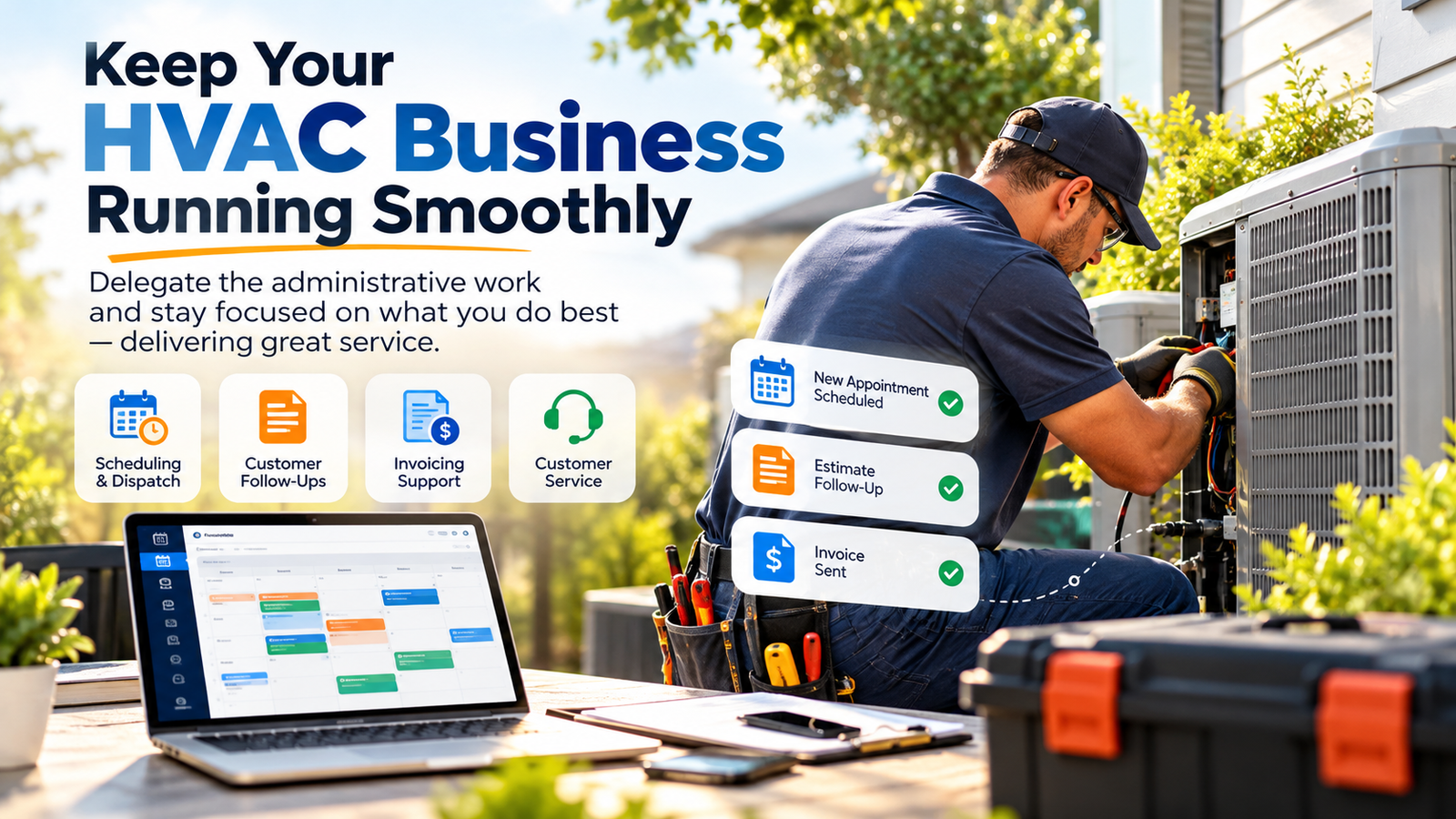
Missed calls, unprocessed estimates, late invoices, and messy job notes quietly drain plumbing companies every week. While you are under a sink or driving between jobs, a potential customer may already be calling the next plumber on Google.
A plumbing virtual assistant gives you reliable back-office coverage without adding another full-time dispatcher to your payroll. The right VA can answer calls, update ServiceTitan, follow up on estimates, support billing, and keep your office workflow moving while licensed professionals retain all technical and safety decisions.
A plumbing virtual assistant is a remote professional trained to handle administrative, customer service, scheduling, and back-office tasks for a plumbing company. They support tools such as ServiceTitan, Housecall Pro, Jobber, QuickBooks, and Google Workspace, but they do not diagnose plumbing problems, approve prices, or make safety decisions.
Why Plumbing Companies Lose Money in the Back Office
Plumbing owners often treat administrative work as something to complete after the last service call. That creates a growing backlog:
- Calls go to voicemail during lunch, job-site visits, or evenings.
- Estimates sit untouched after the first email.
- Technicians forget parts, photos, or trip charges on invoices.
- Warranty documents and permit records become difficult to locate.
- Customers wait too long for updates and choose another contractor.
How a Plumbing Virtual Assistant Fixes Your Back Office
Capture every service call and web lead
Use a VA as a virtual receptionist for plumbers during business hours, lunch periods, evenings, or overflow periods.
The VA can:
- Answer inbound calls using your approved greeting.
- Capture the customer’s name, address, phone number, service type, and preferred appointment window.
- Record whether the issue involves a leak, sewer backup, water heater, drain, fixture, or other approved category.
- Respond to website forms, Google Local Services messages, and email inquiries.
- Escalate urgent situations according to your written call-handling rules.
Use a five-minute response target for web leads and missed-call callbacks. Do not promise a diagnosis. Sell the service visit, collect the facts, and route the call correctly.
Keep the schedule organized without hiring a dispatcher
A VA can maintain your daily schedule while following rules you approve.
They can:
- Confirm appointments.
- Send arrival-window reminders.
- Update customer notes.
- Record technician status.
- Identify open schedule gaps.
- Prepare scheduling options for your office manager or field lead.
Do not give the VA unrestricted authority to assign technicians. Define approved scheduling rules by service area, license, equipment experience, job duration, and availability. The VA updates the board and flags conflicts; your designated manager makes final assignment decisions.
Make ServiceTitan and field-service software work harder
A ServiceTitan virtual assistant supports the system by keeping information complete and current. The same principle applies to Housecall Pro, Jobber, Workiz, and FieldEdge.
Assign tasks such as:
- Creating customer and job records.
- Updating contact information.
- Adding call notes and service categories.
- Attaching customer-submitted photos.
- Moving estimates through approved pipeline stages.
- Updating appointment statuses.
- Checking that technician notes are complete.
- Preparing daily reports for review.
Clean data gives you better visibility into answer rate, booking rate, technician utilization, estimate follow-up, and invoice aging.
Recover revenue from unclosed estimates
Many plumbing companies do not have a lead problem. They have a follow-up problem.
Give your VA a controlled estimate cadence:
- Review open estimates each morning.
- Separate emergency repairs, maintenance work, replacements, and larger projects.
- Send the approved first follow-up message.
- Call customers who have not responded.
- Record objections without arguing about price.
- Escalate high-value opportunities to the owner or manager.
Never allow a VA to change pricing, promise discounts, or negotiate scope. Require approval for every offer.
Prevent invoices, parts, and warranties from slipping
Back-office errors often appear as small omissions but add up across hundreds of jobs.
Ask your VA to check:
- Whether completed jobs have an invoice.
- Whether labor and approved materials appear on the ticket.
- Whether photos and signed documents are attached.
- Whether warranty information is filed.
- Whether purchase receipts match the job record.
- Whether unpaid invoices are placed in the correct follow-up queue.
Use QuickBooks for billing coordination and your field-service platform as the operational source of truth. Require manager review before credit adjustments, write-offs, refunds, or disputed charges.
Handle the 2 a.m. burst-pipe call with clear escalation rules
Emergency calls require calm intake, not guesswork.
For a burst-pipe scenario, instruct the VA to:
- Confirm the caller’s location and callback number.
- Ask whether water is still flowing.
- Direct the caller to follow your approved immediate-response guidance, such as contacting the appropriate shutoff resource when safe.
- Record visible damage and affected areas without diagnosing the cause.
- Check the approved emergency coverage list.
- Escalate to the owner or on-call manager when the situation meets your emergency criteria.
The owner or operations manager keeps priority judgment. The VA never makes a safety decision, diagnoses the issue, promises arrival outside approved coverage, or determines whether a situation requires licensed emergency intervention.
Coordinate permits, warranties, and customer documents
Permit and warranty paperwork creates avoidable friction when nobody owns the checklist.
A VA can:
- Prepare permit application packets from information supplied by your team.
- Track submission dates and missing documents.
- Maintain renewal and inspection reminders.
- Organize manufacturer warranty records.
- Send approved documents through DocuSign.
- Store job photos and supporting files in CompanyCam or your approved drive.
- Update customers about document status.
Require a licensed professional or manager to review technical details before submission. The VA manages the process, not the compliance judgment.
Improve customer follow-up and review consistency
Protect the customer experience after the technician leaves.
Have your VA:
- Send appointment confirmations.
- Notify customers of approved ETA updates.
- Complete post-service satisfaction calls.
- Flag complaints for immediate manager review.
- Request reviews from satisfied customers using your approved process.
- Record warranty questions and callbacks.
- Maintain Google Business Profile task lists.
Support from PHCC can help plumbing and HVAC contractors strengthen education, best practices, and operational discipline. Connect your VA’s checklists to the standards and service expectations your company already follows.
What a Plumbing VA Must Never Do
Set role boundaries before granting access. A plumbing virtual assistant must never:
- Diagnose a plumbing, gas, electrical, or water-quality problem.
- Provide technical instructions beyond your approved script.
- Approve prices, discounts, refunds, or credits.
- Make safety decisions.
- Assign a technician without an approved manager rule.
- Promise code compliance or permit approval.
- Represent themselves as a licensed plumber.
- Share login credentials or customer data outside approved systems.
Use individual logins, least-privilege access, an NDA, a password manager, and two-factor authentication. Reject any provider that relies on shared credentials or has no escalation procedure.
The Dispatcher-versus-VA Economics Decision
The economics depend on hours, coverage, supervision, and task complexity. Virtual Nexgen Solutions’ stated VA rate is $8 per hour. At 40 hours per week for 52 weeks, direct annual labor equals approximately $16,640, before any business-specific software or management costs.
For planning purposes, compare that with an in-house administrative or dispatcher budget of about $60,000 per year, including salary-related overhead. That is not a universal cost; confirm local wages, benefits, taxes, equipment, and office expenses before making a final decision.
The BLS reported a $20.59 median hourly wage for customer service representatives in May 2024. Review the BLS occupational wage data when building your hiring model.
Scenario: after-hours call coverage
Assume a five-technician residential plumbing company receives 12 after-hours calls per month and currently books four of them. A VA follows the approved intake and escalation process, helping the team convert four additional calls into scheduled visits.
At an illustrative average service ticket of $325, those four visits represent $1,300 in booked revenue before labor, materials, taxes, and cancellations. [VNS to confirm any published average-ticket example before use.]
Scenario: estimate and invoice control
Assume an eight-truck company has 35 open estimates and 20 completed jobs awaiting final invoice review. The VA creates a daily queue, completes follow-up on every eligible estimate, checks documentation on every completed job, and escalates exceptions.
The target is not a guaranteed revenue number. The target is measurable process control: 100% of eligible estimates receive the approved cadence, 100% of completed jobs enter invoice review, and every exception has an owner and due date.
A Practical 7–10 Day Go-Live Plan
Move quickly, but protect quality.
Days 1–2: Map the work
Document call categories, emergency rules, escalation contacts, appointment windows, software access, and prohibited decisions.
Days 3–4: Build the operating scripts
Prepare call-intake fields, estimate follow-up messages, invoice checklists, warranty procedures, and customer communication templates.
Days 5–6: Configure access and test
Create individual user accounts. Test ServiceTitan, Housecall Pro, Jobber, QuickBooks, Google Workspace, DocuSign, CompanyCam, and Google Local Services workflows.
Days 7–10: Run a controlled launch
Start with a defined shift or task group. Review calls and records daily. Correct unclear rules before expanding coverage.
Measure the Results at 30, 60, and 90 Days
Track the numbers that show whether the back office is improving:
- Answer rate: Measure calls answered during assigned coverage.
- Booking rate: Compare qualified inquiries with scheduled jobs.
- Estimate follow-up completion: Track eligible quotes touched on schedule.
- Invoice aging: Monitor the number of days between completion and billing.
- No-show rate: Track confirmed appointments that do not occur.
- Data quality: Audit missing notes, photos, materials, and customer details.
- Escalation accuracy: Review whether urgent issues reached the right manager.
Do not choose a provider based only on a low hourly rate. Reject providers that guarantee results, refuse to sign an NDA, use shared logins, cannot explain backup coverage, or have no written escalation process.
Frequently Asked Questions
Should I hire a dispatcher or use a virtual assistant?
Use a plumbing virtual assistant when your main need involves call intake, scheduling support, follow-up, data entry, billing coordination, and customer communication. Hire an in-house dispatcher when the role requires constant physical coordination, complex real-time decisions, or direct field supervision that cannot be documented and escalated.
AI receptionist vs human VA : which is better for a plumbing company?
A human VA is usually better when calls require context, empathy, judgment within approved rules, and accurate documentation across several systems. A receptionist tool may handle basic intake, but you still need a trained person to review exceptions, protect customer experience, and escalate emergencies.
How much does a plumbing virtual assistant cost?
Virtual Nexgen Solutions’ stated rate is $8 per hour. Your total cost depends on scheduled hours, coverage windows, software, training, supervision, and the complexity of the workflow.
Can a virtual assistant use ServiceTitan?
Yes. A trained VA can support ServiceTitan by creating records, entering call notes, updating appointment statuses, checking job documentation, and preparing reports. Restrict access and require manager approval for pricing, technician assignment, refunds, and other sensitive actions.
How fast can a plumbing company start with a VA?
A plumbing company can target a 7–10 day go-live when it provides prompt access, clear scripts, escalation rules, software permissions, and a defined task list. Begin with a controlled launch and expand after reviewing the first week of work.
Give Your Plumbing Back Office a Reliable Owner
If missed calls, unclosed estimates, and late invoices are eating into your week, a plumbing virtual assistant can take those repeatable tasks off your plate. Book a free 30-minute consultation with Virtual Nexgen Solutions to discuss a practical 7–10 day launch plan.