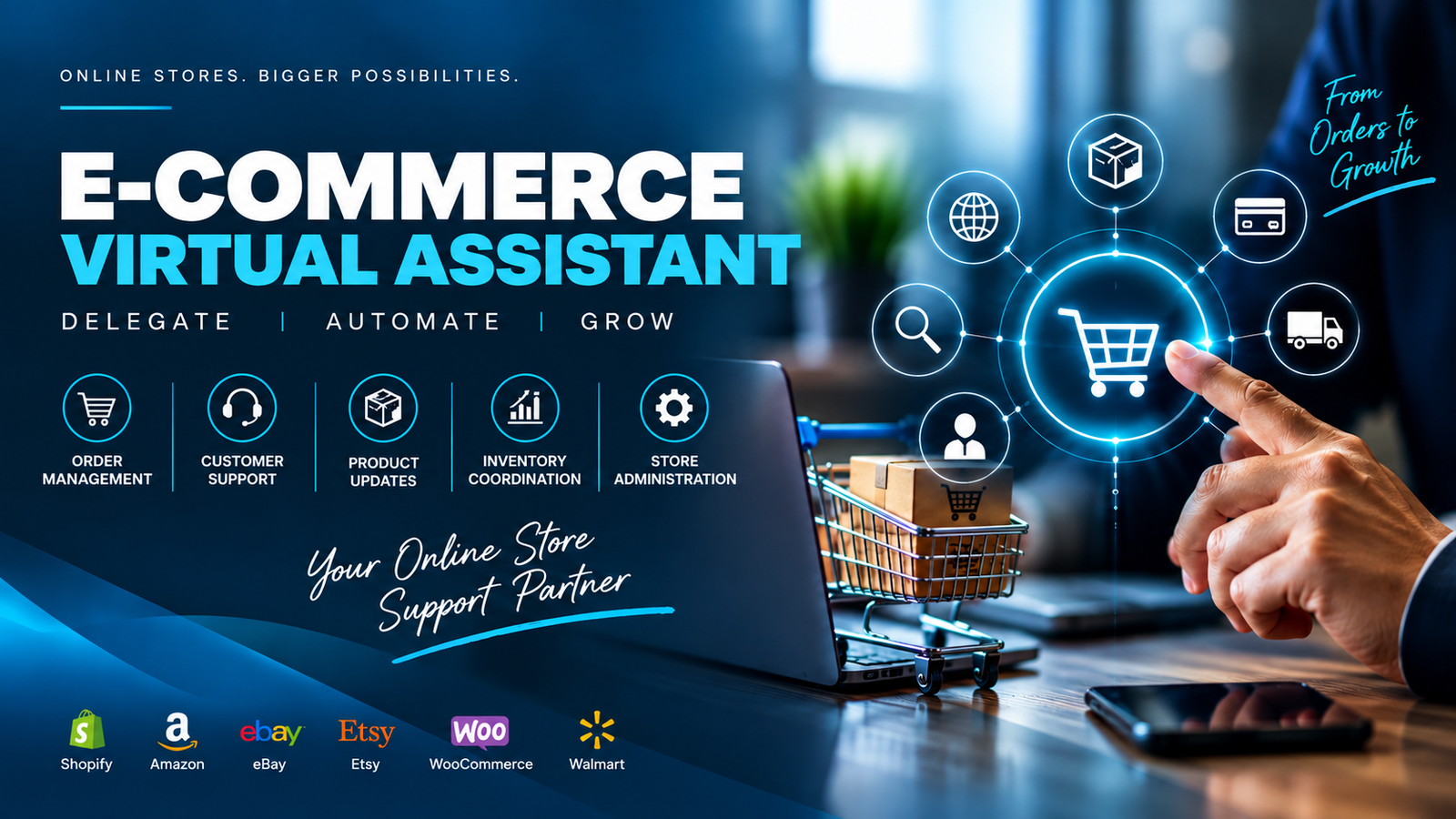
Running an e-commerce business means managing far more than products and sales. Every order creates follow-ups, customer questions, tracking updates, product records, inventory checks, returns, and administrative tasks.
As online sales grow, these responsibilities can quickly consume the time that business owners and internal teams need for product development, marketing, strategy, and growth.
A dedicated E-commerce Virtual Assistant can take ownership of repeatable operational tasks and help keep the store organized while your core team focuses on higher-value work.
What Does an E-commerce Virtual Assistant Do?
An E-commerce Virtual Assistant is a trained remote professional who supports the administrative and operational work behind an online store.
Depending on the business, an e-commerce VA can assist with:
- Order processing and tracking
- Customer service and email support
- Product listing updates
- Inventory coordination
- Returns and exchange administration
- CRM and customer record updates
- Marketplace administration
- Spreadsheet and data management
- Vendor and fulfillment follow-ups
- Routine reporting
The exact responsibilities should be based on the store's processes, platforms, policies, and approval requirements.
Why E-commerce Businesses Need Operational Support
The U.S. e-commerce market continues to represent a significant portion of retail activity. The U.S. Census Bureau estimated $340.2 billion in retail e-commerce sales during Q2 2026, with e-commerce accounting for 17.1% of total retail sales that quarter.
More online transactions also create more operational activity.
A growing store may need to handle:
More orders → more tracking → more customer questions → more support tickets → more returns → more administrative work.
When these tasks remain with the owner or a small internal team, operational work can become a bottleneck.
An e-commerce VA provides dedicated support for the repeatable activities that keep the store running.
1. Order Management and Follow-Up
Order administration is one of the most important areas where a VA can provide support.
A virtual assistant can help:
- Review new orders
- Verify order information
- Update order status
- Monitor tracking information
- Follow up on delayed shipments
- Maintain order spreadsheets or systems
- Flag exceptions for management
- Communicate approved updates to customers
This creates a more consistent process for managing orders from purchase through delivery.
2. Customer Support That Keeps Customers Informed
Customer communication directly affects the shopping experience.
Customers may ask about product availability, delivery status, returns, exchanges, product information, or order changes.
An e-commerce VA can handle routine customer inquiries using approved responses and escalation procedures.
More complex complaints, unusual refund requests, legal issues, or policy exceptions can be escalated to the appropriate manager.
This creates a simple division of responsibility: the VA handles routine communication while management handles decisions requiring authority or judgment.
3. Product Listing and Catalog Management
An online store can have hundreds or thousands of product details that require maintenance.
An E-commerce Virtual Assistant can assist with:
- Product titles
- Descriptions
- Product attributes
- Images
- Tags
- Categories
- Variations
- SKU information
- Collections
- Basic product data updates
Keeping product information organized can also reduce unnecessary customer questions and make it easier for internal teams to maintain the catalog.
4. Inventory Coordination
Inventory errors can create operational problems quickly.
A VA can support inventory workflows by monitoring stock information, updating spreadsheets, comparing quantities across approved systems, and preparing low-stock or discrepancy reports.
For multi-channel businesses, this can be particularly useful because products may be sold through several channels at the same time.
The VA should generally report discrepancies rather than independently make purchasing or inventory investment decisions unless that authority has been explicitly assigned.
5. Returns, Exchanges and Post-Purchase Administration
The sale does not end when the customer receives the product.
Returns, exchanges, damaged shipments, missing packages, and refund requests can generate additional administrative work.
A VA can help:
- Track return requests
- Maintain return records
- Communicate approved return instructions
- Monitor pending exchanges
- Follow up on unresolved cases
- Update customer records
- Escalate exceptions
Clear policies and escalation rules are important so the VA knows what can be handled independently and what requires approval.
6. Why Follow-Up Matters in E-Commerce
Follow-up is easy to overlook when order volume increases.
A customer may be waiting for an answer. A supplier may need to confirm availability. A return may still be pending. A shipping issue may require another check.
Without a structured process, these tasks can remain open.
A VA can maintain task lists, follow-up schedules, spreadsheets, or CRM records so outstanding work remains visible.
That creates a more organized operational workflow instead of relying on memory or scattered inbox messages.
7. Supporting Shopify, Amazon and Multi-Channel Stores
E-commerce businesses operate across different platforms.
A specialized VA may support workflows involving:
- Shopify
- Amazon Seller Central
- WooCommerce
- eBay
- Etsy
- Walmart Marketplace
- Gorgias
- Zendesk
- Klaviyo
- Google Workspace
- QuickBooks
The specific tools depend on the business.
VNS resources describe e-commerce VA support across customer service, order administration, product information, inventory coordination, marketplace operations, and related administrative workflows.
8. E-Commerce Customer Experience Requires More Than Selling
E-commerce businesses often focus heavily on acquiring customers, but the operational experience after a customer clicks "Buy" also matters.
Baymard's research currently puts the average documented online shopping cart abandonment rate at 70.22% across its collected studies. Its research identifies several reasons shoppers abandon during cart and checkout, including additional costs, delivery concerns, account creation, and complicated checkout processes.
A VA cannot fix every checkout problem. However, they can support the operational side of the customer journey by responding to questions, monitoring orders, following up on issues, maintaining product information, and helping customers receive timely communication.
What Should an E-Commerce VA Not Handle?
A strong VA workflow needs clear boundaries.
Depending on the business, final authority should generally remain with the owner or designated manager for areas such as:
- Pricing strategy
- Major discounts and promotions
- Advertising budgets
- Financial decisions
- Supplier contracts
- Legal or tax decisions
- Policy exceptions
- Complex marketplace disputes
- Major inventory purchases
The VA should have clear escalation rules and appropriate account permissions.
How to Start Using an E-Commerce Virtual Assistant
Start with the tasks that are repetitive, measurable, and time-consuming.
A practical approach is:
- List recurring administrative tasks.
- Identify tasks that follow documented processes.
- Create SOPs and escalation rules.
- Provide the VA with approved access and individual logins.
- Start with a defined task list.
- Review quality and turnaround times regularly.
- Expand responsibilities as the workflow becomes stable.
This approach makes delegation easier to manage and gives the business a clear way to measure the value of the support.
Frequently Asked Questions
What does an e-commerce virtual assistant do?
An e-commerce virtual assistant can support order management, customer service, product updates, inventory coordination, returns, marketplace administration, data entry, CRM updates, and other recurring store operations.
Can an e-commerce VA manage a Shopify store?
Yes. A trained VA can support approved Shopify tasks such as order administration, product updates, customer communication, collections, records, and routine store maintenance.
Can a virtual assistant support Amazon sellers?
Yes. Depending on training and permissions, an Amazon-focused VA can assist with Seller Central administration, customer messages, listing updates, order tracking, returns, and routine marketplace tasks.
What tasks should an e-commerce business outsource?
Businesses commonly outsource repetitive administrative tasks such as order follow-ups, customer support, product data updates, inventory coordination, reporting, and CRM or spreadsheet maintenance.
Is an e-commerce VA suitable for a growing online store?
Yes. A VA can provide additional operational capacity without requiring the business owner to personally handle every recurring administrative task.
Final Takeaway
E-commerce growth creates more than additional sales. It creates more orders, customer communication, product information, inventory activity, returns, and follow-up work.
An E-commerce Virtual Assistant can provide dedicated support across these recurring responsibilities, helping online stores maintain organized operations while owners and managers focus on products, customers, marketing, and growth.
If back-office work is taking time away from running your store, Virtual Nexgen Solutions can help build a dedicated e-commerce support workflow around your business.