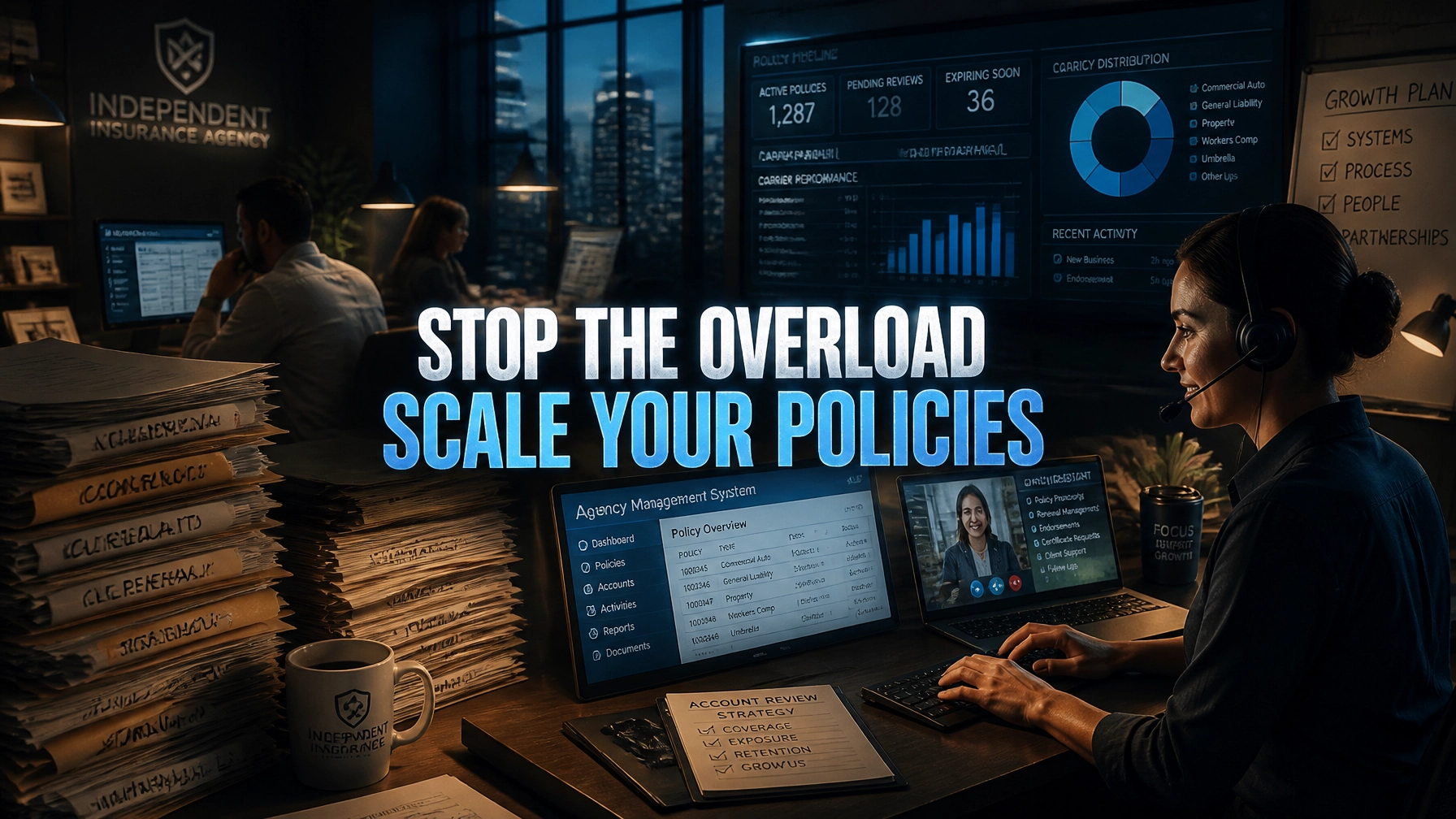
The insurance landscape in 2026 has become a battlefield of data fragmentation and rising operational costs. For independent agencies, brokers, and Managing General Agents (MGAs), the dream of scaling policy volume often hits a brick wall known as "Admin Debt." You want to write more business, but your high-value producers are trapped in a cycle of processing endorsements, chasing down missing signatures, and manually syncing data between your Agency Management System (AMS) and your CRM.
Growth shouldn’t feel like an anchor. If your agency is struggling to move beyond a certain premium threshold, the problem isn't your sales ability, it is your back-office infrastructure. To scale in this environment, you need a Strategic Blueprint that utilizes a specialized Insurance Virtual Assistant to act as the operational engine of your business.
The 2026 Reality: Admin Debt and Profit Leakage
Admin Debt is the accumulated weight of unfinished or inefficient clerical tasks that slow down your revenue-generating activities. In a modern agency using platforms like Applied Epic, AMS360, or HawkSoft, this debt manifests as fragmented data. Perhaps a lead is updated in the CRM but the policy change isn't reflected in the AMS. Or maybe a renewal notice sits in an inbox for three days because your account manager is buried under a mountain of Certificate of Insurance (COI) requests.
Every minute a licensed producer spends on a non-revenue-generating task is a form of Profit Leakage. When you calculate the cost of a $60,000-per-year in-house administrator versus an expert Insurance Virtual Assistant at just $8 per hour, the financial leak becomes even more apparent. You are effectively paying premium prices for commodity labor.
Bridging the Fragmentation: The VA as the System Liaison
One of the biggest hurdles to scaling policy volume in 2026 is the lack of "talk" between software systems. Even the best tech stacks require human intervention to ensure data integrity. An Insurance Virtual Assistant from Virtual Nexgen Solutions doesn't just "do tasks"; they serve as the bridge between your siloed systems.
They ensure that when a policy is bound in EZLynx, the corresponding documents are correctly filed in your document management system and the client’s contact record is updated in the CRM for future marketing. This level of meticulous data management prevents the "oops" moments that lead to E&O claims and lost renewals.
Scaling Policy Volume Without Increasing Headcount
Traditional scaling logic dictates that to sell more, you must hire more. But local hiring in the U.S. has become prohibitively expensive, with benefits, taxes, and office space adding 30-40% on top of base salaries.
A strategic Insurance Virtual Assistant allows you to scale horizontally. By offloading 80% of the administrative lifecycle of a policy, your existing producers can handle 2x or 3x the volume they currently manage. You aren't just adding a helper; you are force-multiplying your most expensive assets.
High-Impact Tasks Handled by a Specialized VA:
- Quote Preparation: Gathering initial data and inputting it into multiple carrier portals for comparative rating.
- Policy Checking: Comparing the issued policy against the quote to ensure no coverages were missed or incorrectly added.
- Endorsement Processing: Managing the back-and-forth with carriers to ensure mid-term changes are processed accurately.
- Renewal Management: Flagging upcoming renewals 90 days out and starting the "remarketing" process before the client even thinks about looking elsewhere.
Tactical SOP: Streamlining Certificate of Insurance (COI) Issuance
To demonstrate the "Deep Value" framework, let's look at one of the most common bottlenecks: COI requests. If your producers stop what they are doing every time a contractor needs a COI, your sales pipeline dies.
SOP Name: Rapid COI Dispatch System
Goal: Process and deliver accurate COIs within 30 minutes of request.
- Request Capture: The Insurance Virtual Assistant monitors a dedicated "certificates@" email alias.
- Verification: The VA logs into the AMS (e.g., AMS360 or Applied Epic) to verify the policy is active and has the required limits requested by the holder.
- Template Generation: The VA uses the standardized ACORD 25 template within the system.
- Holder Addition: The VA adds the new holder's information into the system to ensure an audit trail.
- Quality Control: The VA double-checks for required endorsements (e.g., Waiver of Subrogation or Additional Insured status).
- Delivery: The VA sends the COI directly to the holder and CCs the client, filing a copy in the client’s digital folder simultaneously.
By following this standardized procedure, you ensure consistency and speed that an overworked in-house staff member simply cannot maintain during peak seasons.
Tactical SOP: The 90-Day Renewal Retention Loop
Renewals are the lifeblood of an agency's valuation. Yet, many independent agencies lose 10-15% of their book annually simply because they didn't reach out before the renewal bill arrived.
SOP Name: Proactive Retention Engine
Goal: Increase retention by 5% through early intervention.
- Monthly Audit: On the first of every month, the VA pulls a report of all policies expiring in 90 days.
- Data Scrubbing: The VA checks for any major changes (e.g., claims history or address changes) that might affect the renewal rate.
- Outreach: The VA sends a personalized "Renewal Prep" email to the client on behalf of the agent, asking if anything has changed in their risk profile.
- Carrier Review: If a rate hike is expected, the VA prepares a summary of alternative carrier options for the agent to review.
- Booking: The VA schedules a 15-minute "Renewal Review" call on the agent's calendar.
This system ensures the client feels valued and prevents "rate shopping" by positioning the agency as a proactive advisor rather than a passive vendor.
Why $8/Hour Changes Everything
When you look at the financials, the decision to integrate an Insurance Virtual Assistant becomes a mathematical certainty. An in-house administrative assistant in the U.S. typically costs $45,000 to $60,000 per year when including payroll taxes and benefits.
At Virtual Nexgen Solutions, our specialized VAs are available for $8 per hour. For a full-time equivalent, that is roughly $16,640 per year. You are essentially saving over $40,000 per year per seat. That is capital that can be reinvested into lead generation, marketing, or higher commissions for your top producers. You can learn more about how to optimize your operations in our guide on 7 tools to cut admin costs.
Positioning Your Agency for the Future
The agencies that will dominate in 2026 and beyond are those that view their back office as a profit center, not a cost center. By systematizing your workflows and delegating the execution to a Virtual Nexgen Solutions assistant, you transform your agency into a lean, scalable machine.
Whether you are a wholesaler managing complex risks or a Farmers Insurance agency looking to grow your local footprint, the administrative engine remains the same. You need accuracy, speed, and cost-efficiency.
Conclusion: Stop Dreaming, Start Scaling
The difference between an agency that stays stagnant and one that doubles its policy volume is the courage to change the operational model. Don't let your growth be stifled by "Admin Debt" or the fragmentation of your systems.
Virtual Nexgen Solutions provides the specialized talent you need to reclaim your time and focus on what you do best: building relationships and closing deals. At $8 per hour, the risk of inaction is far higher than the cost of implementation.
Take the first step toward a more profitable agency today. Book a 30-minute strategy session to see how an Insurance Virtual Assistant can fit into your specific workflow.
Frequently Asked Questions
What does an insurance VA do?
An insurance VA handles the administrative work that slows down your licensed team. That includes quoting support, policy checking, endorsement follow-up, renewal prep, CRM updates, document filing, client follow-ups, and certificate tracking inside systems like Applied Epic, AMS360, HawkSoft, and EZLynx. The goal is simple: move repetitive back-office work off your producers so they can focus on selling and servicing revenue-generating accounts.
How much does an insurance VA cost?
At Virtual Nexgen Solutions, an Insurance Virtual Assistant costs $8 per hour. That gives you a much lower-cost way to expand capacity compared with hiring an in-house admin role that can run close to $60,000 per year once payroll costs and overhead are included. If your agency is dealing with admin debt or profit leakage, this pricing can make scaling much easier.
How do VAs handle COIs?
VAs handle COIs by following a documented process. They monitor the certificate request inbox, verify active coverage in your AMS, confirm holder requirements, generate the ACORD 25, review endorsement details such as Additional Insured or Waiver of Subrogation, send the COI to the holder, and file the completed record back into the client file. This keeps turnaround times fast and reduces errors.
How does an Insurance Virtual Assistant handle sensitive client data?
Data security is a top priority. Our VAs work directly within your existing Agency Management Systems (AMS) like Applied Epic or AMS360, adhering to the security protocols you already have in place. We recommend using secure password management tools and restricted access levels to ensure all PII (Personally Identifiable Information) remains protected.
Can a virtual assistant help with surplus lines and MGA workflows?
Yes. VAs are highly effective at managing the additional documentation required for surplus lines, including diligent effort forms, surplus lines tax filings, and coordination with wholesalers. They can streamline the complex "submission to bind" lifecycle that MGAs face daily.
Will I need to spend weeks training a VA on my specific AMS?
While every agency has unique "house rules," our Insurance Virtual Assistants often come with foundational knowledge of major platforms like HawkSoft and EZLynx. Because we focus on SOP-driven workflows, the onboarding process is significantly faster than hiring a generalist assistant.
How do I track the productivity of an $8/hour Insurance Virtual Assistant?
We use transparent time-tracking and reporting tools that give you a clear view of what tasks are being completed and how long they take. Most agencies find that the VA is more productive than in-house staff because they are dedicated solely to their assigned administrative list without the distractions of a physical office.
Does a virtual assistant need an insurance license?
No. At Virtual Nexgen Solutions, our VAs focus on administrative, back-office, and clerical tasks that do not require a license. This allows your licensed staff to focus entirely on activities that require their professional expertise and state-mandated credentials.