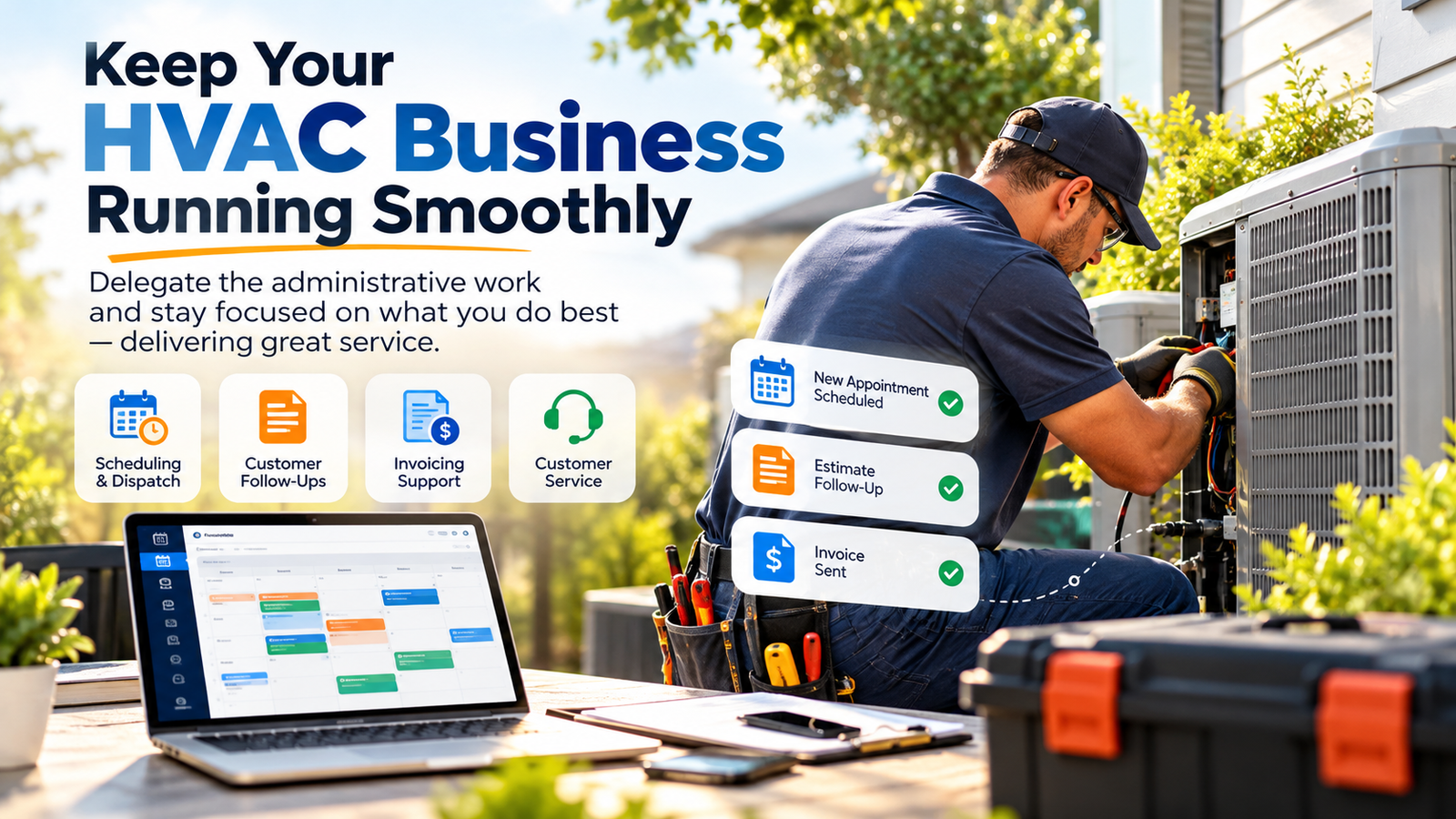
Running an HVAC company involves much more than repairing air conditioners and maintaining heating systems. Contractors must coordinate technicians, answer customer inquiries, schedule service calls, prepare estimates, send invoices, track payments, and keep job records updated.
As a business grows, these administrative responsibilities can become a bottleneck. Calls go unanswered during busy periods, appointments require repeated coordination, invoices remain unfinished, and owners spend time managing paperwork instead of building customer relationships.
An HVAC virtual assistant can help address these challenges by handling defined administrative and operational tasks remotely. With the right processes and software access, virtual assistant support can help HVAC contractors organize daily operations, maintain consistent follow-ups, and give field teams more time to focus on service delivery.
What Is an HVAC Virtual Assistant?
An HVAC virtual assistant is a remote administrative professional who supports heating, ventilation, and air conditioning businesses with recurring office tasks and operational coordination.
Unlike a general assistant with no industry-specific training, an HVAC-focused virtual assistant can be trained on the workflows, terminology, and software used by HVAC contractors.
Depending on the company's needs, responsibilities may include:
- Scheduling service appointments and maintenance visits.
- Coordinating technician calendars and dispatch updates.
- Responding to routine customer inquiries.
- Following up on estimates and outstanding service requests.
- Updating customer records and job details.
- Preparing invoices and tracking payment status.
- Organizing service documents and maintenance records.
- Maintaining administrative reports and follow-up lists.
The objective is straightforward: keep the administrative side of the business organized so contractors and technicians can concentrate on delivering quality service.
5 Administrative Challenges an HVAC Virtual Assistant Can Help Solve
1. Missed calls and delayed customer responses
When office staff are coordinating appointments or handling several customer requests, new inquiries can be overlooked. A delayed response may leave a customer uncertain about availability or encourage them to contact another contractor.
A virtual assistant can help monitor designated communication channels, respond to routine inquiries using approved procedures, record new service requests, and route urgent situations to the appropriate team member.
For emergency heating or cooling calls, the assistant should follow the contractor's escalation protocol rather than independently making technical or safety decisions.
2. Disorganized scheduling and technician coordination
Scheduling becomes more complicated when technicians have different skill sets, appointments run longer than expected, and urgent service requests arrive throughout the day.
An HVAC virtual assistant can update calendars, confirm appointments, send reminders, coordinate schedule changes, and maintain clear records of outstanding jobs.
Using systems such as ServiceTitan, Service Fusion, or Housecall Pro—where the assistant has appropriate training and access—helps keep information aligned with the contractor's existing workflow.
3. Estimates that never receive follow-up
Preparing an estimate does not guarantee that a customer will approve the work. Some customers need clarification, others are comparing options, and some simply forget to respond.
A virtual assistant can maintain an estimate follow-up list, send approved reminders, update the status of each opportunity, and notify the sales or service manager when a customer requests technical clarification.
This creates a more consistent follow-up process without requiring technicians or business owners to remember every outstanding estimate.
4. Incomplete job records and delayed invoicing
After a service visit, the office may need to confirm that job notes are complete, labor information is recorded, and required documents are available before an invoice can be prepared.
A virtual assistant can review job records against a checklist, flag missing information, organize supporting documents, prepare invoices for review, and track submission or payment status.
For commercial HVAC contractors using customer portals, the assistant may also help coordinate approved invoice submissions and monitor rejected or incomplete entries.
Invoice approval, adjustments, refunds, and financial transactions should follow the company's authorization procedures.
5. Outstanding payments and inconsistent follow-ups
Unpaid invoices require organized tracking. Without a clear process, payment reminders may be delayed and staff may struggle to identify which accounts need attention.
An HVAC virtual assistant can maintain an accounts-receivable tracker, send approved payment reminders, document customer responses, and escalate disputed invoices to the appropriate employee.
This helps the company maintain visibility into outstanding balances without making unsupported assumptions about when customers will pay.
Which HVAC Business Tasks Should You Delegate First?
The best starting point is not to outsource every administrative responsibility at once. Identify recurring tasks that consume time, follow predictable procedures, and can be reviewed for accuracy.
| Business function | Tasks suitable for delegation |
|---|---|
| Customer service | Routine inquiries, appointment confirmations, service reminders |
| Scheduling | Calendar updates, maintenance appointments, technician availability records |
| Dispatch administration | Job entry, status updates, technician notifications, documentation tracking |
| Sales support | Estimate follow-ups, lead records, callbacks, customer reminders |
| Invoicing | Invoice preparation, missing-document checks, submission tracking |
| Payment follow-up | Approved reminders, aging reports, payment-status updates |
| Recordkeeping | CRM updates, digital filing, job notes, administrative reports |
Begin with one or two workflows that cause the most friction. Document the steps, assign clear ownership, and review results before expanding the scope.
HVAC Software a Virtual Assistant May Work With
An HVAC virtual assistant should support your existing software rather than force your business to adopt an unnecessary new system.
Common platforms include:
-
ServiceTitan: Job management, scheduling, dispatch coordination, and customer records.
-
Service Fusion: Scheduling, dispatch, customer management, and invoicing workflows.
-
Housecall Pro: Appointment management, estimates, invoicing, and customer communications.
-
QuickBooks: Accounting records, invoice tracking, and payment administration, subject to assigned permissions.
-
Google Workspace or Microsoft 365: Email, calendars, documents, and internal coordination tools.
Actual responsibilities depend on the software configuration, the assistant's training, and the permissions granted by the company. Before assigning tasks, establish individual user access, appropriate authentication, confidentiality expectations, and a clear process for handling sensitive information.
How to Integrate a Virtual Assistant Into Your HVAC Operations
Successful delegation requires more than hiring someone and sharing a login. A structured onboarding process helps the assistant understand how your company operates.
Step 1: Identify the biggest administrative bottleneck. Review where work gets delayed, whether that is scheduling, estimate follow-up, invoice preparation, or customer communication.
Step 2: Document the workflow. Explain how requests arrive, which system should be updated, what information is required, and when an issue must be escalated.
Step 3: Define responsibilities and access. Specify which tasks the assistant can complete independently and which require approval from an owner, manager, technician, or accounting professional.
Step 4: Start with a controlled set of tasks. Begin with a manageable workflow and review completed work regularly. Correct gaps in the procedure before expanding responsibilities.
Step 5: Track operational performance. Measure indicators such as appointment confirmation rates, overdue follow-ups, invoice processing time, record completeness, and outstanding administrative tasks.
This approach makes it easier to evaluate whether the arrangement is improving consistency and reducing the workload on the internal team.
How to Choose the Right HVAC Virtual Assistant Service
Not every virtual assistant provider understands the demands of a field service business. When evaluating providers, look beyond general administrative experience.
Ask whether the provider can:
- Train assistants on HVAC terminology and your operating procedures.
- Work with your existing field service management software.
- Support your required working hours and communication channels.
- Follow documented escalation and approval procedures.
- Protect customer information through appropriate access controls.
- Maintain clear task ownership and reporting.
- Provide supervision, performance feedback, and continuity planning.
You should also clarify the scope of work, communication expectations, training process, and how performance concerns will be addressed.
The right fit depends on your business model. A residential HVAC company may need help with appointment scheduling and estimate follow-ups, while a commercial contractor may require more support with work orders, purchase orders, service documentation, and customer billing portals.
How Virtual Nexgen Solutions Supports HVAC Contractors
Virtual Nexgen Solutions provides virtual assistant services to businesses seeking help with recurring administrative and operational work.
For HVAC companies, support can be structured around agreed responsibilities such as appointment scheduling, customer follow-ups, CRM updates, dispatch administration, job documentation, invoice coordination, and routine back-office tasks.
The scope should reflect your existing systems, business priorities, team structure, and approval requirements. This allows you to delegate appropriate work without losing visibility into daily operations or handing over responsibilities that require technical expertise or authorization.
Whether you manage a growing residential service business or coordinate a commercial HVAC team, the first step is to identify which administrative tasks consume the most time and establish a practical delegation plan.
Ready to spend less time on administrative work and more time growing your HVAC business?
Partner with Virtual Nexgen Solutions for reliable, industry-focused Virtual Assistant support tailored to your business needs.
Book a call: Schedule a consultation
Frequently Asked Questions
What does an HVAC virtual assistant do?
An HVAC virtual assistant helps with administrative work such as scheduling, customer communication, estimate follow-ups, CRM updates, job documentation, invoice coordination, and payment reminders.
Can a virtual assistant help with HVAC dispatch?
Yes. A trained assistant can support dispatch administration by updating job records, communicating schedule changes, maintaining technician availability information, and escalating urgent requests according to established procedures.
Can an HVAC virtual assistant use ServiceTitan?
An assistant may work in ServiceTitan if they have suitable training and authorized access. Before assigning responsibilities, confirm their familiarity with your workflows and provide clear instructions for updating jobs, schedules, and customer records.
Is a virtual assistant suitable for a small HVAC company?
Yes. Small contractors can start by delegating a limited set of recurring tasks, such as appointment confirmations, estimate follow-ups, and administrative recordkeeping. The scope can expand as the business's needs change.
How do I measure the value of an HVAC virtual assistant?
Track operational measures such as completed follow-ups, scheduling accuracy, administrative turnaround times, invoice processing, record completeness, and overdue tasks. Compare performance before and after delegation rather than relying on guaranteed savings or revenue claims.
Can an HVAC virtual assistant replace a technician?
No. A virtual assistant supports administrative and coordination work. Diagnosis, repairs, installation, and other technical field responsibilities remain with appropriately qualified personnel.