The phone rings at 2:15 PM on a Tuesday. Your best technician is under a kitchen sink across town, and your other two trucks are tied up on a whole-house repipe. You are on the other line with a parts supplier. The call goes to voicemail. You think, “I’ll call them back in ten minutes.”
By the time you dial that number at 2:25 PM, that homeowner has already spoken to two of your competitors. One of them answered the phone, triaged the leak, and booked a technician for a 4:00 PM slot. You didn't just lose a $375 drain cleaning job; you lost a customer with a lifetime value of over $1,200.
This is the reality of "Admin Debt" in the plumbing industry. It is the cumulative cost of every missed call, every uncollected diagnostic fee, and every service call that ends in a "let me think about it" because your pricing wasn't presented professionally. When you operate without a specialized plumbing virtual assistant, you are not just busy; you are leaking profit through every crack in your operational foundation.
Virtual Nexgen Solutions has observed that the average plumbing shop loses between $50,000 and $125,000 per year simply because they lack a systematized dispatch-to-close workflow. If your current close rate on service calls is hovering around 40%, you are leaving tens of thousands of dollars on the table every month. By implementing specialized Standard Operating Procedures (SOPs) and leveraging a plumbing virtual assistant at $8 per hour, you can move that close rate to 70% or higher.
Understanding the Plumbing Industry’s Profit Leaks
The plumbing industry is built on urgency. Whether it is a burst pipe, a backed-up sewer line, or a failing water heater, customers call because they have a problem that cannot wait. However, most plumbing business owners are so focused on the technical work that they ignore the administrative engine required to capture that urgency.
Admin Debt: The Silent Growth Killer
Admin Debt occurs when you prioritize field work while neglecting the systems that generate and manage that work. Every time a plumber spends 60 minutes on paperwork, that is an hour of billable time lost, roughly $150 in revenue gone. Over a week, that's $750. Over a year, that’s $37,500 per technician. When you scale this across a 5-truck fleet, the numbers become staggering.
Revenue Leakage Statistics
Recent industry data highlights the severity of these challenges:
- Residential plumbing businesses miss approximately 22% to 35% of all incoming calls during business hours.
- After-hours, that miss rate often exceeds 80%.
- 85% of callers who do not reach a live person on the first attempt never call back; they simply call the next listing on Google.
- A single missed plumbing call is worth roughly $1,200 in lost revenue when factoring in the initial job, potential upsells, and lifetime referral value.
- Shops utilizing time-and-materials pricing typically see a 40% close rate, while those using flat-rate "Good/Better/Best" menus close at 65-70%.
Operational and Staffing Challenges
Plumbing shops face a unique staffing paradox. You need someone to answer the phones, but hiring a full-time, in-house dispatcher in the United States costs upwards of $60,000 per year when including benefits, taxes, and office space. For a small to mid-sized shop, this overhead is often prohibitive. Consequently, the owner or the lead technician ends up playing secretary, which results in burnout and decreased service quality.
Industry Trends and the Shift to Systematic Dispatch
The modern homeowner expects an experience similar to Amazon or Uber: instant communication, transparent pricing, and real-time updates. The days of "we'll be there between 8 AM and 4 PM" are over.
The Rise of Service Management Software
The industry has moved toward sophisticated platforms like ServiceTitan, Housecall Pro, Jobber, and Workiz. These tools are powerful, but they are only as good as the data entered into them. Without a dedicated professional to manage these systems, they become expensive digital filing cabinets. A specialized plumbing virtual assistant from Virtual Nexgen Solutions operates directly within these platforms to ensure every lead is tracked and every technician is optimized.
Flat Rate Pricing Dominance
There is a clear trend toward flat-rate pricing. Customers hate the uncertainty of an hourly clock. They want to know the price before the wrench hits the pipe. Implementing a price book within your software is the first step, but having a virtual assistant prepare those options for the technician to present is the secret to a 70% close rate.
Actionable Industry SOPs: The Virtual Nexgen Solutions Playbook
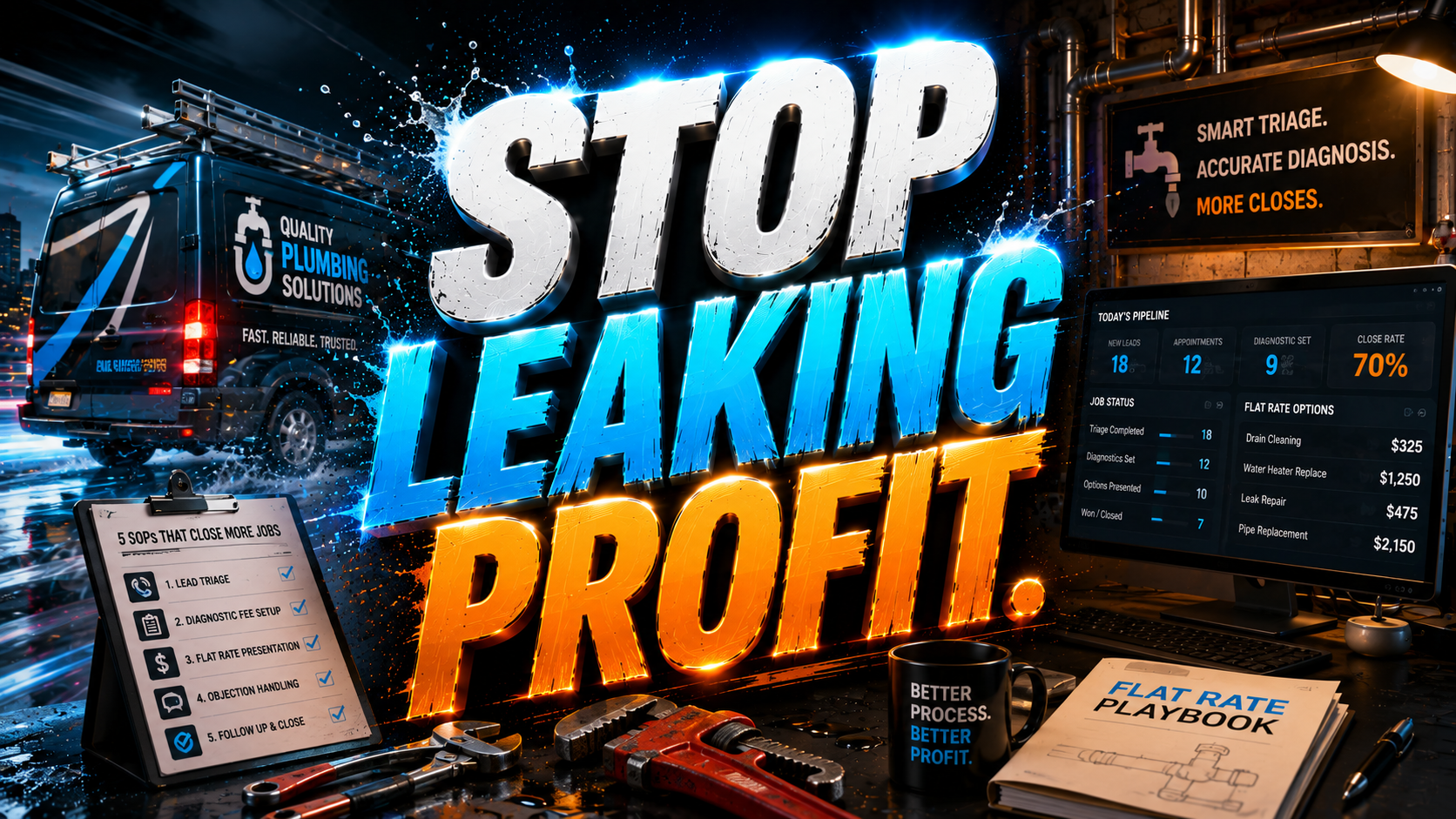
To move from a 40% close rate to 70%, you must move away from "winging it." You need a systematic approach to every touchpoint. Here are the five core SOPs that a specialized virtual assistant handles to transform your plumbing business.
SOP 1: Emergency Dispatch Triage (The 90-Second Rule)
The goal of this SOP is to capture the lead before they hang up. A virtual assistant follows a strict script to triage the call in under 90 seconds.
- Immediate Greeting: "Thank you for calling [Company Name], your local plumbing experts. Is this a plumbing emergency or are you looking to schedule a standard service?"
- Contact Capture: Collect name, phone number, and address immediately. Do not wait until the end of the call.
- Problem Identification: Use a checklist (Leaking, Clogged, No Hot Water, Low Pressure).
- Urgency Assessment: Ask, "Is the water currently off?" or "Is there active flooding?"
- Booking the Diagnostic: "We can have a technician to you between [Window]. Our diagnostic fee is [Amount], which covers the cost of getting a fully-stocked truck and a licensed professional to your door to provide a firm price for the repair."
SOP 2: Diagnostic Fee Capture & Service Call Scheduling
Many shops fail because they offer "free estimates." This attracts price-shoppers who waste your technicians' time. A virtual assistant ensures every call is a qualified lead by systematizing the diagnostic fee.
- Explanation of Value: The virtual assistant explains that the diagnostic fee covers the "travel and professional assessment" and is often credited toward the repair if the customer moves forward.
- Card-on-File: Using ServiceTitan or Housecall Pro, the virtual assistant secures the customer’s credit card information to hold the appointment. This reduces no-shows by 85%.
- Automated Confirmation: The VA triggers an SMS confirmation with the technician’s bio and photo, building immediate trust.
SOP 3: Flat Rate Pricing Presentation & Good/Better/Best Options
This is where the close rate jumps. Before the technician arrives, the virtual assistant prepares the "Good/Better/Best" templates in the software based on the reported problem.
- Option A (Good): The basic repair to solve the immediate issue.
- Option B (Better): The repair plus a preventative component (e.g., adding a shut-off valve or a high-quality supply line).
- Option C (Best): A full solution (e.g., replacing the aging fixture with a high-efficiency model).
- Technician Support: The VA monitors the technician’s progress in the field. If the technician is struggling to present options, the VA can draft the estimate in the office and send it to the homeowner's phone for approval.
SOP 4: Technician Dispatch & Routing Coordination
Efficiency is found in the "windshield time." Every minute a tech spends driving is a minute they aren't billing.
- GPS Monitoring: The virtual assistant uses tools like Samsara or the built-in GPS in Jobber to track truck locations.
- Zone Routing: The VA group calls by zip code to minimize travel time.
- Part Coordination: If a tech needs a specific part, the VA calls the local supply house, checks inventory, and places the order for pickup so the tech doesn't waste time wandering aisles.
SOP 5: Post-Service Follow-Up & Review Collection
The job isn't done until the review is live.
- The "Happy Call": 24 hours after the service, the virtual assistant calls the customer: "This is [Name] with [Company Name]. I'm calling to make sure your [Project] is working perfectly and that our technician left your home cleaner than they found it."
- Review Link: If the customer is happy, the VA sends a direct text link to the Google Business Profile.
- Reschedule/Upsell: If the tech noted a future need (e.g., aging water heater), the VA adds a follow-up task to call back in 3 months to schedule that replacement.
Case Studies: Real ROI for Real Plumbing Shops
Case Study 1: The Ohio 5-Truck Recovery
Scenario: A residential plumbing company in Ohio with 5 trucks was struggling with massive revenue leakage. The owner was answering calls while on job sites, leading to a 30% missed call rate. Furthermore, the shop did not collect diagnostic fees, resulting in technicians spending 15 hours a week on "free estimates" for price-shoppers who never booked.
The Virtual Nexgen Solutions Impact: We implemented a specialized plumbing virtual assistant at $8 per hour. The VA took over all inbound calls, implemented the 90-second triage SOP, and began requiring a $79 diagnostic fee for all new appointments.
The Results:
- Missed Call Rate: Dropped from 30% to under 2%.
- Revenue Increase: The shop captured an additional $18,000 in monthly revenue just from answered calls.
- Efficiency: Technicians regained 12 hours of billable time per week by eliminating non-serious leads.
- Annual Impact: Over $216,000 in additional top-line revenue in the first year.
Case Study 2: Commercial & Residential Expansion in Texas
Scenario: A 12-truck shop in Texas was using time-and-materials pricing. Their close rate on service calls was stuck at 42%. The office staff was overwhelmed with manual technician routing and post-service paperwork, leading to a three-day delay in invoicing.
The Virtual Nexgen Solutions Impact: We integrated a team of two specialized VAs into their ServiceTitan environment. The VAs built out a comprehensive flat-rate price book with "Good/Better/Best" options and took over real-time technician routing.
The Results:
- Close Rate: Moved from 42% to 68% within 90 days.
- Average Ticket: Increased by 22% due to the consistent presentation of "Better" and "Best" options.
- Cash Flow: Invoicing became instantaneous, reducing Days Sales Outstanding (DSO) from 14 days to 2 days.
- ROI: The cost of the VAs was less than $3,000 per month, while the additional profit generated exceeded $35,000 per month.
Cost Comparison: In-House Admin vs. Virtual Nexgen Solutions
When you look at the numbers, the decision to use a specialized plumbing virtual assistant becomes a mathematical certainty.
In-House Admin Staff (1 Employee):
- Annual Salary: $45,000 - $55,000
- Payroll Taxes & Benefits: $10,000 - $15,000
- Office Space & Equipment: $5,000
- Management Overhead: 5-10 hours/week of your time
- Total Annual Cost: ~$60,000 - $75,000
- Availability: 40 hours per week (No nights or weekends)
Virtual Nexgen Solutions VA:
- Hourly Rate: $8.00
- Annual Cost (Full Time): ~$16,640
- Benefits/Taxes: Included in the rate
- Office Space/Equipment: Provided by Virtual Nexgen Solutions
- Availability: 24/7 options available, including weekends and holidays
- Total Annual Savings: Over $43,000 per employee
By choosing a virtual assistant, you are not just saving $43,000 in overhead; you are gaining a specialist trained in plumbing-specific software and SOPs. You pay for production, not for someone to sit at a desk during slow hours.
ROI Comparison: The Value of Inaction
What does it cost you to not hire a virtual assistant?
- Missed Calls: If you miss 5 calls a week, at a lifetime value of $1,200 each, you are losing $6,000 per week ($312,000 per year).
- Poor Close Rates: If you take 20 service calls a week at a 40% close rate (8 jobs) vs. a 70% close rate (14 jobs), you are losing 6 jobs per week. At an average ticket of $375, that is $2,250 per week ($117,000 per year).
- Technician Admin: If your 3 techs spend 5 hours each on paperwork per week, that is 15 hours of lost billable time. At $150/hr, that is $2,250 per week ($117,000 per year).
Total potential "Profit Leakage" for a small shop: $546,000 per year.
A specialized virtual assistant at $8 per hour is the plug for that leak.
Future Trends in Plumbing Operations
As we move toward 2027 and beyond, the plumbing companies that dominate the local market will be those that prioritize operational speed and data accuracy.
Precision Dispatching
The future is "just-in-time" dispatching. Instead of a tech finishing a job and calling the office to ask "what's next," the virtual assistant will have already pushed the next job to their tablet, ordered the necessary parts for the next stop, and notified the homeowner that the tech is 12 minutes away. This level of synchronization is only possible with dedicated administrative support.
Proactive Maintenance Programs
The most stable plumbing businesses rely on recurring revenue. Virtual assistants are the engine behind these programs. They manage the database, call members to schedule their annual inspections, and ensure that "Slow Tuesday" is filled with prepaid maintenance work rather than zero revenue.
Tips and Tricks for Plumbing Efficiency
To maximize your ROI with a virtual assistant, implement these quick wins:
- Record Your Screen: Use a tool like Loom to record yourself performing a task in ServiceTitan once. Send it to your Virtual Nexgen Solutions VA. They now have a permanent SOP to follow.
- The 3:00 PM Triage: Have your VA do a "schedule sweep" every day at 3:00 PM. If a tech is running late, the VA proactively calls the remaining customers to update them. This prevents negative reviews before they happen.
- Price Book Maintenance: Have your VA audit your price book monthly. As material costs rise at the supply house, your VA updates the flat-rate prices in your software so your margins stay protected.
- End-of-Day (EOD) Reports: Require your VA to send a daily summary of: Calls Answered, Jobs Booked, Diagnostic Fees Collected, and Total Estimates Pending. You can review your business health in 60 seconds before you go to bed.
Frequently Asked Questions (FAQ)
1. Does a virtual assistant need a plumbing license?
No. A virtual assistant handles administrative, dispatching, and customer support tasks. They work inside your software and talk to your customers, but all technical advice and physical work are handled by your licensed professionals in the field.
2. Can a virtual assistant work in ServiceTitan or Housecall Pro?
Yes. Virtual Nexgen Solutions VAs are trained specifically on the most popular plumbing industry software, including ServiceTitan, Housecall Pro, Jobber, and Workiz. They can manage your dispatch board, create estimates, and handle invoicing seamlessly.
3. How does the VA handle emergency calls after hours?
We offer 24/7 availability. You can choose to have a VA cover your "after-hours" lines, ensuring that an emergency call at 2:00 AM is answered by a live person who can triage the issue and dispatch your on-call technician according to your specific rules.
4. Will my customers know they are talking to someone outside of my office?
Our VAs are trained in professional, empathetic communication. They use US-based phone numbers and follow your specific scripts and brand voice. Most customers simply assume they are speaking with a dedicated member of your local office team.
5. How do I know the VA is actually working?
Virtual Nexgen Solutions provides detailed activity logs and integrates directly into your service software. You can see every call logged, every job booked, and every update made in real-time on your dispatch board.
6. Can a VA help with my plumbing marketing?
Yes. Beyond dispatch, our VAs can assist with social media updates, customer review management, and email campaigns to your existing customer base to promote seasonal maintenance specials.
7. Is there a long-term contract?
We believe in proving our value every day. While we offer various engagement models, our goal is to become a long-term partner in your growth by consistently delivering ROI that far exceeds our $8 per hour rate.
8. What happens if a technician has a technical question the VA can't answer?
The VA follows a strict "Technical Escalation SOP." If a customer asks a complex code or engineering question, the VA captures the details and notifies you or your lead technician immediately via your preferred communication channel (Slack, text, or phone).
9. How fast can I get a plumbing VA started?
We can typically have a specialized VA integrated into your workflow within 7 to 10 business days. This includes the time to align on your specific scripts, software access, and dispatching rules.
Conclusion: Stop Working for Your Business and Start Growing It
The difference between a plumbing shop that struggles to pay its bills and one that dominates its local market isn't the quality of the wrenches they use: it’s the quality of the systems they deploy.
If you are still answering your own phones, manually routing your trucks, or failing to present consistent "Good/Better/Best" pricing, you are suffering from Admin Debt. This debt is expensive, and it will eventually bankrupt your growth.
Virtual Nexgen Solutions provides the administrative engine you need to reclaim your time and maximize your profit. For just $8 per hour, you can have a specialized plumbing virtual assistant who ensures no call goes unanswered, no diagnostic fee goes uncollected, and every technician is positioned to close at 70%.
Do not let another $1,200 call go to voicemail. Systematize your dispatch, empower your technicians, and start scaling your agency today.