In 2026, the trucking industry has no room for the "seat-of-the-pants" operator. The market is sharp, the margins are thin, and the regulatory environment is more demanding than ever. If your dispatchers are still "panic bidding" on load boards just to keep the wheels turning, you aren't running a logistics business: you are managing a slow-motion financial leak.
The most successful fleets today have transitioned from chaotic, reactive management to what we call "Network Discipline." This is a state where every mile is accounted for, every broker is vetted in seconds, and every driver is supported by a back-office engine that never sleeps. This operational operating system isn't built by hiring more expensive, in-house staff who quit for a fifty-cent raise elsewhere. It is built using a specialized Trucking Virtual Assistant.
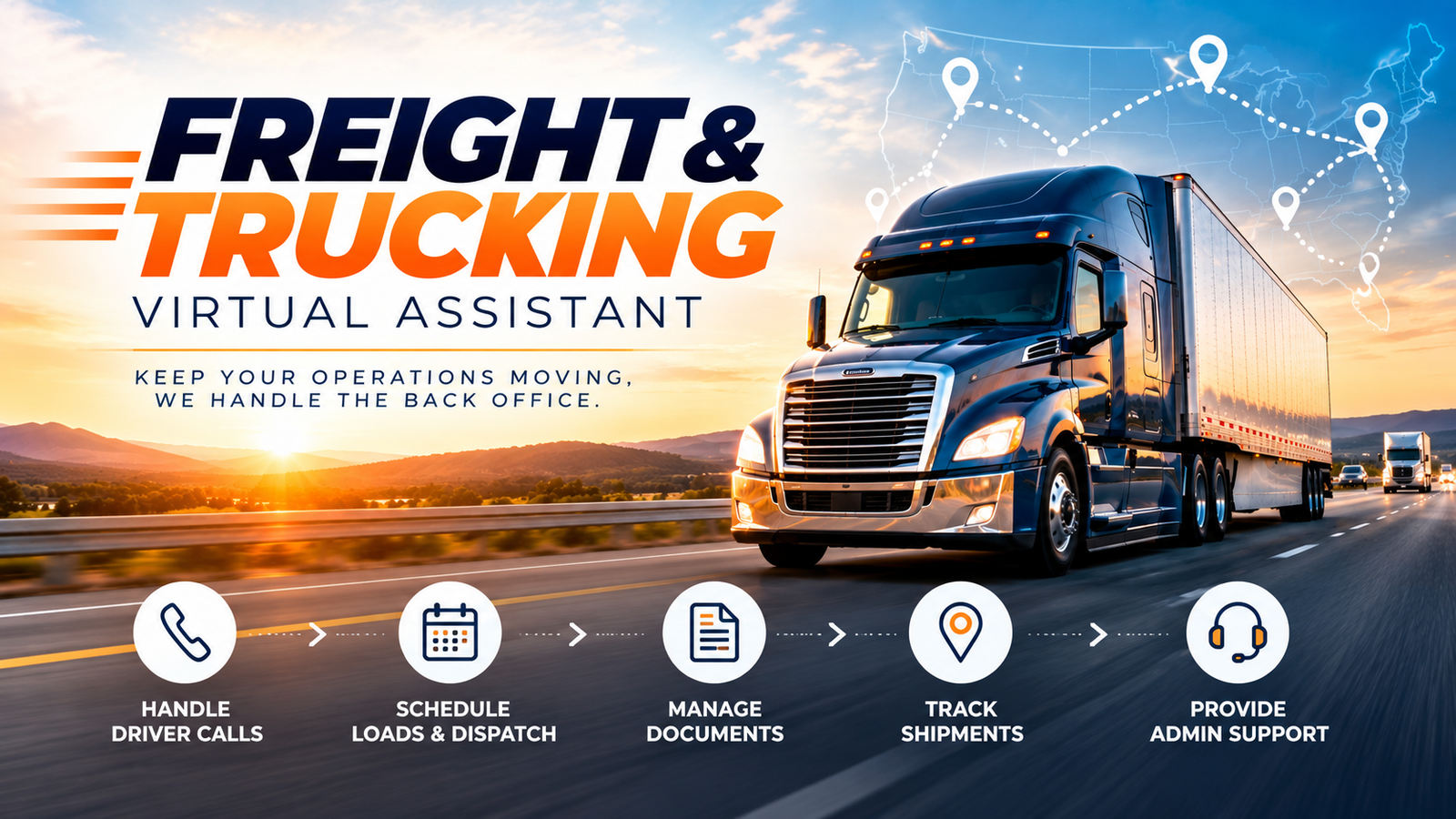
A Logistics Virtual Assistant from Virtual Nexgen Solutions isn't just a remote worker; they are the central nervous system of a high-performance fleet. At $8 per hour, they provide the administrative firepower that allows you to out-compete carriers ten times your size.
The Death of Panic Bidding and the Rise of Network Discipline
For decades, the trucking industry relied on the "hustle." You waited for a call, checked a board, and hoped the broker paid on time. In 2026, hope is a losing strategy. The "Panic Bidding" cycle: where you take a low-rate load just to avoid a deadhead: is a symptom of administrative exhaustion. When your office is buried in BOLs, IFTA filings, and ELD alerts, you lose the mental bandwidth to negotiate effectively.
Network Discipline is the antidote. It requires a dedicated Trucking Dispatch VA who lives and breathes your lanes. Instead of you scrolling through DAT or Truckstop at 2:00 AM, your VA has already mapped out the next three moves for every truck in your fleet. They identify "Power Lanes," vet the brokers' credit scores, and secure the rate confirmation before your competition even finishes their coffee.
This shift moves your business from a defensive posture to an offensive one. You stop taking what is left and start demanding what you are worth.
Real-World ROI: Case Studies in Ruthless Efficiency
Efficiency is a nice word, but in trucking, only metrics matter. Here is how specialized support from Virtual Nexgen Solutions transformed operations for three distinct logistics models.
Lone Star Hauling: The Deadhead Killer
A 25-truck Texas carrier based in Houston was struggling with a 15% "Empty Mile" ratio. Their in-house dispatchers were overwhelmed, often missing high-value backhauls across key Texas lanes because they were tied up with phone calls. They integrated a Virtual Assistant to manage an advanced routing platform and take over all broker communications.
- The Result: The VA synchronized driver HOS (Hours of Service) with live load availability, reducing empty miles by 22% within four months. By delegating the "speed-to-bid" to a dedicated resource, the fleet saved over $180,000 in fuel and maintenance costs annually.
Mile-High Logistics: High-Velocity Scaling
A growing Colorado-based brokerage in Denver hit a ceiling. They could only process 50 loads a day because their team was bogged down by manual document entry and BOL verification. Hiring more local staff at $60,000 a year plus benefits was cost-prohibitive. They pivoted to a Logistics Virtual Assistant to audit document extractions and manage the "paper-chase."
- The Result: The VA standardized the document workflow, allowing the brokerage to scale from 50 to 200 daily loads without adding a single local employee. Their overhead stayed flat while their revenue quadrupled.
Owner-Operator Network: The Power of Five
A group of five independent drivers in the Southeast formed a loose alliance to gain leverage. Individually, they spent 3 hours a day on load boards. They pooled their resources to hire one dedicated Trucking Virtual Assistant from Virtual Nexgen Solutions to handle all their "speed-scrolling" and negotiations.
- The Result: Each driver increased their net revenue by an average of $2,000 per week. The VA freed them from the "scroll," allowing them to focus on safe driving and rest while the VA secured premium loads and handled all detention pay disputes.
Tactical SOP: Mastering the Broker Vetting Process
To maintain Network Discipline, you must never work with a "ghost broker" or a firm with a failing credit score. Use this step-by-step procedure to ensure your Trucking Virtual Assistant protects your cash flow.
- Immediate Credit Check: As soon as a load is identified, the VA must check the broker’s credit score via Ansonia or RTS. Anything below a 90-day pay average is flagged for immediate review.
- Authority Verification: The VA cross-references the MC number on the FMCSA SAFER website to ensure the broker's authority is active and they have the required $75,000 bond.
- The "Five-Minute Rule": The VA must send a standard introductory packet (W-9, Insurance, Authority) to the broker within five minutes of the initial verbal agreement to lock in the rate confirmation.
- Reference Verification: For new brokers, the VA calls at least two carriers who have recently moved loads for them to verify their detention and layover payment history.
- Digital Filing: The signed Rate Con is immediately uploaded to your TMS (Samsara, Motive, or EZLynx) and tagged to the specific driver and truck.
Compliance and the $8/Hour Solution
Admin debt is most dangerous when it involves the DOT. IFTA filings, ELD monitoring, and maintaining Driver Qualification (DQ) files are non-negotiable, yet they produce zero revenue. Many fleet owners pay $25–$30 an hour for local admins to shuffle this paperwork, or worse, they do it themselves on weekends.
Compare that to the Virtual Nexgen Solutions model. For $8 per hour, a specialized VA handles your compliance heartbeat. They monitor ELD alerts in real-time to prevent HOS violations before they happen. They compile IFTA data weekly so that the end-of-quarter filing is a five-minute task instead of a three-day nightmare.
When you factor in the cost of a single "Serious Violation" during a roadside inspection, the ROI of having a dedicated compliance VA is astronomical. You aren't just saving on labor; you are insuring your business against regulatory shutdown.
Scaling Your Fleet Without the Overhead
The traditional way to grow a trucking company is to hire a dispatcher for every 5–7 trucks. In 2026, that model is dead. High-capacity VAs can support significantly larger driver pools by utilizing modern TMS integrations. Whether you use Samsara, Motive, or a custom-built solution, your VA acts as the operator of that system, ensuring that data is entered accurately and acted upon instantly.
By shifting your back-office to Virtual Nexgen Solutions, you eliminate the "Admin Debt" that keeps most fleets small. You can add 10 trucks to your fleet without adding $100k in office rent and salaries. You simply scale your VA support to match your growth.
If you are tired of profit leakage and ready to implement a ruthlessly efficient operational OS, it is time to stop being the dispatcher and start being the CEO.
Stop the leakage. Secure your lanes.
Book a Strategy Session with Virtual Nexgen Solutions
Frequently Asked Questions
How does a VA handle IFTA filings and compliance?
Your Virtual Assistant collects fuel receipts and mileage data from your TMS or ELD provider on a weekly basis. They categorize the data by state and prepare the quarterly reports for your review. By keeping the data "live" throughout the month, they eliminate the stress and errors associated with last-minute filings.
Can a VA vet brokers and perform credit checks?
Yes. VAs are trained to use industry-standard tools to verify broker authority, check credit scores, and review payment history. They ensure you only move freight for companies that are financially stable and have a track record of paying on time.
Is 24/7 night-dispatch coverage available?
Absolutely. Because our VAs operate globally, we can provide seamless coverage for night-dispatch and weekend shifts. This ensures that your drivers always have someone to call for lumper payments, breakdown assistance, or late-night load issues.
How do they manage ELD alerts and Hours of Service (HOS)?
The VA monitors your ELD dashboard (like Motive or Samsara) throughout the day. If a driver is approaching their limit or takes an improper break, the VA sends an immediate alert to both the driver and management to prevent a violation.
Do VAs integrate with TMS systems like Samsara or Motive?
Yes. Our VAs are experienced in navigating the major Transport Management Systems. They handle data entry, load tracking, and document uploads directly into your existing software, ensuring your "single source of truth" is always updated.
Can your VAs handle multi-language driver communication?
Many of our VAs are multilingual, which is a massive asset in the 2026 trucking landscape. They can bridge the communication gap between dispatch and drivers who may prefer speaking Spanish, Punjabi, or other languages, ensuring instructions are clear and safety is maintained.
How fast is the onboarding process for a new VA?
We have a standardized onboarding process that can get a specialized Trucking Virtual Assistant integrated into your workflow in as little as 48 to 72 hours. We focus on your specific SOPs to ensure they hit the ground running.
What is the typical cost-per-load reduction metric?
By shifting the administrative processing to an $8/hour VA, most fleets see their cost-per-load (administrative side) drop by 40% to 60%. This directly increases your margin on every single mile driven.