The 2.a.m. phone call rings. A burst pipe on the fourth floor of a commercial office building. Your technician is dispatched, the vacuum is running, and the fans are being placed. You think the job is under control. But in reality, the clock has already started on a silent financial disaster.
In the world of restoration, the first 24 hours are not just about extraction; they are about evidence. Under the rigorous IICRC S500 2026 revisions, documentation is no longer supporting evidence, it is a central requirement of the standard itself. If your moisture maps aren't timestamped, if your psychrometric data is missing a single day, or if your First Notice of Loss (FNOL) triage is incomplete, you are paying a "Documentation Tax." This tax comes in the form of claim denials, reduced payouts, and endless administrative friction with carriers.
Most water damage company owners are technicians at heart. You thrive in the field. But the administrative debt of running a modern restoration firm is suffocating. You are paying $35/hour to a lead technician only to have them spend 20% of their day on their iPad labeling photos. That is a profit leak that most businesses cannot sustain. This is why a specialized virtual assistant for water damage company is no longer a luxury, it is the operational engine that ensures every drop of water extracted turns into a dollar collected.
Industry Problems: The Administrative Debt of S500 Compliance
The restoration industry is currently facing a "documentation crisis." Carriers are utilizing sophisticated software to audit every single drying log against the S500 standards. If there is a gap, they cut the bill.
The core problems facing water damage companies today include:
- Documentation Gaps: Technicians are great at drying floors but often struggle with data entry. A missing moisture reading on day three can lead to a 50% reduction in the billable equipment days for that entire project.
- Carrier Friction: Claims adjusters are under pressure to reduce payouts. They look for any administrative technicality to deny a supplement.
- Revenue Leakage: Unlogged air movers, untracked dehumidifier run times, and forgotten psychrometric readings mean you are literally leaving thousands of dollars on the table every month.
- Staffing Burnout: Your best project managers are quitting because they are spending 15 hours a week chasing signatures and filing paperwork instead of managing crews.
Industry Statistics: The Brutal Reality of 2026 Restoration
The numbers tell a clear story of why the old way of doing business is failing:
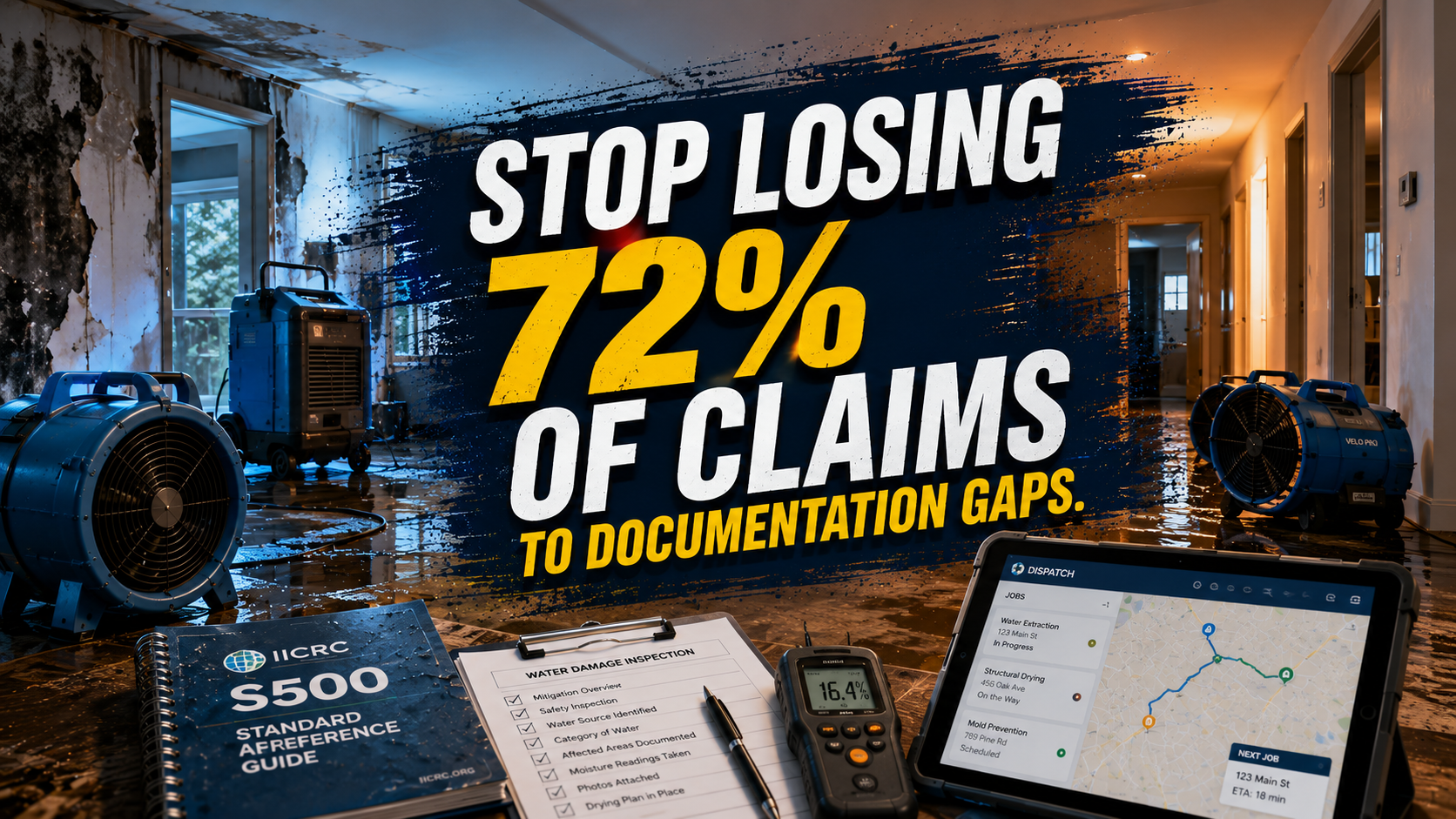
- 72% of claim denials are now caused by documentation gaps, not the actual quality of the restoration work.
- Rapid extraction within the first 24 hours reduces total drying time by 40%, yet 60% of companies fail to document the baseline moisture readings before the fans start blowing.
- IICRC S500 2026 Revision mandates that moisture mapping must be performed and recorded with timestamps for every affected material class.
- Carriers audit 100% of drying logs against psychrometric standards; a GPP (Grains Per Pound) reading that doesn't show a downward trend often results in an automatic audit flag.
- Average revenue leak for a mid-sized water damage firm is estimated at $120,000 annually due to missing billable line items and unapproved supplements.
Revenue Leaks: Where Your Money is Disappearing
Every water damage job has "Administrative Debt." This is the invisible cost of unorganized data.
Profit Leakage Examples:
- Unlabeled Photos: If an adjuster can’t see the source of the loss clearly labeled in Encircle or CompanyCam, they will deny the "Category 3" designation and pay it out as a lower-tier loss.
- Missing Equipment Logs: If a technician forgets to log when a dehumidifier was moved from one room to another, you lose the ability to bill for that specific deployment.
- Delayed FNOL: Every hour it takes to get the initial claim info into your CRM is an hour your competitors have to steal the lead.
- Supplement Delays: Waiting 14 days to file a supplement because the "paperwork isn't ready" results in a cash flow crisis.
Operational and Staffing Challenges
Finding a local administrative assistant who understands IICRC standards, Xactimate codes, and the urgency of a 3 a.m. flood is nearly impossible. If you do find them, they often cost $55,000 to $65,000 a year plus benefits.
This leads to:
- The "PM Bottleneck": Your Project Managers become glorified data entry clerks.
- High Turnover: The stress of constant carrier audits and missing paperwork causes high-performing staff to leave.
- Scaling Friction: You can't take on more jobs because you can't handle more paperwork.
Industry Trends: The Shift to Real-Time Documentation
In 2026, the restoration industry has moved away from "post-job reporting" to "real-time verification." Software like Kahi and Airpinpoint now allow for Bluetooth-connected equipment tracking. However, hardware alone isn't enough. You need a human in the loop to verify that the data is syncing, the moisture readings make sense, and the carrier-mandated photos are uploaded.
A virtual assistant for water damage company acts as the "Air Traffic Controller" for this data. They ensure that while your tech is in the crawlspace, the office records are being updated in real-time.
Industry-Specific Software Expertise
Our specialized VAs are trained to operate the industry’s most critical software stacks. They don't just "help"; they execute tasks inside:
- Xactimate & Symbility: Estimating and supplement generation.
- Encircle & CompanyCam: Photo documentation, moisture mapping, and site notes.
- DASH & MICA: Comprehensive job management and drying logs.
- JobNimbus: CRM and workflow management.
- Kahi: Real-time equipment tracking.
Actionable Industry SOPs: The 5 Pillars of Emergency Response
To eliminate admin debt and stop profit leakage, you must implement these 5 Standard Operating Procedures (SOPs). By delegating these to a Virtual Nexgen Solutions VA for $8/hr, you ensure 100% compliance without taxing your field staff.
SOP 1: Emergency Dispatch Triage & First Notice of Loss (FNOL) Intake
When a lead calls, the clock is ticking. A specialized VA handles the entire intake process:
- Lead Triage: Determine the source, class, and category of the loss via a standardized script.
- Safety Screening: Identify asbestos, lead, or structural risks before the tech arrives.
- Data Entry: Immediately create the job file in DASH or JobNimbus.
- Contract Dispatch: Send the "Authorization to Work" and "Direction to Pay" forms via e-signature before the truck even leaves the shop.
- Tech Briefing: Send the tech a site summary, including building age and occupant info.
SOP 2: Pre-Mitigation Documentation Assembly
Before any equipment is turned on, the "pre-mitigation" state must be documented to satisfy IICRC S500 requirements.
- Photo Audit: The VA reviews photos uploaded by the tech to ensure the source of the loss and the perimeter of the damage are clearly visible.
- Initial Moisture Map: The VA creates the baseline diagram in Encircle based on the tech's meter readings.
- Baseline Psychrometric Entry: Log the initial Temperature, RH, and GPP of the affected and unaffected areas.
- Flag Missing Data: If a tech forgets the "unaffected area" reading (critical for comparison), the VA pings them immediately while they are still on site.
SOP 3: Equipment Placement & Daily Monitoring Log Management
This is where most companies lose money. A VA manages the daily drying cycle:
- Equipment Audit: Cross-reference the "Equipment Placement" log with the field photos to ensure every air mover and dehumidifier is accounted for.
- Daily Log Entry: Transfer tech notes into MICA or DASH every single morning.
- Trend Analysis: The VA monitors the GPP readings. If the GPP isn't dropping, they notify the PM to check the dehumidifiers or adjust the drying strategy.
- Bluetooth Tracking Sync: Verify that Kahi or Airpinpoint sensors are actively reporting.
SOP 4: Drying Validation & Final Documentation Package
Closing a job requires a "Certified Drying Report."
- Validation Check: Ensure every material has reached its "Dry Standard."
- Report Generation: Assemble all moisture maps, psychrometric logs, and equipment logs into a single, PDF-formatted package.
- Completion Certificate: Send the final Certificate of Completion to the property owner for signature.
- Audit Defense: Review the package for "red flags" that might trigger a carrier audit before submission.
SOP 5: Carrier Submission & Supplement Follow-Up
The job isn't done until the check clears.
- Estimate Upload: Upload the Xactimate estimate and the documentation package to the carrier portal.
- Supplement Management: Track the status of every supplement. If an adjuster hasn't responded in 48 hours, the VA follows up.
- Payment Tracking: Log all payments and flag any short-pays for immediate PM review.
Case Study 1: Eliminating the "Documentation Tax" in Florida
The Scenario: A high-volume water damage company in Florida was struggling with a 30% claim denial rate. Their technicians were overwhelmed with back-to-back jobs during hurricane season and frequently skipped the "Baseline Psychrometric" readings. When the firm submitted their $15,000 invoices, carriers were cutting them down to $9,000 due to "insufficient drying evidence."
The Solution: Virtual Nexgen Solutions integrated a specialized VA into their DASH workflow. The VA took over the FNOL intake and real-time photo auditing. For every job, the VA was the "final set of eyes" before the tech left the site, ensuring all 12 required IICRC photos were present.
The Results:
- Claim Denials: Dropped from 30% to 4% within 90 days.
- Average Invoice Value: Increased by $2,200 per job simply by capturing missing equipment billables.
- Admin Costs: The company saved $48,000 a year by replacing their $22/hr local admin with an $8/hr specialized VA.
Case Study 2: Solving the Supplement Bottleneck for a CAT-Focused Firm
The Scenario: A restoration company specializing in Catastrophe (CAT) response was drowning in carrier follow-up. They had $450,000 in outstanding supplements that were over 60 days old. The owner was spending his weekends calling adjusters instead of growing the business.
The Solution: A Virtual Nexgen Solutions VA was assigned to manage the "Supplement Lifecycle." Using a 48-hour follow-up cadence, the VA called adjusters, provided the missing documentation they requested, and tracked every interaction in JobNimbus.
The Results:
- Accounts Receivable: Reduced the 60+ day AR by $310,000 in four months.
- Owner Freedom: The owner reclaimed 20 hours a week of his personal time.
- Cycle Time: The average time from job completion to full payment dropped by 18 days.
Cost Comparison: The $52,000 Difference
When you compare hiring a specialized VA from Virtual Nexgen Solutions versus an in-house administrative assistant, the financial impact is undeniable.
In-House Administrative Assistant:
- Average Salary: $55,000/year
- Taxes & Benefits: $11,000/year
- Office Space & Equipment: $5,000/year
- Total Annual Cost: $71,000
Virtual Nexgen Solutions VA:
- Hourly Rate: $8.00/hr
- Annual Cost (Full Time): $16,640/year
- Taxes, Benefits, & Management: Included
- Total Annual Cost: $16,640
Annual Savings: $54,360 per employee.
For a company with two administrative staff, that is over $108,000 in immediate profit returned to the business.
ROI Comparison: Beyond the Hourly Rate
The ROI of a virtual assistant for water damage company isn't just about the $8/hr rate; it's about the "Yield Per Job."
- Equipment Yield: By ensuring 100% of air movers are logged and billed, a VA typically increases invoice totals by 8-12%.
- Labor Yield: Your technicians can handle one extra "Stop-By" or "Service Call" per day because they aren't stuck doing paperwork in the truck.
- Cash Flow Yield: Reducing your AR cycle by 15 days provides the liquidity needed to take on larger commercial losses without relying on high-interest lines of credit.
Future Trends: The 2027 Documentation Mandate
Looking ahead, we expect carriers to move toward "Automated Audit Engines." They will use AI to scan your photos and moisture logs in real-time. If the data isn't perfect, the system will automatically flag the invoice. Having a Virtual Nexgen Solutions VA ensures that your data is "Audit-Ready" before it ever hits the carrier's system.
Tips and Tricks for Operational Efficiency
- The 24-Hour Checklist: Create a hard rule that no job file is "active" until the VA has verified the FNOL data, initial photos, and baseline moisture readings.
- Moisture Log Templates: Use standardized templates in Encircle or DASH. Your VA can pre-populate these so the tech only has to enter the numbers.
- Carrier Follow-Up Cadence: Use a "3-2-1" rule. Follow up 3 days after submission, 2 days after that, and then daily until the supplement is approved.
- Photo Labeling Standards: Train your techs to use a "Wide, Medium, Close" photo strategy. The VA can then label these photos with the correct Xactimate codes (e.g., "WTR-DRY").
Frequently Asked Questions
1. Does a VA need to be IICRC certified?
No, your VA does not need certification, but they must be trained in IICRC S500 documentation requirements. At Virtual Nexgen Solutions, we train our VAs to understand the technical vocabulary of restoration so they can support your certified techs effectively.
2. How does a VA handle 3 a.m. emergency calls?
Virtual Nexgen Solutions offers 24/7 availability. We can staff your dispatch and FNOL intake overnight, ensuring that every emergency lead is captured and dispatched immediately, even while you sleep.
3. Can a VA use Xactimate?
Yes. Our VAs can assist with data entry into Xactimate, including sketching from your tech's field notes, inputting line items, and preparing the initial estimate for your project manager's final review.
4. How do I send job photos to a VA?
Most clients use software like Encircle, CompanyCam, or DASH. Your tech simply takes the photo on their mobile device, it syncs to the cloud, and your VA immediately begins labeling and organizing them into the job file.
5. What if I already have an office manager?
A VA is the perfect support for an office manager. Instead of your manager doing data entry, they can focus on high-level strategy, local marketing, and managing the field crews, while the VA handles the repetitive $8/hr tasks.
6. Is my data secure with a virtual assistant?
Virtual Nexgen Solutions prioritizes security. We use secure login protocols and can work within your existing software environments (DASH, Encircle, etc.) using restricted permissions to ensure your client data is protected.
7. How quickly can a VA start?
We can typically have a specialized restoration VA integrated into your workflow within 7 to 10 business days, following a needs analysis and customized strategy session.
8. Can a VA help with collections?
Absolutely. One of the highest ROI tasks a VA performs is following up on outstanding invoices and supplements, ensuring your cash flow remains consistent.
9. Do you work with companies outside the US?
While we serve various industries, our focus for restoration is on US-based companies, ensuring our VAs are experts in the specific carrier and IICRC standards relevant to the American market.
Conclusion: Stop Paying the Documentation Tax
The restoration industry is more competitive and administratively heavy than ever before. You cannot afford to let your profits leak through documentation gaps or overpay for administrative support. By implementing the 5 Emergency SOPs and leveraging a specialized virtual assistant for water damage company at $8/hr, you reclaim your time, your margins, and your sanity.
Don't wait for the next major loss to realize your paperwork is in shambles. Systematize your documentation engine today with Virtual Nexgen Solutions.